
Impeller vs Propeller: What's the Difference?
An impeller is a driven rotor that raises a fluid's pressure and flow, while a propeller is a type of impeller designed for fluid to enter and leave along its axis. In boating, the practical distinction is often where the rotor works: a bare propeller pushes water externally, whereas a water-jet impeller works inside a housing that directs water into a jet.
That overlap is why the terms can sound interchangeable. The clearest way to separate them is by the flow path and surrounding hardware, not simply by whether the rotating part has blades.
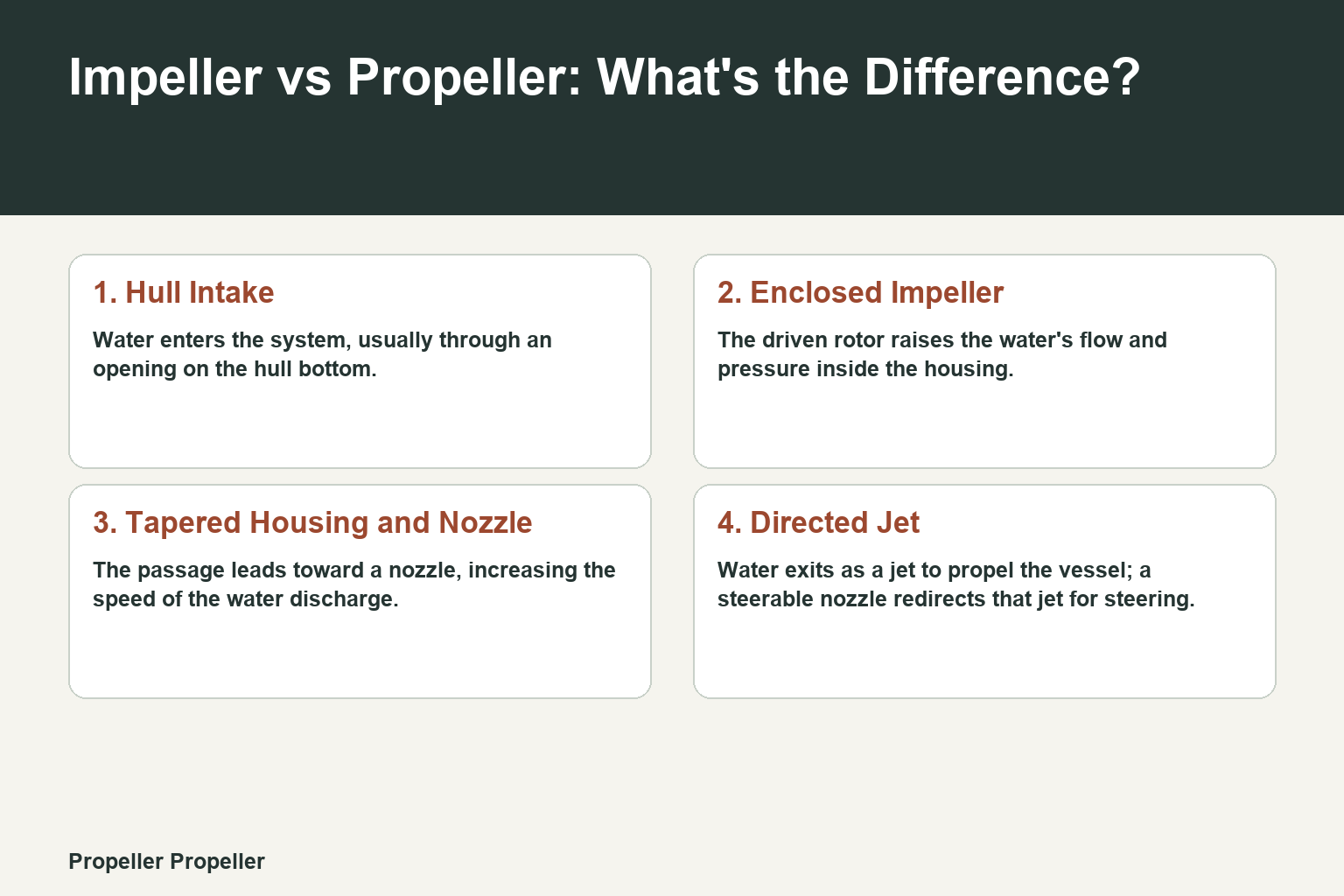
- Hull IntakeWater enters the system, usually through an opening on the hull bottom.
- Enclosed ImpellerThe driven rotor raises the water's flow and pressure inside the housing.
- Tapered Housing and NozzleThe passage leads toward a nozzle, increasing the speed of the water discharge.
- Directed JetWater exits as a jet to propel the vessel; a steerable nozzle redirects that jet for steering.
In a pump-jet, water—not the impeller itself—travels from the intake through the enclosed rotor and out of the nozzle as the thrust-producing jet.
The Terms Overlap, but They Describe Different Roles
Impeller is the broader term. It refers to a driven rotor that adds energy to a fluid, increasing its pressure and flow. A propeller is a subclass of impeller in which the water flow enters and exits axially, meaning generally along the shaft direction. In ordinary boat usage, “propeller” usually means the exposed propulsion rotor at the stern; “impeller” often refers to the rotor enclosed within a pump or water-jet unit.
- An impeller describes the fluid-moving rotor function.
- A propeller describes an axial-flow form of impeller.
- The same broad engineering family can therefore include both terms without making them identical in everyday boat language.
| Term | What It Describes | Water-Flow Relationship |
|---|---|---|
| Impeller | A driven rotor that increases fluid pressure and flow | Broad category; can be used in pumps and water jets |
| Propeller | A subclass of impeller used for propulsion | Water enters and leaves axially |
| Water-jet impeller | The enclosed rotor within a water-jet unit | Accelerates intake water before it reaches the nozzle |
Sources: Wikipedia: Impeller
How a Water-Jet Impeller Produces Thrust
A water-jet system draws water through an intake, usually on the bottom of the hull. Its internal impeller accelerates that water within a housing, and the housing narrows toward a nozzle that increases the speed of the exiting stream. The jet leaving the nozzle provides propulsion. Unlike an exposed propeller, the rotating impeller remains inside the unit; the nozzle redirects the discharged water for steering.
- The intake supplies water to the internal pump.
- The impeller rotates inside the housing rather than moving forward through the water.
- The nozzle directs the accelerated discharge as a jet.
- A steerable nozzle changes the jet direction to steer the vessel.
Sources: Wikipedia: Impeller · Wikipedia: Pump-jet
What Changes on a Boat
An exposed propeller and a pump-jet both create thrust by moving water, but they package the moving parts differently. A pump-jet encloses its rotating element and uses a nozzle for the final discharge. It can also use a reversing bucket to redirect the jet for reverse without changing gear. The supplied evidence identifies benefits such as operation at higher speeds before cavitation, protection for the rotating element, shallow-water operation, and manoeuvrability. These are system-level characteristics, not proof that every jet-equipped boat is preferable for every use.
- A bare propeller acts directly on surrounding water outside the hull.
- A pump-jet combines intake, internal impeller, housing, nozzle, and steering hardware.
- Reverse in a pump-jet can come from a bucket redirecting the jet rather than reversing the gear.
| Feature | Exposed Propeller | Pump-Jet |
|---|---|---|
| Rotor location | Acts externally in the surrounding water | Impeller is enclosed within the jet unit |
| Final water discharge | Propeller acts directly on water | Housing leads to a nozzle that expels a jet |
| Steering approach | Not described in the supplied sources | Steerable nozzle redirects the jet |
| Reverse approach | Not described in the supplied sources | Reversing bucket can redirect the jet without changing gear |
| Source-identified characteristics | Baseline comparison | Protected rotating element; higher speed before cavitation; shallow-water operation and manoeuvrability |
Sources: Wikipedia: Pump-jet
A Practical Way to Use the Right Word
Use “propeller” when discussing the familiar exposed boat rotor. Use “impeller” when discussing the internal rotor of a pump, water jet, or similar fluid-moving device. If the subject is a jet boat, calling the whole propulsion arrangement an “impeller” is incomplete: the intake, housing, nozzle, and steering or reversing components all help determine how the system works. In my view, identifying whether the rotor is exposed or housed prevents most confusion before getting into design details.
- Say “propeller” for the external stern-mounted rotor.
- Say “water-jet impeller” for the rotor inside a jet-drive unit.
- Say “pump-jet” or “water jet” for the complete enclosed propulsion system.
Sources: Wikipedia: Impeller · Wikipedia: Pump-jet
Frequently Asked Questions
Is every propeller an impeller?
In the broad fluid-machinery sense described by the sources, a propeller is a subclass of impeller because it is a driven rotor that moves fluid. The everyday names remain useful because a propeller specifically uses axial flow.
Does a water jet have a propeller?
A water jet has an internal impeller that may resemble a small propeller, but it operates inside a housing and sends water through a nozzle. Calling it an exposed boat propeller would be misleading.
How does a jet boat steer without turning an exposed propeller?
A steerable nozzle redirects the exiting water jet. Changing the direction of that discharge changes the direction of the vessel's thrust.
How can a pump-jet reverse without changing gear?
A reversing bucket can redirect the outgoing jet to create reverse thrust. The supplied source describes this as a way to reverse without changing gear.
Why can pump-jets suit shallow-water operation?
The source identifies shallow-water operation as an advantage of pump-jets over bare propellers. One relevant design difference is that the rotating element is protected within the jet unit rather than exposed below the boat.
Final Thoughts
For a quick distinction, think of a propeller as an axial-flow impeller used openly in the water, and a water-jet impeller as the enclosed rotor within a complete intake-to-nozzle propulsion system.



