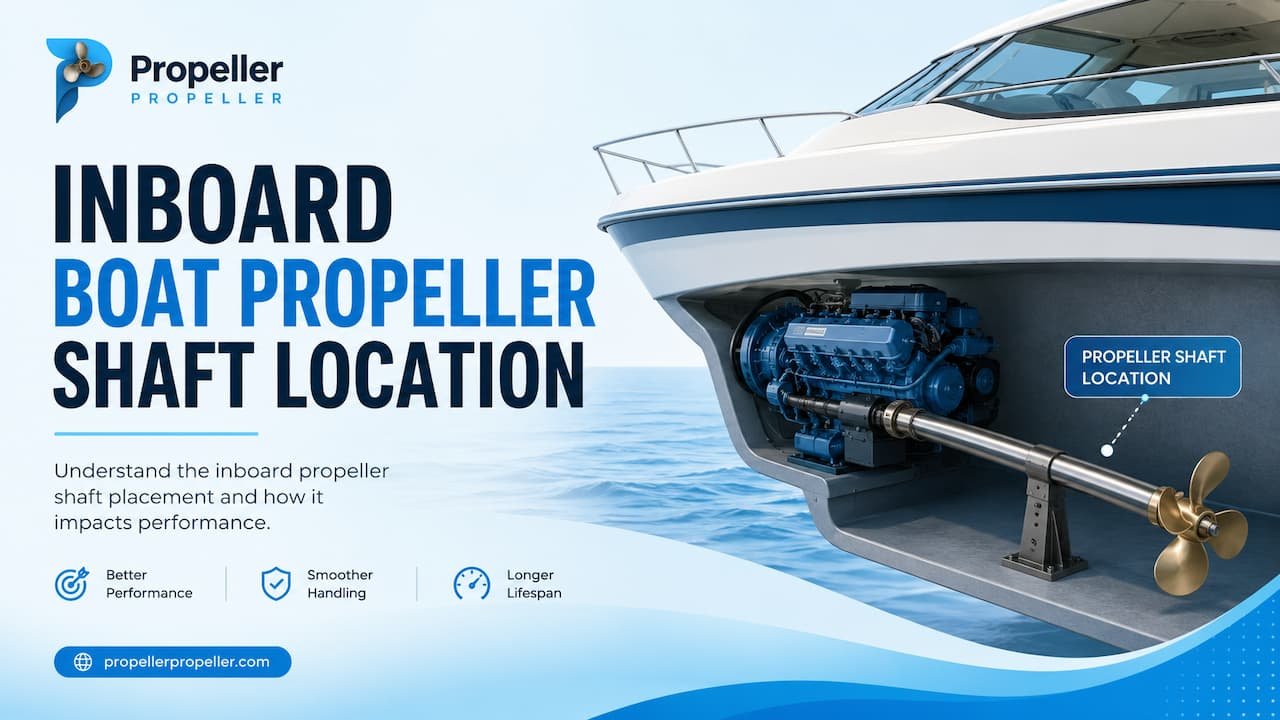
On an inboard boat, the propeller shaft runs from the transmission, mounted near the center of the hull, aft through a sealed shaft log or stuffing box in the hull bottom, then along the keel line to the propeller at the stern. A strut supports the shaft just before it meets the prop. That’s the short version. The longer version depends on what kind of inboard drivetrain you have, and that’s where most guides stop being useful.
Quick Answer: Shaft Location at a Glance
Look aft of your engine and transmission, along the centerline of the hull. That’s where you’ll find the shaft. It exits through a sealed opening in the bottom of the boat, called the shaft log, then runs to a strut just ahead of the propeller.
On most single-engine inboards, this whole path sits roughly under the cockpit sole or beneath the engine room floor. If you can see your transmission, you’re already looking at one end of it.
How the Shaft Path Works, Step by Step
Most owners never actually trace the shaft from front to back. Once you do it once, you’ll never lose track of it again.
From Engine to Transmission
Power starts at the engine. The transmission sits directly behind it, bolted on or connected through a short adapter. This is where rotational force gets converted into something the shaft can use, and where forward, neutral, and reverse get selected.
Through the Shaft Log and Stuffing Box
From the transmission, a coupling connects to the propeller shaft itself. The shaft then passes through the hull via the shaft log, a reinforced tube built into the boat’s structure. A stuffing box surrounds this exit point. Its job is simple: let the shaft spin freely while keeping water out.
A small amount of dripping from the stuffing box while the engine runs is normal. It’s there to lubricate the packing material around the shaft. A steady stream, on the other hand, usually means the packing needs adjusting or replacing.
Past the Strut to the Propeller
Just before the propeller, the shaft passes through a strut. This bracket supports the shaft’s weight and keeps it aligned as it exits into open water. The propeller sits on a tapered section at the very end, locked in place with a nut and key.
I’ve replaced enough stuffing boxes on straight-shaft inboards to notice a pattern. The most common owner mistake isn’t neglecting the shaft itself. It’s assuming any drip or vibration near the stern automatically means a bad propeller, when the real issue is often sitting further forward, at the stuffing box or strut.
Straight Shaft vs. V-Drive: Location Differs by Drivetrain
Here’s where most articles on this topic get it wrong, or just skip the detail entirely. Not every inboard boat has its engine facing the same direction.
On a traditional straight-shaft inboard, the engine faces forward, and the shaft runs backward to the stern, exactly like the walkthrough above.
But on a V-drive boat, common in wake and ski boats and plenty of cruisers, the engine actually faces the transom. Power gets routed through a V-shaped gearbox that sends it back forward, briefly, before the shaft turns around and heads aft again to the prop.
Volvo Penta and several other inboard manufacturers build V-drive systems specifically because they let boatbuilders push the engine weight toward the back of the boat, freeing up cabin space. If you’re standing in the engine room of a V-drive boat expecting to find the shaft running from a center-mounted engine, you’ll be looking in the wrong spot. The engine sits closer to the stern, and the drivetrain layout flips what most people expect from a “typical” inboard.
This single mix-up sends a lot of DIY boat owners searching the wrong section of the bilge entirely.
Single-Shaft vs. Twin-Shaft Boats
Boat size and engine count change where you’ll find the shaft, and how many you’re dealing with.
| Boat Type | Shaft Count | Typical Location |
|---|---|---|
| Small single-engine inboard | One shaft | Centerline, engine room to stern |
| Larger cruiser or trawler | Often twin shafts | Port and starboard of centerline, symmetrical layout |
| V-drive ski or wake boat | Usually one shaft | Runs from transom-facing engine forward, then back aft |
| Sailboat with inboard auxiliary | One shaft | Short run from engine to prop, often near the rudder |
Twin-shaft boats mirror the same components on both sides: two shaft logs, two stuffing boxes, two struts. Access usually means checking both sides of the engine room, not just one.
Why Shaft Location Matters (Beyond Curiosity)
Knowing where your shaft sits isn’t just trivia. It’s the starting point for diagnosing a surprising number of common boat problems.
A vibration that shows up at certain RPMs often traces back to shaft alignment, not the propeller. Misalignment happens when the engine mounts settle over time, shifting the angle between the transmission and shaft ever so slightly. Even a few thousandths of an inch off can cause a noticeable shudder.
A stuffing box that’s dripping more than usual is another location-dependent clue. Since you now know it sits right where the shaft exits the hull, checking it takes seconds once you know where to look. Most marine mechanics check alignment with a feeler gauge or dial indicator at the coupling, right where the transmission meets the shaft, well before assuming the prop itself is damaged.
How to Physically Access Your Shaft for Inspection
You don’t always need a haul-out to check on your shaft. Here’s how to find it without one.
- Open the engine room hatch or lift the companionway steps, depending on your boat’s layout.
- Locate the transmission at the back of the engine. The shaft coupling should be visible just behind it.
- Follow the shaft aft with a flashlight. On smaller boats, it’s often exposed the whole way to the stuffing box.
- Check the stuffing box for drips, and the coupling bolts for looseness, without removing anything.
- If access is tight, a mirror on an extension pole helps you see the strut and shaft angle without crawling further aft.
For anything beyond a visual check, like adjusting packing or inspecting the cutless bearing near the strut, get to a haul-out or a qualified marine mechanic. Working around a spinning shaft or in a cramped bilge isn’t worth the risk of a DIY shortcut.
Materials and Sizing Basics
Shaft diameter on recreational inboards typically ranges from about three quarters of an inch on small boats up to four inches on larger vessels. The right size depends on horsepower, boat length, and shaft length between supports.
Materials matter just as much as size. Stainless steel grades like 630, 316, 304, and 303 are common, along with Naval brass and bronze alloys. Saltwater use tends to favor 316 stainless or bronze, since they resist pitting and crevice corrosion better than the cheaper grades. Freshwater-only boats have more flexibility here, since corrosion risk drops significantly.
Frequently Asked Questions
What is the difference between an inboard and outboard propeller shaft? An inboard shaft runs from an engine mounted inside the hull, through a fixed shaft log, to a propeller at the stern. An outboard shaft is part of a self-contained motor unit mounted outside the transom, with the engine, gearbox, and shaft all combined into one removable assembly.
How much does it cost to replace a boat’s propeller shaft? Cost varies widely by shaft diameter, material, and length, but expect anywhere from a few hundred dollars for a small stainless shaft to well over a thousand for larger or custom-fabricated shafts, plus labor for removal and reinstallation.
Can you access the propeller shaft without hauling the boat? Yes, for a visual inspection. You can check the stuffing box, coupling, and visible shaft sections from the engine room. Replacing packing, bearings, or the shaft itself usually requires haul-out access.
What is a V-drive boat and where is the shaft located in one? A V-drive boat mounts its engine facing the transom instead of facing forward. Power routes through a V-shaped gearbox before the shaft heads aft to the propeller, which puts the engine closer to the stern than a traditional straight-shaft layout.
Final Thoughts: When to Call a Professional
Once you’ve traced your shaft from transmission to prop, most maintenance checks become quick and routine. Alignment work, packing replacement, and anything involving the strut or cutless bearing are best left to a qualified marine mechanic or done with proper haul-out support.
If you’re shopping for coupling replacements, it helps to know choosing the right shaft coupling for your setup before you order anything. Vibration that won’t go away is often a sign it’s time to check signs your shaft needs realignment, and a worn strut bearing is easier to catch early than after replacing a worn cutless bearing becomes urgent.