
How Does a Bow Thruster Work?
A bow thruster is a transverse propulsion device that pushes the bow sideways, helping a boat turn or hold position during slow-speed manoeuvres such as berthing. Unlike the main propulsion and rudder, it can create a turning force when the boat has little or no forward motion. Most common systems use an electric motor to drive a propeller in a tunnel through the bow.
The thrust is useful for precise low-speed corrections, but it is not intended to replace normal steering once the boat is moving ahead.
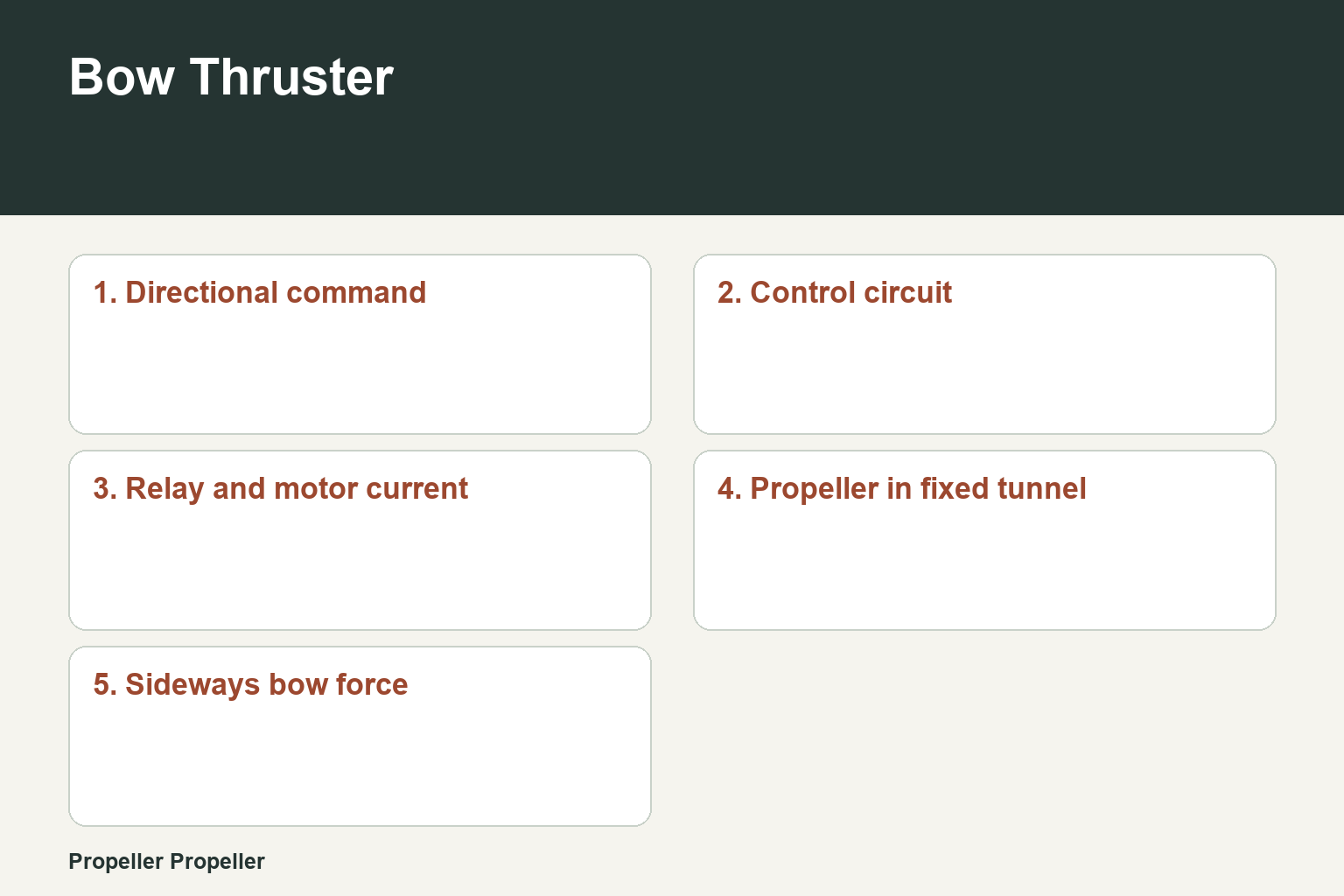
- Directional commandThe operator selects one transverse thrust direction.
- Control circuitA low-current control signal operates the appropriate relay.
- Relay and motor currentThe relay switches the heavy current needed by the electric motor.
- Propeller in fixed tunnelThe motor turns the propeller inside the hull tunnel; reversing motor current reverses thrust direction.
- Sideways bow forceWater is driven through the tunnel, creating transverse force at the bow.
In a typical electric tunnel system, the control circuit actuates relays, while the relays supply motor current to a propeller that remains within a fixed hull tunnel.
What a bow thruster does
A bow thruster acts at the forward end of the vessel, where a sideways push has strong leverage for turning the boat. It addresses a limitation of rudder steering: a rudder depends on water flow from forward motion, so it is less dependable for close-quarters positioning at very low speed. Bow thrusters can push in either transverse direction, allowing the operator to move the bow to port or starboard while manoeuvring.
- It is a manoeuvring aid, not the vessel’s main propulsion.
- Its effect reduces as the boat gains forward speed.
- A stern thruster performs a similar transverse role at the stern.
Sources: Wikipedia: Maneuvering thruster · Marine Insight: Bow thrusters and types of bow thrusters
How a typical electric tunnel bow thruster works
In the common tunnel arrangement, a propeller sits in a tube that passes through the hull below the waterline. When the propeller drives water through that tunnel, the reaction pushes the bow sideways. An electric motor provides the power; selecting the opposite direction reverses the motor current so the propeller produces thrust the other way. The motor itself turns the propeller, while the tunnel remains fixed in the hull.
- The control unit handles a small control current.
- Relays switch the much heavier current required by the motor; their operation can produce an audible click.
- Series-wound motors are commonly used because they provide high starting torque.
Sources: Practical Boat Owner: How does a boat bow thruster work? · Wikipedia: Maneuvering thruster
Bow thruster layouts and where they differ
“Bow thruster” describes the manoeuvring function rather than one fixed installation. Tunnel units are the most common type. Other arrangements alter where the propulsor sits or whether it can be deployed when needed. I would treat the layout choice as an installation and hull-design question first: the same sideways-control goal can be delivered by notably different hardware.
| Arrangement | How it is positioned | Practical distinction |
|---|---|---|
| Tunnel | Propeller operates in a tube through the hull below the waterline. | The most common bow-thruster type. |
| Externally mounted | Unit is mounted outside the hull. | A different installation approach from a through-hull tunnel. |
| Retractable | Thruster can be deployed for use. | Avoids having the unit permanently deployed in the same way. |
| Azimuth | Propulsor arrangement is identified as an azimuth type. | Represents another way to provide manoeuvring thrust. |
Sources: Wikipedia: Maneuvering thruster · Marine Insight: Bow thrusters and types of bow thrusters
Why short, deliberate use matters
An electric bow thruster draws substantial current at startup and can overheat if operated continuously. Thermal cut-outs are used to protect the motor. Battery condition matters as well: low voltage can damage the thruster. One source’s illustrative estimate is that roughly 20 seconds of operation uses about 2Ah, which shows why a thruster should be used in brief corrections rather than held on as a substitute for planning the manoeuvre.
- Use the thruster for low-speed positioning corrections rather than while making way.
- If a protection device stops operation, allow the system to cool rather than trying to override it.
- Keep the battery supply in suitable condition before relying on an electric thruster.
| Factor | What happens | Practical implication |
|---|---|---|
| Forward speed | Thruster effectiveness falls as speed rises. | Reserve it for slow manoeuvres and positioning. |
| Continuous operation | The motor can overheat; thermal cut-outs may operate. | Use brief corrections rather than prolonged running. |
| Low battery voltage | It can damage the thruster. | Do not rely on the system with an inadequate battery supply. |
Sources: Practical Boat Owner: How does a boat bow thruster work? · Wikipedia: Maneuvering thruster
What a bow thruster cannot do
A bow thruster improves control; it does not create unlimited thrust or eliminate the effect of wind, current, hull movement, and forward speed. Its usefulness is greatest during slow manoeuvres, and it becomes less effective as speed rises. That distinction is the practical one: use it to place the bow accurately, while continuing to manage propulsion and steering as the situation requires.
Sources: Wikipedia: Maneuvering thruster · Marine Insight: Bow thrusters and types of bow thrusters
Frequently Asked Questions
Does a bow thruster move the whole boat sideways?
It applies sideways thrust at the bow. That force mainly helps turn or position the forward end of the boat; the overall result also depends on the boat’s movement and surrounding conditions.
Why is a bow thruster less useful at speed?
Its effectiveness drops as forward speed increases. At that point, main propulsion and the rudder provide the normal means of steering the vessel.
What is the click when a bow thruster is selected?
On a typical electric system, the click can be the relays operating. The control circuit uses those relays to switch the heavier current required by the thruster motor.
Can a bow thruster run continuously?
It should not be treated as a continuous-duty steering device. Continuous operation can overheat the motor, which is why thermal cut-outs are used.
Are bow thrusters only installed in tunnels?
No. Tunnel thrusters are the most common type, but externally mounted, retractable, and azimuth arrangements are also described for bow-thruster use.
Final Thoughts
Use a bow thruster as a brief, low-speed positioning tool: it is most effective when it complements sound propulsion and steering decisions rather than replaces them.



