
Contra-Rotating Propellers: How They Work on Boats
Contra-rotating propellers use two propellers on the same shaft line that turn in opposite directions. The forward propeller creates thrust but also leaves a swirling flow behind it; the rear propeller works in that flow, recovering some of its rotational energy while the opposing rotations cancel much of the propeller-induced torque.
On sterndrives, this arrangement is often called a dual-prop system. It is intended to improve how the drive grips the water and to transmit more power within a given propeller radius, but it adds shafts, gears, and maintenance complexity compared with a single-prop drive.
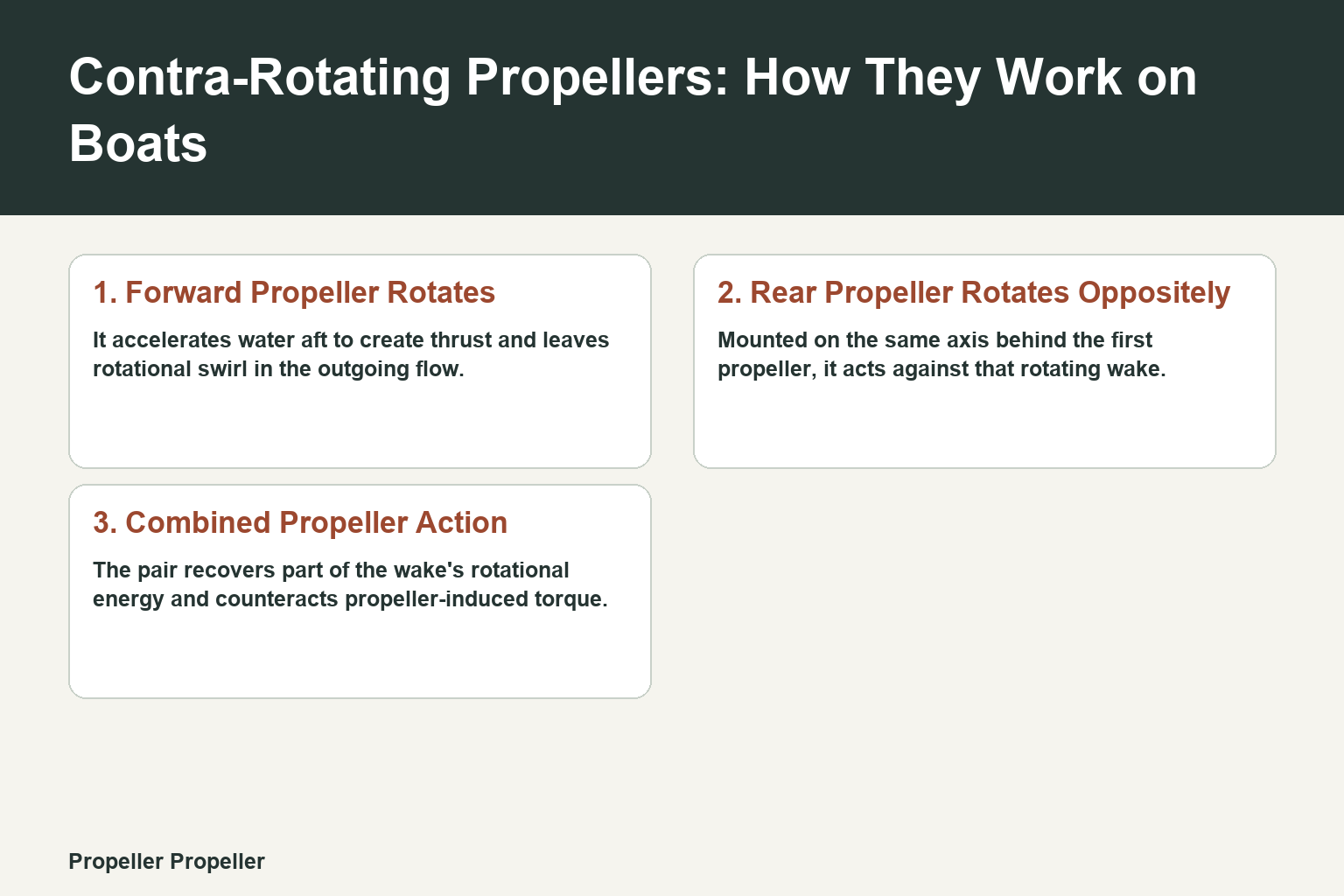
- Forward Propeller RotatesIt accelerates water aft to create thrust and leaves rotational swirl in the outgoing flow.
- Rear Propeller Rotates OppositelyMounted on the same axis behind the first propeller, it acts against that rotating wake.
- Combined Propeller ActionThe pair recovers part of the wake's rotational energy and counteracts propeller-induced torque.
Both propellers rotate in fixed positions on a shared axis; the water, including the leading propeller's swirling wake, moves aft through the pair.
What Makes a Propeller System Contra-Rotating?
The defining feature is not simply having two propellers. They must be coaxial—positioned one behind the other on the same centerline—and rotate in opposite directions. The two propellers are driven as a coordinated system, so their rotational effects oppose one another rather than adding together. This configuration has been used in applications including torpedoes and certain motor boats.
- The forward and rear propellers share a common axis.
- Their opposite rotation helps counter propeller-induced torque.
- The rear propeller operates in the water flow produced by the forward propeller.
Why the Second Propeller Can Improve Water Grip
A single propeller accelerates water aft, but part of that water leaves as a rotating, corkscrew-like wake. With contra rotation, the rear propeller turns against that swirl and can recover some of the energy that would otherwise remain in the wake. The result is more than an extra set of blades: it is an attempt to turn a less orderly outgoing flow into useful thrust. I think this is the clearest way to interpret the design—its purpose is managing the first propeller's wake, not merely doubling propeller area.
- Opposite rotation reduces the net torque effect created by propeller rotation.
- The arrangement can transmit more power for a given propeller radius.
- A second propeller can give a sterndrive a better bite on the water.
| Feature | Single Propeller | Contra-Rotating Pair |
|---|---|---|
| Wake behind the leading propeller | Water is accelerated aft with a rotational swirl. | The rear propeller acts on the leading propeller's swirling wake. |
| Rotational effect | Propeller-induced torque remains in one direction. | Opposing rotation cancels much of the propeller-induced torque. |
| Use of propeller radius | Power transmission is limited by the single-prop arrangement. | The system can transmit more power for a given radius. |
Sources: Wikipedia: Contra-rotating marine propellers · boats.com: Sterndrive show-down, Volvo Penta DuoProp vs MerCruiser Bravo III
How the Flow Changes From One Propeller to the Next
The rear propeller does not move forward into the leading propeller; both remain fixed in position on the drive while they rotate. What moves aft is the water accelerated by the propellers. The rear unit is positioned to act on the leading unit's rotating wake, which explains both the potential efficiency benefit and the need for a more elaborate coaxial-shaft arrangement.
Where You May Encounter Dual-Prop Sterndrives
Volvo Penta's DuoProp, introduced in 1982, and Mercury's MerCruiser Bravo III are examples of contra-rotating sterndrive families. The cited comparison describes both as using through-hub exhaust and cone clutches. Their named versions and stated engine-system coverage differ, so the term “dual prop” does not identify one universal drive or a directly interchangeable propeller set.
- Volvo Penta DuoProp versions named in the comparison are DPH, DPS, and DPR.
- Mercury versions named are Bravo III, Bravo III X, and Bravo III XR.
- The comparison does not identify either family as objectively best.
| Drive Family | Versions Named in the Source | Stated Coverage |
|---|---|---|
| Volvo Penta DuoProp | DPH, DPS, DPR | Systems up to 380 hp |
| MerCruiser Bravo III | Bravo III, Bravo III X, Bravo III XR | Gasoline engines up to 525 hp |
Sources: Wikipedia: Contra-rotating marine propellers · boats.com: Sterndrive show-down, Volvo Penta DuoProp vs MerCruiser Bravo III
The Trade-Off: Thrust Benefits Versus Drive Complexity
Contra rotation can improve acceleration and handling-related water grip, and the cited sterndrive comparison reports acceleration gains of up to 30 percent. That potential comes with a meaningful mechanical cost: coaxial shafts and their supporting components are more complex, costlier, and may require more maintenance. Mechanical losses within the added system can also offset part of the hydrodynamic gain. The sensible comparison is therefore the whole drive system, not the blade count alone.
- Potential gains come from wake-energy recovery, torque cancellation, and improved grip.
- The additional mechanical system can reduce some of the theoretical gain.
- A single-prop and a contra-rotating drive have different complexity and service considerations.
Sources: Wikipedia: Contra-rotating marine propellers · boats.com: Sterndrive show-down, Volvo Penta DuoProp vs MerCruiser Bravo III
Frequently Asked Questions
Do contra-rotating propellers eliminate all torque effects on a boat?
They are designed to cancel much of the propeller-induced torque because the propellers turn in opposite directions. That is a central advantage of the arrangement, but it should not be read as a claim that every handling influence on every boat disappears.
Are dual-prop and contra-rotating propellers the same thing?
In the sterndrive context described here, a dual-prop system uses two coaxial propellers rotating in opposite directions, so it is a contra-rotating arrangement. “Dual prop” by itself is less precise unless the propellers' shared axis and opposite rotation are specified.
Why does the rear propeller need to turn the other way?
The leading propeller leaves a rotating wake. Turning the rear propeller the opposite way lets it act against that swirl and recover some of the associated energy as useful thrust.
Can a contra-rotating system use a smaller propeller radius for the same job?
The cited source states that this arrangement can transmit more power for a given radius. Whether a particular boat can use a different propeller size depends on its specific drive and propeller setup.
Are Volvo Penta DuoProp and MerCruiser Bravo III directly comparable as one design?
They are both named examples of contra-rotating sterndrives, but they are distinct drive families with different listed versions and stated power coverage. The comparison source concludes that neither can objectively be called best.
Final Thoughts
For a boat owner, the useful takeaway is that contra rotation is a wake-management and torque-cancellation design, not just a two-propeller appearance. Judge it as an integrated drive system: the potential grip and power-handling benefits come with additional mechanical complexity.



