
How Does a Boat Rudder Work?
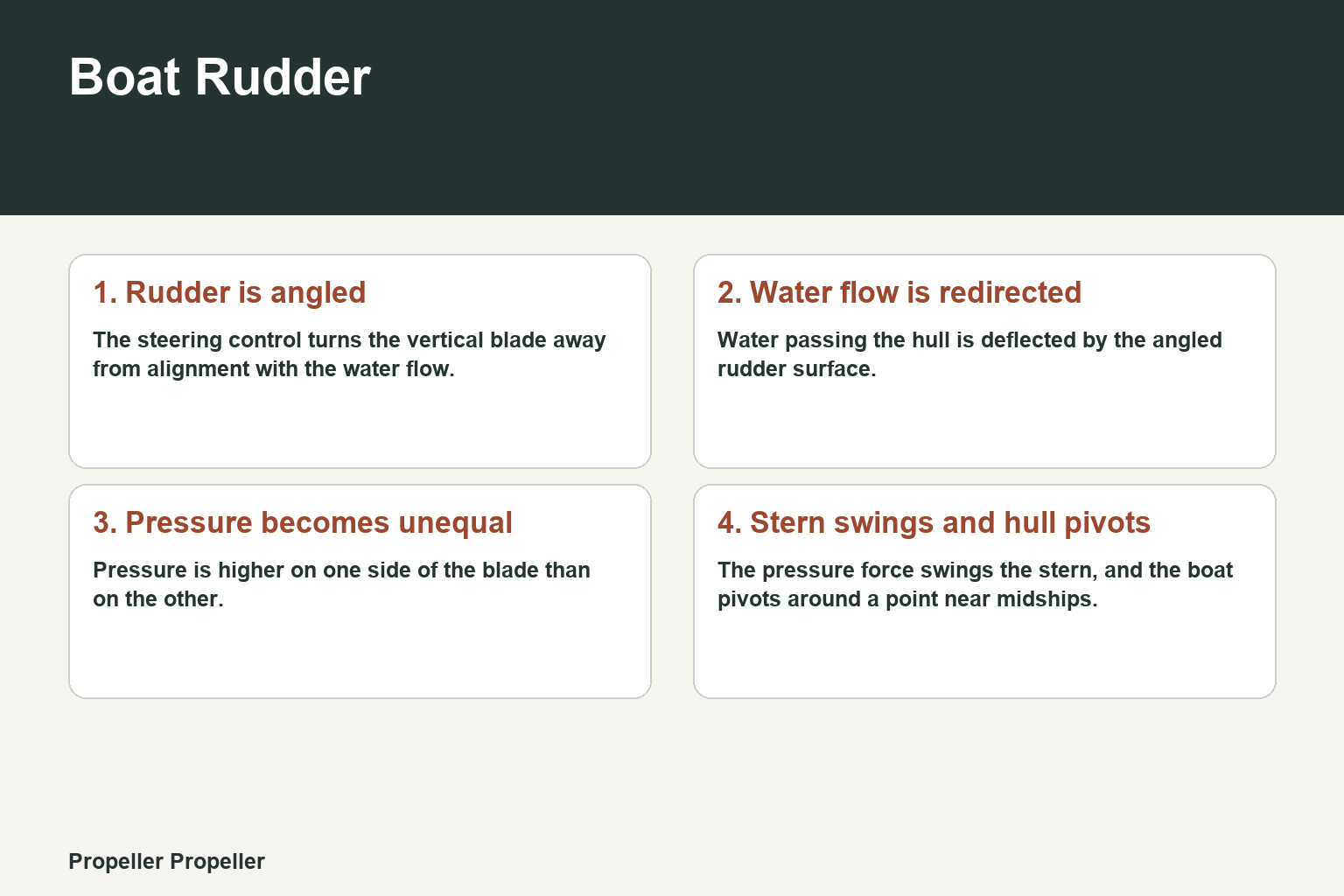
A boat rudder is a vertical steering blade that redirects water flowing past the hull. When the rudder is turned, water pressure becomes greater on one side of the blade than the other, swinging the stern and pivoting the boat around a point near midships. The rudder itself is the control surface; a tiller or wheel is the means of moving it.
Rudders can be mounted at the transom, or farther forward on a keel or skeg. Their location and the steering control fitted to the boat affect leverage and the feel of steering.
- Rudder is angledThe steering control turns the vertical blade away from alignment with the water flow.
- Water flow is redirectedWater passing the hull is deflected by the angled rudder surface.
- Pressure becomes unequalPressure is higher on one side of the blade than on the other.
- Stern swings and hull pivotsThe pressure force swings the stern, and the boat pivots around a point near midships.
The rudder remains at the stern while water moves past it; angling the blade changes the water flow and creates the steering force.
What a boat rudder does
A rudder is a primary control surface: it steers by redirecting the water passing the boat’s hull. In its basic form, it is a flat vertical plane hinged at the stern, often with a tiller attached at its upper end. Turning the blade changes the path of the water flow rather than pushing the entire boat sideways.
- The blade may be mounted on the transom or beneath the boat.
- The rudder is a steering surface, not the device a helmsman holds.
- A tiller or wheel supplies the movement that turns the blade.
Sources: Discover Boating: How does the rudder work? · Wikipedia: Rudder
Why turning the blade changes the boat’s path
With the rudder aligned with the water flow, it produces little steering effect. Once it is angled, it deflects that flow and creates higher pressure on one side of the blade. That pressure makes the stern swing, while the boat pivots around a point near midships. The useful mental model, in my view, is not that the rudder pulls the bow around; it is that the water force acts at the stern and changes the boat’s direction of travel.
Sources: Discover Boating: How does the rudder work? · Wikipedia: Rudder
Rudder location affects turning leverage
A boat may have an outboard rudder hung on its transom, or an inboard rudder supported by a keel or skeg. A transom-hung rudder sits farther aft, giving the water force a greater turning moment than a keel-hung rudder positioned farther forward. That is a matter of leverage: the farther aft steering force has more effect on rotating the hull.
| Mounting arrangement | Where the rudder is supported | Steering implication |
|---|---|---|
| Outboard / transom-hung | At the transom, far aft | Greater turning moment because the force acts farther aft |
| Inboard / keel- or skeg-hung | From a keel or skeg, farther forward | Less turning moment than a farther-aft transom rudder |
Sources: Wikipedia: Rudder
How the helmsman turns the rudder
On smaller sailboats, generally those under about 30 feet, the rudder is commonly controlled directly with a three- or four-foot tiller. Larger boats commonly use a wheel linked to the rudder through cables and a quadrant. A tiller provides immediate feedback to the person steering, which is one reason it is useful for learning how a boat responds.
- A tiller connects the helmsman directly to rudder movement.
- A wheel system uses cables and a quadrant to transmit steering input.
- The control method changes how the rudder is moved, not the basic water-pressure principle.
| Control | Typical association | How steering input reaches the rudder |
|---|---|---|
| Tiller | Smaller sailboats, generally under about 30 feet | Direct hand control; provides immediate feedback |
| Wheel | Larger boats | Cables and a quadrant transmit wheel movement |
Frequently Asked Questions
Is a boat rudder always mounted on the transom?
No. A rudder can be hung on the transom, or it can be inboard and supported by a keel or skeg.
What part of the boat actually swings when the rudder is turned?
The pressure difference on the angled blade swings the stern. The boat then pivots around a point near midships.
Why can a transom-hung rudder have more turning effect?
Because it is farther aft. Water force applied farther from the boat’s pivoting area produces a greater turning moment than a rudder positioned farther forward.
What is the difference between a tiller and a wheel?
They are different steering controls. A tiller is used directly to move the rudder, while a wheel commonly operates it through cables and a quadrant.
Do larger boats use a different rudder principle than small sailboats?
No. The basic principle remains the same: the rudder redirects water flow and the resulting pressure turns the boat. Larger boats commonly differ in using a wheel-based control system.
Final Thoughts
To understand a boat rudder, focus on the chain of cause and effect: turn the blade, redirect water, create unequal pressure, and swing the stern. Its mounting location and steering control determine how that same principle is applied.



