
Folding Propeller: How It Reduces Drag Under Sail
A folding propeller is a sailboat propeller whose blades close when the boat is under sail, reducing the resistance a conventional fixed propeller creates in the water. Tests cited by SAIL Magazine find folding designs produce the least sailing drag, particularly two-blade versions. The trade-off is that closed blades project aft and can require rudder-clearance checks.
Unlike a fixed propeller, a folding design is principally a drag-reduction choice for sailors who spend meaningful time under sail. It is not simply another blade shape: the closed position changes how much propeller area remains exposed to the moving water.
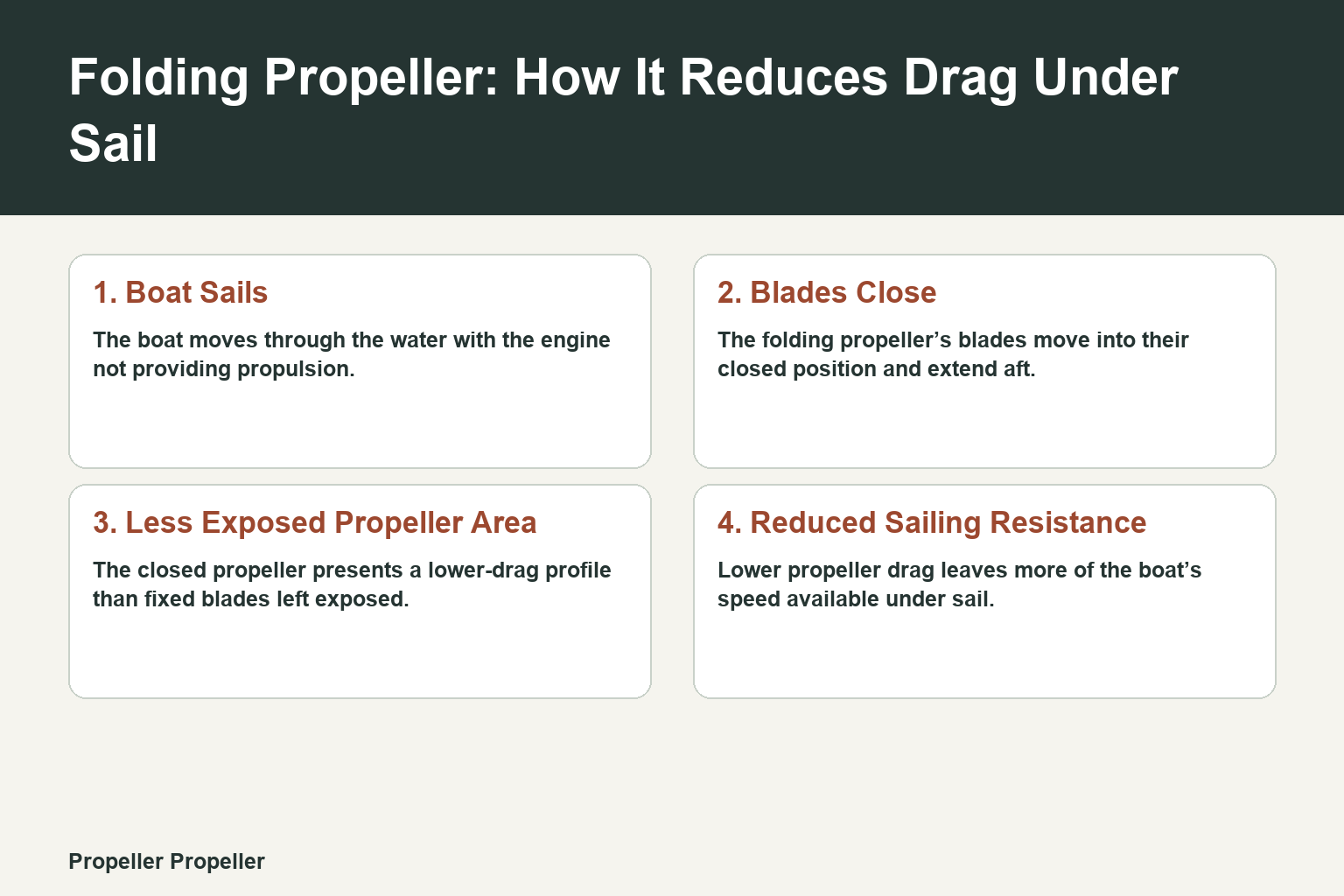
- Boat SailsThe boat moves through the water with the engine not providing propulsion.
- Blades CloseThe folding propeller’s blades move into their closed position and extend aft.
- Less Exposed Propeller AreaThe closed propeller presents a lower-drag profile than fixed blades left exposed.
- Reduced Sailing ResistanceLower propeller drag leaves more of the boat’s speed available under sail.
A folding propeller reduces resistance under sail by closing its blades; its aft extension when closed is why rudder clearance must be checked.
What a Folding Propeller Does
A fixed propeller remains exposed in the water while a sailboat is moving under sail. A folding propeller instead closes its blades, leaving a smaller drag-producing profile. This matters because a propeller is part of the boat’s underwater resistance even when the engine is not being used. SAIL Magazine reports that folding propellers create the least drag in sailing tests, with two-blade folding models especially effective.
- The purpose of the closed-blade position is to reduce sailing drag.
- The drag benefit concerns the boat while sailing, rather than engine-driven operation.
- A folding propeller is an alternative to both fixed and feathering propellers.
Sources: SAIL Magazine: Folding propellers vs feathering propellers
Folding, Feathering, and Fixed Propellers Compared
The central distinction is what the blades do while the boat sails. Fixed blades stay in their normal exposed position. Folding blades close, while feathering blades turn to present a lower-drag orientation. The evidence cited by SAIL Magazine favors folding props for the lowest sailing drag, particularly in two-blade form. In my view, that makes the folding design easiest to understand as the low-drag-focused option, rather than a universal replacement for every propeller type.
| Propeller type | Blade position under sail | Sailing-drag takeaway |
|---|---|---|
| Fixed | Blades remain exposed | A three-blade fixed prop can reduce a medium cruiser’s speed by as much as 20 percent. |
| Folding | Blades close | Lowest drag in the cited tests; two-blade types were especially effective. |
| Feathering | Blades turn to a lower-drag orientation | A low-drag alternative, but not the lowest-drag result in the cited tests. |
Sources: SAIL Magazine: Folding propellers vs feathering propellers
Clearance and Cost Are the Key Trade-Offs
A folding propeller’s closed geometry needs attention before installation. Its blades extend farther aft when closed, so the available distance to the rudder matters. Do not assume a propeller that fits at the shaft will necessarily have adequate closed-blade clearance; the relevant check is the blade position when folded. Cost is also part of the comparison: SAIL Magazine notes that a two-blade feathering propeller can cost more than twice as much as a two-blade folding propeller.
- Check clearance to the rudder with the blades in their closed position.
- Treat clearance as a design-fit issue, not merely a blade-count issue.
- Compare like-for-like propeller configurations when weighing cost.
| If this is your priority | What the evidence suggests |
|---|---|
| Minimize drag while sailing | Consider a folding propeller; two-blade versions performed especially well in the cited tests. |
| Avoid rudder interference | Verify clearance with the blades closed, because they extend farther aft. |
| Compare with feathering cost | A two-blade feathering prop can cost more than twice a two-blade folding prop. |
Sources: SAIL Magazine: Folding propellers vs feathering propellers
When a Folding Propeller Makes Sense
A folding propeller is most directly suited to a sailor prioritizing reduced resistance under sail. The case is strongest when sailing performance matters enough to justify replacing a fixed propeller, which SAIL Magazine says can reduce a medium cruiser’s sailing speed by as much as 20 percent. A two-blade folding design is the notable low-drag choice in the cited testing, but fit at the rudder must still be confirmed for the individual boat.
Sources: SAIL Magazine: Folding propellers vs feathering propellers
Frequently Asked Questions
Does a folding propeller reduce drag more than a feathering propeller?
According to the sailing tests cited by SAIL Magazine, folding propellers create the least drag under sail. Two-blade folding designs were especially effective.
Why can a fixed propeller slow a sailboat?
Its blades remain exposed to the water while the boat sails, adding resistance. SAIL Magazine reports that a three-blade fixed prop can reduce a medium cruiser’s sailing speed by as much as 20 percent, or roughly 0.6 to 1.2 knots.
Do folding propellers need extra rudder clearance?
They may. Folding blades extend farther aft when closed, so clearance between the closed blades and the rudder needs to be checked.
Is a folding propeller less expensive than a feathering propeller?
It can be. SAIL Magazine notes that a two-blade feathering propeller can cost more than twice as much as a comparable two-blade folding propeller.
Are two-blade folding propellers the lowest-drag choice?
The cited tests found that folding propellers had the least drag under sail, especially two-blade types. That result addresses sailing drag, not every aspect of propeller selection.
Final Thoughts
For a sailboat where minimizing propeller drag is the priority, a folding propeller—especially a two-blade design—is the evidence-backed option to consider. Confirm the closed-blade clearance to the rudder before treating that advantage as a workable installation.



