
What Is a Bilge?
A bilge is the lowest interior area of a boat’s hull, where water and other liquids naturally collect. It is a place in the boat, not the water itself. On many boats, it lies along the bottom where the hull sides meet; its exact boundaries can vary with the boat’s shape and the regulatory purpose being considered.
In ordinary use, “the bilge” often also refers to the water found there. More precisely, a bilge-pumping system is the equipment intended to remove the relatively minor water that reaches this low area during normal operation.
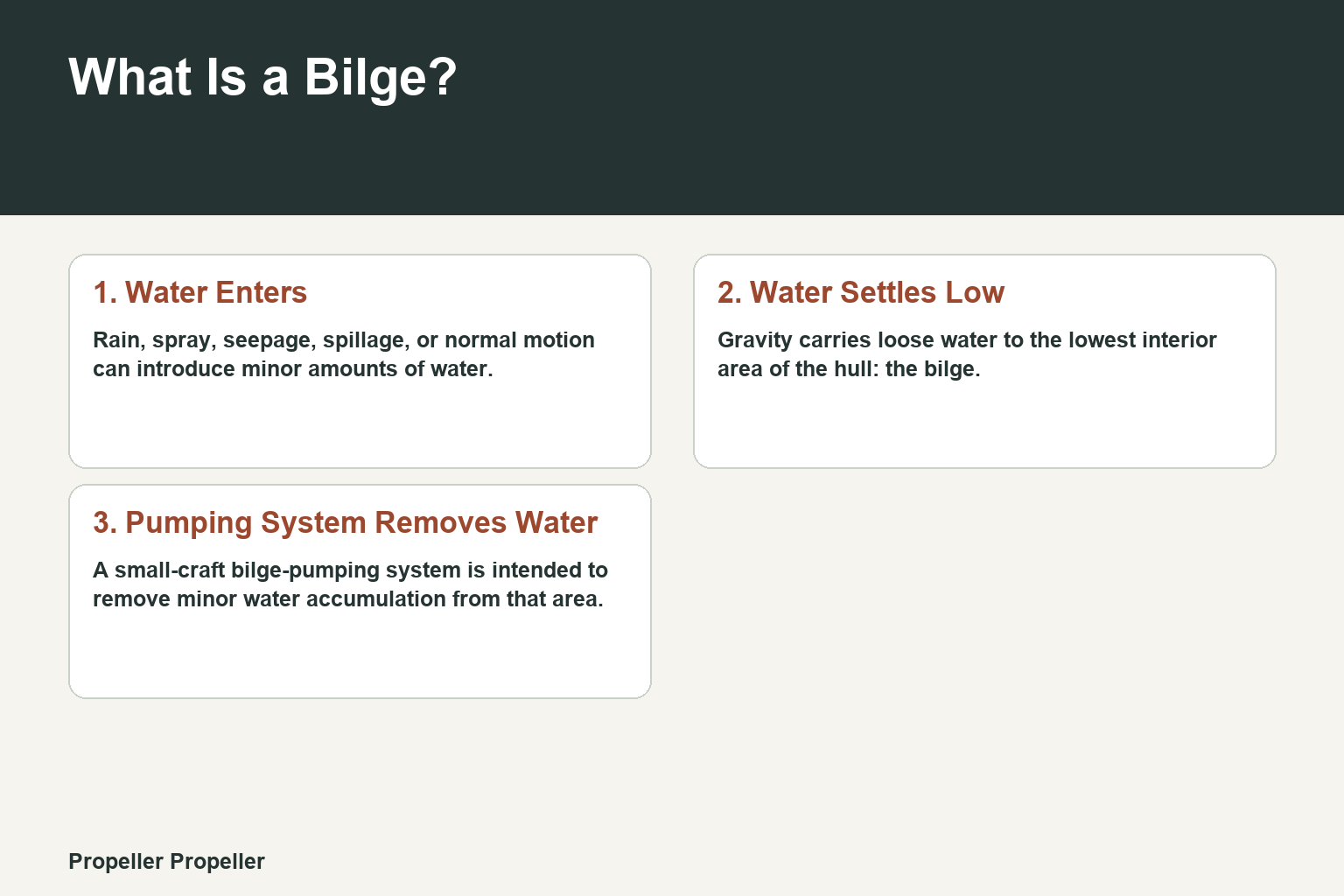
- Water EntersRain, spray, seepage, spillage, or normal motion can introduce minor amounts of water.
- Water Settles LowGravity carries loose water to the lowest interior area of the hull: the bilge.
- Pumping System Removes WaterA small-craft bilge-pumping system is intended to remove minor water accumulation from that area.
The hull’s low interior area remains the bilge; water moves down into it, and a pumping system can remove minor accumulated water.
Where the Bilge Is Located
The bilge occupies the lowermost inside portion of the hull. Texas Parks & Wildlife describes it as the lowest interior part of a boat where the two sides come together at the bottom. Because gravity carries loose liquid downward, this is the area where water collects when a boat is sitting normally in the water.
- A bilge is part of the boat’s interior structure, rather than a separate tank.
- Its low position makes it the natural collection point for water inside the hull.
- The shape and extent of the bilge depend on the hull design.
Sources: 2003 BoatBuilder’s Handbook | Flotation Section · Texas Parks & Wildlife Department Boating Safety Manual 2026
Bilge, Bilge Water, and Engine-Room Bilge
The most useful distinction is between the space and its contents: the bilge is the low area; bilge water is water that has collected there. In a federal safety definition, “bilge” is limited to the area below a point 4 inches above the lowest place where liquid can collect while the boat is floating at rest, and it excludes engine rooms. That narrow definition serves a specific regulatory purpose, so everyday boating language may use “bilge” more broadly.
- Bilge: the low interior area of the hull.
- Bilge water: liquid collected in that area.
- Engine-room bilge: a separately identified area in construction and safety contexts.
| Term | What It Means | Why the Difference Matters |
|---|---|---|
| Bilge | The low interior area of the hull where liquid collects | It is a location, not the liquid itself. |
| Bilge water | Water that has accumulated in the bilge | It may result from several normal-service sources, not only a leak. |
| Bilge pump | Part of a system that removes minor accumulated water | It is equipment; it is not another name for the bilge. |
Sources: 33 CFR 183.110 – Definitions · 2003 BoatBuilder’s Handbook | Flotation Section · Texas Parks & Wildlife Department Boating Safety Manual 2026
Why Boats Have Bilge Areas
A bilge is not an added feature that boats can simply do without; it follows from having a hull with a lowest interior area. Boatbuilders identify bilge and engine-room bilge areas in flotation planning. In day-to-day service, the bilge provides the place where small amounts of water can gather rather than remain spread across the interior.
- Spray and rain can contribute water.
- Seepage and spillage can add small amounts of liquid.
- Normal motion and breaking waves can lead to water collecting in the bilge.
| Source | How It Reaches the Bilge | Context |
|---|---|---|
| Rain or spray | Water enters the boat and settles at the lowest interior point | Normal small-craft operation |
| Seepage or spillage | Small amounts of liquid make their way into the low hull area | Normal-service accumulation |
| Boat motion or breaking waves | Water associated with motion can collect at the bottom of the hull | Conditions addressed by small-craft bilge-pumping systems |
Sources: 2003 BoatBuilder’s Handbook | Flotation Section · ISO 15083:2020, Small craft — Bilge-pumping systems
What a Bilge Pump Is Meant to Do
A bilge pump is part of a bilge-pumping system: it removes minor quantities of water that collect in the bilge from sources such as rain, spray, seepage, spillage, and normal boat movement. The pump does not define the bilge—the bilge is still the low space in the hull. I find that distinction prevents a common misunderstanding: a boat can have a bilge whether or not it has a pump installed or running.
- The bilge is the collection area.
- The pumping system removes water from that area.
- The ISO small-craft standard describes these systems in the context of minor water accumulation in normal service.
Sources: ISO 15083:2020, Small craft — Bilge-pumping systems · Texas Parks & Wildlife Department Boating Safety Manual 2026
Keeping the Bilge Clean and Dry
Keeping the bilge clean and dry is a basic boating-care objective identified in the Texas boating safety manual. Practically, that starts with recognizing that accumulated liquid belongs in the lowest hull area, not assuming that “bilge” means a pump or a leak. Specific inspection, cleaning, and pumping arrangements vary by boat, so use the boat’s applicable instructions for those tasks.
- Look at the bilge as a hull area that can collect liquid.
- Treat the presence of water as separate from the meaning of the term “bilge.”
- Use boat-specific guidance for the installed pumping system and access arrangements.
Sources: ISO 15083:2020, Small craft — Bilge-pumping systems · Texas Parks & Wildlife Department Boating Safety Manual 2026
Frequently Asked Questions
Is the bilge a tank?
No. A bilge is generally the low interior area of the hull where liquid can collect. It is a location within the boat, not necessarily a purpose-built tank.
Does every boat have a bilge?
Boats have a lowest interior hull area, though its shape and accessibility vary. The term is used for that low area where liquid collects.
Is bilge water always from a leak?
No. For small craft, bilge-pumping systems are described as handling minor water from rain, spray, seepage, spillage, normal boat motion, and breaking waves. A leak is not the only possible source.
Is an engine room included in the bilge?
It depends on the context. The cited federal definition excludes engine rooms, while construction guidance separately identifies bilge and engine-room bilge areas.
What is the difference between a bilge and a bilge pump?
The bilge is the low area inside the hull where water collects. A bilge pump is equipment used in a bilge-pumping system to remove minor accumulated water.
Final Thoughts
Think of the bilge as the boat’s lowest interior collection area. Once that is clear, bilge water and bilge pumps are easy to distinguish: one collects there, and the other is intended to remove it.



