Choosing the right propeller can boost your boat’s speed and acceleration by double-digit percentages.
That’s why the Mercury Spitfire vs Enertia debate is one of the hottest topics for boat owners today.
More boaters are comparing aluminum and stainless props. Understanding the differences between these two Mercury Marine types can improve your boating experience.
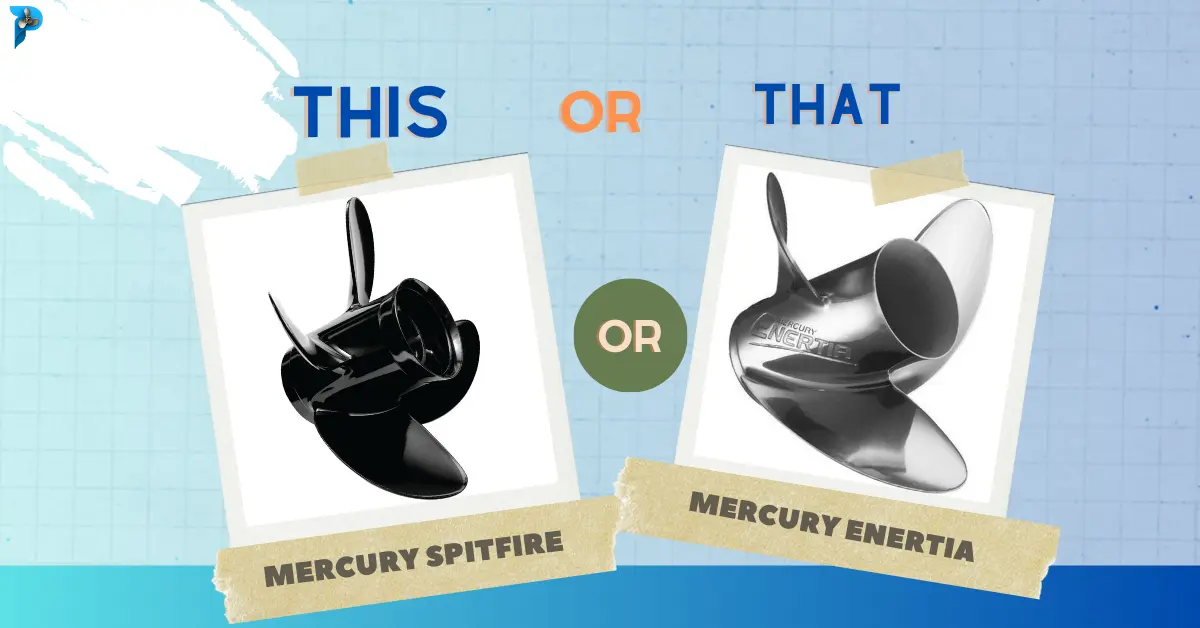
The Spitfire offers a 4-blade aluminum design that maximizes grip, lift, and hole-shot acceleration for boats under 150 HP.
Whereas the Enertia, crafted from Mercury’s X7 stainless steel alloy, uses a 3-blade stainless steel design to deliver higher top-end speed, smoother mid-range efficiency, and durability for engines above 150 HP.
This guide will break down every performance aspect, from acceleration curves and RPM behavior to durability and pitch selection.
Therefore, let’s get started!
Mercury Spitfire vs Enertia: Quick Comparison Chart
Here’s a side-by-side comparison of Mercury Spitfire vs Enertia propellers.
| Feature | Mercury Spitfire | Mercury Enertia |
|---|---|---|
| Material | Aluminum | Stainless steel (X7 alloy) |
| Blade Count | 4 blades | 3 blades |
| Durability | Moderate | Very high |
| Hole Shot | Excellent | Good |
| Fuel Economy | Moderate | High |
| Torque & Lift | Strong lift | Good lift |
| Best For | For fast planing, strong hole-shot, & cost-effective upgrades | For top-end speed, cruising efficiency, fuel economy, & long-term durability |
| Top-End Speed | Limited by the drag of 4 blades | High |
| Recommended Engine Range | <150 HP | >150 HP |
Mercury Spitfire Propeller: Complete Overview
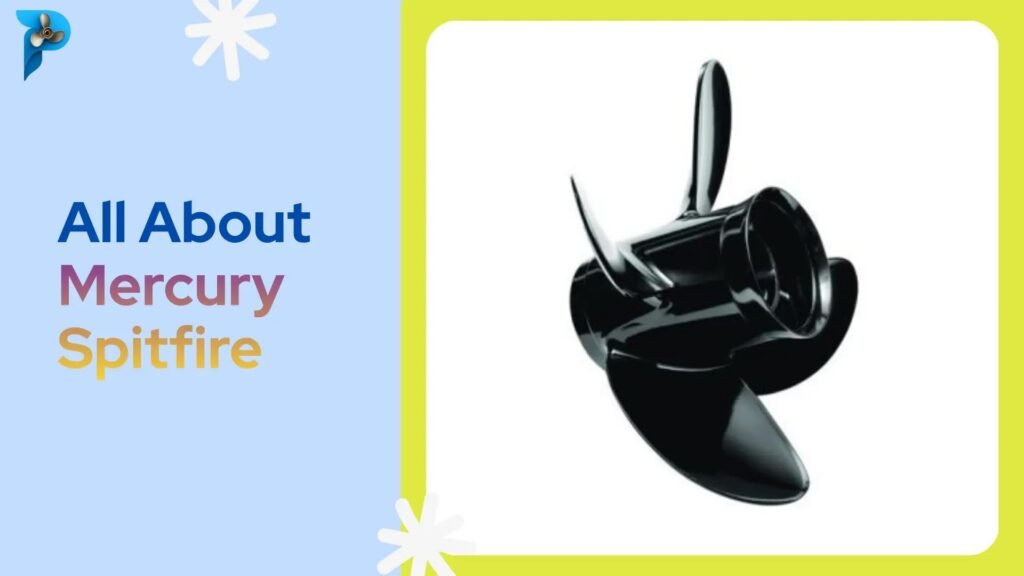
The Mercury Spitfire is a 4‑blade aluminum propeller manufactured by Mercury Marine.
It is crafted from Mercalloy, Mercury’s proprietary aluminum alloy, which provides exceptional strength while allowing the blades to remain relatively thin for reduced drag.
Mercury lists this prop suitable for Mercury and Mariner outboards from 90 – 350 HP, as well as MerCruiser Alpha One and Bravo One sterndrives.
Many Spitfire props are supplied with Flo‑Torq Reflex (or II) hub kits, which absorb shock and protect the drivetrain.
The Mercury Spitfire has an aggressive rake (angle) and extra cup (curvature) on its blades to improve handling and grip in tight turns.
According to Mercury, the Spitfire provides 16 – 25% faster acceleration compared to a comparable 3‑blade aluminum prop.
In the Bris Marine spec sheet testing, the prop demonstrated up to 25% faster acceleration from 0 – 32 km/h.
Its high-blade-area, low-diameter design delivers strong initial thrust.
The Spitfire is ideal for small to mid-sized boats, including pontoons, fishing boats, and recreational runabouts.
For example, the Mercury Spitfire 13”×17” is designed for 75 – 125 HP outboards and delivers explosive hole-shot acceleration, improved lift, and stable handling.
That 4-blade geometry gives more blade surface area within a compact diameter. The result: stronger water bite, better lift, and thrust.
Its Mercalloy aluminum construction ensures a balance of lightweight durability. In addition, it tolerates minor impacts or shallow-water contact better than some high-performance stainless props.
For boats that often run light to moderate loads, or those that need good get-on-plane performance (fishing, tubing, casual cruising), Mercury Spitfire 13”×17” tends to deliver smooth acceleration, efficient mid-range performance, and easier handling.
Key Specifications
- Diameter & Pitch: Diameters: 9.3″ – 14″; Pitches: 9.5 – 23″
- Material: Aluminum (Mercalloy®)
- Finish: Standard satin aluminum finish
- Top Speed: Best for boats under ~45 – 50 mph
- Recommended HP: Best for boats up to 150 HP
- Hub Compatibility: Flo-Torq II, compatible with standard Mercury hubs
- Price Range: ~$120 – $200 based on diameter/pitch
Pros
- Excellent hole-shot performance
- Strong grip and lift
- Four-blade design improves stability
- Wide variety of sizes and pitch options
Cons
- Aluminum construction limits top-end speed.
- Less efficient under very high RPMs.
- It can be damaged in shallow or debris-filled waters.
Best Boat Types & Usage Conditions
- Small to Mid-Size Boats: Perfect for aluminum fishing boats, pontoon boats, and recreational runabouts.
- Light to Moderate Loads: Handles normal passenger and gear weight effectively.
- Entry-to-Mid-Level Outboards: Works best with engines up to 150 HP.
- Everyday Boating: Ideal for boaters who want a balance of acceleration, control, and reliability.
- Tube Pulling & Recreational Water Sports: 4-blade geometry provides extra lift and stability.
Mercury Enertia Propeller: Complete Overview
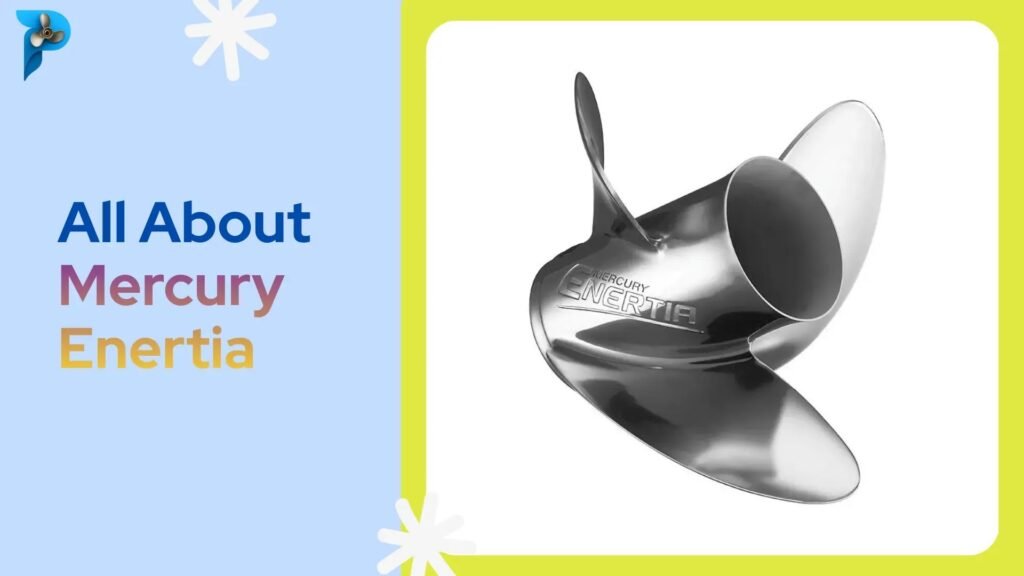
The Mercury Enertia propeller is crafted from Mercury’s X7 stainless-steel alloy, which is approximately 30% stronger and up to 4 times more durable than conventional stainless steel.
The standard Enertia features a 3-blade design.
The Enertia ECO also uses the Performance Vent System (PVS). This lets you adjust the venting to improve either acceleration or fuel efficiency
Mercury claims the Enertia is “the top performer” for heavy pontoons, offshore center consoles, and sterndrives.
In internal testing, the Enertia ECO improved fuel economy by more than 10% compared to a Revolution 4 prop on a Boston Whaler with twin 300 HP Verados.
The X7 alloy also provides enhanced strength, durability, and excellent resistance to corrosion and wear.
The standard Enertia uses Flo-Torq SSR (or SSR HD) hub kits, which reduce noise and vibration while protecting the drivetrain.
Both Enertia and Enertia ECO props are compatible with Mercury and Mariner outboards, as well as Alpha One and Bravo One sterndrives.
The ECO is particularly suited for 135 HP+ outboards, with Mercury noting a fuel-saving advantage for 200+ HP setups.
According to Mercury testing, on a 24′ center-console with a 250 hp outboard, Enertia improved 0-20 mph and 0-30 mph acceleration by ~20% compared to a standard stainless prop of the same pitch.
For high-performance boating, the Mercury Enertia 15”×15” stands out.
The 15×15 model is a 3-blade X7 stainless steel propeller, suitable for higher-power outboards and sterndrives.
The prop’s design helps maintain reliable “hook-up” (less slip) under load, which is useful for towing or carrying heavy loads.
The Mercury 15×15 Enertia is often selected for mid-to-high-HP outboards and sterndrives, which shows that it’s designed to deliver strong mid-range and high-speed performance across a broad load range.
Its stainless X7 build and 3-blade geometry reduce blade flex under load, which helps maintain consistent performance and shaft alignment even under stress.
In Mercury testing, an Enertia prop achieved 39.6 mph at 5,997 RPM on a 225 HP engine, with 0 – 20 mph acceleration in just 4.64 seconds.
Mercury recommends this prop across a broad horsepower range, from 90 to 400 HP, which makes it an excellent choice for larger pontoons, runabouts, center console boats, and sterndrives.
If you’re ready to make a purchase, you can buy this prop from PropellerPropeller.
Key Specifications
- Diameter & Pitch: Diameters: ~15″; Pitches:16.5 – 22.5″
- Material: Mercury X7 stainless‑steel alloy
- Finish: Polished stainless
- Recommended HP: 90 – 400 HP
- Hub Compatibility: Mercury Flo‑Torq SSR / SSR HD hub kits
- Price Range: ~$800 – $1,150 based on diameter/pitch
Pros
- Strong “holding power” in turns
- 10%+ fuel savings at cruising RPMs
- Durable than standard stainless steel
- Good acceleration + strong top-end speed
- Great for long-distance cruising
Cons
- Higher price than aluminum
- Impact risk in shallow water
- PVS tuning requires effort
Best Boat Types & Usage Conditions
- High-HP Outboards and Sterndrives: Ideal for mid-to-large boats (pontoon, center console, sterndrive), especially those over ~135 HP.
- Heavy or Loaded Boats: Great for pontoons or boats that carry weight.
- Cruisers & Long-Distance Boaters: The ECO version is perfect for those who cruise often at mid-RPMs.
- Performance-Oriented Boats: Standard Enertia delivers solid acceleration, good top-end speed, and strong turn performance.
- Multi-Engine & Racing Use: The Enertia ECO XP (16″ diameter) is ideal for center consoles, performance boats, or multi-engine setups.
Mercury Spitfire vs Enertia: Performance Comparison
Both props deliver strong results, but their performance differs sharply based on speed, load, and driving style. Here’s how they compare.
1. Top Speed
The Spitfire offers good speed for an aluminum 4-blade, but the extra blade creates more drag, which naturally limits its maximum speed.
The Enertia’s X7 stainless blades hold their shape at high RPM, reduce drag, and preserve pitch.
This produces higher and more consistent WOT speeds across most mid to high horsepower setups.
Summary: For top speed, Enertia is the clear leader.
2. Hole Shot (Acceleration)
The Spitfire’s 4-blade design delivers noticeably quicker takeoff. More blade area means a stronger bite, faster planing, and better lift under light or heavy loads.
The Enertia accelerates well, too, but its 3-blade stainless geometry is tuned for maintaining speed rather than explosive launch.
PVS tuning can improve its hole-shot, but it still trails the Spitfire in raw off-the-line punch.
Summary: Spitfire wins for immediate acceleration; Enertia is balanced but speed-focused.
3. Smoothness & Vibration
The Spitfire runs smoothly for an aluminum prop, but its 4‑blade design can vibrate a little if the pitch or hub isn’t set correctly.
The Enertia’s stiff X7 stainless blades stay balanced at high RPMs and give a smoother ride with less vibration.
Summary: The Enertia feels more refined at wide-open throttle.
4. Handling & Stability
The Spitfire’s extra blade gives boats better grip and reduces ventilation. Small and mid-size boats get tighter turns and more control in choppy water.
The Enertia, made from rigid X7 stainless steel, stays stable at high speeds and tracks well during sharp turns without losing performance.
Summary: The Spitfire is best for low-speed handling and heavy loads, while the Enertia performs better at higher speeds.
5. Fuel Efficiency
The Spitfire focuses on acceleration, so it uses more fuel at normal cruising speeds compared to a fuel-efficient stainless prop.
The Enertia, especially the ECO version, is designed to save fuel at cruising speeds. Many setups get around 10% or more fuel savings compared to standard props.
Summary: Enertia (ECO) is the fuel-efficient choice.
Mercury Enertia vs Spitfire for Different Boat Types
Matching the Spitfire or Enertia to your boat type ensures optimal performance and a smoother ride.
| Boat Type / Use | Recommended Prop |
| Pontoons (casual/family) | Spitfire |
| Pontoon (high-HP, heavy load) | Enertia |
| Bass (light load) | Spitfire |
| Bass (heavy load) | Enertia |
| Deep-V / Cruiser / Offshore | Enertia |
| Watersports | Spitfire |
| High-speed | Enertia |
1. Best Choice for Pontoons
The Spitfire (4-blade aluminum) is ideal for pontoon boats. It offers strong lift, quick planing, and excellent low-to-mid-speed stability.
Enertia can work on heavier, high-HP pontoons where cruise efficiency is more important than initial acceleration.
So, the Spitfire generally remains the preferred choice.
2. Best for Bass Boats
For bass or shallow-water boats, the Spitfire gives quick responsiveness, strong lift, and precise control.
3. Best for Deep-V Boats / Larger Cruisers
Deep-V hulls and larger cruisers perform well with the Enertia, a 3‑blade stainless prop made from X7 alloy. It improves top speed, stability at high speed, and fuel efficiency in the mid-range.
4. Best for Heavy Loads or Watersports
Spitfire: The 4-blade design gives fast takeoff and quick planing. Great for watersports, towing, or boats with several passengers.
Enertia: Provides stable and efficient cruising at mid to high speeds. Works well for heavier boats or longer trips.
5. Best for High-Speed Performance Boats
High-performance runabouts and speed hulls do well with the Enertia’s X7 stainless blades. They reduce drag, keep the pitch steady at WOT, and provide smoother, faster runs.
Price Comparison: Mercury Spitfire vs Enertia
Choosing the right propeller is about cost, long-term value, and durability.
| Propeller | Price Range |
| Mercury Spitfire (Aluminum 4‑Blade) | ~$180 – 250 based on pitch and diameter |
| Mercury Enertia (X7 Stainless 3‑Blade) | ~$700 – 900+ based on model and pitch |
- Budget-conscious / casual use: Spitfire – reliable, affordable, and versatile.
- Performance-focused / long-term value: Enertia – superior speed, stability, and durability justify the higher cost.
Which Prop Is Better for Your Engine HP Range
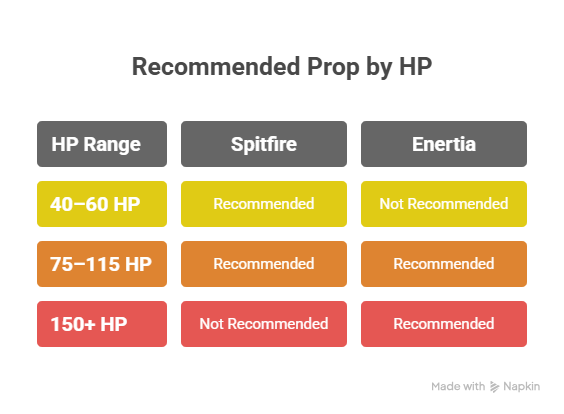
Selecting the right prop for your engine HP range is critical to maximizing acceleration, top-end speed, and overall boat performance.
1. 40 – 60 HP
Recommended: Spitfire (4-blade aluminum)
For this horsepower range, the extra blade area and lift of a 4‑blade prop help your boat get on plane faster.
It improves hole-shot and overall acceleration. Merten Marine recommends the Spitfire for lower‑HP outboards, including 40 – 60 HP.
2. 75 – 115 HP
Recommended: Spitfire
In this mid-range horsepower range, many boaters prefer the Spitfire. Its 4‑blade design gives strong lift, reliable acceleration, and good handling.
It works especially well on smaller to mid-size boats, pontoons, bass boats, and runabouts.
Mercury lists the Spitfire for outboards from 90–350 HP, which includes this horsepower range.
3. 150+ HP
Recommended: Enertia (X7 stainless, 3-blade)
At high horsepower, the strength of stainless blades really shows. They reduce drag and stay stable at high RPMs.
The Enertia is designed to handle heavy hulls, high speeds, and sustained cruising or carrying loads.
These are areas where 4‑blade aluminum props often struggle. Mercury recommends Enertia and similar stainless props for heavier outboards and sterndrives in this power range.
FAQs
1. Is the Spitfire better than the Enertia for a hole shot?
Yes, the Mercury Spitfire is better than the Enertia for hole shot (acceleration), with its 4-blade aluminum design. It provides stronger lift and faster plane-up times compared to the Enertia’s 3-blade stainless design. For boats under 150 HP or lighter hulls, the extra blade surface improves traction and acceleration.
2. Does the Enertia increase top speed noticeably?
Yes, the Mercury Enertia can boost top speed. Its stainless steel X7 alloy reduces flex and drag at high RPMs, which gives higher speeds and better handling under load. The Spitfire is great for a fast hole shot, but the 3‑blade Enertia performs best once the boat is on plane.
3. Which is better for fuel efficiency?
The Enertia ECO is built to save fuel. It works best at cruising speeds and mid-range RPMs. The Spitfire gives faster acceleration but can use more fuel at higher RPMs, especially during long cruises.
4. Can you switch from a 3-blade to a 4-blade without losing speed?
You can switch propellers, but the effect depends on your boat and engine. A 4‑blade prop, like the Spitfire, gives better grip, lift, and a faster hole shot. A 3‑blade prop, like the Enertia, can give a slightly higher top speed. Knowing the difference between 3‑blade and 4‑blade props helps you choose: more acceleration and control versus a little extra top-end speed.
Final Verdict: Which Prop Is Right for You?
Choosing between the Mercury Spitfire and Enertia depends on your boat, engine, and what you want from performance.
The Spitfire is a 4‑blade aluminum prop that works best on boats under 150 HP. It gives a faster hole shot, better lift, and more responsive handling. It’s ideal for pontoons, bass boats, and light recreational use.
The Enertia is made from stainless steel with Mercury’s X7 alloy. It shines in top-end speed, mid-range fuel efficiency, and stability under heavier loads. It’s the better choice for larger boats, engines over 150 HP, or long cruising sessions.
If you want a budget-friendly option or have a lighter setup, the Spitfire still offers good acceleration and everyday versatility. Smaller boats and moderate engines get the most benefit from it.
For high-powered boats, heavier loads, or fuel-conscious cruising, the Enertia is the superior choice.
For readers considering alternative high-performance options, comparisons like Mercury Black Max vs Vengeance offer insights on stainless vs aluminum performance.
For those ready to make a purchase, both props are conveniently available at PropellerPropeller. We ensure that you get the right fit for your boat without hassle.