
A marine battery switch should match the way your boat is wired. A basic On/Off isolator can disconnect one battery during storage, while a selector switch can choose between two banks or combine them. Current rating, voltage range, terminal fit, mounting location and ignition protection all affect whether a switch belongs in your installation.
The eight switches here divide into straightforward single-circuit cutoffs and four-position selectors. I would start by deciding whether you need to manage one battery or two. Then confirm that the switch rating, cable terminals and installation style fit the electrical system rather than choosing solely by housing style or knob layout.
Top Marine Battery Switches on the Market

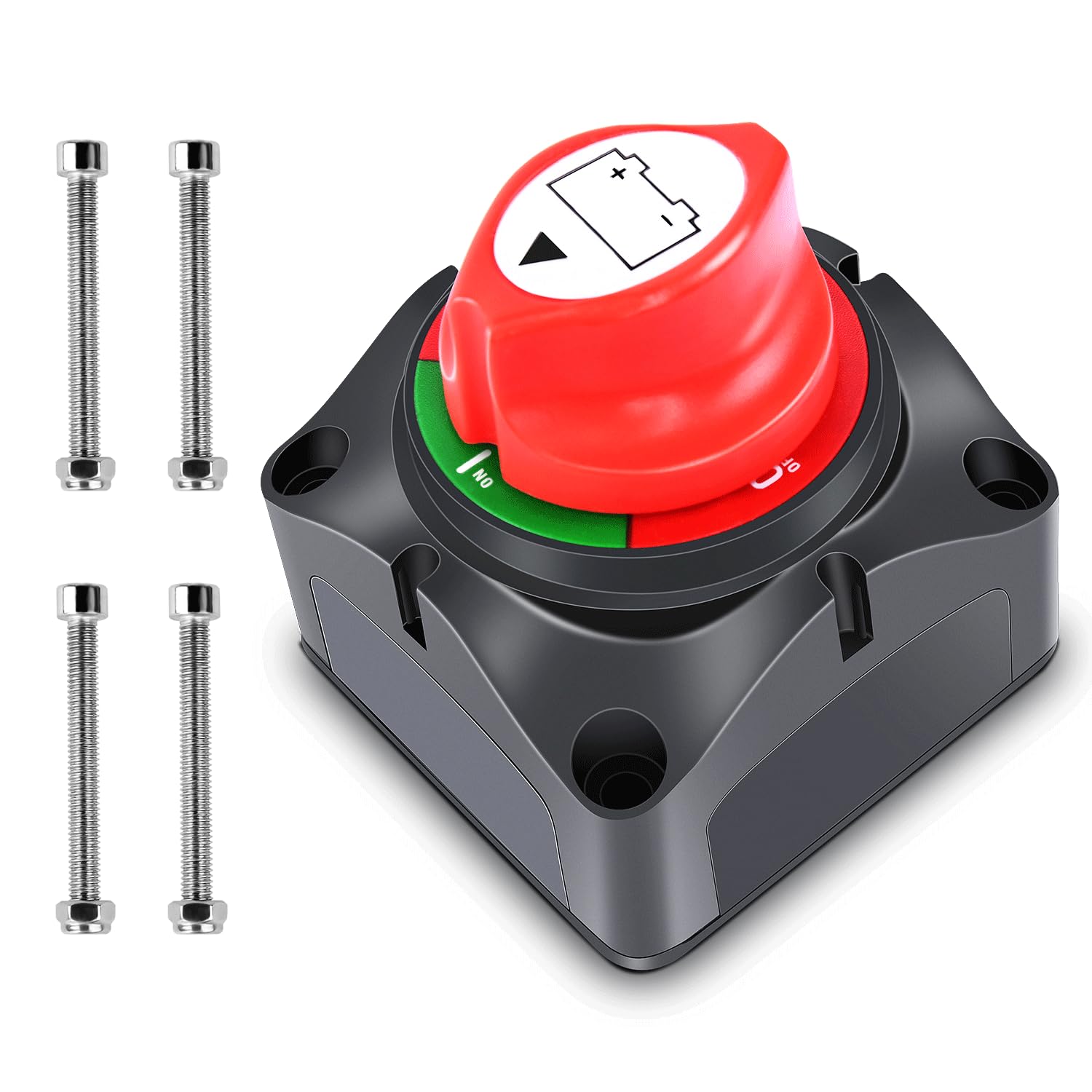
Nilight 90015A On/Off Battery Switch
- On/Off two-position control
- DC 12–48V systems
- 275A continuous at 12V
- 1250A momentary at 12V
- ABS housing with rear cover

Blue Sea Systems e-Series Selector Switch
- Four-position battery selection
- Surface or rear-panel mounting
- Ignition protected
- 7/8-inch copper studs
- Tactile low-light switch face

Seachoice Dual Battery Select Switch
- Dual-battery selection and parallel operation
- For systems under 50V
- 250A continuous rating
- UL listed and ignition protected
- 5-1/4 x 2-5/8-inch size

RVMARINEPAT 300A On/Off Disconnect Switch
- Single-circuit On/Off control
- 12–48V DC systems
- 300A continuous rating
- 900A for 30 seconds
- Ignition protected design

Malictele 300A 1-Both-2-Off Switch
- 1-Both-2-Off four-position control
- Make-before-break contacts
- 300A continuous rating
- 48V DC maximum voltage
- Three mounting options

Joinfworld On/Off Marine Cutoff Switch
- On/Off two-position control
- DC 12–48V systems
- 275A continuous for one hour
- 1250A cranking for 10 seconds
- M10 tinned copper studs
Joinfworld Side Post Disconnect Switch
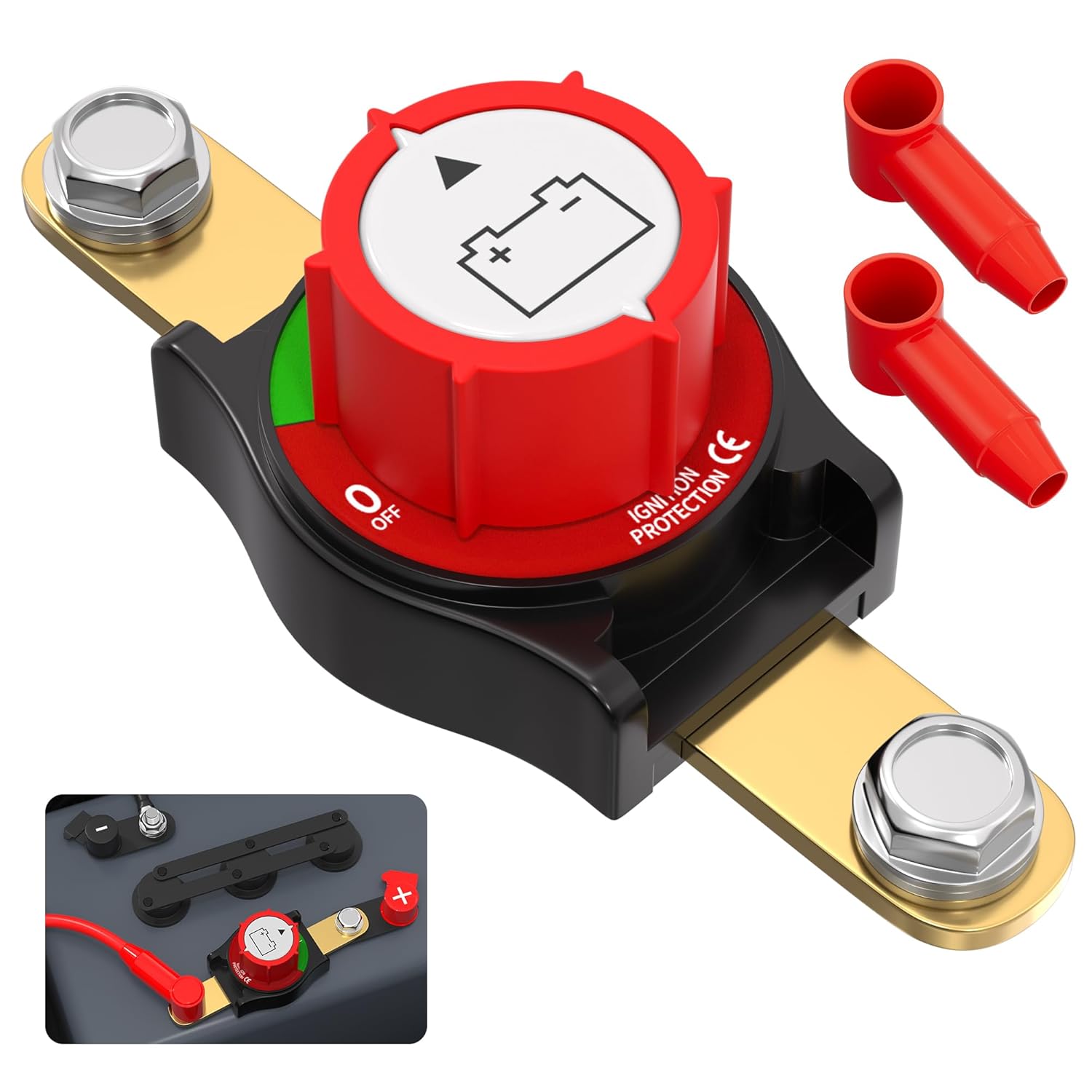
- Direct side-post battery connection
- On/Off two-position control
- DC 12–48V systems
- 275A continuous for one hour
- 1250A cranking for 10 seconds
RVMARINEPAT 300A Four-Position Selector
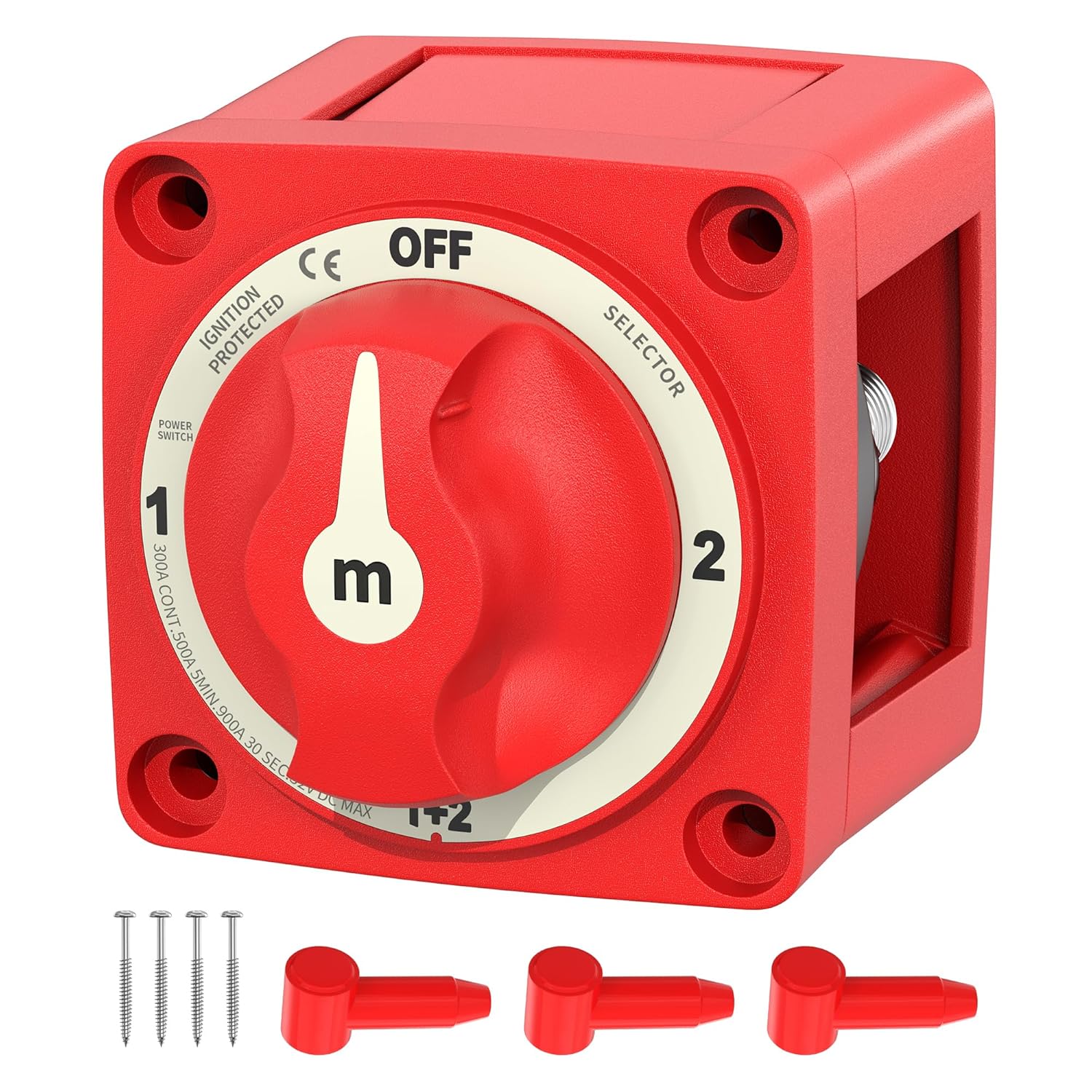
- 1-Both-2-Off selector positions
- Make-before-break design
- 300A continuous rating
- IP68 waterproof rating
- Accepts up to 2/0 AWG cables
Detailed Product Reviews
Nilight 90015A On/Off Battery Switch
- Switch Positions
- On/Off 2 positions
- Voltage Range
- DC 12 – 48V
- Continuous Rating
- 275 A continuous at DC 12V
- Intermittent Rating
- 455 A intermittent at DC 12V
- Momentary Rating
- 1250 A momentary at DC 12V
Advantages
- Simple two-position operation
- DC 12–48V compatibility
- 275A continuous 12V rating
- 1250A momentary 12V rating
- Rear terminal insulation cover
Limitations
- Does not select between battery banks
I would choose the Nilight 90015A when the job is simply isolating one battery bank between outings. Its On/Off 2 positions avoids the added decision-making of a selector switch. The switch is specified for DC 12–48V systems, so it can serve a range of marine DC installations within that voltage range.
At 12V, its published electrical ratings are 275 A continuous at DC 12V, 455A intermittent, and 1250A momentary. The ABS housing has a rear terminal cover intended to insulate the terminals, and the compact 2.68 x 2.68 x 3.07-inch dimensions give a clear mounting footprint. Four bolts are included for mounting.
Against the Blue Sea Systems e-Series Selector Battery Switch, 4-Position, the Nilight gives up battery-bank selection and combining. That is a worthwhile tradeoff for a single-battery setup where a quick master cutoff matters more than managing two banks. Choose the Blue Sea model instead when the wiring plan needs selectable battery banks.
Blue Sea Systems e-Series Selector Switch
- Switch Positions
- 4-Position
- Mounting Options
- surface or rear of the panel
- Engine Room Use
- gasoline powered boat engine rooms
- Stud Length
- 7/8″ long
- Alternator Field Disconnect
- does not include an alternator field disconnect
Advantages
- Selects or combines battery banks
- Surface or rear-panel mounting
- Ignition protected for gasoline engine rooms
- 7/8-inch tin-plated copper studs
- Textured face aids low-light operation
Limitations
- No alternator field disconnect
The Blue Sea Systems e-Series Selector Battery Switch, 4-Position suits a boat with more than one battery bank to manage. Its 4-Position selector arrangement supports choosing between banks or combining them for onboard loads. That is a fundamentally different role from a single-battery disconnect.
Installation flexibility is a key reason to consider it. The switch can be surface mounted or rear mounted through a panel, and its compact design is intended for tight locations. It is ignition protected for gasoline-powered boat engine rooms. The one-piece tin-plated copper studs are 7/8 inch long and accept multiple cables, while textured face details aid knob operation in low or no light.
Compared with the Seachoice Battery Select Switch, Disconnect Isolator Cutoff, Dual, 12 -50V, this model has stated surface or rear-panel mounting options and 7/8-inch studs. However, the Blue Sea switch does not include an alternator field disconnect. I would choose it when mounting flexibility and the stated engine-room suitability are central to the install, while Seachoice is a viable dual-battery selector where its stated electrical ratings are the priority.
Seachoice Dual Battery Select Switch
- Switch Positions
- Dual
- Voltage Range
- under 50V
- Continuous Rating
- 250A continuous
- Intermittent Rating
- 360A intermittent
- Certifications
- UL listed, ignition protected and CE approved
Advantages
- Selects batteries for starting or charging
- Supports parallel operation
- 250A continuous rating
- UL listed and CE approved
- Ignition protected
Limitations
- Physical size requires mounting-space check
The Seachoice Battery Select Switch is aimed at a dual-battery boat installation where you want to select a battery for starting, charging, or operation in parallel. Its Dual switch arrangement makes it more capable than an On/Off master disconnect for that wiring approach. It is specified for systems under 50V.
Its stated ratings are 250A continuous and 360A intermittent. The 5-1/4 by 2-5/8-inch dimensions should be checked against the available panel or mounting area before purchase. This switch is UL listed, ignition protected, and CE approved, which are relevant stated qualifications for a marine electrical installation.
The Malictele 300A 1-Both-2-Off Heavy Duty Cutoff Switch is the closer alternative if you specifically want four named positions and a make-before-break contact design. The Seachoice model is a better match when its 250A continuous rating and listed approvals align with the system requirements. Neither choice replaces checking cable, fuse, battery and alternator requirements for the complete circuit.
RVMARINEPAT 300A On/Off Disconnect Switch
- Switch Positions
- single circuit ON/OFF design
- Voltage Range
- 12-48V DC
- Continuous Rating
- 300A continuously
- Cranking Rating
- 900A for 30 seconds
- Stud Size
- 2 x 3/8″ (10mm)
Advantages
- Single-circuit On/Off control
- 12–48V DC range
- 300A continuous rating
- 900A 30-second rating
- Ignition protected design
Limitations
- Does not manage separate battery banks
This RVMARINEPAT switch is for a single circuit that needs a straightforward battery cutoff with a stated 300A continuous rating. The single circuit ON/OFF design keeps operation direct. It is specified for 12–48V DC systems and is not a selector for independently managing two battery banks.
The electrical ratings include 300A continuously, 500A for five minutes, and 900A for 30 seconds. It has two 3/8-inch, 10mm studs with tinned copper inner studs. The flame-retardant plastic housing is described as disassemblable, with internal room for wiring, and the base uses a partitioned layout intended to separate wires.
The Nilight 90015A is the more comparable basic isolator, but its listed continuous rating is 275A at 12V rather than 300A. I would select this RVMARINEPAT model where the 300A continuous figure, 3/8-inch studs, and ignition-protected design match the electrical plan. Choose the Nilight when its compact published dimensions are more useful for the available mounting location.
Malictele 300A 1-Both-2-Off Switch
- Switch Positions
- 1-Both-2-Off
- Voltage Range
- 48V DC
- Continuous Rating
- continuous rating of 300A
- Contact Design
- make-before-break contact design
- Mounting Options
- surface, front panel, or rear panel mounting
Advantages
- 1-Both-2-Off battery selection
- Make-before-break contact design
- 300A continuous rating
- Surface, front or rear mounting
- Ignition protected design
Limitations
- 48V DC maximum stated
The Malictele 300A switch is for a two-bank setup that needs a 1-Both-2-Off selector rather than a simple storage disconnect. Its 1-Both-2-Off control can direct isolated battery banks to loads, combine banks to loads, or turn the system off. That makes it appropriate for a wiring plan designed around separate battery banks.
Its defining detail is the make-before-break contact design, which is intended to maintain power while changing between battery banks. The switch is rated at 300A continuously and 48V DC maximum. It uses an ABS housing and tinned copper studs, with surface, front-panel, or rear-panel mounting options. It is also described as ignition protected for gasoline-powered boats.
The RVMARINEPAT Battery Disconnect Switch 12V–48V 300A Heavy Duty 4-Position Battery Switch Selector is the nearest alternative because it also has a 1-Both-2-Off layout, 300A continuous rating, and make-before-break design. Pick Malictele when its stated front-panel mounting option suits the installation. Pick the other RVMARINEPAT selector if the stated IP68 waterproof rating and 2/0 AWG cable capacity are needed.
Joinfworld On/Off Marine Cutoff Switch
- Switch Positions
- On/Off 2 Position
- Voltage Range
- DC 12 – 48V
- Continuous Rating
- 275A DC Continuous (1hr)
- Intermittent Rating
- 455A DC Intermittent (5 min)
- Cranking Rating
- 1250A DC Cranking (10 sec)
Advantages
- Simple two-position cutoff
- DC 12–48V compatibility
- 275A one-hour continuous rating
- 1250A 10-second cranking rating
- M10 tinned copper studs
Limitations
- Does not provide two-bank selection
The Joinfworld Battery Disconnect Switch is a conventional master cutoff for a single battery circuit. Its On/Off 2 Position layout is intended to disconnect the battery when the boat is not in use. It supports DC 12–48V systems and can operate as a standalone switch or alongside other switches.
For 12V use, the published ratings are 275A DC Continuous (1hr), 455A intermittent for five minutes, and 1250A cranking for 10 seconds. The switch uses M10 tinned copper studs and nuts. Its ABS plastic body includes a rear cover intended to insulate the terminals, and four stainless steel mounting screws and caps are included.
Compared with the Joinfworld Side Post Battery Disconnect Switch, this version is the better fit when the system uses its M10 stud connections rather than a direct side-post battery connection. Both share the same published voltage range and electrical ratings. Choose the side-post model when direct attachment to a side-post battery is the installation requirement.
Joinfworld Side Post Disconnect Switch
- Switch Positions
- On/Off 2 Position
- Voltage Range
- DC 12 – 48V
- Continuous Rating
- 275A DC Continuous (1hr)
- Intermittent Rating
- 455A DC Intermittent (5 min)
- Cranking Rating
- 1250A DC Cranking (10 sec)
Advantages
- Direct side-post battery connection
- DC 12–48V compatibility
- 275A one-hour continuous rating
- 1250A 10-second cranking rating
- Rear terminal insulation cover
Limitations
- Designed specifically around side-post battery installation
This Joinfworld model is the targeted choice for an installation using a side-post battery. Its directly connected to side post batteries installation approach uses copper conductive-sheet mounting brackets, removing the need for additional connection parts described for that direct fit. It remains a basic On/Off battery isolator rather than a dual-bank selector.
The switch is specified for DC 12–48V systems. Its listed capacity is 275A DC Continuous (1hr), 455A intermittent for five minutes, and 1250A cranking for 10 seconds. It has 2 x 3/8-inch M10 studs, an ABS plastic housing, and a rear cover intended to insulate the terminals.
The standard Joinfworld Battery Disconnect Switch has the same stated voltage range and ratings, but it uses M10 tinned copper studs and nuts rather than the side-post connection arrangement. I would choose this side-post version only when that direct battery connection solves the actual fit problem. For a cable-based installation, the standard Joinfworld version is the more appropriate match.
RVMARINEPAT 300A Four-Position Selector
- Switch Positions
- 1-Both-2-Off
- Voltage Range
- 48V DC
- Continuous Rating
- continuous rating of 300A
- Contact Design
- make-before-break
- Cable Size
- up to 2/0 AWG cables
Advantages
- 1-Both-2-Off selector control
- 300A continuous rating
- Make-before-break switching
- Accepts up to 2/0 AWG cables
- IP68 waterproof rating
Limitations
- For two-bank systems rather than simple On/Off isolation
The RVMARINEPAT 300A four-position selector is for a two-battery installation where you need to choose Bank 1, Bank 2, Both, or Off. The 1-Both-2-Off layout supports that full set of control choices. In Off, it functions as a total cutoff for the connected system.
The switch is rated for 48V DC and continuous rating of 300A. Its make-before-break design is intended to avoid dropping power while changing settings. The 3/8-inch-16 terminals are stated to accept up to 2/0 AWG cables. It also has surface, front-panel, and rear-panel mounting options, along with an IP68 waterproof rating and ignition-protected design.
The Malictele 300A 1-Both-2-Off Heavy Duty Cutoff Switch offers the same stated selector layout, 300A continuous rating, and make-before-break principle. This RVMARINEPAT model is the stronger fit when the installation calls for the stated up to 2/0 AWG cables capacity or IP68 rating. The Malictele is a reasonable alternative where its stated mounting arrangement is preferred.
How to Choose a Marine Battery Switch
Choose the switch around the electrical layout first, then verify its electrical and physical fit. A battery switch is part of a complete DC system, so the battery arrangement, cable terminations, mounting location and applicable requirements all matter.
Choose the Switching Function
Use an On/Off switch when one battery bank only needs isolation during storage, service, or inactivity. Choose a selector switch when the boat has two banks that must be selected separately or combined. A 1-Both-2-Off layout is useful only when the system wiring is designed for those operating positions.
Match Voltage and Current
Confirm the switch voltage range covers the DC system voltage. Compare continuous rating with the sustained current expected in the circuit, then consider intermittent and cranking ratings where they are stated and relevant. Do not treat a short-duration rating as a substitute for a suitable continuous rating.
Plan Terminal Connections
Check stud diameter, thread format and stated cable capacity against the cable lugs and conductors already planned. Terminals must accommodate the required connections without forcing cable bends or stacking hardware beyond its intended arrangement. Use appropriately sized cables and overcurrent protection for the complete circuit.
Check Mounting Location
Measure the available mounting area and account for cable clearance behind the switch. Surface, front-panel and rear-panel mounting options can change where a switch will fit. For gasoline-powered boat engine rooms, choose a model specifically stated as ignition protected for that location.
Consider Switching Continuity
A make-before-break selector is designed to maintain power while moving between battery-bank positions. That can matter where a momentary interruption is undesirable. It does not eliminate the need to understand the charging system and alternator requirements before changing battery-switch positions.
Protect the Installation
A terminal cover can help isolate exposed connections, while a stated waterproof rating may matter in a wet mounting area. These details do not replace sound wiring practice. Mount the switch securely, keep terminals protected, and follow the equipment documentation and applicable marine electrical guidance for the full installation.
Marine Battery Switch Comparison Table
| Product | Best For | Switch Positions | Voltage Range | Continuous Rating | Intermittent Rating | Terminal Material |
|---|---|---|---|---|---|---|
| Nilight 90015A On/Off Battery Switch | For Simple Battery Isolation | On/Off 2 positions | DC 12 – 48V | 275 A continuous at DC 12V | 455 A intermittent at DC 12V | Not Specified |
| Blue Sea Systems e-Series Selector Switch | For Flexible Dual-Bank Control | 4-Position | Not Specified | Not Specified | Not Specified | Tin plated copper studs |
| Seachoice Dual Battery Select Switch | For Dual-Battery Switching | Dual | under 50V | 250A continuous | 360A intermittent | Not Specified |
| RVMARINEPAT 300A On/Off Disconnect Switch | For 300A Single-Bank Cutoff | single circuit ON/OFF design | 12-48V DC | 300A continuously | Not Specified | tinned copper inner studs |
| Malictele 300A 1-Both-2-Off Switch | For Uninterrupted Bank Switching | 1-Both-2-Off | 48V DC | continuous rating of 300A | Not Specified | tinned copper studs |
| Joinfworld On/Off Marine Cutoff Switch | For M10 Stud Connections | On/Off 2 Position | DC 12 – 48V | 275A DC Continuous (1hr) | 455A DC Intermittent (5 min) | M10 tinned copper studs and nuts |
| Joinfworld Side Post Disconnect Switch | For Side-Post Batteries | On/Off 2 Position | DC 12 – 48V | 275A DC Continuous (1hr) | 455A DC Intermittent (5 min) | Not Specified |
| RVMARINEPAT 300A Four-Position Selector | For Large Cable Installations | 1-Both-2-Off | 48V DC | continuous rating of 300A | Not Specified | Not Specified |
How We Evaluated Marine Battery Switches
I compared the stated switching functions, voltage ranges, continuous and short-duration current ratings, terminal details, mounting options, and installation-oriented protections. The recommendations separate simple single-bank isolation from two-bank selection because that distinction determines the switch’s job before secondary details such as housing or mounting style. Specifications were treated as model-specific, and no performance or durability conclusions were drawn beyond the stated information.
Frequently Asked Questions
Do I need an On/Off switch or a battery selector switch?
Use an On/Off switch for isolating a single battery bank. Use a selector switch when the boat has two battery banks that need to be selected independently or combined. The wiring design must support the selector positions you intend to use.
What does 1-Both-2-Off mean?
It identifies four selector positions: Battery 1, both batteries, Battery 2, and Off. The arrangement can support different battery-bank operating choices, but the exact result depends on how the banks and loads are wired.
Why does continuous current rating matter most?
Continuous rating describes the current a switch is specified to handle on an ongoing basis. Intermittent and cranking ratings apply for limited durations. Select a switch based on the sustained electrical demand in the circuit, not only its highest short-duration number.
Can a battery switch be mounted in a gasoline engine room?
Only use a switch in that location when it is specifically stated as ignition protected and the complete installation meets applicable requirements. Mounting location, ventilation, wiring, and protection of connections all remain part of the installation decision.
What is make-before-break switching?
A make-before-break selector is designed to establish the next connection before releasing the prior one during a position change. This is intended to prevent a momentary power interruption while moving between battery-bank settings. Verify compatibility with the charging system before operating any selector.
Should I disconnect the battery during boat storage?
A battery disconnect switch can isolate the connected electrical system when the boat is not in use. It is not a substitute for checking battery condition, charging arrangements, bilge-pump needs, security equipment, or any device that must remain powered during storage.
Final Thoughts
My main recommendation for a simple single-bank marine cutoff is the Nilight 90015A because it pairs uncomplicated On/Off control with stated 12–48V compatibility and clear 12V current ratings. For two-bank management, the Blue Sea Systems e-Series Selector Battery Switch, 4-Position is the choice I would make when its ignition protection and mounting flexibility fit the installation. Choose a 300A 1-Both-2-Off model when that specific selector layout and continuous rating are required.



