
How Long Does a Trolling Motor Battery Last?
A trolling motor battery may provide roughly 6–8 hours of runtime with about 110 amp-hours of capacity per battery as a practical planning rule, but the real answer depends on the battery’s usable capacity and the motor’s average amp draw. That is motor-running time, not necessarily the length of your fishing trip.
Because a trolling motor is often used in bursts rather than continuously, a battery can support considerably more time on the water than its continuous-runtime estimate suggests. The useful approach is to match battery capacity to the motor’s actual usage pattern.
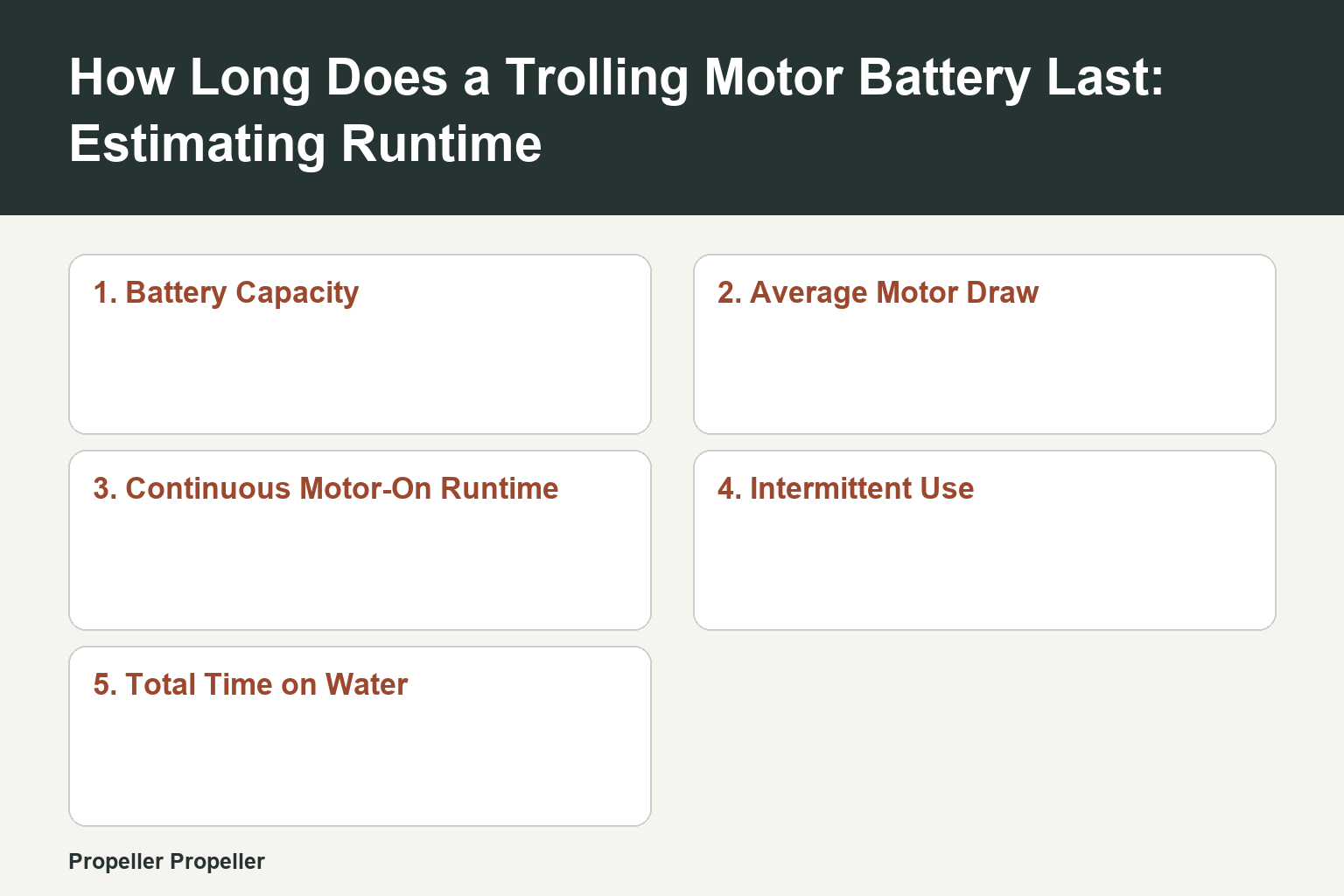
- Battery CapacityThe battery provides a finite amp-hour capacity.
- Average Motor DrawThe operating pattern determines how quickly the motor uses that capacity.
- Continuous Motor-On RuntimeCapacity compared with average draw produces an estimated running-time range.
- Intermittent UseTime spent with the trolling motor off does not consume trolling-motor runtime.
- Total Time on WaterThe outing can outlast the continuous motor-on estimate when use is intermittent.
Battery runtime is consumed while the trolling motor runs; total time on the water also includes periods when the motor is off.
Runtime Means Motor-On Time
The most useful distinction is between time the trolling motor is actually drawing power and total time spent on the water. Runtime estimates describe how long the motor can run; they do not count drifting, casting, anchoring, or running the boat with the trolling motor switched off. Minn Kota’s general rule of thumb is approximately 110 Ah per battery for roughly 6–8 hours of runtime, provided the battery can supply the required amperage. In my view, that figure is a starting point for trip planning rather than a promise for every boat and motor combination.
- A battery with too little available current may run the motor briefly, then cause it to shut off or operate erratically.
- Intermittent trolling can make a day on the water last longer than the calculated continuous motor-on time.
Sources: Trolling Motor Power Considerations – Minn Kota · Boat Battery Maintenance • Outdoor Canada
Estimate Runtime From Capacity and Average Draw
A basic estimate compares the battery’s amp-hour capacity with the trolling motor’s average amp draw. Divide the available amp-hour capacity by the average amps the motor draws to estimate continuous motor-running time. The important word is average: a motor used at different speed settings will not draw the same amount all day. Also, an amp-hour label alone does not guarantee a fixed amount of usable on-water time, so treat the calculation as a planning estimate.
1Find the battery capacity
Use the battery’s amp-hour rating as the starting point for estimating available energy.
2Identify average motor draw
Base the estimate on the motor’s average draw during your expected use, rather than assuming every minute is spent at one setting.
3Estimate motor-on hours
Compare amp-hour capacity with average amp draw to estimate continuous running time, then allow for the fact that battery capacity is not wholly available under every real-world condition.
| Planning Input | What It Represents | What It Does Not Represent |
|---|---|---|
| Amp-hour capacity | A starting measure of battery energy capacity | A guaranteed number of hours on the water |
| Average amp draw | The motor’s typical electrical demand during use | A fixed draw at every speed or moment |
| Estimated runtime | Continuous time the motor can run | Fishing time when the motor is frequently off |
Sources: Trolling Motor Battery FAQs: Setup, Charging & Tips | West Marine · Boat Battery Maintenance • Outdoor Canada
What Changes the Result on the Water
Two boats with similarly rated batteries can see different results because their motors may draw power differently over the course of a trip. Higher or more sustained draw uses available capacity sooner, while lighter or intermittent use extends total outing time. Battery condition and usable capacity matter as well. For that reason, it is better to plan around the way you normally position the boat than around a single headline runtime number.
- Continuous use produces the shortest practical estimate of battery duration.
- Periods with the trolling motor off do not consume trolling-motor runtime.
- A battery must supply sufficient amperage as well as have adequate amp-hour capacity.
Sources: Trolling Motor Power Considerations – Minn Kota · Trolling Motor Battery FAQs: Setup, Charging & Tips | West Marine · Boat Battery Maintenance • Outdoor Canada
Use the Right Battery Setup for the Motor
For lead-acid setups, Minn Kota specifies deep-cycle marine 12-volt battery arrangements for trolling-motor operation. A dedicated deep-cycle battery is materially different from using the boat’s starting battery for this job: West Marine cautions that trolling duty can degrade starting-battery plates rapidly, shorten battery life, and produce poor runtime. If more runtime is needed, identical deep-cycle batteries connected in parallel can approximately double available time while retaining the same voltage. Any battery and installation choice should meet applicable Coast Guard and ABYC requirements.
| Setup | Runtime or Battery-Life Implication | Key Limitation |
|---|---|---|
| Dedicated deep-cycle marine battery | Designed for trolling-motor duty in compatible 12-volt lead-acid setups | Capacity and current still must match motor use |
| Starting battery used for trolling | May deliver poor runtime | Trolling use can rapidly degrade its plates and shorten life |
| Identical deep-cycle batteries in parallel | Can approximately double available time | Voltage remains the same; installation must be appropriate |
Sources: Trolling Motor Power Considerations – Minn Kota · 2021 Minn Kota Battery Charts · Trolling Motor Battery FAQs: Setup, Charging & Tips | West Marine · Boat Battery Maintenance • Outdoor Canada
Plan Charging and Operate Under Load Safely
A battery that appears adequate for one outing may not be ready for the next unless there is sufficient time to recharge it. Charging time changes with battery capacity, how deeply it was discharged, and charger output. For realistic load and safe operation, do not switch on the trolling motor until its propeller is in the water. That instruction affects both normal use and any attempt to judge how the battery is performing.
Sources: 2021 Minn Kota Battery Charts · Trolling Motor Battery FAQs: Setup, Charging & Tips | West Marine
Frequently Asked Questions
How many hours will a 110 Ah trolling motor battery last?
Minn Kota gives about 6–8 hours per 110 Ah battery as a practical rule of thumb. Actual continuous runtime still depends on the motor’s average amp draw and the battery’s usable capacity.
Why does my battery last longer than the calculated runtime?
The calculation estimates time that the trolling motor is running. If you use the motor intermittently, the overall time you can fish or remain on the water can be much longer.
Can I use my boat’s starting battery for a trolling motor?
It is not a good substitute for a dedicated deep-cycle trolling battery. Trolling use can cause rapid plate degradation in a starting battery, reducing both battery life and runtime.
Will two batteries double trolling motor runtime?
Two identical deep-cycle batteries connected in parallel can approximately double available time while keeping the same voltage. The arrangement must still suit the motor and the installation requirements.
Does a larger amp-hour number always mean a fixed number of extra hours?
No. Amp-hour capacity is one input, but actual runtime also depends on usable capacity and average motor draw. It is best used for an estimate rather than a guaranteed duration.
Final Thoughts
For a dependable estimate, start with amp-hour capacity and your expected average draw, then plan the result as motor-on time. A properly matched deep-cycle setup and a realistic charging plan matter as much as the battery’s rating.



