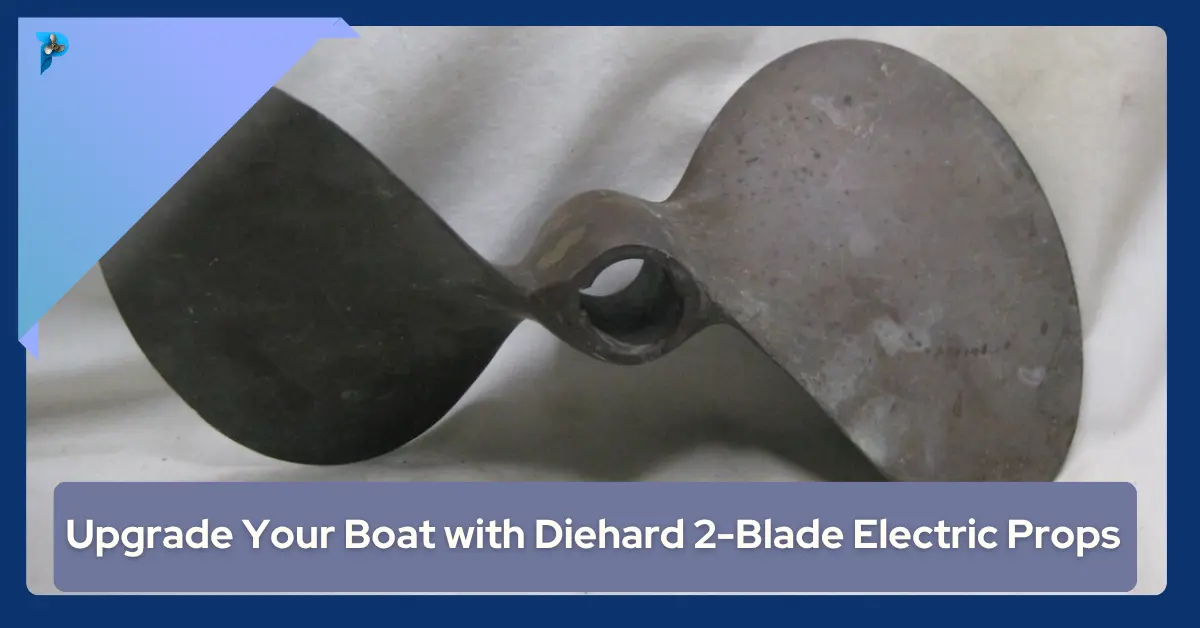
If you own a trolling motor or small electric outboard, the Diehard Electric Boat 2 blades boat prop is a game-changer.
The Diehard Electric Boat 2-blade propeller increases thrust efficiency for electric RC boats by reducing drag and maximizing torque transfer.
Its two-blade design delivers higher top-end speed and smoother handling compared to three-blade props, which is ideal for lightweight, high-RPM setups.
This two-blade prop is designed for control, durability, and performance. It provides reliable thrust and operates energy efficiently.
In this guide, you’ll learn all about trolling motor props. It covers material construction and hub specifications.
You’ll also find tips on installation, maintenance, and choosing the right prop for your motor.
Henceforth, let’s dive into it!
What is a Diehard Electric Boat 2-Blade Prop?
The DieHard Electric Boat 2-Blade Prop is a two-blade replacement propeller offered especially for small electric outboards and trolling motors.
Its primary function is to provide efficient thrust and ensure smooth & controlled movement of electric boats, especially in calm waters.
This prop is optimized for reduced drag, improved top-end speed, and longer battery run time in lightweight/high-RPM electric setups.
The propeller is made for electric boats and trolling motors, whether transom or bow-mounted. It focuses on better battery life and top-end efficiency.
2-blade props are commonly chosen by anglers and small-boat users who want longer cruising range and smoother handling in calm water.
Overview of Sizes and Compatibility
The Diehard 2-Blade Propeller is compatible with several electric trolling motors, including the ET44L, ET54L / D65L / T34, as well as Newport Vessels’ 36/40/46lb models, by enhancing performance and reducing drag.
Many replacement props list a hub/shaft size, and knowing the correct propeller hub replacement is essential. For example, outside diameter ≈ 3-1/4″, hub height ≈ 2-1/4″, overall length ≈ 8-7/8″. Match that to your motor.
Pick a prop optimized for your motor’s thrust range (e.g., 36 – 46 lb props for 36 – 46 lb motors).
It is also compatible with Newport Vessels’ 36 lb, 40 lb, and 46 lb thrust motors. It optimizes efficiency for these sizes.
Why “Two-Blade”: The Design and What It Delivers
Fewer blades mean less wetted area and lower hydrodynamic blockage, which is why many anglers debate 2 blade vs 3 blade prop to balance efficiency and battery run time.
For electric motors, a 2-blade propeller uses less power at cruising speed. Hence, it extends battery life and run time.
It also allows higher RPM and smoother performance with less vibration, which highlights the importance of understanding low pitch vs high pitch propeller choices.
However, it offers less low-speed thrust and slower acceleration than 3- or 4-blade props. It’s best for those prioritizing range and top speed over power and quick starts.
Top 3 Diehard Electric Boat 2 Blades Boat Prop
Below are the specs you must verify before buying,
Diameter should be ~8-9 in for small trolling motors.
For pitch, many replacement props do not list an explicit pitch like larger outboards do. Instead, they list compatible thrust and motor RPM suitability.
The hub OD ~3-1/4″, hub height ~2-1/4″ will be for DieHard/Sears older props.
For material, go for fiberglass-reinforced nylon / high-strength nylon. These are good strength-to-weight & corrosion resistance.
Metal/stainless hubs or reinforced composites are used for heavy-duty or saltwater applications.
Now, keeping all these in mind, here are the top 3 products you can choose for your diehard electric boat 2 blades boat prop. Let’s get started,
1. MotorGuide Power Prop 2-Blade – Best overall 2-blade replacement
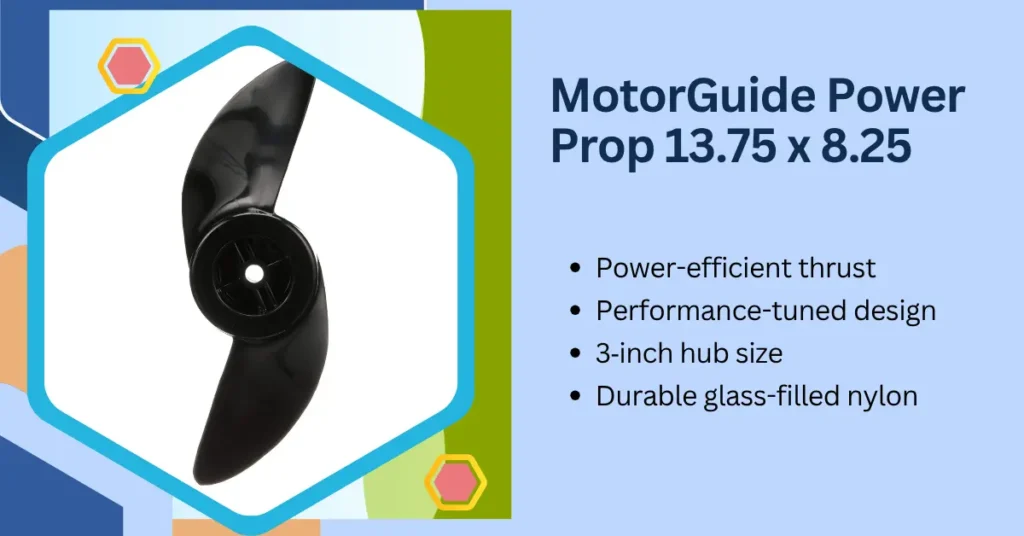
The MotorGuide Attwood Power Prop is a 2-blade replacement propeller. The prop is made from durable molded nylon. It is designed for general trolling motor use.
The prop delivers a balance of efficiency and thrust for small to medium electric motors. It serves as an industry-standard replacement.
Its design reduces drag compared to multi-blade props while keeping enough bite for typical fishing and boating conditions
Performance
This prop offers steady cruise efficiency, quiet operation, and good wear resistance.
It also provides noticeably better top-end speed and slightly longer battery run times on light boats compared to heavier 3-blade units.
In addition, it accepts common prop hardware and fits a wide range of aftermarket shafts.
As a neutral, general-purpose 2-blade prop, it performs well for users who want economy and proven fitment.
Key Features
- Molded nylon construction for impact resistance.
- Two-blade efficient geometry, lower drag at cruise.
- Widely available replacement part with common hub sizes.
- Performs best in open or lightly weeded water.
- Recommended uses for salt water.
Why We Picked It
We picked the MotorGuide Attwood’s Power Prop because it is a durable, widely compatible 2-blade option that consistently matches the needs of DieHard-style motors.
2. Newport Vessels 2-Blade Replacement Prop – Best for Newport/compatible thrust ranges
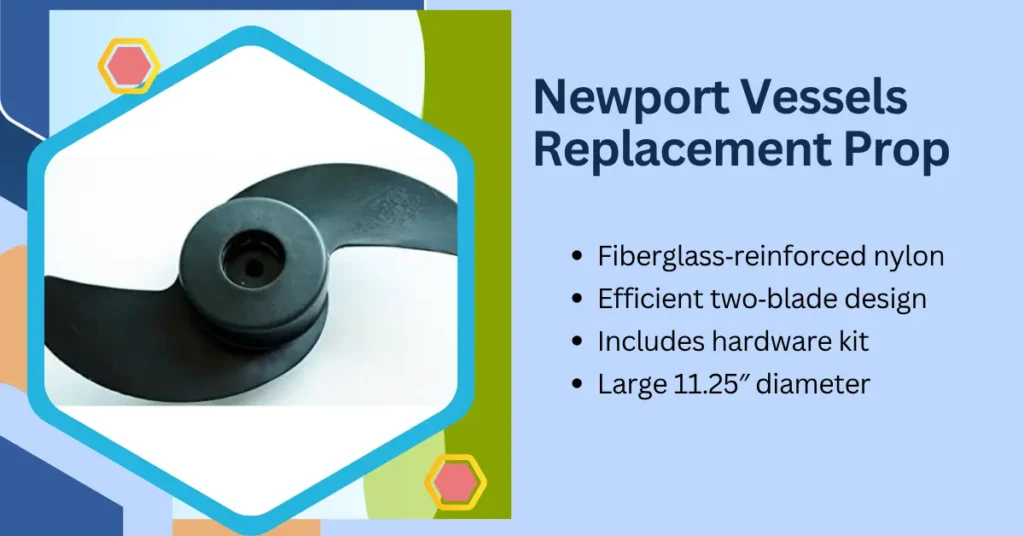
The Newport Vessels 2-Blade Replacement Prop is made from fiberglass-reinforced nylon. It fits Newport thrust ranges, including 36, 40, 46 lb, and some larger 55, 62, 86 lb models.
The prop has an approximate 8.9″ diameter, with a hub sized for Newport lower units.
It combines two-blade efficiency with decent low-end performance. Some come with hardware for easy drop-in replacement.
It is positioned as a mid-range OEM and aftermarket option.
Performance
The Newport’s 2-blade prop improves battery efficiency and maintains speed in calm to moderate conditions.
It shows slower acceleration than multi-blade alternatives but extends run time on electric setups.
Build quality is solid for the price point, and it’s often recommended as a direct replacement for Newport motors or for owners of similar thrust small craft seeking an OEM-style fit.
Key Features
- Fiberglass-reinforced nylon construction.
- Diameter ~8.9″ (check SKU) and internal hub ~3-3/16″ on small SKUs.
- Designed specifically for Newport thrust ranges (36/40/46 lb or 55/62/86 lb).
- Marketed as a battery-efficient 2-blade replacement for trolling motors.
Why We Picked It
We picked the Newport’s prop as a direct replacement for Newport motors and a very good fit for owners of similar thrust-rated motors (including many DieHard-style setups).
It offers a reliable mix of efficiency and OEM compatibility at a competitive price.
3. Minn Kota Weedless Wedge – Best weed-shedding 2-blade prop
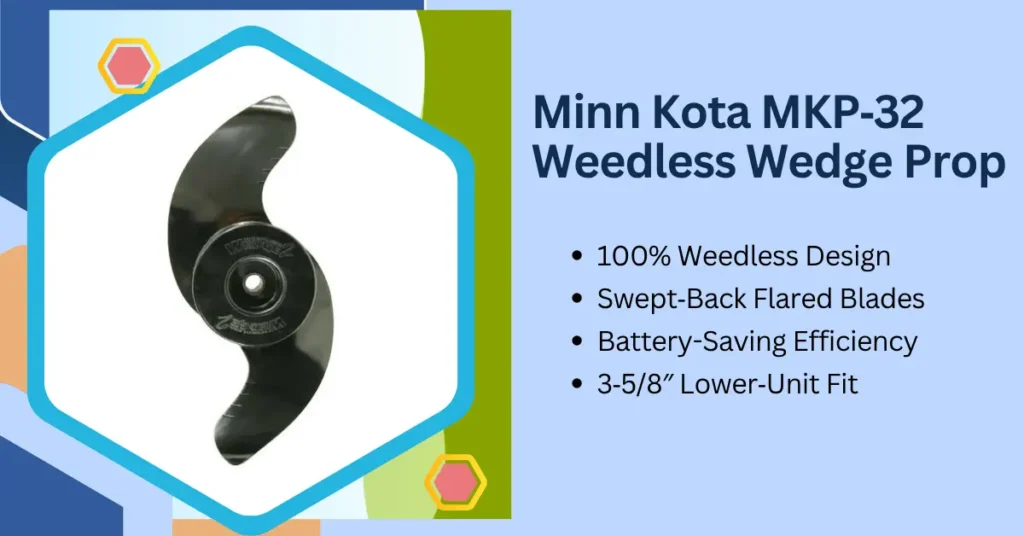
While the Minn Kota Weedless Wedge 2 (MKP-32) is an excellent weed-clearing prop, it’s not automatically compatible with every electric trolling motor.
Many non–Minn Kota units, like certain DieHard 2-blade motors, also may not fit.
The MKP-32 is engineered specifically for 3-5/8″ lower-unit diameters, and Minn Kota limits its compatibility to a defined list of motors identified by certain serial-number prefixes (for example, “WWAF”-“WWAI” or “J”-“R”).
Because of these restrictions, the MKP-32 may not fit properly on a DieHard electric motor unless the motor’s lower-unit dimensions and hardware match Minn Kota’s requirements.
The prop has swept-back, flared blade tips that push vegetation away instead of collecting it. This preserves propulsion and reduces the need for frequent clearing.
Performance
This propeller clears weeds effectively at trolling speeds with minimal motor load. It has good battery efficiency even in vegetation.
It sacrifices some low-end bite for cleaner operation and longer run time. This makes it ideal for anglers in weed-choked lakes.
Performance is reliable when installed on matching lower-unit diameters.
Key Features
- Weedless swept/flared blade design (wedges vegetation away).
- Fits 3-5/8″ motor diameters.
- Fiberglass-reinforced plastic for corrosion resistance.
- OEM Minn Kota parts with a wide model compatibility and factory support.
Why We Picked It
We chose the Weedless Wedge 2 because it delivers strong weed-shedding performance and is a proven OEM design, but only for motors that match its 3-5/8″ lower-unit size.
It’s included here as a possible upgrade for DieHard users if their motor dimensions align, but it is not universally compatible with DieHard 2-blade motors.
How to Select the Right 2-Blade Electric Boat Prop?
Choosing the correct 2-blade propeller matches your boat size, hull type, and motor thrust to the prop’s diameter, pitch, hub, and blade geometry.
Below is a step-by-step guide that shows you how to pick a 2-blade prop that delivers the performance you need.
Understand your boat and motor specs
Start by gathering these baseline specs; they determine everything else.
1. Boat size & hull type- Pontoon, jon boat, small skiff, bass boat, inflatable, or V-hulled runabout behave very differently.
Flat, lightweight hulls plane faster and need less thrust; heavier displacement hulls need more torque.
2. Total loaded weight (boat + motor + passengers + gear)- A lightly loaded 12 – 14 ft jon boat needs far less thrust than the same boat with three passengers and gear.
3. Motor thrust (lbs)- Electric motors are rated in lbs of thrust (e.g., 30 lb, 45 lb, 55 lb); match the prop to that thrust range.
4. Shaft length & mounting position- Measure shaft length and confirm it suits your transom height or bow mount.
Choose diameter, pitch, hub & blade count with 2-blade context
When you’re choosing specs, think about the tradeoffs, especially since a 2-blade prop emphasizes efficiency and top speed.
1. Diameter
Bigger diameter = more water moved per revolution = more low-end thrust.
Smaller diameter = less drag, higher top speed, and lower current draw on electric motors.
2. Pitch
Higher pitch = higher top speed but greater motor load (more amperage).
Lower pitch = stronger acceleration and better tiller/hold.
3. Hub & fitment
Measure the hub OD and internal bore, or reference the motor manual.
A wrong hub = vibration, slippage, or inability to install.
4. Blade count
2 blades = less wetted area – lower drag – better battery run time and higher top speed.
For electric boats prioritizing range, a 2-blade is often ideal.
Battery Run Time vs Acceleration
If you fish all day and need range, choose a 2-blade with a conservative pitch and a narrower chord.
If you frequently haul heavy loads/need quick acceleration, consider a 3-blade.
Prop clearance
Keep the prop at an appropriate depth from the hull/keel.
Too shallow causes ventilation (air ingestion), too deep reduces efficiency for bow-mounted motors.
For transom mounts, ensure the cavitation plate or skeg is positioned as recommended.
Cavitation vs ventilation
Cavitation is caused by local pressure drop on blades (bubbles forming), and ventilation is caused by surface air/wake.
If you see persistent bubbles or loss of thrust, check clearance and trim angle.
Why Choose a 2-Blade Prop for an Electric Boat?
A 2-blade propeller is a balanced design choice. With less blade area cutting through water, it creates less drag.
This helps the boat reach higher speeds and use less power. However, it sacrifices some low-end thrust and acceleration
1. Efficiency and battery usage
Lower hydrodynamic drag = less current draw.
A 2-blade propeller has less surface area and allows smoother water flow than 3- or 4-blade designs.
This lets the motor spin more freely at the same throttle. It also draws less power, giving longer battery life and better range for electric boats.
With less drag, the motor reaches higher RPMs more easily. This helps improve top speed without overloading or drawing too much current.
If your priority is battery life and steady cruising (fishing, trolling all day, long patrol runs), a 2-blade prop is usually the better choice.
2. Top speed vs acceleration
2-blade props often provide a slightly higher top speed with the same motor and voltage.
The reduced drag helps the motor reach higher RPMs before hitting its load limit.
More blades = more “bite.”
3- and 4-blade props provide greater immediate thrust and better acceleration (and better boat control when heavily loaded or in rough water).
Choose a 2-blade if you want economy and top-end speed from an electric motor.
Choose 3-blade (or 4-blade) when you need quick planing, heavy-load thrust, or superior low-speed control (big boats, rough water, heavy anglers/gear).
3. Weed and debris handling
Many brands make weedless 2-blade props with swept or flared blades to prevent weed buildup.
Examples include Minn Kota’s Weedless Wedge and MotorGuide’s Katana. Their design helps shed vegetation while keeping good efficiency.
A 2-blade prop with a narrow shape and swept tips clears weeds more easily than multi-blade props. That’s why anglers in weed-heavy waters prefer weed-optimized 2-blade models.
In shallow or debris-filled areas, these props also reduce hangups. Always choose a prop labeled “weedless” or made for shallow water use.
Quick decision guide
- Pick a 2-blade if you need longer battery run time, higher cruise/top speed, a lightweight boat, or high-RPM electric setups, and you fish in moderately weedy waters.
- Pick a 3/4-blade if you need better low-end thrust, faster acceleration, a stronger grip in turns, or if you operate a heavier boat in rough water.
Installation Guide: How to Install a DieHard Electric Boat 2-Blade Prop
Following the right installation process helps maintain efficiency and prevents costly damage to your trolling motor.
Tools & Materials You’ll Need
- Safety gloves and eye protection
- Screwdriver or drift punch (for pin removal)
- Needle-nose pliers
- Small hammer or mallet
- Prop wrench or adjustable wrench
- Replacement hardware (drive pin, nut, washer)
- Marine grease or anti-corrosion lubricant
- Clean rag or paper towels
Safety First
- Disconnect the battery before touching the propeller.
- Work on land or a trailer, never in water.
- Wear gloves and eye protection when removing or installing pins or nuts.
- Keep children and pets away from the work area.
Step-by-Step Installation
Step 1: Disconnect Power
Always begin by removing the negative terminal from your trolling motor’s battery. This ensures zero electrical power during installation.
Step 2: Position the Motor
Tilt or raise your motor out of the water and secure it so that the propeller is accessible and stable.
Step 3: Remove the Old Propeller
Hold the prop firmly and remove the prop nut using a wrench or pliers. Then, take off the washer.
Carefully slide the prop off the shaft. If it’s stuck, wiggle gently. Use a punch and hammer to remove the drive pin from the shaft.
Step 4: Inspect & Clean the Shaft
Wipe the shaft clean with a rag. Inspect for rust, pitting, or bends.
Apply a thin layer of marine grease to prevent corrosion and ease future removal.
Step 5: Check the New Prop Fitment
Before installing, test-fit your DieHard 2-blade prop on the shaft.
Ensure the bore and keyway/drive pin hole line up perfectly. The prop should slide smoothly without wobbles.
Step 6: Install the Drive Pin
Insert the new drive pin into the shaft hole. Use needle-nose pliers or a light tap with a hammer to seat it securely.
Step 7: Mount the Propeller
Align the prop’s pin slot or keyway with the drive pin. Slide the propeller onto the shaft until it’s fully seated against the hub shoulder.
Step 8: Secure with Washer and Nut
Install the washer, then thread the prop nut by hand. Tighten with a wrench until snug.
Do not over-tighten; too much torque can strip threads or crack the hub.
Step 9: Spin Test
Rotate the prop by hand; it should spin freely with no scraping, wobble, or stiffness.
Check that the blades clear the lower unit housing and cavitation plate.
Step 10: Reconnect Power & Test Run
Reconnect the battery. Briefly power the motor at low speed for 2-3 seconds out of the water to verify smooth operation.
Pro Tips
- Always carry a spare prop and hardware kit on board.
- If you frequently operate in heavy weeds or shallow water, choose a weedless 2-blade model (like Minn Kota Weedless Wedge 2).
- Periodically check for fishing line or debris between the prop and lower unit.
Diehard 2-Blade vs 3-Blade vs 4-Blade Boat Props
Choosing between a 2-blade, 3-blade, or 4-blade propeller can dramatically affect your boat’s speed, efficiency, and control on the water.
| Type | Speed | Efficiency | Maneuverability | Best for |
| 2-Blade | High | Excellent | Average | Electric boats, fishing, and weedless water |
| 3-Blade | Moderate | Good | Better | Recreational boating, mixed conditions |
| 4-Blade | Lower | Lower | Great | Heavy boats, towing, high-load situations |
A 2-blade prop presents less wetted surface and blade interference, so it produces less hydrodynamic drag and lets an electric motor reach higher RPMs for a given voltage.
It boosts top speed and efficiency. That makes two-blade props particularly attractive for lightweight electric boats and trolling motors.
3-blade props add blade area and chord, increase thrust, and improve acceleration.
They’re a balanced choice when you need decent efficiency but also better low-end performance.
4-blade props sacrifice top speed and efficiency for maximum bite, grip, and smoothness under heavy load.
They reduce ventilation and improve control in rough water, which makes them the go-to for heavy pontoons and towing.
FAQs
How do I know if the DieHard 2-blade prop fits my motor?
Check your trolling motor’s shaft diameter, drive pin size, and thrust rating. The DieHard 2-blade prop typically fits motors with a 3¼″ hub diameter and 1″ × 3/16″ drive pin, similar to models like the ET44L, ET54L, D65L, and T34.
Is a 2-blade prop better for speed or battery life?
A 2-blade prop is optimized for speed and efficiency. Its reduced drag allows higher RPMs and lower current draw, which improves both top-end speed and battery run time.
How can I improve thrust with a 2-blade prop?
To increase thrust, ensure the prop’s pitch and diameter match your motor’s output and boat weight. Cleaning the blades regularly, avoiding excessive weed buildup, and maintaining a fully charged battery can also maximize thrust efficiency.
Can I use this prop in saltwater?
Yes, you can use this prop in saltwater, but it’s essential to rinse thoroughly with fresh water after each use. The DieHard 2-blade prop’s composite materials resist corrosion, but the motor shaft and hardware should be greased with marine-grade lubricant to prevent oxidation.
How often should I replace or service the prop?
Inspect your propeller every few trips for nicks, cracks, or bent blades. Replace it immediately if damage affects balance or performance. Under normal conditions, a high-quality 2-blade prop can last several seasons with proper cleaning, lubrication, and handling.
Bottom Line
The DieHard Electric Boat 2 blades boat prop proves to be a smart upgrade for anyone seeking better efficiency, speed, and battery performance from their electric boat.
The 2-blade design reduces drag. It provides smoother handling and quieter operation. It also helps the motor run longer.
This makes it ideal for anglers and small boat owners who spend long hours on the water.
Built from durable, corrosion-resistant materials, it performs reliably in both freshwater and saltwater environments.
Ideal for lightweight boats and electric motors in the 30 – 60 lb thrust range, this prop shines in weedy or shallow waters where other designs struggle.
Overall, it strikes an excellent balance of value, performance, and durability.
Best of luck!