
What Is a Keel?
A keel is an underwater longitudinal part of a boat; on a sailboat, it commonly acts as a fin that resists sideways drift, helps the boat stay on course, and contributes to keeping it upright. As the sails push the boat sideways as well as forward, the keel develops an opposing sideways force in the water.
The exact meaning can vary by boat and context. In sailing, it often means a central appendage below the hull, while formal sailing rules also distinguish related arrangements such as bilge keels.
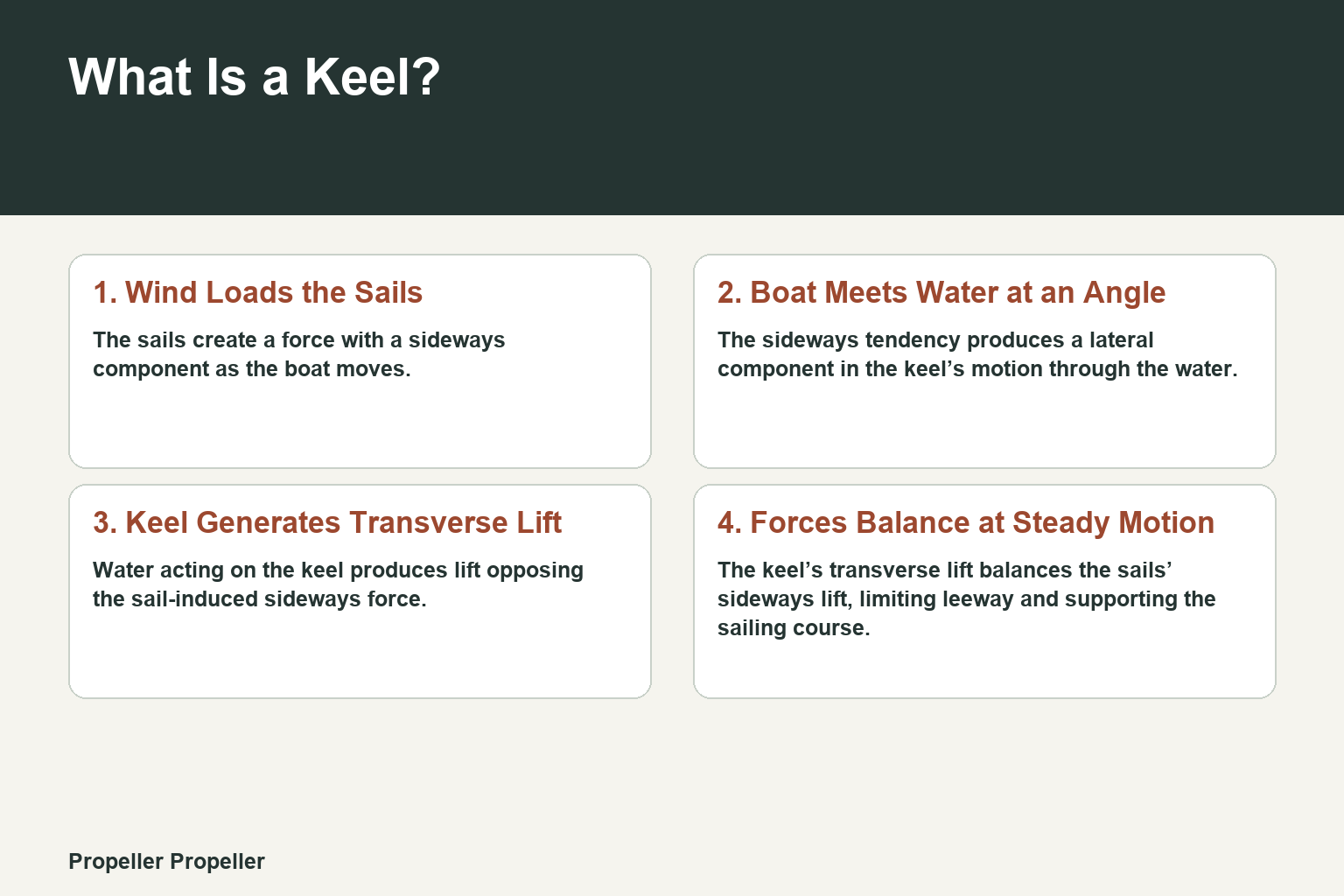
- Wind Loads the SailsThe sails create a force with a sideways component as the boat moves.
- Boat Meets Water at an AngleThe sideways tendency produces a lateral component in the keel’s motion through the water.
- Keel Generates Transverse LiftWater acting on the keel produces lift opposing the sail-induced sideways force.
- Forces Balance at Steady MotionThe keel’s transverse lift balances the sails’ sideways lift, limiting leeway and supporting the sailing course.
At steady speed and direction, transverse lift from the keel balances the sideways lift generated by the sails; the keel does not itself supply the boat’s forward drive.
What a Keel Does on a Sailboat
The working job of a sailing keel is to counter leeway: the sideways movement caused by wind pressure on the sails. At a steady course and speed, the sails’ sideways lift is balanced by transverse lift generated by the keel. This balance lets a sailboat make progress upwind rather than simply being pushed sideways. The keel also establishes the center of lateral resistance, the effective underwater point through which the boat resists sideways motion.
- The sails create both forward drive and a sideways force.
- Water flowing around the keel creates transverse lift opposing that sideways force.
- The resulting balance of forces helps determine how the boat tracks through the water.
| Part | Force or Role | Effect on the Boat |
|---|---|---|
| Sails | Create a sideways force as well as drive | Tend to push the boat sideways while moving it ahead |
| Keel | Generates transverse lift in the water | Balances the sails’ sideways force and resists leeway |
| Combined balance | Relates sail force to underwater resistance | Allows controlled progress on a chosen sailing angle |
Sources: The physics of sailing · Keel – Sailing Glossary | UK Sailmakers
How the Keel Produces Sideways Resistance
A keel works in water much as an underwater foil: when the boat moves ahead with a sideways component to its motion, water acting on the keel produces transverse lift. That lift is directed against the sideways force from the sails. The keel is therefore not a part that propels the boat forward on its own; it is part of the force balance that allows the sail force to be used effectively for forward progress. I find this distinction is the clearest way to understand why a sailboat can sail toward the wind at an angle rather than drifting with it.
Sources: The physics of sailing · Keel – Sailing Glossary | UK Sailmakers
Keel Terminology: Keel, Bilge Keel, and Keelson
Keel-related words describe different parts or arrangements, so they should not be treated as interchangeable. World Sailing’s equipment rules distinguish a keel from a bilge keel, indicating that a boat may have different keel configurations in formal terminology. A keelson is different again: it is a support beam attached to the keel, rather than the keel itself.
- Keel: a keel appendage or arrangement as defined for the boat and context.
- Bilge keel: a separately distinguished keel-related arrangement in sailing rules.
- Keelson: a structural support beam attached to the keel.
| Term | What It Refers To | Key Distinction |
|---|---|---|
| Keel | A keel appendage or arrangement on the boat | Helps provide underwater lateral resistance in sailing |
| Bilge keel | A distinct keel-related arrangement in sailing terminology | Not treated as identical to a keel in formal rules |
| Keelson | A support beam attached to the keel | A structural member, not another name for the keel |
Sources: Part 2 Definitions – Equipment Rules of Sailing 2025-2028 · Boating Safety: Part 1 of 16 – Nautical Terms – UF/IFAS Extension Escambia County
Why the Keel Affects Course Keeping
Because the keel provides underwater sideways resistance, its position is central to how the boat responds to the lateral force from its sails. The center of lateral resistance is the reference point for that resistance. In practical terms, course keeping is not produced by the keel in isolation: it comes from the relationship between the sail force above water and the keel’s opposing force below it.
Sources: The physics of sailing · Keel – Sailing Glossary | UK Sailmakers
A Useful Way to Identify the Part
When someone refers to a sailboat’s keel, they usually mean the underwater fin or appendage involved in resisting leeway and supporting the boat’s sailing balance. If the conversation is about rules, design drawings, or structural members, ask whether the term means a keel, a bilge keel, or a keelson. That one clarification prevents a common mix-up between an underwater appendage and an attached structural support.
Sources: Part 2 Definitions – Equipment Rules of Sailing 2025-2028 · Keel – Sailing Glossary | UK Sailmakers · Boating Safety: Part 1 of 16 – Nautical Terms – UF/IFAS Extension Escambia County
Frequently Asked Questions
Does a keel make a sailboat go forward?
Not directly. The sails provide the driving force, while the keel generates an opposing sideways force in the water. Together, those forces allow useful forward progress, including when sailing upwind at an angle.
What is leeway?
Leeway is the sideways movement of a sailboat caused by the sideways component of wind force on its sails. A keel helps resist that movement.
Why can a sailboat sail toward the wind without moving directly into it?
The boat sails at an angle to the wind. Its sails produce force, and the keel supplies transverse lift that counters the sideways part of that force, allowing a forward component of motion.
Is a keelson another name for a keel?
No. A keelson is a separate support beam attached to the keel. The terms describe different structural parts.
Are bilge keels and a keel the same thing?
They are related terms, but formal sailing rules distinguish a bilge keel from a keel. The intended meaning depends on the boat’s configuration and the context in which the term is used.
Final Thoughts
Think of the keel as the sailboat’s underwater counterforce: it resists sideways drift so the force from the sails can be turned into controlled progress. For precise discussions, distinguish it from a bilge keel and from the separate structural keelson.



