
Types of Boat Motors: Outboard, Inboard, Stern-Drive, and Jet Drive
The main types of boat motors are outboard, inboard, stern-drive, and jet-drive systems. The distinction is chiefly about where the propulsion equipment is installed and how it moves the boat: an outboard is a removable self-contained unit at the transom, while inboard, stern-drive, and jet arrangements place engine or drive components within the boat in different ways.
The word motor is often used broadly, but a boat may be identified by its engine location, its drive arrangement, or both. I find it clearest to separate the engine from the means of propulsion, especially when comparing a conventional propeller setup with a jet pump.
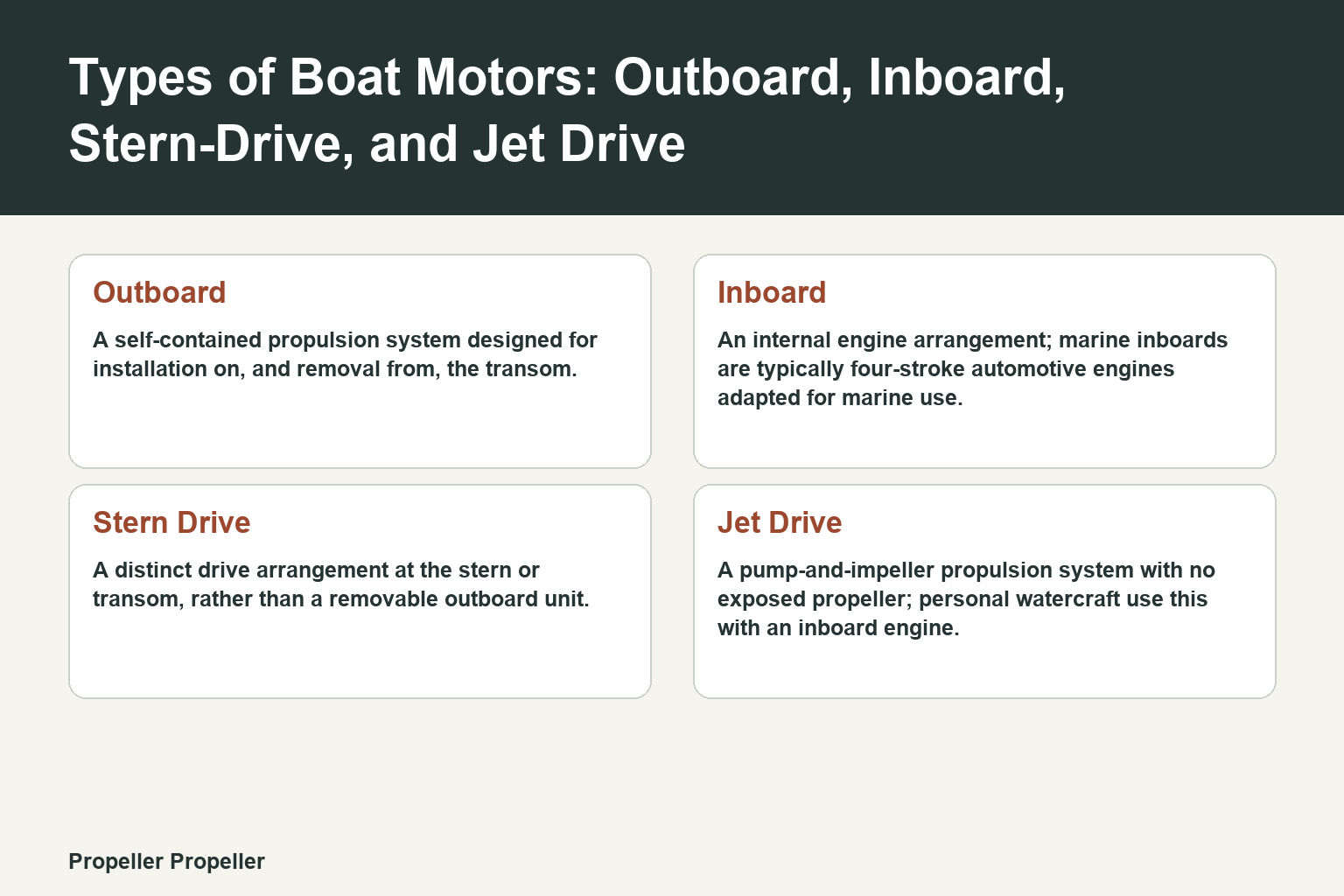
- OutboardA self-contained propulsion system designed for installation on, and removal from, the transom.
- InboardAn internal engine arrangement; marine inboards are typically four-stroke automotive engines adapted for marine use.
- Stern DriveA distinct drive arrangement at the stern or transom, rather than a removable outboard unit.
- Jet DriveA pump-and-impeller propulsion system with no exposed propeller; personal watercraft use this with an inboard engine.
Outboard, inboard, stern-drive, and jet-drive labels describe different engine and propulsion arrangements; a personal watercraft illustrates an inboard engine paired with jet-pump propulsion.
The Four Common Boat Motor Arrangements
Motorboats are commonly described as having outboard, stern-drive, or inboard engines. Jet drive is another propulsion arrangement, using a pump and impeller rather than an exposed propeller. These labels are not interchangeable: some identify a self-contained motor, while others describe how the engine and propulsion system are arranged on the boat.
- Outboard: a self-contained propulsion system mounted at the boat’s transom.
- Inboard: an engine arrangement used within the boat; marine inboards are typically four-stroke automotive engines adapted for marine use.
- Stern-drive: an arrangement associated with the transom that combines an internal engine installation with a drive at the stern.
- Jet drive: a pump-and-impeller propulsion system with no exposed propeller.
| Type | Defining Arrangement | Key Distinction |
|---|---|---|
| Outboard | Self-contained system designed for installation on the transom | Designed to be removable from the transom |
| Inboard | Marine engine arrangement; typically a four-stroke automotive engine adapted for marine use | Describes the engine arrangement rather than a removable transom unit |
| Stern drive | Drive arrangement at the stern or transom | A separate category from an outboard |
| Jet drive | Pump and impeller propel the boat | No exposed propeller |
Sources: III. Engine (motor). Do not overpower your vessel by using a motor with a horsepower rating higher than the maximum stated on the boat’s capacity plate. · Boat Basics – Division of Boating and Ocean Recreation · Code of Federal Regulations, 33 CFR subpart on outboard motor standards
Outboard Motors: Self-Contained Units at the Transom
Federal terminology defines an outboard motor as a self-contained propulsion system designed to be installed on, and removable from, a boat’s transom. That definition is useful because it distinguishes an outboard from an internal engine connected to a separate drive system. Outboards may use local starting controls or remote starting controls; those control terms describe how the motor is operated, not a different propulsion category.
- The transom is the mounting location specified in the regulatory definition.
- Removability is part of the defining concept of an outboard motor.
- Remote and local starting controls are separate control concepts under the outboard standards.
Sources: Code of Federal Regulations, 33 CFR subpart on outboard motor standards
Inboard and Stern-Drive Systems: Do Not Treat Them as the Same Label
Both inboard and stern-drive boats have propulsion equipment that is not simply a removable outboard unit on the transom, but they are described differently. The Corps of Engineers manual characterizes inboard engines as typically four-stroke automotive engines adapted for marine use. It separately depicts stern-drive arrangements at the transom, which is why stern drive should remain its own category rather than being casually called an outboard.
- Inboard refers to an engine arrangement rather than a removable transom-mounted motor.
- Stern drive identifies a stern or transom drive arrangement.
- An engine inside the boat does not automatically make the boat an outboard or a jet boat; the propulsion layout still matters.
Sources: III. Engine (motor). Do not overpower your vessel by using a motor with a horsepower rating higher than the maximum stated on the boat’s capacity plate. · Boat Basics – Division of Boating and Ocean Recreation · Code of Federal Regulations, 33 CFR subpart on outboard motor standards
Jet Drive: Pump Propulsion Instead of an Exposed Propeller
A jet-drive system uses a pump and impeller to create propulsion, rather than an exposed propeller. This is a propulsion-system description, so it can be paired with an inboard engine arrangement. Hawaii’s boating guidance identifies personal watercraft as using an inboard engine with a jet-pump mechanism, making personal watercraft a clear example of why engine type and drive type should be considered together.
- The impeller is part of the pump-based jet-drive system.
- A jet drive has no exposed propeller.
- Personal watercraft are described as combining an inboard engine and a jet pump.
Sources: III. Engine (motor). Do not overpower your vessel by using a motor with a horsepower rating higher than the maximum stated on the boat’s capacity plate. · Boat Basics – Division of Boating and Ocean Recreation
How to Classify a Boat Motor Without Guessing
Start with the physical arrangement, then use the boat’s documentation to confirm the terminology. A removable, self-contained unit designed for the transom is an outboard. A pump-and-impeller system without an exposed propeller is jet drive. For an internal engine and stern-mounted drive arrangement, stern drive is the more precise term. This approach avoids using motor, engine, and drive as if they meant exactly the same thing.
1Identify the propulsion arrangement
Determine whether the boat uses a self-contained transom-mounted unit, a pump-and-impeller system, or an internal engine with a stern-drive arrangement.
2Use the boat’s stated configuration
Check the manufacturer’s description and operating information for the formal engine and drive terminology rather than relying on a casual label.
3Confirm the permitted horsepower
Before changing or replacing an engine, check the boat’s capacity plate. Do not use a motor with horsepower exceeding the maximum shown on that plate.
| What the Description Says | Most Precise Classification | What It Does Not Establish |
|---|---|---|
| Self-contained and removable, designed for the transom | Outboard motor | Whether starting controls are local or remote |
| Pump and impeller, with no exposed propeller | Jet drive | Whether the engine is described separately as inboard |
| Inboard engine with a jet-pump mechanism | Personal watercraft jet-propulsion arrangement | An outboard-motor installation |
| Stern-drive arrangement at the transom | Stern drive | A removable self-contained outboard |
Sources: III. Engine (motor). Do not overpower your vessel by using a motor with a horsepower rating higher than the maximum stated on the boat’s capacity plate. · Code of Federal Regulations, 33 CFR subpart on outboard motor standards
Frequently Asked Questions
Is a stern drive an outboard motor?
No. An outboard is defined as a self-contained propulsion system designed to be installed on and removable from the transom. Stern drive is a separate stern or transom drive arrangement.
Does a jet boat have a propeller?
A jet-drive system uses a pump and impeller and does not have an exposed propeller.
Are personal watercraft powered by outboards?
Hawaii’s boating guidance describes personal watercraft as using an inboard engine with a jet-pump mechanism.
What does remote starting control mean for an outboard?
It is a control concept distinct from local starting control. It describes how the outboard is started, not a separate type of outboard motor.
Can I install any horsepower motor on my boat?
No. The Corps of Engineers boating manual says not to use a motor with a horsepower rating higher than the maximum stated on the boat’s capacity plate.
Final Thoughts
When identifying boat motor types, classify the propulsion layout first: removable transom unit for an outboard, internal engine and stern arrangement for a stern drive, or pump-and-impeller propulsion for a jet drive. Then verify the boat’s documented configuration and capacity-plate limit before making an engine change.



