
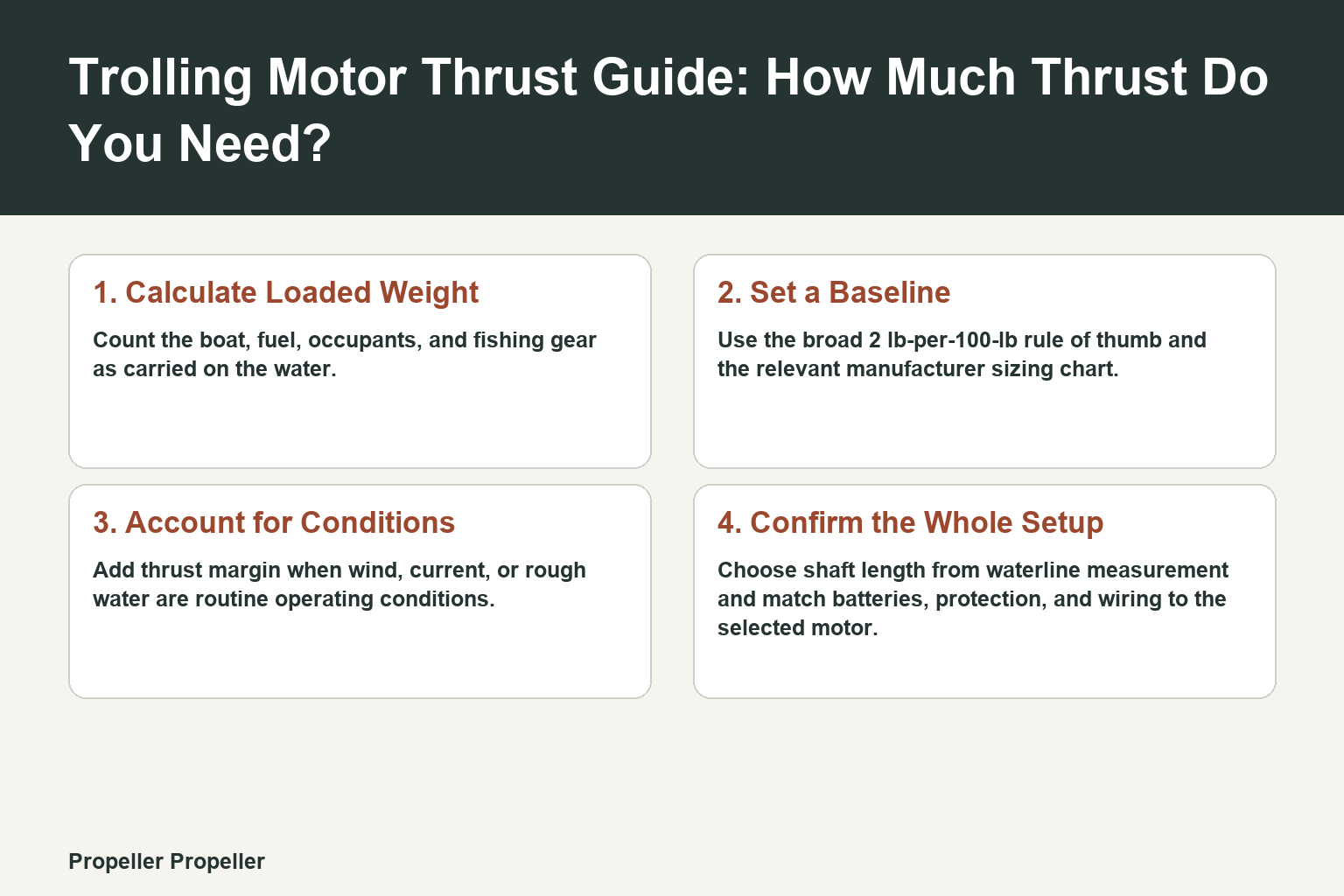
Trolling Motor Thrust Guide: How Much Thrust Do You Need?
Choose trolling-motor thrust from your boat’s fully loaded weight, then allow extra capacity for the wind, current, waves, and loads you actually expect. A common starting rule is about 2 pounds of thrust per 100 pounds of total loaded weight, but it is only a baseline; shaft length, battery system, and wiring must also suit the motor.
The useful distinction is that thrust helps a motor push and hold a boat, while shaft length determines whether the propeller can operate at the right depth. More thrust does not correct an incorrectly sized shaft.
- Calculate Loaded WeightCount the boat, fuel, occupants, and fishing gear as carried on the water.
- Set a BaselineUse the broad 2 lb-per-100-lb rule of thumb and the relevant manufacturer sizing chart.
- Account for ConditionsAdd thrust margin when wind, current, or rough water are routine operating conditions.
- Confirm the Whole SetupChoose shaft length from waterline measurement and match batteries, protection, and wiring to the selected motor.
Thrust starts with loaded weight and operating conditions; shaft length and electrical compatibility are separate checks required for the selected motor.
What Trolling Motor Thrust Tells You
Thrust is the pushing force a trolling motor produces. As loaded boat weight rises, more thrust is generally needed to move and control the boat. Manufacturer selection guidance treats normal lake fishing as the baseline, not a promise that one thrust rating will handle every hull, payload, or weather condition. I would treat a thrust chart as a minimum starting point rather than a target to undershoot.
- Total loaded weight includes the boat, fuel, occupants, and gear.
- Boat length can help with broad selection charts, but weight is central to thrust sizing.
- Wind, current, and rough water can justify moving above a normal-condition recommendation.
Sources: Trolling Motor Selection and Boat Size Guide – Minn Kota · CHOOSE THE RIGHT TROLLING MOTOR FOR THE WAY YOU FISH. – MotorGuide · How to Choose the Right Trolling Motor Size for Your Boat – West Marine
Start With Fully Loaded Weight, Not the Empty Hull
Estimate the boat as it will be used on the water: include fuel, people, fishing gear, and other carried load. MotorGuide’s broad rule of thumb is roughly 2 pounds of thrust for every 100 pounds of that loaded weight. Then compare the result with the applicable manufacturer sizing chart, which may also organize recommendations by boat length and normal operating conditions.
| Selection Input | What to Include or Check | How It Affects the Choice |
|---|---|---|
| Loaded boat weight | Boat, fuel, occupants, and gear | Use it for the initial thrust estimate; a broad starting rule is about 2 lb per 100 lb. |
| Manufacturer chart | Applicable boat-weight and boat-length guidance | Use it to check that the initial estimate meets the maker’s normal-condition recommendation. |
| Typical water conditions | Wind, current, and wave action | Frequent adverse conditions support selecting additional thrust margin. |
Sources: Trolling Motor Selection and Boat Size Guide – Minn Kota · CHOOSE THE RIGHT TROLLING MOTOR FOR THE WAY YOU FISH. – MotorGuide
Build Margin for the Conditions You Fish
A motor that is adequate on a protected lake may feel undersized when it must overcome wind, current, or wave action. These conditions add resistance and can make position control harder, so the selection guidance from both manufacturers and retailers points toward more thrust where adverse conditions are routine. This is a decision about your expected use, not simply the largest number available.
- Use the normal-condition estimate when your boating is mainly calm-water fishing with a typical load.
- Consider additional thrust when stronger wind, current, rough water, or a consistently heavier load is part of normal use.
- Do not use extra thrust as a substitute for selecting the correct shaft length.
Sources: Trolling Motor Selection and Boat Size Guide – Minn Kota · CHOOSE THE RIGHT TROLLING MOTOR FOR THE WAY YOU FISH. – MotorGuide · How to Choose the Right Trolling Motor Size for Your Boat – West Marine
Match Thrust to Shaft Length and Electrical Capacity
Thrust selection affects more than propulsion. A chosen motor has a corresponding electrical demand, and its breaker or fuse rating must be sized for that motor. If wiring is extended beyond the supplied leads, conductor gauge must follow the motor maker’s extension guidance. Separately, measure for shaft length using the waterline-based method specified by the motor manufacturer; thrust alone does not select the shaft.
- Check the motor’s required battery configuration and voltage along with its thrust rating.
- Size circuit protection for the specific trolling motor, not a generic assumed rating.
- Plan wire gauge around the total extension length when the supplied leads are not long enough.
| System Element | Selection Basis | Why It Cannot Be Assumed |
|---|---|---|
| Shaft length | Manufacturer waterline measurement method | Thrust does not determine how deeply the propeller sits. |
| Battery system | The selected motor’s voltage and battery requirements | A thrust choice is tied to the motor’s required power configuration. |
| Breaker or fuse | The specific motor’s electrical guidance | Circuit protection must suit the trolling motor used. |
| Extended wiring | Motor guidance and extension length | Longer-than-supplied leads may require a different conductor gauge. |
Sources: Trolling Motor Selection and Boat Size Guide – Minn Kota · Trolling Motor Wiring and Battery Guide – Minn Kota · How to Choose the Right Trolling Motor Size for Your Boat – West Marine
A Practical Way to Choose Your Thrust Rating
Work from the boat’s real fishing load and regular conditions, then confirm that the candidate motor can be installed with the right shaft and electrical system. This avoids a common mismatch: selecting by one appealing thrust number while overlooking whether the batteries, breaker, wiring, and mounting measurement support that choice. If you are between baseline choices and regularly face adverse water, the guidance supports choosing more thrust rather than less.
Sources: Trolling Motor Selection and Boat Size Guide – Minn Kota · Trolling Motor Wiring and Battery Guide – Minn Kota · CHOOSE THE RIGHT TROLLING MOTOR FOR THE WAY YOU FISH. – MotorGuide · How to Choose the Right Trolling Motor Size for Your Boat – West Marine
Frequently Asked Questions
Does boat length determine trolling motor thrust?
Not by itself. Manufacturer charts may use boat length as part of broad guidance, but total loaded weight is a key factor in thrust selection. Shaft length is a separate waterline-based measurement decision.
Should I count people and gear when sizing thrust?
Yes. The rule-of-thumb calculation is based on total loaded weight, including the boat, fuel, occupants, and gear rather than the empty hull alone.
Should I choose more thrust for river fishing?
Current is one of the conditions that can justify more thrust than a normal-lake baseline. Wind and rough water can create the same need for added margin.
Can a higher-thrust motor use the same wiring as a smaller one?
Do not assume so. Maximum amp draw, circuit protection, battery configuration, and allowable wire size can vary with the motor selected. Match the breaker or fuse and any wire extension to the motor maker’s guidance.
Will more thrust solve a shaft-length problem?
No. More thrust increases pushing force, but it does not establish the correct propeller depth. Select shaft length from the manufacturer’s waterline measurement guidance.
Final Thoughts
Size for the loaded boat and the conditions you routinely face, then verify the shaft measurement and electrical requirements before committing to a motor.



