
An AGM marine battery has to match more than a voltage label. A trolling-motor-only setup needs usable deep-cycle capacity, while an outboard that must start reliably also needs enough cranking output. Group size matters just as much because a battery that does not fit the tray is not a workable upgrade.
These six 12V options divide into a compact 50Ah deep-cycle battery and dual-purpose batteries with capacities from 70Ah to 100Ah. I would begin by confirming your required BCI group size, then decide whether long accessory runtime, engine starting power, or the ability to cover both jobs with one battery is the priority.
Top AGM Marine Batteries on the Market
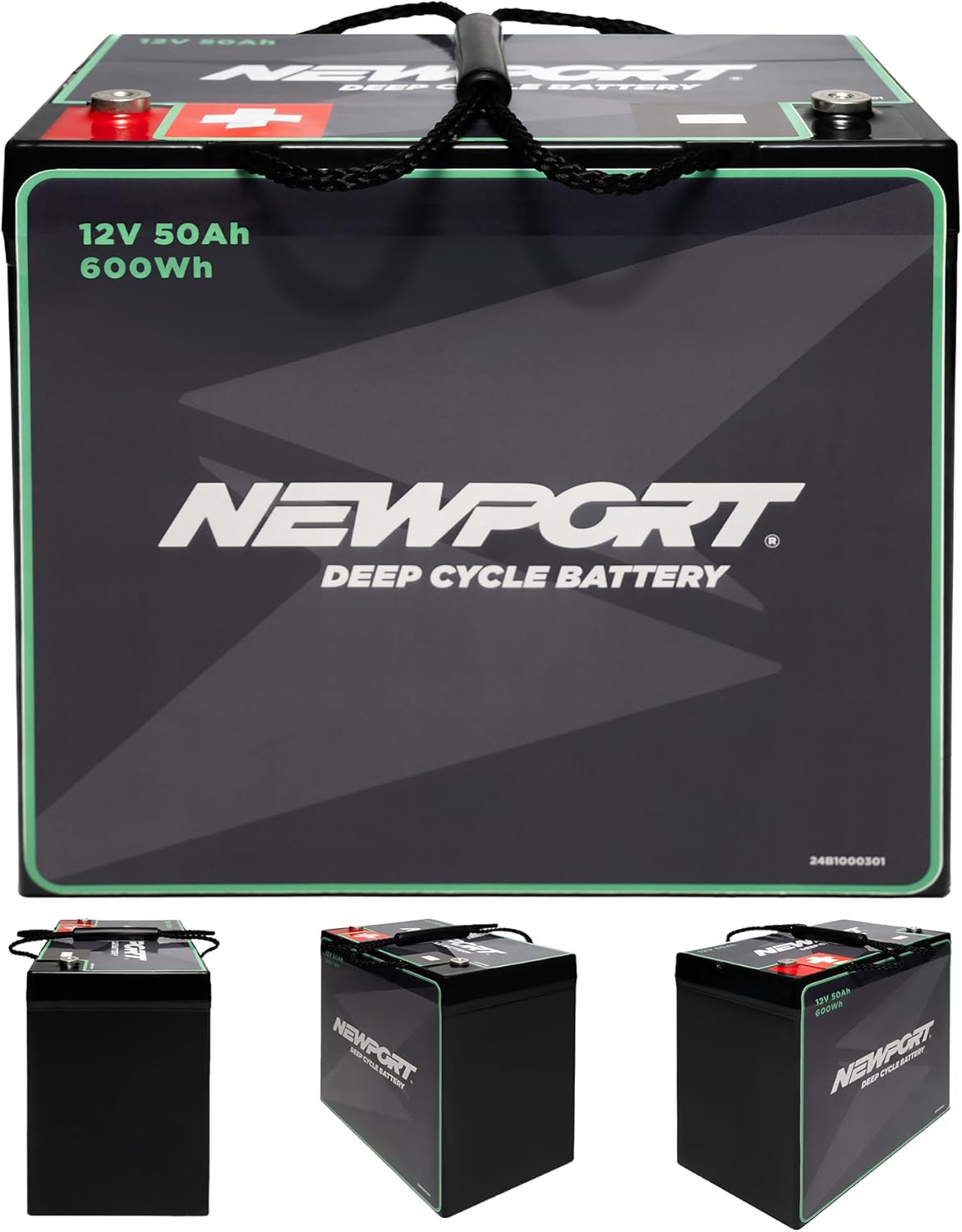
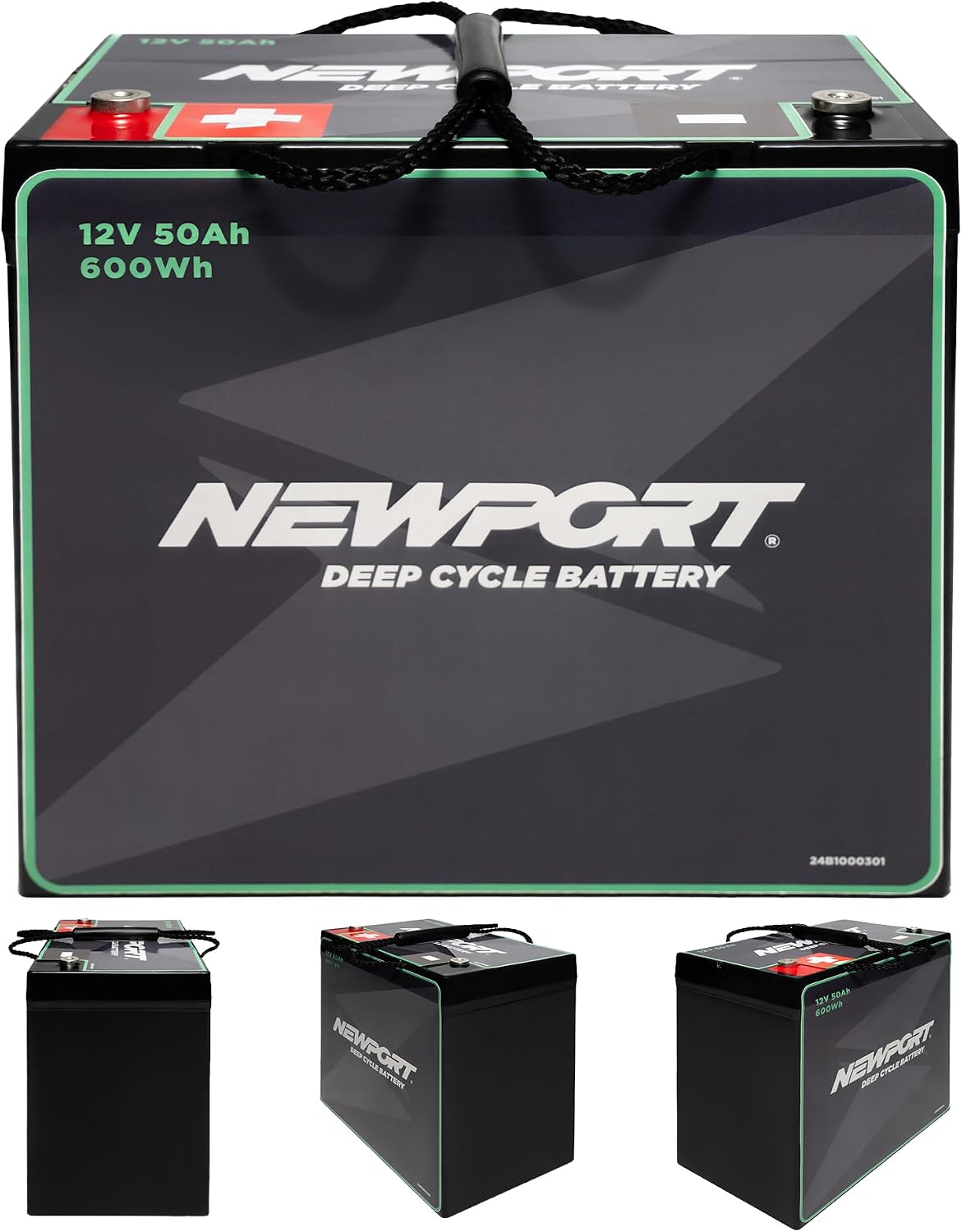
Newport 12V 50Ah Deep Cycle AGM Battery
- 12V 50Ah deep-cycle battery
- Sealed AGM construction
- Designed for trolling motors
- Suitable for small watercraft
- Compatible with 12V electronics

Interstate 100Ah Group 31M AGM
- 12V 100Ah capacity
- 825CCA starting output
- Group 31M fitment
- Dual-purpose AGM design
- For marine and RV use
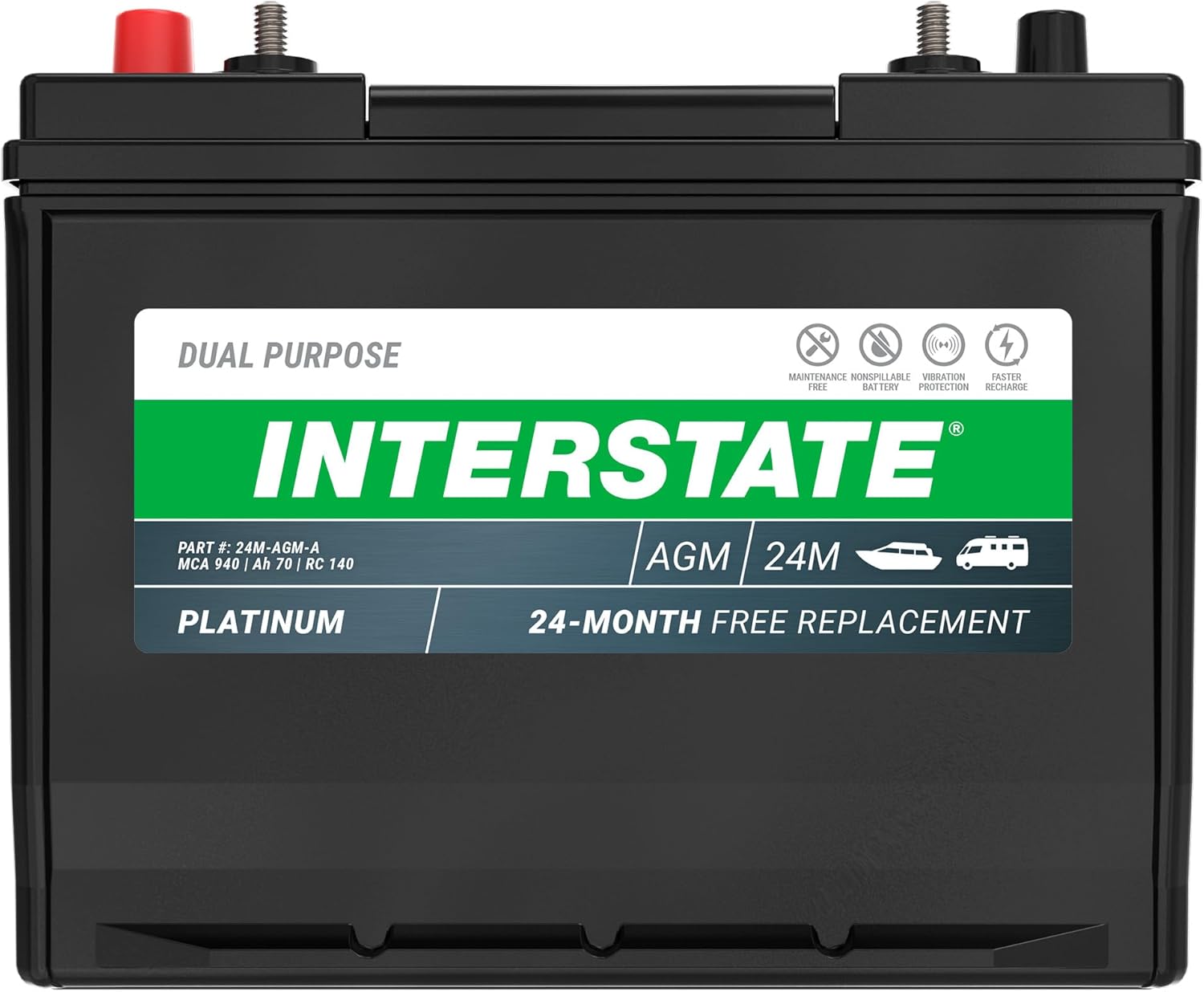
Interstate 70Ah Group 24 AGM
- 12V 70Ah capacity
- 750CCA starting output
- Group 24 fitment
- Dual-purpose AGM design
- For marine and RV use

Mighty Max MM-G24M 90Ah AGM
- 12V 90Ah capacity
- 550 CCA starting output
- 700 MCA marine rating
- 145 RC reserve capacity
- Group Size 24M
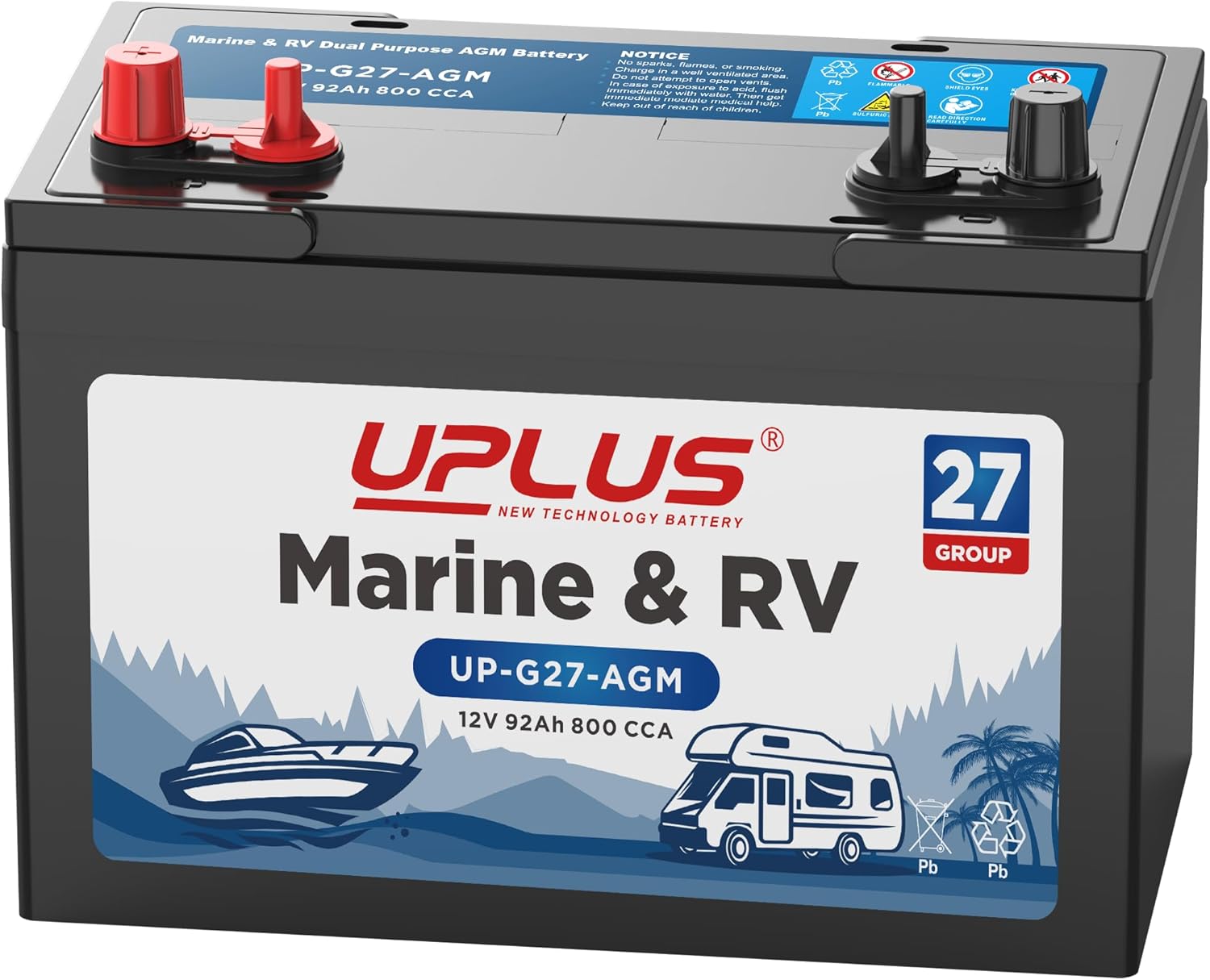
UPLUS Group 27M 92Ah AGM
- 12V 92Ah capacity
- 800CCA starting output
- 175RC reserve capacity
- Group 27M fitment
- Dual-purpose battery design
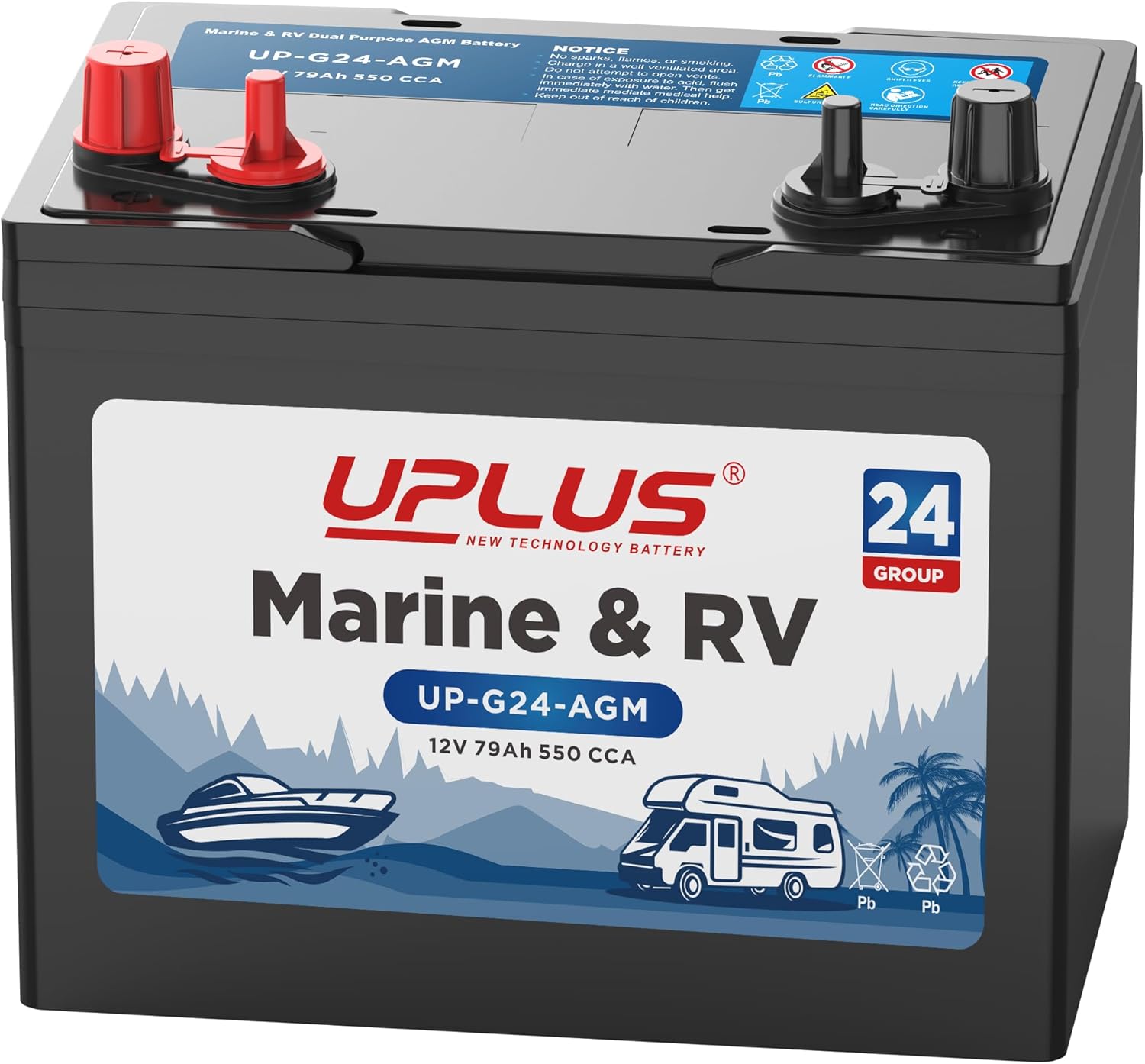
UPLUS Group 24M 79AH AGM
- 12V 79AH capacity
- 550CCA starting output
- 150RC reserve capacity
- Group 24M fitment
- Dual-purpose battery design
Detailed Product Reviews
Newport 12V 50Ah Deep Cycle AGM Battery
- Voltage
- 12V
- Capacity
- 50Ah
- AGM Construction
- AGM
- Battery Type
- Deep Cycle
Advantages
- 50Ah deep-cycle capacity
- Sealed AGM construction
- Designed for 12V trolling motors
- Suited to kayaks and small boats
- Can power compatible 12V electronics
Limitations
- Not presented as a starting battery
- Lower capacity than dual-purpose options
I would choose the Newport 12V 50Ah Deep Cycle AGM Battery for a kayak, inflatable, jon boat, or other small craft that needs a dedicated source for a trolling motor or 12V electronics. Its 50Ah capacity places the focus on a manageable deep-cycle power source rather than on cranking an engine. That is a sensible match for an electric-only setup where carrying the battery from vehicle to launch is part of the routine.
The sealed AGM construction is relevant for regular marine use because it creates a sealed, low-maintenance lead-acid battery arrangement. Newport identifies this model as a deep-cycle battery, so it is intended to supply power over time rather than serve as a dual-purpose starter battery. Confirm that your electronics and motor are 12V, and plan runtime around the actual draw of the equipment rather than treating 50Ah as a fixed number of hours on the water.
Against the Interstate Batteries 12V 70Ah Group 24 AGM, the Newport has less stated capacity but is specifically positioned for compact small-watercraft use. Pick the Newport when a dedicated 12V trolling-motor battery is the job. Choose the Interstate instead when the boat requires a Group 24 dual-purpose battery with both stated starting output and greater capacity.
Interstate 100Ah Group 31M AGM
- Voltage
- 12V
- Capacity
- 100Ah
- Cold Cranking Amps
- 825CCA
- Group Size
- Group 31M
- AGM Construction
- AGM
Advantages
- 100Ah stated capacity
- 825CCA starting output
- Group 31M fitment
- Dual-purpose marine and RV design
- AGM construction
Limitations
- Requires a Group 31M-compatible tray
The Interstate Batteries 12V 100Ah Group 31M AGM is the selection for a boat or RV that needs one battery to cover engine starting and deep-cycle loads. Its 100Ah capacity is the largest stated capacity here, while 825CCA addresses the separate demand of starting an engine. That combination makes more sense for a system with accessories alongside a motor than for a simple trolling-motor-only installation.
This is a Group 31M battery, so tray fit and hold-down compatibility should be confirmed before ordering. Interstate describes it as a dual-purpose pure-lead AGM battery for cranking and repeated discharge. The brand also states an expected service-life comparison with conventional alloy AGM and flooded batteries, but service life in any installation still depends on charging practice, discharge depth, temperature, and electrical load.
The UPLUS Group 27M 92Ah is the closer alternative when you want dual-purpose operation but require a Group 27M battery. The Interstate brings higher stated capacity and CCA, but its Group 31M designation may not fit a Group 27M tray. I would select this Interstate only after confirming that Group 31M is the required physical fit.
Interstate 70Ah Group 24 AGM
- Voltage
- 12V
- Capacity
- 70Ah
- Cold Cranking Amps
- 750CCA
- Group Size
- Group 24
- AGM Construction
- AGM
Advantages
- 750CCA stated output
- 70Ah stated capacity
- Group 24 fitment
- Dual-purpose battery design
- AGM construction
Limitations
- Requires Group 24 compatibility
- Less stated capacity than 79Ah Group 24M alternative
The Interstate Batteries 12V 70Ah Group 24 AGM is aimed at a Group 24 boat or RV battery compartment where one battery must start the motor and support onboard loads. It pairs 70Ah capacity with 750CCA, making it a dual-purpose choice rather than a dedicated house or trolling-motor battery. That is useful when tray space or wiring simplicity rules out separate starting and deep-cycle batteries.
The Group 24 designation is the first compatibility check, since it must match the battery tray and securing hardware. Interstate describes the battery as pure-lead AGM with thick plates and as suitable for repeated recharge cycles. Its dual-purpose role does not remove the need to consider the draw of lights, pumps, appliances, and other connected equipment when planning a trip.
Compared with the UPLUS Group 24M 79AH 550CCA, this Interstate has lower stated capacity but higher stated CCA. Both are dual-purpose Group 24-family choices, so the better option depends on the exact group-size fit required and whether your system places more value on the listed starting figure or the listed amp-hour capacity. Verify the precise tray specification instead of assuming Group 24 and Group 24M are interchangeable.
Mighty Max MM-G24M 90Ah AGM
- Voltage
- 12V
- Capacity
- 90Ah
- Cold Cranking Amps
- 550 CCA
- Group Size
- Group Size 24M
- Reserve Capacity
- 145 RC
Advantages
- 90Ah stated capacity
- 145 RC reserve capacity
- 550 CCA starting output
- 700 MCA marine rating
- Published dimensions and weight
Limitations
- Requires Group 24M compatibility
- 52.20-pound listed weight
The Mighty Max MM-G24M is worth considering when a Group 24M installation needs more stated deep-cycle capacity than the 79AH UPLUS Group 24M provides. It combines 90Ah capacity with dual-purpose starting and deep-discharge positioning. The stated 145 RC reserve capacity also gives buyers another runtime-related figure to compare, provided they understand reserve capacity is measured under a defined discharge condition rather than being a direct prediction of their boat’s runtime.
For fit planning, Mighty Max lists dimensions of 10.25 x 6.63 x 8.63 inches, a total height of 9.38 inches, and a weight of 52.20 pounds. The battery is described as maintenance-free and spill-proof, with an ABS shell. Those details matter when checking enclosure clearance, the hold-down arrangement, and whether the battery can be safely handled during installation.
The UPLUS Group 24M has the same stated group family but lists 79AH, 550CCA, and 150RC. Mighty Max lists more capacity, while UPLUS lists slightly more reserve capacity. I would favor Mighty Max for the higher stated amp-hour figure and its published dimensions. Choose the UPLUS when its stated 150RC better matches the comparison figure you prioritize and the exact Group 24M fit is confirmed.
UPLUS Group 27M 92Ah AGM
- Voltage
- 12V
- Capacity
- 92Ah
- Cold Cranking Amps
- 800CCA
- Group Size
- Group 27M
- Reserve Capacity
- 175RC
Advantages
- 92Ah stated capacity
- 800CCA starting output
- 175RC reserve capacity
- Group 27M fitment
- Dual-purpose battery design
Limitations
- Requires Group 27M-compatible tray
- Engine compatibility still needs confirmation
I would select the UPLUS Group 27M when a boat is built around a Group 27M battery tray and needs a single dual-purpose battery. It brings 92Ah capacity, 800CCA, and a 175RC rating to a combined starting and deep-cycle role. UPLUS states that it is intended for engines from 70 to 350hp, but matching the battery to the engine manufacturer’s requirements remains essential.
A dual-purpose battery can simplify an electrical system by combining starter and deep-cycle functions in one unit. UPLUS also describes AGM construction and vibration resistance for wave pounding and trailer transport. Those are useful design aims for marine installation, but correct mounting and a compatible charging system still matter. The 175RC figure can help compare the model with other batteries that publish reserve capacity under the same rating convention.
The Interstate 100Ah Group 31M AGM lists greater capacity and CCA, but it is a different Group 31M size. The UPLUS is the better buy when Group 27M is the required tray size and you need a listed 800CCA output. Move to the Interstate only if the boat accepts Group 31M and the extra listed capacity is more important than retaining Group 27M fitment.
UPLUS Group 24M 79AH AGM
- Voltage
- 12V
- Capacity
- 79AH
- Cold Cranking Amps
- 550CCA
- Group Size
- Group 24M
- Reserve Capacity
- 150RC
Advantages
- 79AH stated capacity
- 550CCA starting output
- 150RC reserve capacity
- Group 24M fitment
- Dual-purpose battery design
Limitations
- Requires Group 24M compatibility
- Lower stated capacity than Mighty Max 24M
The UPLUS Group 24M is a targeted option for a boat that requires Group 24M fitment and needs one battery for starting plus marine electrical loads. It lists 79AH capacity, 550CCA, and 150RC reserve capacity. That makes it a reasonable starting point for a system where fitting the correct group size is non-negotiable and separate batteries are not desired.
UPLUS presents this as a 12V dual-purpose AGM battery for engines from 70 to 350hp. Its sealed AGM design is described as vibration resistant, while the dual-purpose format is intended to reduce the need for two separate units. Check the engine manual, battery tray, cable reach, terminal layout, and charging equipment before treating any one battery as a direct replacement.
The Mighty Max MM-G24M is the most relevant comparison because it is also designated Group 24M and lists the same 550 CCA. Mighty Max lists 90Ah and 145 RC, whereas UPLUS lists 79AH and 150RC. Choose UPLUS when its higher stated reserve-capacity figure is the deciding comparison and Group 24M fit is confirmed. Choose Mighty Max when its higher stated amp-hour capacity better suits the planned electrical load.
How to Choose an AGM Marine Battery
Start with the battery compartment and the jobs the battery must perform. A 12V AGM battery can be a dedicated deep-cycle source or a dual-purpose battery, but neither label substitutes for confirming fitment, starting requirements, and the electrical demands of the boat or RV.
Match the Group Size
BCI group size is a fitment specification, not a performance ranking. Match the required group size to the existing tray, hold-down, cable reach, and available clearance. Do not assume similar labels such as Group 24 and Group 24M fit identically. If the vessel manual specifies a group size, treat that as the starting point for the purchase.
Choose Battery Role
Dedicated deep-cycle batteries are intended to supply power over time for loads such as a trolling motor or compatible electronics. Dual-purpose batteries combine a starting role with deep-cycle use. A dual-purpose design can reduce the number of batteries in a simple system, while a dedicated deep-cycle battery can suit an electric-only or accessory-focused setup.
Compare Capacity
Amp-hour capacity is a useful way to compare batteries of the same voltage, but it does not guarantee a certain number of hours underway. Runtime changes with the current draw, speed setting, connected loads, wiring, temperature, and battery condition. Estimate the loads you actually run together, then leave a practical charging margin instead of planning to exhaust the battery.
Check Starting Ratings
For a battery that will start an engine, compare the required cranking output with the battery’s stated CCA or marine cranking rating. These ratings describe starting capability under specified conditions, while amp-hours describe stored capacity. A larger capacity figure does not automatically make a battery the right engine-starting choice, so follow the engine manufacturer’s battery guidance.
Use Reserve Capacity Carefully
Reserve capacity is often useful when comparing dual-purpose batteries because it measures how long a battery can supply a standardized load before reaching a specified voltage. It is not interchangeable with amp-hours, and it is not a personalized runtime guarantee. Compare RC figures only when they are stated for the models under consideration, then account for your own electrical draw.
Plan Charging and Mounting
AGM batteries are sealed lead-acid batteries, but they still need an appropriate charging system and secure marine mounting. Verify charger compatibility, inspect cable condition, and ensure the battery is restrained for boat movement and trailer transport. Protect terminal connections from accidental contact and follow the vessel, engine, battery, and charger instructions for installation and charging.
AGM Marine Battery Comparison Table
| Product | Best For | Capacity | Starting Output | Group Size | Reserve Capacity | Voltage |
|---|---|---|---|---|---|---|
| Newport 12V 50Ah Deep Cycle AGM Battery | For Small Watercraft | 50Ah | Not Specified | Not Specified | Not Specified | 12V |
| Interstate 100Ah Group 31M AGM | For Group 31M Capacity | 100Ah | 825CCA | Group 31M | Not Specified | 12V |
| Interstate 70Ah Group 24 AGM | For Group 24 Starting | 70Ah | 750CCA | Group 24 | Not Specified | 12V |
| Mighty Max MM-G24M 90Ah AGM | For Reserve Capacity | 90Ah | 550 CCA | Group Size 24M | 145 RC | 12V |
| UPLUS Group 27M 92Ah AGM | For Group 27M Boats | 92Ah | 800CCA | Group 27M | 175RC | 12V |
| UPLUS Group 24M 79AH AGM | For Group 24M Fit | 79AH | 550CCA | Group 24M | 150RC | 12V |
How We Evaluated AGM Marine Batteries
I compared these batteries by their stated voltage, capacity, group size, starting output, reserve capacity where published, and whether they are presented as deep-cycle or dual-purpose designs. Fitment and intended electrical role carried more weight than broad marketing claims because a battery must first fit the tray and satisfy the boat’s starting and onboard-power demands. Recommendations distinguish stated specifications rather than assume real-world runtime, durability, or starting performance.
Frequently Asked Questions
What is the difference between a deep-cycle and dual-purpose marine battery?
A deep-cycle battery is intended to deliver power over time for loads such as trolling motors and electronics. A dual-purpose battery is intended to provide both engine starting power and deep-cycle support. The right choice depends on whether one battery must perform both roles.
Can I replace a Group 24 battery with a Group 27 battery?
Only if the battery compartment, hold-down, cable reach, and vessel guidance allow it. Group designations relate to physical fitment, so moving to another group size can create installation problems even when both batteries are 12V.
How do amp-hours affect trolling-motor runtime?
Amp-hours provide a capacity comparison at a stated test rate. Actual runtime depends on the trolling motor’s current draw, speed setting, connected electronics, wiring, temperature, and battery condition. Use your motor’s draw information to estimate runtime rather than relying on capacity alone.
What do CCA and MCA mean on a marine battery?
CCA is cold cranking amps, a standardized starting-output rating at a cold temperature. MCA is marine cranking amps, a marine starting rating measured under a different temperature condition. For engine starting, compare the applicable rating with the engine manufacturer’s battery requirement.
Does a sealed AGM battery need maintenance?
A sealed AGM battery does not require adding water like a conventional serviceable flooded battery. It still needs correct charging, clean and secure terminal connections, periodic inspection, and proper mounting. Follow the battery and charger instructions for care and charging limits.
Can one dual-purpose battery replace separate starting and house batteries?
It can simplify a modest system when its stated capacity and starting output meet the boat’s requirements. Larger accessory loads or extended time away from charging may call for separate starting and house banks. Evaluate the full electrical load and the engine’s specified starting requirement first.
Final Thoughts
My main recommendation is to choose by confirmed group size before comparing the larger capacity and cranking numbers. For a dedicated small-craft trolling setup, the Newport 50Ah is the focused deep-cycle choice. For a Group 31M dual-purpose installation, the Interstate 100Ah combines the highest stated capacity here with 825CCA. Boats requiring Group 27M or Group 24M should stay within those fitment families and select between the published capacity, cranking, and reserve-capacity figures that suit their electrical plan.



