
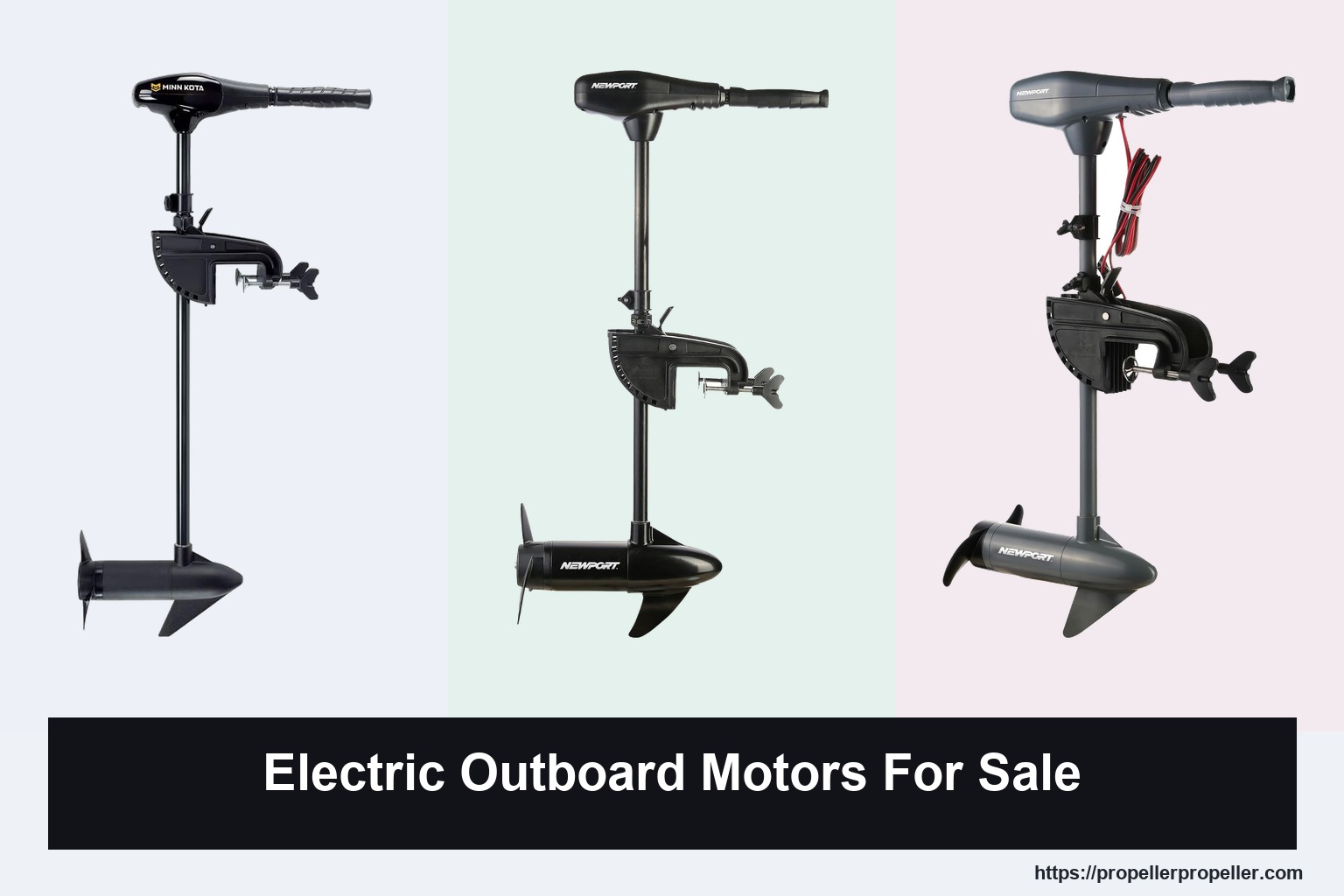
Choosing an electric outboard is really about matching thrust, shaft length, control style, and battery demands to the boat you actually run. A motor that feels perfect on a kayak can be underwhelming on a heavier transom boat, while a GPS bow mount can be far more control than a casual angler needs. The best option is the one that fits your hull, your fishing style, and how much effort you want to spend steering, deploying, and managing runtime.
This roundup focuses on practical differences that matter on the water. Some motors emphasize simple transom-mount control and lighter weight. Others add saltwater materials, battery meters, or speed settings that make longer days easier to manage. One model stands out for advanced GPS control, while the budget end of the group keeps the category accessible. The point is not just to compare thrust numbers, but to identify which design makes the most sense for your boat and your use case.
Top Electric Outboard Motors For Sale on the Market

Minn Kota Endura C2 30 lb Thrust Motor
- 30 lb thrust
- 30-inch shaft
- 12-volt power
- Telescoping tiller
- Freshwater use

Newport NV-Series 55 lb Saltwater Motor
- 55 lb thrust
- 30-inch shaft
- LED battery meter
- 8 total speeds
- Saltwater ready

Newport Kayak Series 36 lb Motor
- 36 lb thrust
- 24-inch fiberglass shaft
- 8 total speeds
- Saltwater rated
- 5’6 battery cables

Minn Kota Terrova 55 lb GPS Motor
- GPS trolling system
- Spot-Lock positioning
- 54-inch shaft
- Wireless remote
- Bow mount

PEXMOR 26 lb 8-Speed Motor
- 26 lb thrust
- 8 speed control
- LED battery indicator
- Adjustable handle
- Transom mount
This article may contain affiliate links. As an Amazon Associate, the website may earn from qualifying purchases at no additional cost to you.
Electric Outboard Motors For Sale Reviews
Minn Kota Endura C2 30 lb Thrust Motor
- Voltage
- 12 volts
- Mounting Type
- Transom Mount
- Item Weight
- 17 pounds
- Manufacturer Warranty Description
- 2 year Manufacturer
- Recommended Uses For Product
- For Inflatable Boats
Advantages
- Light 17-pound build
- Five forward speeds
- Three reverse speeds
- Composite shaft durability
- Vegetation-ready power prop
Limitations
- Freshwater use only
- No advanced steering automation
The Endura C2 is the most approachable choice here for a small boat or inflatable setup that needs simple propulsion without a steep learning curve. Its 30 lb. Thrust and 30-inch shaft pair well with compact hulls, and the transom mount format keeps the install straightforward. The 12-volt setup and 17-pound weight also matter because they make the motor easier to move, store, and mount than bulkier options in this lineup. For anglers who want basic control and low fuss, that combination is exactly the point.
Operation is intentionally uncomplicated. Five forward speeds and three reverse speeds give you enough range to fine-tune trolling pace or back out of tight spots, and the 6-inch telescoping tiller improves comfort when you are seated for long stretches. The push-to-test battery meter is a useful reality check before you commit to a longer run. The composite bracket and indestructible composite shaft are the durability story here, while the power prop is a practical advantage in heavier vegetation. The limitation is clear too. This is a freshwater motor, so buyers who need saltwater protection should look elsewhere.
Against the rest of the group, the Endura C2 trades raw capability and automation for simplicity and value. It does not try to solve navigation or long-range boat control, but that restraint keeps the package light, affordable, and easy to understand. That makes it the strongest fit for smaller freshwater boats, backup use, or anyone who wants dependable transom-mounted thrust without spending on features they will not use. If you care more about getting on the water quickly than about advanced controls, this is the one to start with.
PHOTO: Minn Kota Endura C2 – Trolling Motor → Source: Amazon.com
Newport NV-Series 55 lb Saltwater Motor
- Voltage
- 12 volts
- Mounting Type
- Transom Mount
- Item Weight
- 23.2 pounds
- Recommended Uses For Product
- For Salt Water
Advantages
- 55 lb thrust
- Saltwater-ready build
- Five forward speeds
- Three reverse speeds
- LED battery meter
Limitations
- Battery sold separately
- Heavier than compact models
This motor is aimed at boaters who need more push and saltwater-ready construction without jumping to an expensive GPS platform. The 55 lb. Thrust gives it noticeably more authority than the lighter motors in this group, and the 30-inch shaft keeps it in a familiar transom-mount format. The 12-volt design is straightforward, but the real appeal is the balance of power and efficiency for steady trolling. That makes it a good match for anglers who want stronger low-speed control on a saltwater boat without overcomplicating the setup.
The practical hardware here is well chosen. A 5-LED battery meter helps you keep track of runtime, and the 6-inch telescoping tiller makes steering more comfortable when you are making repeated course corrections. Eight speeds, split into five forward and three reverse, give you finer control than a basic two-speed motor. The 3-blade prop is also a meaningful detail because it is intended to improve low-end torque. The tradeoff is that the motor depends on a separate deep-cycle battery, and the 52-amp maximum draw means battery planning matters.
Compared with the lighter freshwater options, this Newport adds more thrust and corrosion-minded versatility. Compared with the GPS-equipped motor in this group, it stays much simpler and far less expensive while still addressing serious saltwater use. That makes it the best fit for anglers who need dependable transom-mounted performance, want a visible battery readout, and do not need automated positioning or remote steering. If your priority is usable power in a broad set of boating conditions, this model deserves a close look.
PHOTO: Newport NV-Series 55 lb – Transom-Mount Motor → Source: Amazon.com
Newport Kayak Series 36 lb Motor
- Voltage
- 12 volts
- Mounting Type
- Transom Mount
- Item Weight
- 20 pounds
- Recommended Uses For Product
- For Salt Water
Advantages
- 24-inch fiberglass shaft
- Saltwater-rated hardware
- Five forward speeds
- Three reverse speeds
- Long battery cables
Limitations
- Battery not included
- Less thrust than larger motors
The Kayak Series is built for a very specific job, and that focus is what makes it compelling. Its 24-inch fiberglass shaft is shorter than the shafts on the transom motors in this roundup, which matters when you are trying to set the prop at the right depth on a kayak. The 36 lb. Thrust level sits in a useful middle ground for small craft, giving you more authority than ultra-light motors without pushing into the bulk of a heavier platform. For kayak anglers, that is a practical balance rather than an abstract spec.
The rest of the design reinforces that use case. Eight speeds, split between five forward and three reverse, make it easier to hold position or nudge around obstacles. The 6-inch telescoping handle improves comfort, and the 5’6″ battery cables create useful freedom when positioning the battery for better trim and weight distribution. Saltwater-rated hardware matters here too, because the motor is built with an aluminum head and corrosion-resistant components. The limitation is that the battery is not included, so you need to plan the power system separately.
This model occupies a narrower niche than the broader transom-mount choices above, but that is exactly why it stands out. It gives kayak and canoe users a more tailored shaft length and more flexible battery placement than a general-purpose motor. It also stays simpler and more affordable than the GPS bow-mount option, which would be overkill for most small-craft owners. If you need a kayak-specific saltwater motor with enough control to make close-quarters fishing easier, this is the most focused option in the set.
PHOTO: Newport Kayak Series 36 – Transom-Mount Motor → Source: Amazon.com
Minn Kota Terrova 55 lb GPS Motor
- Voltage
- 12 volts
- Mounting Type
- Bow Mount
- Item Weight
- 48.8 pounds
- Recommended Uses For Product
- Freshwater
Advantages
- GPS trolling system
- Spot-Lock control
- Wireless remote included
- One-touch deploy and stow
- Digital Maximizer
Limitations
- Highest price
- Heavy for transport
The Terrova is the most sophisticated motor in this lineup and the best choice for boaters who care about precise positioning more than simple propulsion. Its GPS trolling system and Spot-Lock change the job description entirely, because the motor can hold a position instead of asking you to constantly feather the tiller. The 55 lb. Thrust and 54-inch shaft suit a larger freshwater boat, and the bow-mount layout is what makes the navigation features especially valuable. This is the model for people who want control, not just movement.
The operating experience is defined by convenience features that reduce effort over a long day. The wireless remote with LCD screen supports hands-free control, and the one-touch deploy and stow lever makes getting the motor in and out of the water much easier. Drift mode, follow mode, and dodge mode expand how the motor behaves in changing conditions, while Digital Maximizer technology is aimed at stretching runtime. The tradeoff is size and weight. At 48.8 pounds, it is far less portable than the transom models, and it is clearly built around a different style of boat.
Against the other four motors, the Terrova is the clear premium choice. It costs far more, but it replaces manual course management with automated positioning and remote control, which can be worth it on long freshwater trips or when precise boat placement matters. The stronger shaft length and bow-mount format also place it in a different class from the kayak and transom options. If your priority is staying on target with minimal effort and you are willing to pay for that capability, this is the decisive recommendation.
PHOTO: Minn Kota Terrova 55 – Bow-Mount Motor with Remote → Source: Amazon.com
PEXMOR 26 lb 8-Speed Motor
- Mounting Type
- Transom Mount
- Manufacturer Warranty Description
- 180 day warranty
- Color
- Grey
- Material Type
- Aluminum
Advantages
- Low entry price
- Eight speed settings
- LED battery indicator
- Adjustable depth and angle
- Three-blade prop
Limitations
- Short 180-day warranty
- Least powerful in group
PEXMOR keeps the entry price low while still covering the basics that matter most on a small boat. The 26 lb. Thrust output and 12-volt electric setup are aimed at light-duty use, and the 8-speed control gives you more pace adjustment than a bare-bones motor. The LED battery indicator is also useful because it reduces guesswork about remaining charge. For anglers or casual boaters who want an inexpensive way to move around a kayak or small fishing boat, that combination is easy to understand and easy to justify.
The motor adds a few convenience features that improve day-to-day use. The 6-inch telescoping adjustable handle changes how you stand or sit at the controls, and the adjustable shaft angle and depth let you adapt to changing water conditions. The three-bladed prop is intended to improve motivation and help with weed clearance. Those are useful details for a budget motor, but the 180-day warranty is a notable limitation compared with the longer coverage on several other models in this roundup. That shorter protection window matters if you expect frequent use.
Relative to the other selections, this is the least specialized motor and the one most focused on affordability. It does not match the power of the 55 lb. Class motors, and it lacks the premium navigation features of the GPS model, but it covers the essentials at a lower cost. That makes it best for shoppers who need an entry-level transom motor and can live with shorter warranty coverage. If your goal is to spend as little as possible while still getting adjustable control and battery feedback, this is the right compromise.
PHOTO: PEXMOR 26 lb 8-Speed – Trolling Motor → Source: Amazon.com
How to Choose Electric Outboard Motors
The right electric outboard is less about choosing the strongest motor and more about matching the motor to the boat, water, and control style you actually need. Shaft length, thrust, mounting style, and battery requirements all affect how the motor behaves once it is on the transom or bow. A lightweight motor may be easier to handle every day, while a more advanced system can save effort over long runs. The best purchase is the one that solves your real boating problem without adding unnecessary complexity.
Thrust and Boat Size
Thrust determines how much authority you have when wind, current, or load starts working against the boat. A small tender, inflatable, or kayak can often do well with a lighter motor, while heavier hulls need more push to keep speed and steering predictable. The important part is not chasing the biggest number. It is avoiding a motor that feels underpowered once gear, passengers, and conditions are added to the equation.
Shaft Length Matters
Shaft length affects where the prop sits in the water, and that changes both efficiency and control. If the shaft is too short, the prop can ventilate or lose bite in chop. If it is too long for the hull, the motor can be awkward and harder to trim properly. Kayaks and low-freeboard boats usually need shorter shafts than larger transom boats, so measuring the mounting height before you buy is one of the most useful steps you can take.
Mounting Style Choices
Transom mounts are simple and familiar. They are usually the easiest to install and remove, which makes them a strong fit for small boats and casual outings. Bow mounts suit anglers who want finer steering control and better boat positioning, especially when fishing spot to spot. The right mount depends on how you move on the water. If you spend your day making short corrections, the steering layout matters as much as the thrust rating.
Battery and Runtime
Electric outboards are only as useful as the battery system behind them. Voltage, amp draw, and battery type all affect how long you can run before recharge. A battery meter can help you avoid being surprised mid-trip, but it does not replace planning. If you expect long days or strong current, it is worth thinking about runtime before you think about top-end thrust. A motor that sips power can be more valuable than one that looks impressive on paper.
Controls and Features
Simple motors usually rely on a tiller handle and speed settings, while more advanced options add remote control, GPS, or automatic positioning. You should decide whether you want basic movement or precise boat management. Features like telescoping handles, deploy-and-stow levers, and battery indicators may seem secondary, but they directly affect fatigue and convenience. Over a long day, those details often matter more than a small difference in raw thrust.
Saltwater Durability
Saltwater use changes the buying decision because corrosion resistance becomes part of the purchase, not an afterthought. Materials, hardware, and the manufacturer’s intended use all matter when the motor will regularly see brackish or salt exposure. A freshwater-only motor can still be excellent value, but only if you keep it in the right environment. If your boating is mixed or coastal, it is usually smarter to pay attention to corrosion-focused construction from the start.
Electric Outboard Comparison Table
| Product | Best For | Thrust | Mount Type | Voltage | Weight | Warranty |
|---|---|---|---|---|---|---|
| Minn Kota Endura C2 30 lb Thrust Motor | Best Lightweight Starter | 30 hp | Transom Mount | 12 volts | 17 pounds | 2 year Manufacturer |
| Newport NV-Series 55 lb Saltwater Motor | Best Saltwater Value | 0.83 hp | Transom Mount | 12 volts | 23.2 pounds | 2 year manufacturer |
| Newport Kayak Series 36 lb Motor | Best Kayak Pick | 0.83 hp | Transom Mount | 12 volts | 20 pounds | 2 Year Warranty |
| Minn Kota Terrova 55 lb GPS Motor | Best Advanced Control | 1 hp | Bow Mount | 12 volts | 48.8 pounds | Three-Year Warranty with Registration |
| PEXMOR 26 lb 8-Speed Motor | Best Budget Option | Not Specified | Transom Mount | Not Specified | Not Specified | 180 day warranty |
How We Tested & Analyzed Electric Outboard Motors for Sale
This roundup evaluates each motor by how it serves a real boat owner, not by a single headline spec. Thrust, shaft length, mounting style, voltage, weight, and control layout all influence how the motor performs in day-to-day use. A lighter transom motor and a GPS bow mount solve different problems, so the analysis focuses on whether the design matches the likely hull, water type, and boating routine rather than ranking every model on one scale.
Construction and usability also mattered heavily. Features such as telescoping tillers, battery meters, deploy-and-stow systems, corrosion-resistant hardware, and variable speed control can change how tiring the motor feels over time. Those details were weighed alongside warranty coverage and intended water type because durability and ownership cost are part of the buying decision. The result is a comparison that favors practical consequences over spec-sheet noise.
One important limitation is that not every record includes the same depth of specifications. When a key detail was missing, it was not inferred. That means the recommendations lean on verified facts and on the operational meaning those facts carry. The goal is to help you choose with confidence using the evidence available, while avoiding unsupported assumptions about performance, compatibility, or long-term reliability.
Frequently Asked Questions
How much thrust do I need for a small boat?
It depends on hull size, load, and the water you run. A lighter boat in calm conditions can usually get by with less thrust, while heavier boats or windy, current-prone waterways need more. The safest approach is to size up enough to keep control without forcing the motor to work at its limit all the time.
Why does shaft length matter so much?
Shaft length determines how deeply the prop runs in the water. Too short, and the prop can lose traction in waves or chop. Too long, and the motor can be harder to trim cleanly. Matching shaft length to mounting height is one of the easiest ways to improve control and reduce frustration on the water.
Do I need a GPS trolling motor?
Only if you want automated positioning and more precise boat control. GPS features can be extremely helpful when you fish specific spots, hold in wind, or want to stay locked on a location without constant steering. For casual propulsion, a simpler motor is usually enough and costs much less.
What should I know about battery setup?
Electric motors depend on the right battery type, voltage, and capacity to deliver useful runtime. A battery meter is helpful, but it does not replace good planning. If you expect long outings, check the motor’s power draw and make sure your battery system can support the duration you want.
Final Thoughts
The best electric outboard is the one that matches your boat before it matches your ambition. Small craft and occasional anglers usually benefit from simple, lighter transom motors. Saltwater users should pay close attention to corrosion-ready construction and battery planning. If your fishing style rewards precise boat control, a GPS bow mount can be worth the higher cost because it changes how you manage position, not just how you move.
Choose for the water you actually run, the time you spend on it, and how much control you want to handle manually. That approach makes the decision clearer than chasing the biggest thrust number or the longest feature list. Once those priorities are set, the right motor usually stands out quickly, and the rest becomes a question of budget and convenience rather than uncertainty.



