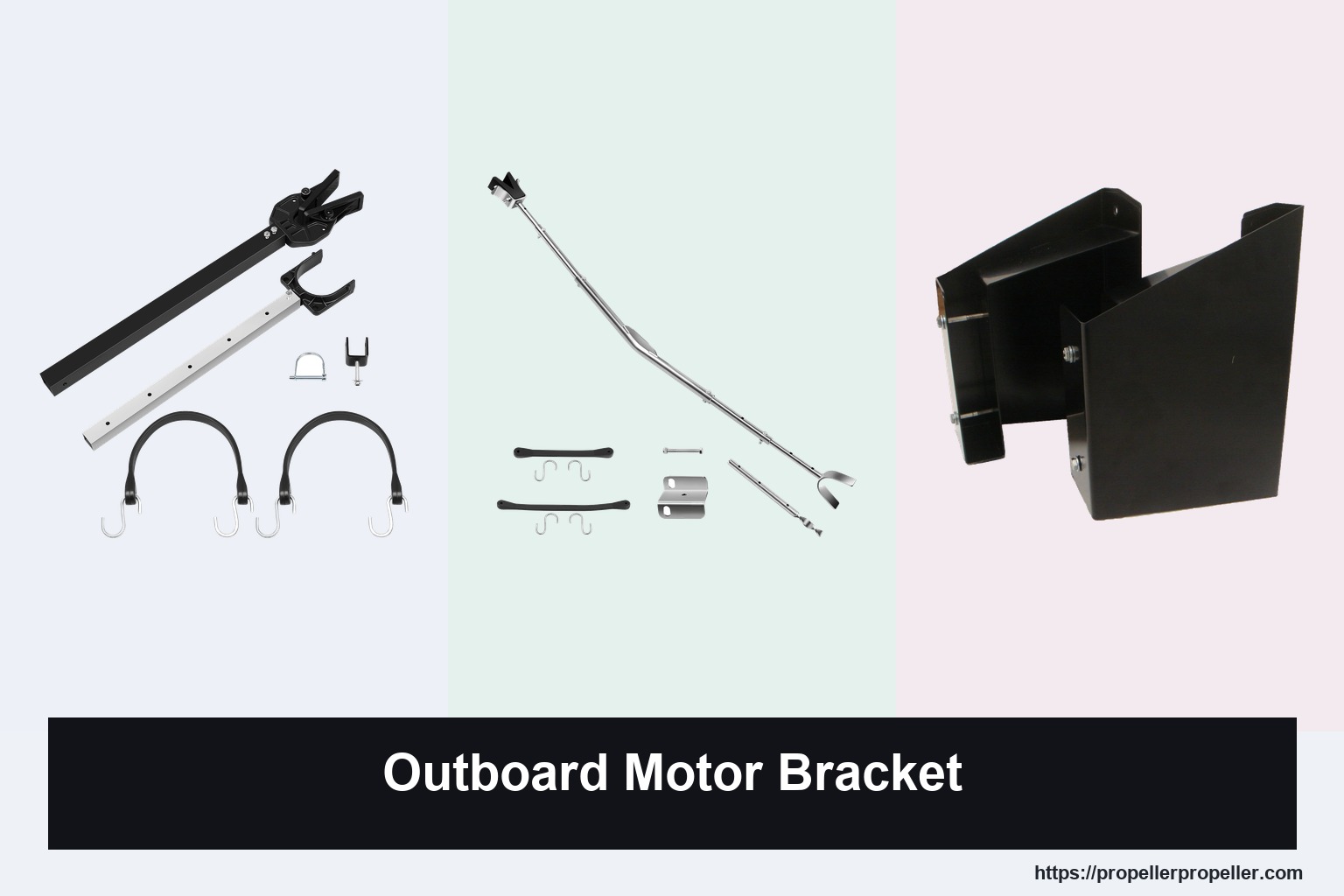
Choosing an outboard motor bracket is really about protecting hardware that is expensive to replace and annoying to troubleshoot on the water. The right support or mount keeps the engine from taking unnecessary abuse during trailering, storage, or auxiliary use. The wrong one can leave you fighting fit issues, awkward adjustment ranges, or mounting hardware that is simply not matched to the motor size and use case you actually have.
The five options here span trailering supports, wall storage, auxiliary motor brackets, and swim platform mounting. That variety matters because buyers use the phrase outboard motor bracket for very different jobs. The best choice depends on horsepower range, mounting style, material, adjustability, and how much weight or movement the bracket has to manage. The comparisons below focus on those practical differences so you can match the bracket to the boat, the motor, and the way you store or transport it.
Top Outboard Motor Bracket on the Market

JY PERFORMANCE Adjustable Transom Saver
- Supports motors up to 100 HP
- Adjusts from 23 to 35 inches
- Aluminum shaft with ABS head
- Includes trailer mount bracket

JY PERFORMANCE Heavy-Duty Transom Saver
- Supports motors up to 150 HP
- Adjusts from 28 to 59 inches
- Heavy-duty steel construction
- Rubber V-block protection

Wall Storage Bracket Me-165
- Wall-mounted storage solution
- Carbon steel construction
- 8 x 3.5 x 12 inches
- Black texture powder coat

Panther Auxiliary Motor Bracket 10-inch
- Five vertical running positions
- Handles up to 35 HP
- Supports 263 lb motors
- 10 inches of travel

Panther Swim Platform Bracket
- For swim platform mounting
- Maximum 20 hp
- Aluminum construction
- Salt water use
This article may contain affiliate links. As an Amazon Associate, the website may earn from qualifying purchases at no additional cost to you.
Outboard Motor Bracket Reviews
JY PERFORMANCE Adjustable Transom Saver
- Material Type
- Acrylonitrile Butadiene Styrene (ABS), Aluminum
- Manufacturer Warranty Description
- 1 year
- Item Weight
- 1.67 kg
- Color
- Black+Silver
- Finish Types
- Powder Coated
Advantages
- Adjustable for multiple trailer setups
- Lightweight aluminum construction
- ABS clamp protects contact points
- Hardware included for installation
- One-year warranty
Limitations
- Not for larger 150 HP motors
- Trailering use only
This transom saver is built for owners who want a straightforward trailering support for a lighter outboard. The key range is 23 to 35 inches of adjustability, which lets you match the brace to the distance between the motor and the trailer point without resorting to improvisation. Its aluminum construction keeps the structure focused on support rather than bulk, while the composite head with a marine-grade ABS clamp is aimed at protecting the engine surface from scratching during transport.
The setup is shaped for practical trailering use rather than permanent mounting. The included trailer mount bracket, rubber string with S-hooks, and clevis pins with retainers give you the hardware needed to secure the support without piecing together extra parts. That matters because a transom saver is only useful if it actually fits your trailer geometry cleanly. The stated one-year warranty also adds a basic ownership cushion, which is worthwhile for a component that will see repeated load cycles and weather exposure.
Against the heavier-duty 150 HP model, this one is the easier match when you do not need the extra span or steel construction. It is also more focused than the wall bracket and swim platform options because it serves a transport role, not storage or auxiliary mounting. If your motor falls within the stated 100 HP ceiling and you want a compact support with fewer moving parts to manage, this is the more economical and less overbuilt pick.
PHOTO: JY PERFORMANCE Adjustable Transom – Outboard Support Kit → Source: Amazon.com
JY PERFORMANCE Heavy-Duty Transom Saver
- Material Type
- Alloy Steel
- Mounting Type
- Transom Mount
- Manufacturer Warranty Description
- 1 year
- Item Weight
- 5.6 kg
- Color
- Silver
Advantages
- Supports motors up to 150 HP
- Wide 28 to 59 inch range
- Steel construction for toughness
- Rubber V-block reduces shock
- Complete installation components
Limitations
- Heavier than compact alternatives
- Still limited to transport use
This is the more serious trailer support in the group for owners who need longer reach and a higher horsepower ceiling. The 28 to 59 inches adjustment range is the most accommodating span among the trailering-style options here, and that flexibility matters when the trailer geometry or motor position does not leave much room for a short brace. The heavy-duty steel build is the other major clue. It is meant for buyers who value rigidity and long-term toughness more than low mass.
The rubber V-block is a meaningful detail because trailering damage often comes from vibration and contact pressure rather than catastrophic force. By softening that interface, the bracket is doing more than simply holding the motor in place. The included tubes, brackets, U-attachments, V-block, straps, and related parts point to a more complete installation package, which reduces the chance of having to source missing pieces. The 1-year warranty is modest, but it at least matches the product’s role as repeated-use transport equipment.
Compared with the 100 HP saver, this one is the better call when the motor is larger, the span is longer, or you want more structural reserve. It is not the lightest option, and it is clearly more specialized than the storage bracket because it is built for trailering support rather than keeping a motor off the floor. For buyers with larger outboards who want the strongest adjustment envelope in this group, it is the most compelling transport pick.
PHOTO: JY PERFORMANCE Heavy-Duty Transom – Support Bar Kit → Source: Amazon.com
Wall Storage Bracket Me-165
Advantages
- Saves floor space
- Wall-mounted storage design
- Compact footprint
- Carbon steel build
- Powder-coated finish
Limitations
- Hardware not included
- Requires proper wall backing
This bracket is for owners who are trying to get a motor off the floor and onto the wall. That makes it a storage product first, not a trailering support or an auxiliary running mount. The compact carbon steel construction and black texture powder coat finish suggest a hard-wearing storage piece rather than a delicate rack. Its value comes from freeing floor space while keeping clamp-on outboards accessible and organized.
The design is more dependent on the installation environment than the other options in this roundup. It mounts to a wall, hardware is not included, and the load capacity changes based on the board type and length you use, with 2 by 8 lumber called out as the board format. That means buyers need to plan the mounting surface carefully before committing. The compact 8 by 3.5 by 12 inch size is useful because it keeps the bracket itself unobtrusive, but the real strength comes from proper installation rather than the bracket alone.
Compared with the trailering supports, this one is the right answer when the goal is storage and floor-space recovery. It also differs sharply from the auxiliary and swim platform brackets because it is not meant to carry a motor in service. Buyers with a workshop, garage, or storage wall and one or more clamp-on outboards will get the most from it. If you need a neat storage system more than a transport brace, this is the clearest fit.
PHOTO: Wall Storage Bracket Me-165 – Wall Storage Bracket → Source: Amazon.com
Panther Auxiliary Motor Bracket 10-inch
Advantages
- Five running positions
- 10 inches of travel
- Handles up to 35 HP
- Stainless steel hardware
- ABYC standard compliant
Limitations
- Requires safety cable use
- Not for large main engines
This is the most purpose-built running bracket in the group, and that makes it especially relevant for trolling or auxiliary propulsion. The standout feature is the ability to move through five vertical running positions, which lets you adapt prop height to changing water or load conditions instead of living with a fixed compromise. The 10-inch travel and 35 HP, 263 lb capacity frame the product as a serious support for modest auxiliary engines rather than a general-purpose mount.
The bracket’s anodized aluminum body and stainless steel hardware are important because they address the two stress points that matter most in this category: weight and corrosion. The hand-adjustable knob and stainless steel torsion springs also make height changes less awkward, which matters when you want quick trim changes without wrestling the engine. The 2-inch-thick extra-wide mounting board adds confidence at the interface with the boat, especially when the motor is constantly shifting load.
This bracket sits in a different category from the transom savers because it is designed to operate with the motor on the boat, not just support it during transport. It is also more functional than the storage bracket because it actively manages running position. The included safety cable requirement is an important part of the buying decision, since ABYC compliance is only meaningful if you follow the system as intended. For buyers who need auxiliary propulsion support and adjustability, this is the most technically complete option here.
PHOTO: Panther Auxiliary Motor Bracket – Auxiliary Outboard Bracket → Source: Amazon.com
Panther Swim Platform Bracket
- Maximum Horsepower
- 20 hp
- Material Type
- Aluminum
- Mounting Type
- Transom Mount
- Recommended Uses For Product
- For Salt Water
- Item Weight
- 15.9 pounds
Advantages
- Built for swim platform mounting
- Salt water use
- Aluminum construction
- Compact dedicated assembly
- 20 hp maximum
Limitations
- Limited to small motors
- Specialized installation fit
This bracket serves a narrower but very practical role: mounting a small motor to a swim platform. The 20 hp maximum immediately defines the use case, so this is not a universal answer for larger outboards. What it does offer is a dedicated aluminum mounting solution that is explicitly aimed at salt water use, which is valuable for buyers who need an auxiliary or small motor location that fits a marine environment.
The transom mount specification and electric operation mode indicate that setup is tied to a specific mounting style rather than broad all-boat compatibility. That makes it important to verify platform geometry before buying, because the bracket has to work with the structure you already have. At 15.9 pounds, it is substantial enough to suggest a real mounting assembly rather than a lightweight clamp-on accessory, and the limited warranty is consistent with a specialist marine part rather than a universal hardware product.
Compared with the auxiliary motor bracket, this one is less about adjustment and more about placement. Compared with the trailering supports, it is not meant to manage transport loads at all. The upside is that it solves a narrow installation problem cleanly for small motors in salt water environments. If your goal is a fixed swim-platform installation and your horsepower requirement stays within the stated limit, this is the most appropriate specialized bracket in the group.
PHOTO: Panther Swim Platform Bracket – Swim Platform Motor Bracket → Source: Amazon.com
How to Choose an Outboard Motor Bracket
The first decision is not style or price. It is use case. An outboard support for trailering, a wall storage bracket, an auxiliary running mount, and a swim platform bracket solve different problems, and the wrong one will never feel right no matter how well it is built. Once you know where the motor will live and when it will be supported, the rest of the choice becomes much clearer. Horsepower limit, span, mounting surface, and material all matter, but only after the bracket is matched to the job.
Match the Use Case
Trailering supports keep the motor steady during transport. Storage brackets hold a motor off the floor. Auxiliary brackets manage a running motor on the boat. Swim platform mounts create a fixed location for a small engine. Those jobs are not interchangeable, and a bracket that excels in one role may be awkward or unsafe in another. Start with the task, then narrow the field by the exact kind of support you need.
Check Horsepower Limits
Horsepower is the quickest way to rule a bracket in or out. A support rated for a small outboard may be fine for a compact motor but inadequate for a larger one, especially when weight and leverage increase together. Do not stretch a bracket beyond its stated range just because the mounting points seem close. The right limit gives you a cleaner fit and a more realistic safety margin.
Pay Attention to Reach
Adjustable span matters more than many buyers expect. Trailer geometry, transom height, and motor position can change the actual distance a support must cover. A short range can work well when the setup is predictable. A longer range is more forgiving when the motor sits farther from the trailer point or when the mounting situation varies from one boat to another. Choose the span that matches your real setup, not an idealized one.
Prioritize Mounting Surfaces
Some brackets depend on a trailer point, some on a wall, and others on the boat itself. That means the strength of the supporting surface is part of the product choice, not an afterthought. A wall storage bracket needs proper backing. A transom support needs geometry that lines up with the trailer. A swim platform bracket needs enough structure to carry the load. A great bracket on the wrong surface is still the wrong solution.
Look for Contact Protection
Where the bracket touches the motor is where damage usually starts. Rubber blocks, composite heads, and protective clamps all reduce the chance of scratches, pressure points, and vibration wear. Those details matter most during transport, when the motor is bouncing and the support is doing repetitive work. If your boat sees rough roads or frequent trips, contact protection should be part of the purchase decision rather than a nice extra.
Consider Corrosion Resistance
Marine hardware lives with moisture, sun, and salt. Aluminum, steel with powder coating, and stainless hardware all help the bracket survive that environment longer. No material is magic, but corrosion resistance does reduce the maintenance burden and the odds that the bracket becomes hard to adjust or visually degraded after exposure. If the boat spends time in salt water or outdoors, choose construction that is clearly meant for that environment.
Outboard Motor Bracket Comparison Table
| Product | Best For | Material | Weight | Warranty | Color |
|---|---|---|---|---|---|
| JY PERFORMANCE Adjustable Transom Saver | Best Compact Trailer Support | Acrylonitrile Butadiene Styrene (ABS), Aluminum | 1.67 kg | 1 year | Black+Silver |
| JY PERFORMANCE Heavy-Duty Transom Saver | Best Heavy-Duty Trailering Support | Alloy Steel | 5.6 kg | 1 year | Silver |
| Wall Storage Bracket Me-165 | Best Storage Space Saver | Not Specified | Not Specified | Not Specified | Not Specified |
| Panther Auxiliary Motor Bracket 10-inch | Best Auxiliary Motor Mount | Not Specified | Not Specified | Not Specified | Not Specified |
| Panther Swim Platform Bracket | Best Swim Platform Mount | Aluminum | 15.9 pounds | LIMITED WARRANTY | Black |
How We Tested & Analyzed Outboard Motor Bracket
The analysis compared each bracket by role first, then by the practical details that affect how it works in that role. Horsepower ceiling, span or travel, mounting style, material, and included hardware all matter differently depending on whether the bracket is meant for transport, storage, auxiliary propulsion, or platform mounting. That framework keeps the evaluation grounded in how buyers actually use these products rather than in isolated spec comparisons.
Where multiple products addressed similar tasks, the comparison focused on how much flexibility each one gave the installer and how much confidence the construction suggested under load. Adjustable range, corrosion-resistant materials, and contact-protection features were weighted heavily because those are the details that change fit and durability in real use. For narrower products, the key question was whether the specialization was appropriate or overly limiting.
The review also treated missing details as meaningful. When a product did not specify a value, that absence affected how confidently it could be recommended for broader use. The goal was to distinguish products that are versatile because they are truly adjustable from products that are specialized because that is exactly what they are meant to be. That distinction matters more than marketing language in this category.
Frequently Asked Questions
What is the difference between a transom saver and a motor bracket?
A transom saver supports an outboard during trailering, while a motor bracket may store, mount, or reposition a motor depending on the design. The terms overlap in shopping language, but the function is different. Matching the bracket to the job is more important than the name on the label.
How do I know what horsepower rating I need?
Choose a bracket whose stated horsepower limit meets or exceeds your motor’s requirements. That rating is one of the clearest indicators of whether the bracket is intended for a small auxiliary motor, a larger outboard, or just transport support. Staying within the published limit is the safer and more predictable choice.
Why does adjustability matter so much?
Adjustability determines whether the bracket fits your actual geometry without forcing the motor into a poor angle or a stressed position. On trailer supports, it helps align the brace with the trailer point. On running mounts, it helps set motor height for changing conditions. More range usually means fewer fit problems.
What material is best for marine use?
There is no single best material for every case, but aluminum, steel with protective coating, and stainless hardware are all common reasons a bracket lasts longer near water. The right choice depends on whether you need low weight, high stiffness, or stronger corrosion resistance. The more exposure to weather or salt water, the more that finish and hardware quality matter.
Final Thoughts
The best outboard motor bracket is the one that matches the exact job you need it to do. Trailer support, storage, auxiliary mounting, and swim platform installation each demand different strengths. Once the use case is clear, the rest of the decision comes down to load limit, span, hardware, and how much protection the bracket gives the motor where it makes contact.
If you want the simplest path, pick the product that aligns most closely with your motor size and mounting setup rather than chasing the most features. A well-matched bracket is easier to install, safer in use, and less likely to become a maintenance headache later. In this category, precision matters more than versatility for its own sake.