
Submarine Propeller: How It Balances Thrust and Stealth
A submarine propeller is the vessel’s water-working propulsor, but its defining design goal is a low acoustic signature rather than maximum efficiency. Its design balances propulsion performance against noise, especially noise associated with cavitation. Blade geometry and the water flow arriving at the propeller are treated as connected design choices, then candidate designs can be compared through controlled model testing.
That balance is the key to understanding a submarine propeller. There is no single blade geometry that is best in every operating condition: an acoustic improvement can involve a performance trade-off.
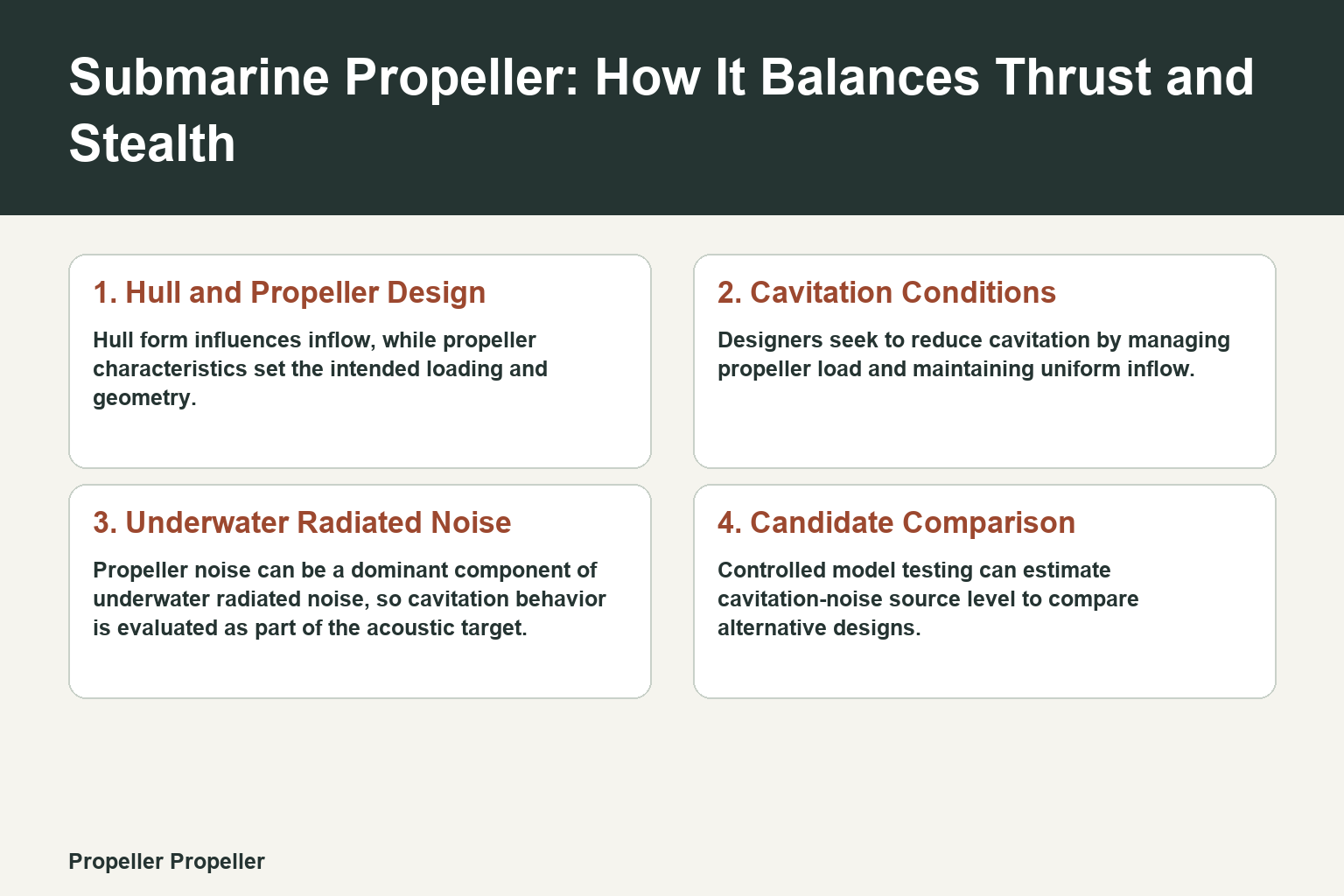
- Hull and Propeller DesignHull form influences inflow, while propeller characteristics set the intended loading and geometry.
- Cavitation ConditionsDesigners seek to reduce cavitation by managing propeller load and maintaining uniform inflow.
- Underwater Radiated NoisePropeller noise can be a dominant component of underwater radiated noise, so cavitation behavior is evaluated as part of the acoustic target.
- Candidate ComparisonControlled model testing can estimate cavitation-noise source level to compare alternative designs.
Propeller characteristics and hull-created inflow jointly influence cavitation-related noise; model testing supports comparison of alternatives rather than guaranteeing a full-scale result.
The Defining Requirement Is Low Acoustic Signature
For submarine propeller development, acoustics comes before efficiency. The propeller must still provide the required propulsion performance, but a design that is efficient in a narrow sense is not automatically the preferred design if it produces a stronger underwater acoustic signature. This is a system-level compromise rather than a one-variable choice.
- Low acoustic signature is the primary design requirement described for submarine propellers.
- Efficiency remains relevant, but it is optimized after acoustic needs.
- The preferred compromise can change with the operating conditions being considered.
| Design focus | What designers seek to manage | Decision implication |
|---|---|---|
| Acoustic signature | Underwater radiated noise, including cavitation-related noise | Acoustics takes priority for submarine propeller development. |
| Propulsion performance | The propeller’s ability to meet propulsion needs | Performance is retained, but not pursued independently of noise. |
| Operating conditions | The conditions under which objectives are assessed | One geometry cannot be assumed best in every condition. |
Why Cavitation Drives the Noise Conversation
Propeller noise can make up a dominant share of a vessel’s underwater radiated noise, and cavitation reduction is therefore a central objective. The relevant relationship is not simply “more blades means less noise” or any other single rule. Propeller loading and the uniformity of water entering the propeller both affect the conditions designers seek to manage. Hull design and propeller design consequently need to work together.
- Reducing propeller load is one design route considered for cavitation reduction.
- A more uniform inflow to the propeller is another relevant condition.
- Diameter, blade number, blade area, pitch, skew, rake, and section shape are among the characteristics considered in propeller design.
Geometry Is a Set of Trade-Offs, Not a Noise Formula
Propeller geometry gives designers several linked levers, including blade count, area, pitch, skew, rake, and section shape. Those features should not be interpreted in isolation: they are selected together to manage loading, incoming flow, acoustic behavior, and propulsion performance. I would treat a claim that one visible feature alone makes a propeller quiet with caution, because the supplied design guidance points instead to an integrated optimization problem.
Sources: Aspects of Propeller Developments for a Submarine · Revised guidelines for the reduction of underwater radiated noise from shipping to address adverse impacts on marine life · Rules and Regulations for the Classification of Naval Ships, Chapter 1: Propellers
How Designers Compare Candidate Propellers
Before full-scale construction, model testing can provide a controlled way to estimate the source level of propeller cavitation noise and compare candidate designs. That is valuable for judging relative alternatives during ship design, but it is not a promise of one exact full-scale noise outcome. The model-test method is an evaluation tool within a larger design decision that also includes propulsion and acoustic requirements.
1Set the Design Priorities
Establish the propulsion and acoustic objectives, recognizing that low acoustic signature is the leading requirement for a submarine propeller.
2Develop Alternatives as a System
Vary the relevant propeller characteristics and consider the inflow conditions created by the hull rather than treating the propeller as independent of the vessel.
3Evaluate Cavitation-Noise Source Level
Use an appropriate model-test approach to estimate cavitation-noise source level and compare alternatives under controlled conditions.
4Select the Best Compromise
Choose the alternative that best balances acoustic and propulsion objectives for the intended conditions; no single geometry is universally optimal.
| Layer | What it addresses | What it does not establish alone |
|---|---|---|
| Integrated design choices | Propeller characteristics, loading, and inflow conditions | A universal quiet-propeller formula. |
| Model cavitation-noise testing | Estimated source level and relative comparison of alternatives | A guaranteed full-scale noise outcome. |
| Naval classification rules | Design, survey, geometry, and functional-support requirements | A general performance tutorial for submarine propulsors. |
Sources: Aspects of Propeller Developments for a Submarine · Revised guidelines for the reduction of underwater radiated noise from shipping to address adverse impacts on marine life · ISO 20233-1:2018 Ships and marine technology — Model test method for propeller cavitation noise evaluation in ship design — Part 1: Source level estimation
Design Includes the Supporting Arrangement
A naval propeller is not treated solely as a blade shape in formal design and service-life rules. The scope also includes supporting arrangements and controls needed to keep the propeller functional. Classification rules provide defined geometry terms, including maximum skew angle, and establish design and survey criteria. They are useful boundaries for engineering and compliance, not a general recipe for predicting submarine performance or quietness.
Sources: Rules and Regulations for the Classification of Naval Ships, Chapter 1: Propellers
Frequently Asked Questions
Is a quieter submarine propeller always less efficient?
Not necessarily. The available submarine-design source says acoustic and efficiency objectives must be balanced and that acoustic gains can carry a performance cost. The outcome depends on the operating conditions and the overall design compromise.
Does blade number by itself determine propeller noise?
No. Blade number is one of several characteristics considered alongside diameter, blade area, pitch, skew, rake, and section shape. Propeller load and the uniformity of incoming water also matter for cavitation reduction.
What is propeller skew?
Skew is a formally defined propeller-geometry characteristic in naval classification rules; those rules include a definition for maximum skew angle. Its presence in a design does not, by itself, establish a particular acoustic result.
Why does the hull matter to propeller noise?
Hull design affects the flow arriving at the propeller. The IMO guidance identifies maintaining uniform inflow through hull design as one of the measures relevant to reducing cavitation.
Can model tests prove how quiet a full-scale submarine propeller will be?
Model tests can estimate cavitation-noise source level and help compare alternatives during design. The ISO method supports controlled evaluation, but it does not guarantee a full-scale noise outcome.
Final Thoughts
A submarine propeller is best understood as an acoustics-first propulsion design problem: manage cavitation and inflow while retaining the propulsion performance the vessel needs. Judge any individual blade feature as part of that wider compromise, not as a stand-alone answer.



