
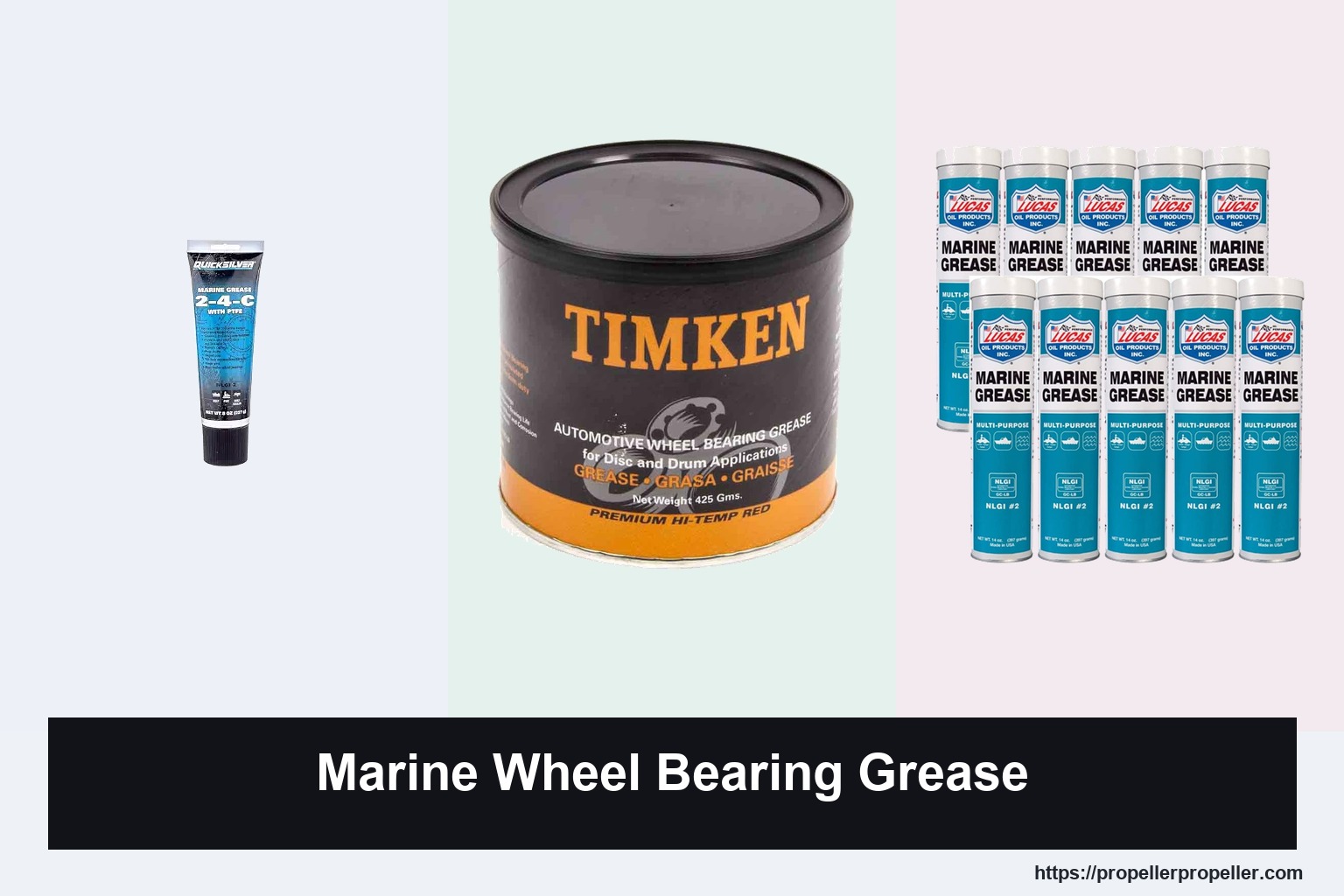
Marine wheel bearings live a harder life than most grease applications. Water intrusion, frequent immersion, heat from road use, and long storage gaps all punish the lubricant, so the right choice is less about brand familiarity and more about how well the grease holds its structure, resists washout, and protects loaded metal surfaces over time.
This roundup focuses on three practical options that cover different buyer priorities. One leans on broad marine versatility, one is a conventional high-temperature wheel bearing grease with strong protection features, and one is built around heavy-duty marine and trailer use in a larger multi-pack format. The best choice depends on whether you want the most all-around marine lubricant, the most straightforward wheel bearing protection, or the most capacity for repeated service.
Top Marine Wheel Bearing Grease on the Market

Quicksilver 2-4-C Marine Grease
- PTFE-enhanced marine grease
- Lithium-based NLGI 2
- 8 oz tube
- Trailer wheel bearing use
- Water resistance

Allstar Timken Red Wheel Bearing Grease
- Hi-temp wheel bearing grease
- Corrosion and wear inhibitors
- Water-resistant additives
- 16 oz tub
- NLGI GC and LB

Lucas Marine Grease 10-Pack
- Marine and trailer use
- Lithium complex GC-LB
- Timken load 80 lbs
- 14 oz cartridges
- Pack of 10
This article may contain affiliate links. As an Amazon Associate, the website may earn from qualifying purchases at no additional cost to you.
Marine Wheel Bearing Grease Reviews
Quicksilver 2-4-C Marine Grease
- Container Type
- Tube
- Liquid Volume
- 8 fluid ounces
- Viscosity
- 2-4
- Item Form
- Grease
Advantages
- PTFE-enhanced marine formula
- Water resistant in use
- Covers many marine components
- Compact tube for storage
- Extreme pressure additives
Limitations
- Smaller 8 oz volume
- Not a dedicated bearing-only grease
Quicksilver 802859Q1 sits at the broadest end of this group. Its PTFE-enhanced formula and NLGI 2 consistency make it more than a narrow wheel bearing product, because it is also aimed at steering system cables, throttle and shift cables, tilt lock mechanisms, tilt tubes, remote controls, prop shafts, and swivel pins. That kind of range matters for buyers who want one marine lubricant that can cover several service points without changing products every time they open a compartment. The 8 oz tube is compact, so it is easy to store in a boat box or tow vehicle without taking much space.
The practical advantage here is not just compatibility but resilience. The grease is described as water resistant and resistant to oxidation and degradation, which is exactly what matters when hardware sees splash, condensation, and seasonal idle periods. Extreme pressure additives further strengthen its case for loaded moving parts that do not stay perfectly dry or lightly stressed. That said, the smaller tube format means this is not the obvious pick if you are servicing multiple trailers or repacking several hubs at once. It is better suited to targeted jobs than bulk maintenance.
Against the other two products here, Quicksilver is the most clearly multi-purpose marine lubricant. It does not present itself as a dedicated wheel bearing specialist in the same way a traditional automotive bearing grease does, and it does not come in the larger high-volume package of the Lucas option. Those tradeoffs are not weaknesses if your goal is an all-in-one marine service grease that can move between steering, control, and trailer hardware. Choose it when you value versatility and water resistance over tub size or specialized wheel bearing focus.
PHOTO: Quicksilver 2-4-C Marine Grease – Tube front label → Source: Amazon.com
Allstar Timken Red Wheel Bearing Grease
- Container Type
- Pail
- Liquid Volume
- 16 fluid ounces
- Material
- Lithium
- Warranty Description
- 90 days
- Specific Uses For Product
- High-temperature automotive wheel bearing applications
Advantages
- High-temp wheel bearing formula
- Corrosion inhibitors included
- Anti-wear additives included
- Water-resistant additive package
- 90-day limited warranty
Limitations
- Short warranty period
- Less versatile than marine multipurpose grease
Allstar ALL78241 is the most direct wheel bearing answer in this group. It is a premium hi-temp red grease formulated for both disc and drum bearing applications, so the target use is clear from the start. That matters because wheel bearings on trailers and vehicles care less about broad marine versatility and more about sustained load support, heat tolerance, and resistance to washout or corrosion. The 16 oz tub is a sensible size for hub service, and the grease is framed around demanding bearing work rather than general marina upkeep.
Several verified details make it stand out as a technical bearing grease rather than a generic lubricant. It contains corrosion inhibitors, anti-wear additives, and water-resistant additives, and it uses an NLGI No. 2 lithium-complex thickener. Those are the kinds of characteristics that support stable consistency under load and help the grease stay where it belongs in a bearing cavity. The 55 Timken OK load also points to meaningful load-carrying capability. On top of that, the 90-day limited factory warranty is short, but it is still a concrete backing that the other products here do not match in the same way.
Compared with the Quicksilver option, this is the more focused wheel bearing product. Compared with the Lucas pack, it is less about bulk supply and more about a straightforward service tub with explicit bearing credentials. That makes it the best fit for buyers who want a conventional high-temperature wheel bearing grease with recognized performance markers and who do not need a multi-pack. Choose it when the priority is bearing-specific protection first, not multipurpose marine lubrication.
PHOTO: Allstar Timken Red Wheel – Timken wheel bearing grease → Source: Amazon.com
Lucas Marine Grease 10-Pack
- Container Type
- Cartridge
- Liquid Volume
- 14 fluid ounces
- Material
- Lithium
- Number of Items
- 10
- Item Highlight
- Maritime Boat Trailer Wheel Bearings AntiCorrosion Blue Lithium Compound Aqua Shield Submerged Protection Tubes Ten Units
Advantages
- Pack of 10 cartridges
- GC-LB certified grease
- Timken load 80 lbs
- Dropping point 540 lbs
- Trailer and wheel bearing use
Limitations
- Pack size may be excessive
- Less compact for small jobs
Lucas Oil Marine Grease is the capacity play in this lineup. The 10-pack format immediately separates it from the single-tube and single-tub options, and that matters if you service multiple trailers, re-pack bearings regularly, or prefer to keep spare cartridges on hand for seasonal maintenance. Its stated applications include trailer lubrication, chassis lubrication, automotive wheel bearings, and outboards, so it stretches across marine and towing tasks without forcing you into a specialized one-trick product. The 14 oz cartridge size is also practical for grease guns and repeat use.
The technical side is competitive in the ways that matter. This is a heavy-duty lithium complex grease with GC-LB certification, which is one of the most useful signals for buyers comparing wheel bearing lubricants. It also lists a Timken load of 80 lbs and a dropping point of 540 lbs, both of which speak to durability under heat and pressure. In plain terms, this is the product in the group most prepared for repeated service intervals, hotter operating conditions, and more demanding trailer work. The tradeoff is that the pack size is only worthwhile if you truly use grease regularly.
Against the Quicksilver tube, Lucas is less of a general marine service grease and more of a supply choice. Against the Allstar tub, it is the stronger option when you want multiple cartridges rather than a single container. That makes it the right recommendation for owners maintaining several hubs, shops that go through grease quickly, or anyone who values buying once and storing the rest. If you want the widest practical coverage and the most total volume, this is the one to pick.
PHOTO: Lucas Marine Grease 10-Pack – Multi-pack tubes → Source: Amazon.com
How to Choose Marine Wheel Bearing Grease
Marine wheel bearing grease has to do more than lubricate. It needs to stay stable under load, resist water intrusion, and keep protecting parts after long periods of storage or intermittent use. That is why the best option is not always the most famous grease or the one with the biggest claims. You need to match the formula to how the bearing is used, how often you service it, and whether the same grease will also be asked to cover other marine hardware.
Water Resistance
Water resistance is the first filter because marine and trailer bearings are exposed to splash, spray, and sometimes immersion. A grease that breaks down in the presence of water will leave metal unprotected long before the bearing looks obviously dry. Look for language that points to water resistance, washout protection, or submerged use, especially if your trailer is launched regularly or stored outdoors. The right grease should keep its body and cling to surfaces instead of emulsifying or thinning when moisture gets into the hub.
Heat and Load
Wheel bearings need a grease that can stay consistent when temperature rises and pressure builds. Heat from towing and friction from loaded hubs can soften weaker lubricants, which changes how well the grease stays in place. NLGI consistency, lithium-complex construction, and any verified load or high-temperature claims all matter here because they indicate whether the grease can remain mechanically stable. If you haul longer distances, carry heavier loads, or repack bearings that already run warm, this becomes especially important.
Container Format
The container should match how often you service equipment. Tubes and cartridges are convenient for grease guns and smaller maintenance tasks, while tubs suit hand application and workbench use. Larger multi-packs make sense only if you know you will use the grease repeatedly. Buying a large supply for occasional use can leave you with old product sitting around, while a tiny container can be frustrating if you are doing several hubs or maintaining multiple trailers at once. Format is not a minor detail. It changes how easy the job feels and how much you spend per service cycle.
Multi-use Coverage
Some marine greases are broad enough to cover wheel bearings along with steering components, cables, or outboard-related hardware. That can simplify maintenance if you want one product for multiple touchpoints on the same boat or trailer setup. A dedicated wheel bearing grease may still be the better choice if your priority is hub service alone, especially when it has stronger bearing-specific certifications or load claims. The best approach is to decide whether convenience or specialization matters more in your maintenance routine.
Certifications and Claims
Certification language can help separate marketing from useful performance signals. Wheel bearing greases often mention GC-LB or other standards, while marine lubes may emphasize resistance to oxidation, corrosion, or degradation. Those details are useful because they indicate what kind of protection the grease is designed to maintain. Do not treat every impressive-sounding phrase as equal. A clear performance claim tied to a known category is usually more meaningful than a vague promise of premium protection.
Marine Grease Comparison Table
| Product | Best For | Container | Volume | Material | Count | Global Trade Identification Number |
|---|---|---|---|---|---|---|
| Quicksilver 2-4-C Marine Grease | Best all-around marine grease | Tube | 8 fluid ounces | Various Materials | 1 | 00745061039056 |
| Allstar Timken Red Wheel Bearing Grease | Best wheel bearing protection | Pail | 16 fluid ounces | Lithium | 1 | 00848238040364 |
| Lucas Marine Grease 10-Pack | Best bulk marine value | Cartridge | 14 fluid ounces | Lithium | 10 | 10049807103207 |
How We Tested & Analyzed Marine Wheel Bearing Grease
This category was evaluated around the factors that actually affect bearing life in service: water resistance, heat tolerance, load support, consistency, and the way the grease is packaged for real maintenance routines. Those criteria matter because wheel bearing grease fails by losing structure, not by losing marketing appeal. The analysis therefore favors verified properties that translate into practical durability, easier application, and better fit for trailer or marine environments.
Comparisons also weighed how narrowly or broadly each grease is positioned. Some products are built as multi-purpose marine lubricants, while others are more clearly targeted at wheel bearing service. That distinction matters because a broader formula can simplify ownership, but a focused bearing grease may better match the demands of hubs under heat and pressure. Capacity was another key factor. Package size changes whether a product makes sense for one-off service or repeated maintenance over a season.
Limitations were handled conservatively. If a product did not state a value, the analysis did not infer one. That means the recommendations stay grounded in the confirmed evidence rather than in assumptions about what a marine grease ought to do. The result is a buyer-focused comparison that emphasizes the tradeoffs you actually face: versatility versus specialization, small tube versus bulk supply, and general marine use versus bearing-specific protection.
Frequently Asked Questions
What makes marine wheel bearing grease different from standard grease?
Marine wheel bearing grease is expected to handle moisture, splash, and long storage without breaking down as easily. Standard grease may lubricate well in dry conditions, but it is not always built for the same water exposure or corrosion risk. For trailer hubs and other marine-related bearings, water resistance and structural stability matter as much as raw lubricity.
Should I choose a multipurpose marine grease or a bearing-specific grease?
Choose based on how many jobs you want one grease to cover. A multipurpose marine grease can simplify maintenance if you also service cables, pivots, or other hardware. A bearing-specific grease is usually better when hub performance is the main concern, especially if you want a formula aimed directly at heat, load, and wheel bearing protection.
Does package size matter that much?
Yes, because grease format affects both convenience and waste. Small tubes are easy to store and use for targeted jobs. Tubes or tubs in moderate sizes work well for occasional hub service. Multi-packs make sense only when you service several bearings regularly or want supply on hand for repeated maintenance. Otherwise, extra volume can be unnecessary.
What performance details are worth paying attention to?
The most useful details are water resistance, heat tolerance, load-carrying claims, consistency grade, and any certification tied to wheel bearing use. These tell you more about real-world durability than general marketing language. If the grease also includes corrosion or anti-wear protection, that is another positive sign for bearings that spend time in wet or changing conditions.
Final Thoughts
The best marine wheel bearing grease is the one that matches your maintenance pattern, not the one with the broadest headline claim. If you want a grease that can move across several marine service points, the most versatile option is compelling. If your priority is dedicated wheel bearing protection, a formula built around heat, load, and water resistance is the safer call. If you service equipment often and want to buy in bulk, a larger cartridge pack can be the smartest value.
Choose with the bearing environment in mind. Saltwater exposure, trailer heat, and storage conditions all push the grease in different directions, so the right answer is the product that stays stable under your actual use case. Once you match water resistance, load handling, and container format to the way you maintain your gear, the decision becomes much clearer and the chance of premature bearing problems drops substantially.



