Marine bearings live in one of the harshest lubrication environments. Water intrusion, salt exposure, heat, and long service intervals can all turn the wrong grease into a maintenance problem fast. The best choice is rarely the thickest or the most expensive. It is the one that stays in place, resists washout, and matches the load, temperature, and material demands of the part you are protecting.
That is why this roundup focuses on practical fit rather than marketing claims. Some greases are built for general-purpose marine use, while others lean toward wheel bearings, high-load chassis points, or broader workshop duty. The best options here differ in container size, thickener chemistry, water resistance, temperature capability, and application range. Those differences matter because marine equipment is varied, and the wrong formula can be overkill in one place and under-specified in another.
Top Marine Bearing Grease on the Market

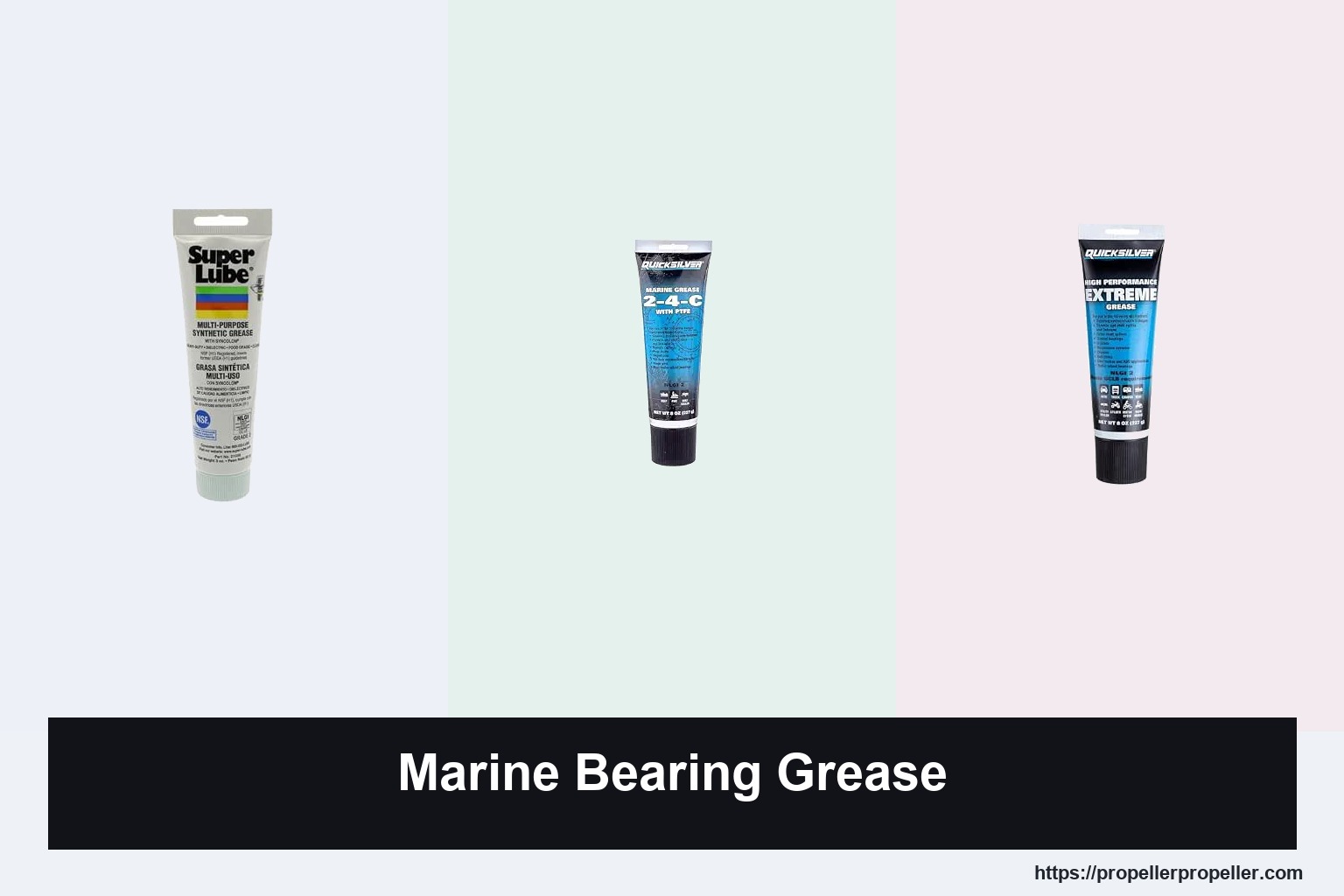
Super Lube Multi-Purpose Synthetic Grease
- 3 oz tube
- NSF H1 food grade
- 450 °F upper rating
- Water and corrosion resistant

Quicksilver 2-4-C Marine Grease

Quicksilver Extreme Marine Grease
- 8 oz tube
- Calcium sulfonate based
- Mercury Marine OEM spec
- High-load applications

Allstar Timken Wheel Bearing Grease
- 16 oz tub
- Hi-temp red grease
- Corrosion inhibitors
- 90-day limited warranty
This article may contain affiliate links. As an Amazon Associate, the website may earn from qualifying purchases at no additional cost to you.
Marine Bearing Grease Reviews
Super Lube Multi-Purpose Synthetic Grease
- Container Type
- Tube
- Liquid Volume
- 3 fluid ounces
- Upper Temperature Rating
- 450 °F
- Compatible Material
- Metal
- Flash Point
- 450 °F
Advantages
- Small tube stores easily
- Water and salt-water resistant
- High temperature tolerance
- NSF H1 food grade
- Non-melting formula
Limitations
- Smallest capacity in the group
- Not marine-specific
Super Lube is the most versatile small-format option in this group. The 3 fluid ounces package keeps it easy to store in a toolbox, tackle box, or maintenance kit, and the 450 °F upper temperature rating gives it useful headroom for parts that see heat as well as moisture. Because it is positioned as a multipurpose lubricant for mechanical use, it fits buyers who want one grease that can cross between marine hardware, shop tasks, and other metal-on-metal contact points without forcing a separate product for every job.
Its value is not just in what it can lubricate. The synthetic formula is described as resistant to water, salt water, dirt, and corrosion, which is exactly the sort of protection marine bearings need when splash exposure is part of the job. The non-melting behavior also matters in real use because it helps the grease stay where it is applied instead of running or separating after warm operation. The tradeoff is capacity. A 3-ounce tube is convenient, but it is not the best fit for buyers maintaining multiple trailers or doing repeated wheel-bearing repacks.
Compared with the larger marine-focused options in this roundup, Super Lube is the most flexible but also the least specialized. The food-grade NSF H1 registration and Kosher certification add appeal for sensitive environments, but the strongest reason to buy it is portability and broad utility. It is the right call for buyers who want one small, stable grease for mixed-duty maintenance and occasional marine work. If you need a compact tube that can handle water exposure and high temperature without taking up space, this is the one to start with.
PHOTO: Super Lube Multi-Purpose Synthetic – Tube Package → Source: Amazon.com
Quicksilver 2-4-C Marine Grease
Advantages
- Marine-focused formulation
- PTFE wear protection
- Water resistant
- Useful for cables and pins
- Portable 8 oz tube
Limitations
- Not the largest size
- Less general than workshop greases
Quicksilver 2-4-C is the most directly marine-oriented grease in the group. The NLGI 2 consistency gives it the familiar body many buyers expect for protected moving parts, while the PTFE additive adds a wear-reduction angle that matters on cables, pins, and steering interfaces. It is described as a general-purpose marine lubricant for steering system cables, throttle and shift cables, tilt lock mechanisms, tilt tube, remote controls, prop shaft, swivel pins, and trailer wheel bearings, so it reaches beyond a single service point.
The practical advantage is its water resistance. The formula is said not to break down in the presence of water, which is the kind of property that separates marine grease from ordinary chassis products. It also carries extreme pressure additives and resistance to oxidation and degradation, so it is better positioned for the combination of friction and exposure that marine hardware often sees. The 8-ounce tube is a useful middle ground. It is big enough for ongoing service but still easy to keep on board or in a trailer tool kit.
Against the other products here, Quicksilver 2-4-C is the clearest match for buyers who want marine-specific coverage without moving up to a large pail. It is less broadly positioned than the Super Lube tube, but its target use cases are more directly aligned with boat hardware and trailer points. That makes it the strongest pick for someone maintaining steering, cables, swivel pins, or similar assemblies and wanting a grease that speaks the language of marine service first. For that job, it is the most purposeful choice in the roundup.
PHOTO: Quicksilver 2-4-C Marine Grease – Marine Grease Tube → Source: Amazon.com
Quicksilver Extreme Marine Grease
- Container Type
- Tube
- Viscosity
- High Viscosity
- Liquid Volume
- 236 ml
- Item Form
- Paste
Advantages
- High-load formulation
- Mercury Marine OEM specification
- Broad vehicle compatibility
- Useful squeeze tube
- Heat-focused grease
Limitations
- Only 8 ounces
- Less economical for frequent service
This Quicksilver grease is the most load-focused option in the set. Its calcium sulfonate-based structure and NLGI 2 grade point to a grease built for heat and pressure rather than simple light lubrication. The product positioning is broad enough for steering cables, gimbal bearings, U-joints, suspension systems, and wheel bearings, but the real strength is the way it is framed for high-temperature and high-load applications. That makes it attractive for owners who prioritize durability under stress.
Its compatibility range is broader than the marine label alone suggests. The description explicitly includes trucks, campers, ATV/UTVs, snowmobiles, utility trailers, and motorcycles. That matters because many buyers need one grease that can cover marine and powersports maintenance without forcing separate tubs for each vehicle. The squeeze tube format is also useful during service because it gives you more control than a large pail when packing bearings or applying grease to confined fittings. The main limitation is simple. It is still an 8-ounce tube, so frequent use will outgrow it faster than a larger tub.
Compared with Quicksilver 2-4-C, this version leans more toward demanding load-bearing tasks than water-exposure convenience. Compared with the Allstar tub, it is more compact and easier to handle, but it does not offer the same bulk capacity. That makes it the best fit for buyers who want a marine grease with a stronger high-load identity and OEM alignment to Mercury Marine equipment. If your maintenance list includes wheel bearings, gimbal bearings, or mixed-use equipment that sees hard service, this is the most capable heavy-duty choice here.
PHOTO: Quicksilver Extreme Marine Grease – Extreme Grease Tube → Source: Amazon.com
Allstar Timken Wheel Bearing Grease
- Container Type
- Pail
- Liquid Volume
- 16 fluid ounces
- Item Weight
- 1.1 pounds
- Material
- Lithium
- Warranty Description
- 90 days
Advantages
- Largest container here
- Corrosion inhibitors included
- Water-resistant additives
- Wheel-bearing focused
- Limited warranty
Limitations
- Less portable than tubes
- Bulk tub is less convenient onboard
Allstar’s Timken-branded wheel bearing grease is the most storage-friendly bulk option in the group. The 16 fluid ounces tub gives you significantly more working material than the tube products, and the 90-day limited factory warranty adds a small but useful layer of buyer confidence. It is specifically formulated for disc and drum bearing applications, so it is the most obvious choice when the job is a wheel bearing repack rather than general marine hardware lubrication. The red, hi-temp character also signals that it is meant for demanding bearing work.
The practical appeal is the combination of capacity and protection. The grease includes corrosion inhibitors, anti-wear additives, and water-resistant additives, which are the three things most buyers want to see when bearing life is the priority. The product description also notes NLGI certifications and a lithium-complex thickener that resists softening, along with a 55 Timken OK load. That combination suggests a grease that is built to hold its structure and manage load well, especially in challenging environments where heat and moisture are both concerns. The tub format is less portable than a squeeze tube, but it is well suited to a garage or service bay.
Against the other products, Allstar is the best pick for volume and wheel-bearing focus. It is not as portable as the tube options, and it is less obviously marine-specific than Quicksilver 2-4-C, but it offers a strong balance of capacity, water resistance, and bearing-oriented formulation. For buyers maintaining trailers, wheel bearings, or mixed automotive and marine gear at home, it is the most practical bulk choice. Choose it when you want enough grease to last and do not need a small tube for onboard storage.
PHOTO: Allstar Timken Wheel Bearing – Premium Red Grease Can → Source: Amazon.com
How to Choose Marine Bearing Grease
Marine bearing grease has to do more than lubricate. It has to resist washout, stay stable under heat, and protect metal in an environment where moisture is almost guaranteed. That is why the best choice depends on how the part is used. A trailer hub, a steering cable, a tilt mechanism, and a general-purpose maintenance point all reward different balance points between water resistance, load capacity, container size, and ease of application. The right grease reduces service frequency and keeps bearings and related hardware from deteriorating early.
Water Resistance
Water exposure is the first filter because it separates true marine lubrication from ordinary grease. You want a formula that stays intact when splashed, washed, or exposed to humid storage conditions. If a grease breaks down in water, it can leave bearings underprotected even when the part was recently serviced. That is especially important on trailers and boat hardware that may sit between launches or spend time in wet ramps and salt air. Strong water resistance is often the difference between a smooth repack and a repeat repair.
Heat and Load
Heat and load matter because marine bearings rarely work in isolation. They may sit near hubs, rotating shafts, or other components that generate temperature and pressure. A grease with higher temperature tolerance and solid load-carrying behavior is less likely to thin out or move away from the contact point. That helps keep the film where it belongs during hard towing, long storage periods, or repeated use in warm weather. Buyers should look for evidence that the formula is meant for demanding bearing service, not only light lubrication.
Application Type
The best grease depends on the part you are servicing. Wheel bearings reward a stable, load-oriented formula. Steering cables and tilt hardware benefit from a grease that applies cleanly and stays on the contact surfaces. General-purpose marine use can justify a more flexible product if you need one container for multiple jobs. A grease that excels at one task is not automatically the best choice for every marine component, so match the product to the service point instead of buying only by brand or container size.
Container Size
Container size affects both convenience and value. Small tubes are easier to store in a boat locker or tow vehicle, and they are well suited to intermittent maintenance. Larger tubs are better when you service multiple bearings or want a supply that lasts through several jobs. The tradeoff is portability. A larger container is harder to keep on board, but it usually makes more sense for a garage-based owner who repacks bearings regularly. Choose the size that matches how often you actually grease parts.
Compatibility Needs
Compatibility should be checked at the component level. Some greases are positioned for wheel bearings, while others are broader multipurpose lubricants for metal parts, cables, and fittings. That distinction matters because a grease can be excellent in one environment and merely adequate in another. If you are maintaining mixed equipment, a more versatile formula can reduce clutter. If your work centers on wheel bearings or a single marine system, a more targeted product may deliver better confidence and fewer compromises.
Marine Grease Comparison Table
| Product | Best For | Container | Volume | Viscosity | Warranty | Global Trade Identification Number |
|---|---|---|---|---|---|---|
| Super Lube Multi-Purpose Synthetic Grease | Best for compact use | Tube | 3 fluid ounces | 350 | Warranty | 00082353210305, 30082353210306 |
| Quicksilver 2-4-C Marine Grease | Best for marine hardware | Not Specified | Not Specified | Not Specified | Not Specified | Not Specified |
| Quicksilver Extreme Marine Grease | Best for high-load service | Tube | 236 ml | High Viscosity | Warranty | 00745061910553 |
| Allstar Timken Wheel Bearing Grease | Best value tub | Pail | 16 fluid ounces | Not Specified | 90 days | 00848238040364 |
How We Tested & Analyzed Marine Bearing Grease
This roundup was organized around the decisions buyers actually make when selecting marine bearing grease: water resistance, heat tolerance, load handling, application range, container size, and storage practicality. Those factors matter because marine and trailer service usually exposes lubricants to moisture, temperature swings, and repeated mechanical stress. Priority was given to clearly stated performance cues such as NLGI grade, temperature ratings, additive packages, and compatibility language that signal how the grease should behave in use.
Comparisons focused on where each product is strongest rather than trying to force a single winner for every job. A small multipurpose tube can be the right answer for portable maintenance, while a larger tub can be better for repeated wheel-bearing service. Products were weighed against each other on likely buyer tradeoffs such as portability versus capacity, broad versatility versus marine specialization, and general utility versus heavier load support. That approach keeps the recommendations useful for different maintenance routines instead of flattening everything into one ranking.
Limitations were also part of the analysis. Some greases are described with broader mechanical uses, while others are clearly more focused on wheel bearings or marine hardware. Container format affects convenience as much as value. When a product lacked a clear specification in one area, that gap was treated as part of the buying decision rather than ignored. The result is a category guide that emphasizes fit, consequences, and maintenance practicality instead of raw feature count.
Frequently Asked Questions
What makes a grease suitable for marine bearings?
A suitable marine grease resists water washout, stays stable under heat, and protects metal in wet or salty conditions. It should also maintain enough body to stay on the bearing surfaces rather than thinning out too quickly. Those qualities help extend service intervals and reduce the chance of premature wear.
Should I choose a tube or a tub?
Choose based on how you service equipment. A tube is easier to carry and apply in tight spaces, which works well for onboard storage or occasional jobs. A tub is better if you repack bearings often or want a larger supply for a garage or workshop. Convenience versus volume is the core tradeoff.
Is one marine grease enough for every part?
Sometimes, but not always. Wheel bearings, steering cables, tilt points, and general metal hardware can ask for different handling characteristics. A versatile grease can cover mixed maintenance, but a more targeted product may be the better fit if your work centers on one specific system. Matching the grease to the job usually produces better results.
Why do temperature and load ratings matter?
They matter because marine bearings often face heat from rotation and pressure from towing or mechanical stress. A grease with better temperature stability and load support is less likely to move away from the contact area or lose performance during demanding use. That directly affects durability and how often you need to service the part.
Final Thoughts
The best marine bearing grease is the one that matches your maintenance pattern. If you need a small, flexible tube for mixed use, a multipurpose synthetic option can be the most convenient. If your work is centered on marine hardware, wheel bearings, or trailer service, a more focused marine or bearing grease is usually the smarter buy. The right balance of water resistance, heat tolerance, and application format matters more than chasing the broadest claim.
For most buyers, the decision comes down to how often you service parts and where the grease will live. Portable tubes make sense for onboard storage and quick jobs. Larger tubs reward frequent garage use and repeated bearing work. Once you narrow the choice by exposure, load, and container size, the best option becomes much clearer. Pick for the environment first, then choose the package that fits your workflow.