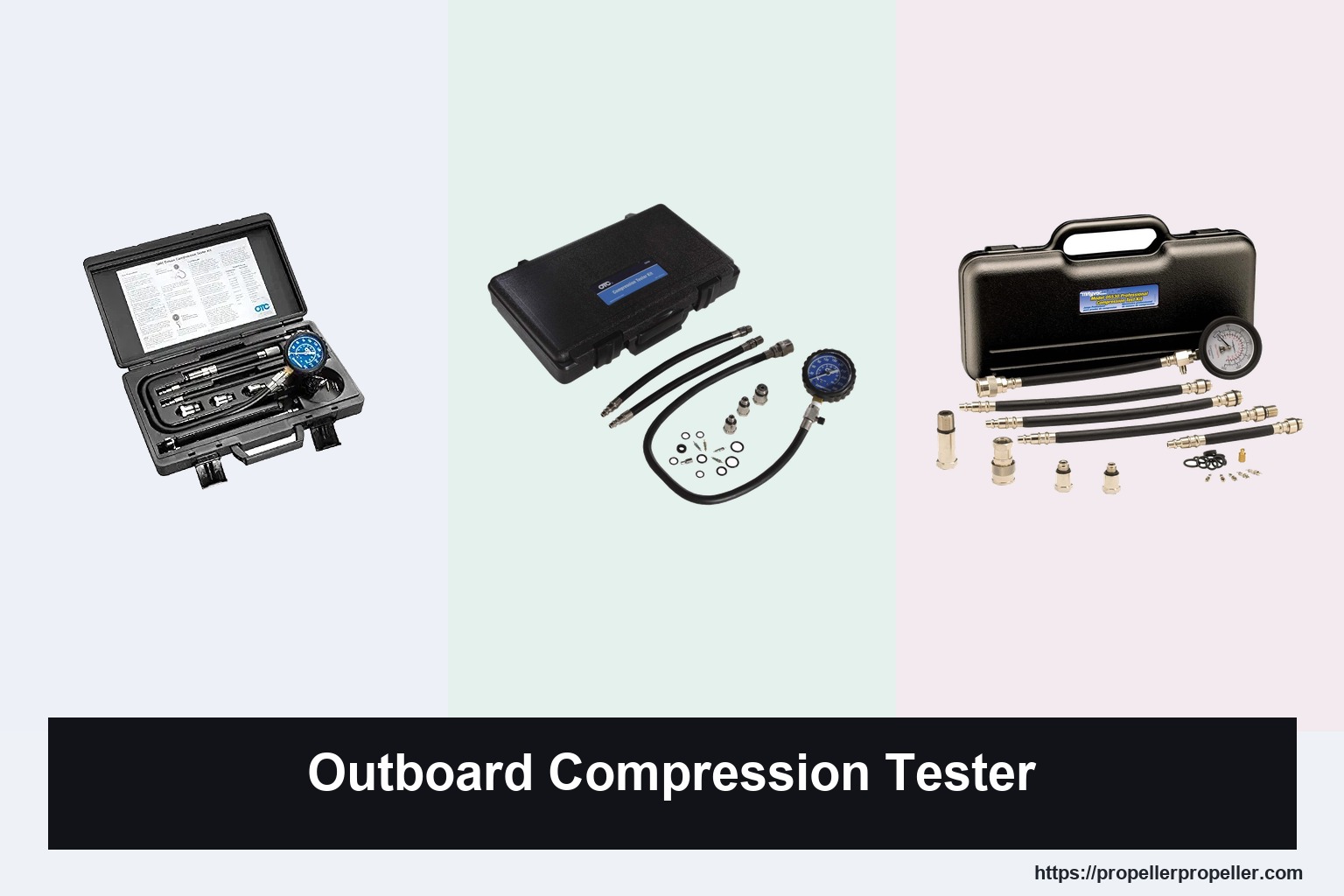
Compression testing is one of the fastest ways to separate a fuel or ignition problem from a mechanical one. For outboard owners, that matters because a weak cylinder can look like a carburetion issue, a bad plug, or a tuning problem until you measure it directly. A good tester needs to seal well, read clearly, reach awkward plug wells, and include the right adapters for marine-style engines without turning setup into a project.
This roundup focuses on practical tools that can handle gasoline engines, with an emphasis on reach, gauge readability, adapter coverage, and storage. Some kits are broader and better suited to mixed garages. Others are simpler and cheaper, which can be enough if you only need periodic checks. The best choice depends on how often you test, how hard your plugs are to access, and whether you want a compact kit or a more complete diagnostic set.
Top Outboard Compression Tester on the Market

OTC 5605 Deluxe Compression Kit
- 2-1/2 inch dual-scale gauge
- 25 inch flex hose
- Deep well connector included
- Nickel-plated metal components
- Hard case storage

OTC 5606 Compression Tester Kit
- Marine-compatible gasoline use
- Zero-adjust gauge
- 25 inch flex hose
- Nickel-plated finish
- Limited lifetime warranty

Mityvac MV5530 Compression Test Kit
- Dry and wet testing
- 2-3/4 inch Bourdon gauge
- Quick-disconnect coupler
- Manual pressure release
- Stainless steel parts

Innova 3612 Compression Tester Kit
- 15-inch rubber hose
- Side-release valve
- Bourdon tube gauge
- Works on marine applications
- Compact 4-piece kit

ZJERYL GULL 8-Piece Compression Tester
- 0-300 psi range
- Acrylic dial with cover
- 14-inch extension hose
- PVC carrying case
- Eight-piece kit
This article may contain affiliate links. As an Amazon Associate, the website may earn from qualifying purchases at no additional cost to you.
Outboard Compression Tester Reviews
OTC 5605 Deluxe Compression Kit
- Warranty Description
- One (1) year limited warranty
- Material Type
- Triton
- Thread Style
- 16mm
- Item Dimensions
- 3.5 x 15 x 4.6 inches
- Item Weight
- 2.09 g
Advantages
- Wide adapter coverage
- Long flex hose
- Corrosion-resistant finish
- Organized hard case
- Clear dual-scale gauge
Limitations
- Higher price than basic kits
- Not the lightest option
The OTC 5605 is the most complete option here for buyers who want one kit that can cover more than a single outboard job. Its 2-1/2 inch dual-scale gauge gives you a direct psi and kPa reading, which matters when you want a clean, unambiguous result instead of translating between units. The 25 inch flex hose is long enough to keep the gauge in view when the plug location is buried in a crowded engine bay. That combination makes the kit feel deliberately built for access, not just measurement.
The adapter mix is where this kit earns its place. It includes a deep well connector for recessed plug wells, a Ford Triton adapter, and multiple thread adapters, so you are less likely to stop mid-job because the engine uses an awkward plug style. The nickel-plated metal components are a useful durability choice because they resist corrosion better than bare metal in a marine-minded tool set. The blow-molded case also matters. Compression testers get messy in storage, and keeping the hoses and adapters organized saves time when you need to confirm a cylinder quickly.
Against the rest of this group, the OTC 5605 stands out for breadth rather than simplicity. It is more expensive than the budget kits, but the broader adapter coverage and deeper accessory set reduce the chance that you will need another tester later. The one-year limited warranty is more modest than some buyers may hope for, yet the kit’s overall package is still the strongest all-around match for someone who wants fewer compromises. Choose this one if you want the most versatile tester in the roundup and you expect to service more than one engine type.
PHOTO: OTC 5605 Deluxe Compression – Open Case Kit → Source: Amazon.com
OTC 5606 Compression Tester Kit
- Warranty Description
- Limited lifetime warranty
- Material Type
- Metal
- Item Dimensions
- 14.95 x 9.85 x 3.65 inches
- Item Weight
- 1.61 g
- Part Number
- 5606
Advantages
- Broad gasoline-engine coverage
- Zero-adjust gauge
- Long flex hose
- Corrosion-resistant finish
- Limited lifetime warranty
Limitations
- Fewer specialty adapters than top kit
- No deep well connector
The OTC 5606 is the safer pick when your testing goes beyond one type of gasoline engine. It is described for domestic, import, motorcycle, marine, and small engines, so it fits a garage that sees more than just a single application. The 2-1/2 inch diameter gauge reads both psi and kPa, and the zero-adjust feature is a useful detail for anyone who wants the needle set cleanly before a test begins. That makes the result easier to trust at a glance.
The hose and adapter setup are practical rather than flashy. The 25 inch flex hose helps when a plug sits deep in a compartment or near other hardware that blocks a straight approach. The included 10mm, 12mm, 14mm, and 18mm adapters, plus the flat- and tapered-seat compatibility, give it enough range for a wide variety of gasoline engines. The nickel-plated metal finish adds some insurance against the corrosion that can shorten the life of a tool that is stored in a damp garage or used around marine equipment.
Compared with the 5605, this one gives up some specialty depth but keeps the useful parts of the package. It is slightly lighter, and the limited lifetime warranty is a stronger long-term ownership signal than the shorter coverage on some rivals. That makes it a good middle ground for buyers who want a durable, do-everything compression tester without paying for every niche adapter under the sun. If your engine mix is varied and you value a longer warranty, this is the more balanced choice.
PHOTO: OTC 5606 Compression Tester – Storage Case Kit → Source: Amazon.com
Mityvac MV5530 Compression Test Kit
- Warranty Description
- 1 yr warranty on material and workmanship
- Material Type
- Stainless Steel
- Thread Style
- Metric
- Item Dimensions
- 14.5 x 8.3 x 3.2 inches
- Item Weight
- 3.4 pounds
Advantages
- Dry and wet testing
- Large gauge face
- Quick accessory swaps
- Stainless steel build
- Air-hold adapter
Limitations
- Not for diesel engines
- Heavier than simpler kits
The Mityvac MV5530 is the most diagnostic-focused tool in the group. It is designed for dry and wet compression tests, which gives you more information than a basic gauge when you are trying to distinguish rings, valves, head problems, or other mechanical faults. The 2-3/4 in. Bourdon tube gauge is the largest gauge in this roundup, and that extra size helps when you want a reading you can check quickly in a cramped work area. The manual pressure release is also important because it lets you clear the gauge deliberately between tests.
This kit is built around flexibility at the adapter end as well. It includes threaded adapters for motorcycles, marine engines, and small engines, along with an air-hold adapter for repair work that does not require cylinder-head removal. The quick-disconnect coupler speeds accessory changes, which becomes valuable when you are comparing cylinders one after another. Stainless steel construction is another meaningful durability point, especially for a tool that may live in a damp shop or marine environment. The downside is weight. At 3.4 pounds, it is less featherlight than simpler kits, but that mass is part of the more substantial build.
Against the OTC options, the Mityvac is less about broad all-purpose coverage and more about deeper diagnosis. It also comes with the clearest limit in this roundup: it is not designed for diesel engines. For buyers focused on gasoline outboards, motorcycles, and small-engine work, that is not a problem. In fact, the added diagnostic functions may matter more than having the widest possible adapter box. Choose this one if you want the most serious troubleshooting kit and you value test control over sheer convenience.
PHOTO: Mityvac MV5530 Compression Test – Carrying Case Kit → Source: Amazon.com
Innova 3612 Compression Tester Kit
- Warranty Description
- 1 year limited
- Material Type
- Alloy Steel, Rubber
- Thread Style
- Metric
- Item Dimensions
- 12 x 15 x 5 inches
- Item Weight
- 8 ounces
Advantages
- Lowest price here
- Side-release valve
- Marine application support
- Clear dual-scale gauge
- Compact four-piece kit
Limitations
- Shorter hose than premium kits
- Less adapter breadth
The Innova 3612 is the most approachable entry point in the group. It is aimed at diagnosing damaged pistons, worn rings, burnt valves, and blown head gaskets, which tells you exactly what kind of job it is built for. The 2-1/2-inch dial face is easy to read, and the dual-calibrated scale gives you both psi and kPa without extra mental math. The 15-inch rubber hose is shorter than the long-hose kits above, but it still covers a lot of routine testing when the plug access is not especially hostile.
The hose and valve layout are geared toward efficiency. The side-release valve lets you repeat a test without disconnecting the hose, which saves a few steps every time you move from cylinder to cylinder. Its adapters cover 12mm, 14mm, and 18mm thread sizes, and the kit is described for motorcycle, ATV, snowmobile, and marine applications as well as domestic and import vehicles. That is a strong spread for the price. The tradeoff is that the overall kit is less elaborate than the pricier options, so you get function first rather than a more expansive accessory set.
Compared with the other testers here, the Innova wins on value and loses on depth. It lacks the broad specialty coverage and premium construction cues of the top kits, but it also costs far less. For many outboard owners who only need periodic compression checks, that is the right balance. It is the one I would point to for buyers who want a straightforward gauge, enough adapter range for common jobs, and a price that stays comfortably lower than the professional-grade kits.
PHOTO: Innova 3612 Compression Tester – Gauge and Hose → Source: Amazon.com
ZJERYL GULL 8-Piece Compression Tester
- Number of Items
- 3
- Material Type
- Plastic red
- Item Dimensions
- 4.7 x 9 x 1.5 inches
- Item Weight
- 1.3 pounds
Advantages
- Lowest price overall
- Acrylic dial cover
- PVC carrying case
- Multiple adapter sizes
- Compact starter kit
Limitations
- More basic construction
- Less refined for heavy use
The ZJERYL GULL 8PCS kit is the simplest and least expensive option in this group, which makes it useful for buyers who want a basic compression check without paying for a heavier-duty professional set. The 0-300 psi range covers the usual gasoline-engine compression window, and the acrylic dial with rubber cover is meant to stay readable while taking some abuse in storage. The kit format is straightforward. You get a gauge, cone ends, metal adapters, and a 14-inch extension hose, which is enough to get started on common petrol engines.
Its value depends on expectations. The PVC carrying case keeps the pieces together and protects the gauge during transport, which is helpful if the tool will live in a truck box or shelf drawer rather than a dedicated shop cabinet. The adapter set is broad enough for routine use, with M10, M12, M14, and M18 pieces, plus straight and curved rubber cone ends for general gasoline testing. What it does not offer is the refined build and extra diagnostic polish of the more expensive kits, so the savings come with a more basic feel.
Relative to the rest of the lineup, this is the least specialized choice but also the easiest on the budget. It is the one to consider if your priority is occasional use and simple cylinder checks rather than frequent diagnostic work. Buyers who need a compact starter kit will appreciate the price, but anyone who values long hose reach, premium metal construction, or a wider professional accessory set will be better served by one of the higher-end options above. It is a sensible entry point, not a long-term upgrade path.
PHOTO: ZJERYL GULL 8-Piece Compression – Red Case Kit → Source: Amazon.com
How to Choose an Outboard Compression Tester
The right compression tester should do more than produce a number. For outboard use, it needs enough reach to clear covers and cowls, a gauge you can read quickly, and adapters that seal without constant improvisation. A cheap kit can work for a simple health check, but once access gets tight or plug styles vary, convenience starts to matter as much as the gauge itself.
Gauge Readability
A compression test is only useful if the reading is easy to capture and trust. Larger faces are generally easier to read in poor light and when you are leaning over a crowded engine. Dual-scale gauges are also practical because many technicians think in psi while others prefer kPa. A clear dial does not make the tool more accurate by itself, but it reduces the chance of misreading a result when you are comparing cylinders quickly.
Adapter Coverage
Outboard and marine-adjacent engines can vary more than many buyers expect, so the adapter set matters a lot. Look for a kit that covers common thread sizes and includes pieces that can seal well on different plug styles. Flat-seat and tapered-seat compatibility is worth paying attention to because it expands the number of engines you can service without extra parts. If you already know your plug type, focus on a kit that matches it cleanly rather than buying the broadest package available.
Hose Length and Access
Reach is one of the most practical differences between testers. A longer flex hose can keep the gauge visible when the plug is recessed or surrounded by hoses, brackets, or wiring. Shorter hoses can still work fine on open engines, but they become more frustrating as access gets tighter. For marine work, where equipment is often crowded and awkwardly placed, hose length is one of the first features that affects how pleasant the tool is to use.
Build and Storage
A compression tester often sits unused for long periods, so how it stores matters. Corrosion-resistant finishes are useful around boats because damp air and salt exposure can shorten the life of exposed metal. A hard case or structured storage box also protects adapters from getting lost, which is important because a kit is only as useful as its smallest seal. If you plan to move the tester between home, dock, and truck, sturdy storage becomes a real convenience feature rather than a bonus.
Test Control
Some testers do more than show pressure. A manual pressure release or side-release valve can speed repeated checks because you do not need to fully disconnect the hose every time. That is helpful when you are diagnosing multiple cylinders in a row. Features like air-hold adapters or support for wet and dry testing matter when you want deeper fault isolation. These are not essential for every buyer, but they are valuable if your goal is diagnosis rather than a one-time snapshot.
Compression Tester Comparison Table
| Product | Best For | Warranty | Weight | Size | Thread Style | Material Type |
|---|---|---|---|---|---|---|
| OTC 5605 Deluxe Compression Kit | Best Overall Kit | One (1) year limited warranty | 2.09 g | 3.5 x 15 x 4.6 inches | 16mm | Triton |
| OTC 5606 Compression Tester Kit | Best for Mixed Engines | Limited lifetime warranty | 1.61 g | 14.95 x 9.85 x 3.65 inches | Not Specified | Metal |
| Mityvac MV5530 Compression Test Kit | Best Diagnostic Kit | 1 yr warranty on material and workmanship | 3.4 pounds | 14.5 x 8.3 x 3.2 inches | Metric | Stainless Steel |
| Innova 3612 Compression Tester Kit | Best Budget Pick | 1 year limited | 8 ounces | 12 x 15 x 5 inches | Metric | Alloy Steel, Rubber |
| ZJERYL GULL 8-Piece Compression Tester | Best Entry Kit | Not Specified | 1.3 pounds | 4.7 x 9 x 1.5 inches | Metric | Plastic red |
How We Tested & Analyzed Outboard Compression Tester
This guide was built around the most decision-relevant traits for compression testing in an outboard context: gauge clarity, hose reach, adapter variety, sealing approach, storage, and long-term durability. Those categories matter because compression work is often done in awkward spaces where a theoretically capable tool can still be frustrating if the gauge cannot be seen or the adapter does not seat cleanly. I prioritized features that change actual use, not just marketing language.
Comparison focused on the practical spread between basic, midrange, and more complete kits. That meant weighing whether a tester was best for occasional checks, mixed-engine ownership, or deeper diagnostics. Kits with stronger accessory coverage and better access features were favored for versatility, while simpler and less expensive options were treated as value picks when their limitations were clear and acceptable. Warranty, materials, and case design were also considered as indicators of ownership convenience.
I also treated missing information carefully. When a product record did not provide a meaningful detail, that detail was left out rather than inferred. The result is an editorial ranking based on verified differences that affect setup, compatibility, and day-to-day use. For a tool like this, that approach matters because the wrong hose length or adapter style can be a bigger problem than a small difference in price.
Frequently Asked Questions
What makes a compression tester useful for outboards?
For outboard use, the main priorities are adapter fit, reach, and readability. A tester should connect securely to the plug type you actually have and let you see the gauge without fighting the engine layout. Because marine compartments are often tight, hose length and a clear dial can matter as much as the pressure range.
Do I need a long hose on a compression tester?
Not always, but it helps more often than buyers expect. A longer flex hose keeps the gauge visible when the plug is recessed or surrounded by hardware. If your engine is easy to access, a shorter hose can be fine. If the plugs sit deep or behind covers, extra length reduces frustration.
Why does adapter compatibility matter so much?
A compression tester is only as useful as its seal. Different engines can use different thread sizes and seat styles, so the wrong adapter can waste time or give unreliable readings. A broader adapter set is useful if you service multiple engines. If you only have one engine type, matching that thread style is usually the smarter move.
Is a more expensive compression tester always better?
Not always. Higher-priced kits usually bring more adapters, better storage, or extra diagnostic features, but those advantages only matter if you will use them. For occasional checks, a simpler kit can be perfectly adequate. The better choice is the one that matches your access needs, engine variety, and how often you will actually test.
Final Thoughts
Compression testing is one of the most direct ways to judge whether an outboard issue is mechanical or something easier to fix. That is why the best tester is not just the one with the highest price or the largest accessory count. It is the one that seals well, reaches the plug comfortably, and gives you a reading you can trust without wasting time on setup.
For buyers who want the broadest, most adaptable kit, the top OTC option is the strongest all-around pick. If you need deeper diagnostic control, the Mityvac stands out. Budget-conscious owners can still get solid utility from the Innova or the ZJERYL GULL starter kit, depending on how often they test. Choose for access, sealing, and the engines you actually service, and you will end up with a tool that pays for itself the first time it rules out a bigger problem.