
How to Drive a Boat: A Beginner’s Safe Operating Sequence
To drive a boat safely, prepare the boat and crew before departure, start and operate the engine using the procedures for that specific vessel, maintain a proper lookout, and use the Navigation Rules whenever other vessels are involved. Slow, deliberate control matters most near docks, shorelines, and other boats; formal instruction is the sensible starting point for a new operator.
The exact controls, starting sequence, and handling response vary by hull, propulsion system, and engine. I would treat the boat’s owner’s manual and a recognized boating-safety course as prerequisites to operating an unfamiliar boat alone.
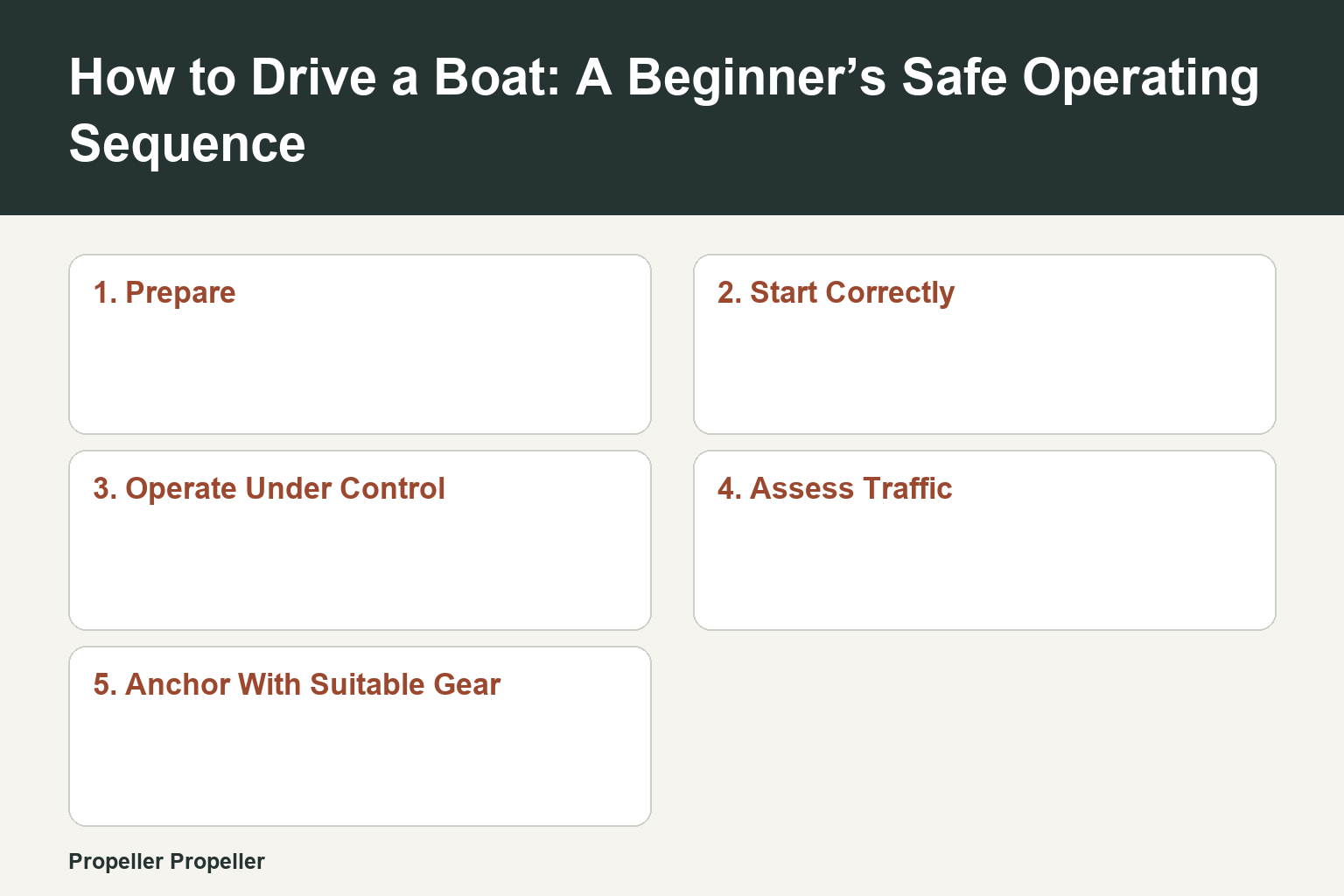
- PrepareConfirm applicable requirements, required equipment, and crew readiness before departure.
- Start CorrectlyWith passengers aboard and clear of boarding activity, use the engine-specific procedure; attach a fitted kill-switch lanyard as directed.
- Operate Under ControlGet clear of close-quarters areas cautiously and maintain a continuous lookout.
- Assess TrafficRecognize head-on, crossing, or overtaking situations and use Navigation Rules to avoid collision.
- Anchor With Suitable GearMatch the anchor system to the vessel, depth, and conditions, with secure attachment.
Safe boat operation moves from preparation to controlled underway operation, continuous collision avoidance, and condition-appropriate anchoring; engine-specific procedures remain governed by the applicable manufacturer instructions.
Start With Legal Readiness and Safety Equipment
The person operating a recreational boat is responsible for meeting applicable operating rules and carrying required safety equipment. Federal requirements are only part of the picture: state and local requirements may also apply. Before taking the helm, confirm that the boat is properly equipped for the intended trip and that you understand the rules governing the waters where you will operate.
1Learn the rules for your operating area
Review the applicable federal, state, and local requirements before departure. Navigation Rules provide the common framework vessels use to avoid collision when meeting, crossing, or overtaking.
2Take formal boating instruction
Complete a boating-safety course and get supervised practice in the boat you intend to operate. The Coast Guard identifies lack of instruction as a frequent factor in fatal boating incidents.
3Account for the people aboard
Make sure passengers know basic onboard safety expectations before the boat gets underway. The operator should remain responsible for the vessel and its required equipment throughout the trip.
| Area | What the Operator Needs to Establish | Why It Affects Operation |
|---|---|---|
| Rules and equipment | Applicable federal, state, and local requirements; required onboard equipment | The operator is responsible for compliant, safe operation. |
| Crew status | Everyone is aboard and settled before engine start | Passengers should not board or leave while the engine is being started. |
| Engine procedure | The starting directions for the installed boat and engine | Controls and startup instructions are vessel- and engine-specific. |
| Traffic awareness | A continuous lookout and basic Navigation Rules knowledge | Meeting, crossing, and overtaking situations require predictable collision-avoidance conduct. |
Sources: A Boater's Guide to the Federal Requirements for Recreational Boats · UNITED STATES COAST GUARD NAVIGATION RULES
Prepare the Boat Before Starting
A controlled departure begins while the boat is still secured. Check that the crew is settled and that you can operate without anyone boarding or stepping ashore during engine start. For a Yanmar Dtorque 111, the manufacturer specifically directs the operator to attach the kill-switch lanyard before startup; other engines may use different controls or sequences, so use the manual for the engine installed on your boat.
1Secure the crew before engine start
Do not start the engine while passengers are boarding or alighting. Have everyone aboard and situated before proceeding.
2Set up the operator safety device if fitted
Attach the kill-switch lanyard to yourself before starting when your engine is equipped with one. This is a specific Dtorque 111 instruction; confirm the arrangement and procedure for your own engine.
3Use the vessel-specific starting procedure
Start the engine only as directed by the boat and engine manufacturers. Do not substitute a generic starting sequence for the instructions supplied with an unfamiliar vessel.
Sources: Owner’s manual Dtorque 111 · A Boater's Guide to the Federal Requirements for Recreational Boats
Get Underway With Space and a Lookout
Once underway, the operator’s job is not simply to point the boat toward a destination. Keep watch in the direction of travel and around the vessel, assess other traffic early, and make maneuvers that other operators can understand. Navigation Rules create a consistent approach to boats meeting head-on, crossing, and overtaking, but they do not eliminate the need for attention and judgment.
1Move away from the dock or launch area cautiously
Use deliberate, low-speed control until clear of nearby boats, people, and fixed structures. Keep the boat under control rather than treating acceleration as the first objective.
2Maintain a proper lookout
Continuously watch for vessels and conditions that may affect your course. Do not assume another operator has seen you or will make the maneuver you expect.
3Identify the traffic situation early
Determine whether vessels are meeting head-on, crossing, or overtaking. Apply the Navigation Rules appropriate to that situation and act in time to avoid collision.
- Head-on, crossing, and overtaking situations are governed by Navigation Rules.
- The rules serve the same broad purpose on the water that road rules serve on land: predictable conduct among users.
Use the Navigation Rules to Avoid Collisions
Right-of-way is not a license to continue unchanged into danger. The practical purpose of the Navigation Rules is collision avoidance. When another vessel is involved, first recognize the situation, then take the action required by the rules while continuing to keep watch. If you are unsure how to apply a rule in real traffic, create more space and seek qualified instruction rather than relying on a guess.
- A head-on situation requires attention from both vessels.
- A crossing situation requires identifying which vessel must keep clear under the rules.
- An overtaking vessel has responsibilities when passing another vessel.
| Situation | What It Means | Operating Focus |
|---|---|---|
| Head-on | Two vessels are approaching each other | Recognize the developing encounter and apply the relevant Navigation Rules. |
| Crossing | One vessel is approaching from the side | Determine the rule-based responsibility early and avoid a collision. |
| Overtaking | One vessel is passing another from behind | The passing maneuver has specific Navigation Rules responsibilities. |
| Any uncertain situation | You cannot confidently predict the other vessel’s action | Keep watch, create space where possible, and avoid relying on assumptions. |
Anchor Only After Matching Gear to Conditions
Anchoring is a separate boat-handling task, not merely a way to stop the boat. The anchor, chain, or line need to suit the vessel, water depth, and conditions, and the system must be securely attached. Before relying on an anchor, understand the equipment installed aboard and choose an anchoring location and method appropriate to the conditions.
1Check the anchoring system before you need it
Confirm that the anchor, chain, or line is secure and appropriate for the vessel and expected conditions.
2Consider depth and conditions
Select and use anchoring gear with the water depth and prevailing conditions in mind. Do not assume one setup suits every location or trip.
3Prepare for water removal needs
Carry the required manual bilge pump or bailer for the vessel, as applicable, as part of onboard emergency preparedness.
Sources: Safe Boating Guide · A Boater's Guide to the Federal Requirements for Recreational Boats
Frequently Asked Questions
Do I need a course before driving a boat?
Formal boating-safety training is strongly advisable before operating independently. The Coast Guard guide notes that many fatal incidents involve operators who lacked instruction, and training helps establish the safety and rule knowledge that manuals alone cannot provide.
Who is responsible for safety equipment on a recreational boat?
The operator is responsible for ensuring the boat meets applicable requirements and carries required equipment. Requirements may come from federal, state, and local authorities.
What should I do if another boat is approaching?
Keep a lookout, identify whether the vessels are meeting, crossing, or overtaking, and apply the relevant Navigation Rules early enough to avoid collision. Do not assume the other operator has seen you.
Should I attach the kill-switch lanyard before starting?
If the boat has a kill-switch lanyard, use it according to the engine manufacturer’s directions. Yanmar’s Dtorque 111 manual specifically says to attach it to the operator before startup.
Can I use any anchor setup in shallow or deep water?
No. Transport Canada advises matching the anchor, chain, or line to the vessel, water depth, and conditions, with secure attachment. The appropriate arrangement can change with those factors.
Final Thoughts
Learn the applicable rules, prepare the boat and crew before startup, and practice under qualified supervision. When operating, keep the boat under control, maintain a lookout, and make collision avoidance your constant priority.



