
A dual purpose marine battery has to do two jobs that can pull in different directions: deliver a strong burst for an outboard start, then keep electronics and trolling loads running. The choices here range from compact Group 24 100Ah lithium units to Group 31 batteries with 2112Wh of stored energy, plus an AGM alternative for buyers who prefer that battery chemistry.
The deciding details are cranking current, case group, usable energy, cold-weather charging provisions, reserve behavior and the exact charging-system compatibility of your outboard. I would start by confirming the engine’s charging regulator and the battery compartment size, then choose capacity based on how much time your electronics need to run after the engine starts.
Top Dual Purpose Marine Batteries on the Market

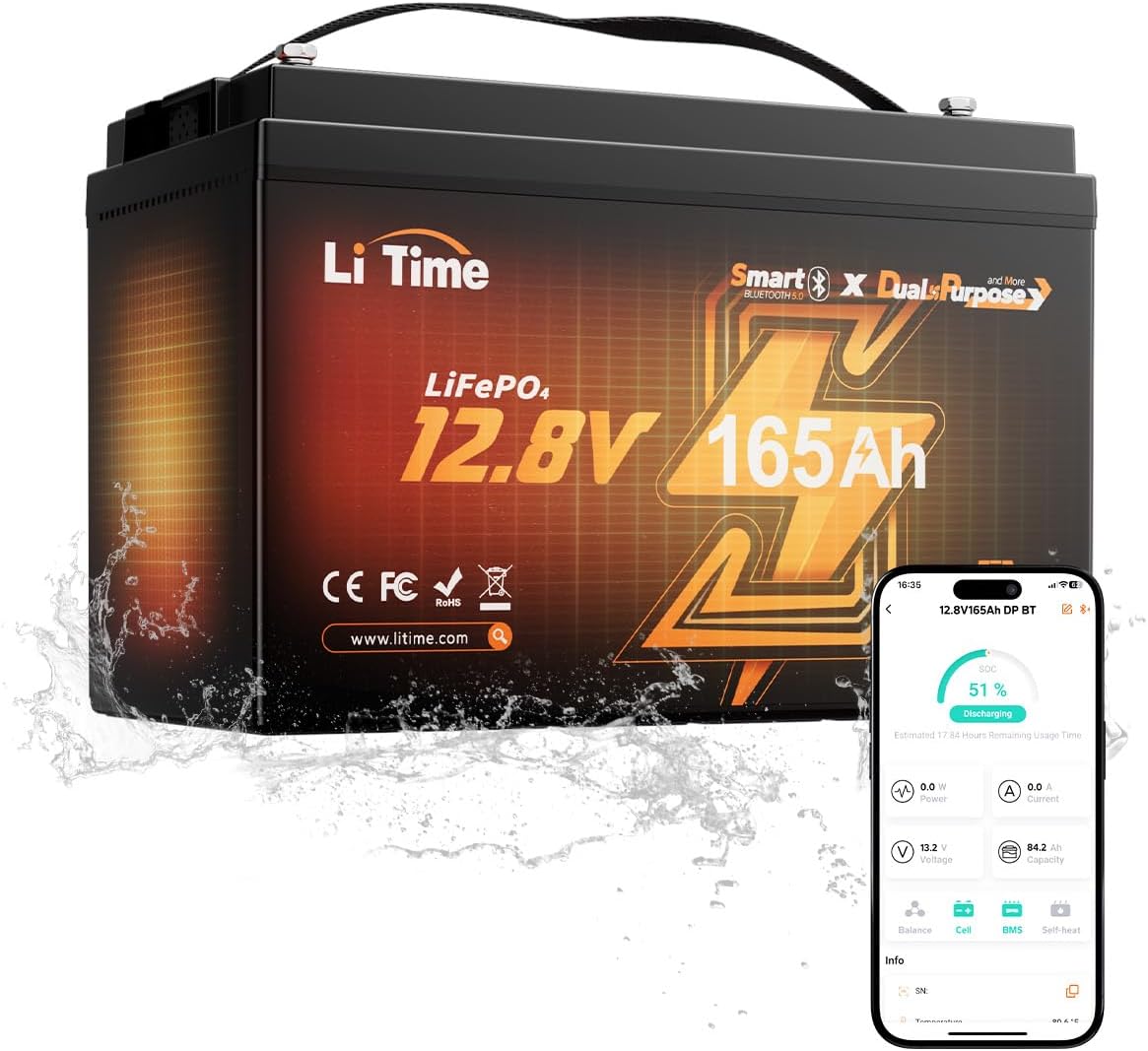
Litime 12V 165Ah Marine Battery
- 1200CCA at 14°F
- 2112Wh capacity
- Group 31 case size
- 15% emergency reserve
- Self-heating charging

Power Queen 12V100Ah Group 24 Battery
- 900CCA starting current
- 100Ah capacity
- Group 24 case size
- IP67 protection
- Bluetooth monitoring

Power Queen 12V100Ah Cranking Battery
- 900CCA starting current
- 100Ah capacity
- Group 24 case size
- IP67 protection
- Bluetooth monitoring

Redodo 100Ah Group 27 Two-Pack
- Two 100Ah batteries
- 900 CCA starting current
- Group 27 case size
- Bluetooth 5.0 monitoring
- IP67 waterproof housing

Odyssey 34M-PC1500ST-M Marine Battery
- 850 CCA rating
- AGM battery chemistry
- Maintenance-free design
- -40°C to 80°C operation
- Vibration-resistant design

Redodo 165Ah 1200CCA Marine Battery
- 1200CCA starting current
- 2112Wh capacity
- Group 31 case size
- IP67 protection
- Bluetooth with OTA updates
Redodo 165Ah Lithium Starting Battery
- 1200 CCA at 14°F
- 2112Wh capacity
- Group 31 case size
- IP67 protection
- Bluetooth 5.0 monitoring

Redodo 165Ah Group 31 Two-Pack
- Two 165Ah batteries
- 1200CCA starting current
- 2112Wh per battery
- Group 31 case size
- IP67 protection
Detailed Product Reviews
Litime 12V 165Ah Marine Battery
- Starting Current
- 1200CCA(@14°F)
- Group Size
- Group 31
- Battery Voltage
- 12V
- Capacity
- 2112Wh
- Emergency Reserve
- 15%
Advantages
- 1200CCA at 14°F
- 2112Wh stated capacity
- Group 31 case size
- 15% emergency reserve
- Self-heating charging
Limitations
- Not compatible with LiveScope system chargers
- Not for unregulated outboards or inboard systems
I would choose the Litime for a boat that needs one battery to handle outboard starting and a substantial electronics load. Its 1200CCA(@14°F) rating and 2112Wh capacity give it a clearly larger stated energy reserve than the 100Ah options in this group. That combination suits a Group 31 installation where replacing separate cranking and house batteries is the goal.
The 15% emergency reserve automatically cuts off discharge below that state of charge to preserve starting power. Self-heating activates below 32°F for charging and the battery stops discharge at –4°F, which makes its cold-weather rules important to understand before a winter trip. It is intended for ABYC-compliant installations and is compatible with many Honda, Suzuki, Evinrude and Tohatsu outboards. It is not compatible with LiveScope fish finder system chargers, unregulated outboards including Evinrude, Johnson and Mercury Black Max, or MerCruiser and inboard systems.
Compared with the Power Queen 12V100Ah Dual Purpose Deep Cycle Starter Lithium Marine Battery, the Litime supplies 2112Wh rather than 100Ah and uses a Group 31 case rather than Group 24. Choose the Litime when your compartment and power plan call for the larger Group 31 battery. The Power Queen is the more appropriate alternative when a Group 24 replacement is required.
Power Queen 12V100Ah Group 24 Battery
- Starting Current
- 900CCA
- Group Size
- group 24
- Capacity
- 100Ah
- Ingress Protection
- IP67
- Emergency Reserve
- 15%
Advantages
- 900CCA starting current
- Group 24 case size
- IP67 ingress protection
- Bluetooth battery monitoring
- 15% emergency reserve
Limitations
- Not compatible with unregulated specified outboards
- Limited to stated fuel outboards up to 250HP
The Power Queen suits a boat built around a Group 24 battery tray that needs both starting support and deep-cycle power without changing to a larger case. It combines 900CCA with 100Ah capacity, and its stated use includes fuel outboards up to 250HP. That is a focused choice for anglers running a trolling motor and electronics alongside a compatible fuel outboard.
Bluetooth monitoring reports battery capacity, operating current, estimated remaining runtime and fault alerts. The battery also holds a 15% emergency reserve. Its IP67 rating addresses water and dust ingress, while the self-heating system is designed to restore charging in freezing conditions. Low-temperature protection stops charging below 32°F. Verify that the boat’s outboard has a voltage regulator before installation, since the stated exclusions include unregulated Evinrude, Johnson and Mercury Black Max models.
Against the Power Queen 12V100Ah Dual Purpose Cranking Starting Lithium Marine Battery, the published core specifications are the same, including 900CCA, 100Ah, Group 24 sizing, IP67 protection and a 15% reserve. This version specifically states that it is not compatible with unregulated Evinrude, Johnson and Mercury Black Max motors. That explicit restriction makes charging-system verification especially important for this exact model.
Power Queen 12V100Ah Cranking Battery
- Starting Current
- 900CCA
- Group Size
- group 24
- Capacity
- 100Ah
- Ingress Protection
- IP67
- Emergency Reserve
- 15%
Advantages
- 900CCA starting current
- 100Ah stated capacity
- Group 24 case size
- IP67 ingress protection
- Bluetooth battery monitoring
Limitations
- Charging stops below 32°F
- Verify outboard charging-system compatibility
This Power Queen is for a Group 24 dual-purpose setup where checking the battery’s status from a phone matters as much as its basic starting and deep-cycle roles. It has 900CCA cranking performance and 100Ah capacity, with stated support for fuel outboards up to 250HP. Its intended load mix includes trolling motors and marine electronics after engine startup.
Bluetooth monitoring provides capacity, operating current, estimated remaining runtime and fault alerts. The 15% reserve is designed to retain power for an engine start. The IP67-rated enclosure is specified for water and dust protection, and self-heating supports charging in freezing conditions. Charging automatically stops below 32°F, so charging conditions still need attention during cold-weather storage and use.
The Power Queen 12V100Ah Dual Purpose Deep Cycle Starter Lithium Marine Battery is the closest selected alternative because both models share the same 900CCA, 100Ah, Group 24 and IP67 specifications. The other Power Queen expressly identifies several unregulated outboard exclusions. Pick this model only after confirming the exact motor and charging-system fit, rather than assuming two similarly specified Group 24 batteries have identical compatibility.
Redodo 100Ah Group 27 Two-Pack
- Starting Current
- 900 CCA
- Group Size
- Group27
- Capacity
- 100Ah
- Battery Quantity
- 2 Pack
- Dimensions
- 12.13 “L x 6.69” W x 8.31 “H
Advantages
- Two batteries in one package
- 900 CCA starting current
- Group 27 dimensions stated
- Bluetooth 5.0 monitoring
- IP67 waterproof housing
Limitations
- May require proper charger or DC-to-DC converter
- Not for generators without voltage regulators
The Redodo two-pack makes sense for a boat that needs two matching 12V batteries rather than a single larger unit. Each battery is specified at 100Ah and 900 CCA, while the package contains two batteries. That format can suit separate battery positions or a planned multi-battery installation, provided the boat’s wiring design and charging equipment support it.
Each Group 27 battery measures 12.13 “L x 6.69” W x 8.31 “H” and is listed at 23.1 pounds. Bluetooth 5.0 monitoring, IP67 housing, self-heating and an approximately 25% energy reserve are included. The reserve can be overridden through the app or by holding the battery button for two seconds in an emergency. A proper charger or DC-to-DC converter may be required, depending on generator type.
Compared with the single Redodo 12V 165Ah Dual Purpose Lithium Marine Battery, this package provides two 100Ah batteries instead of one Group 31 2112Wh battery. I would choose this pair when two physical batteries are part of the boat’s electrical plan. Choose the single 165Ah Redodo when one Group 31 location must carry both starting and deep-cycle duties.
Odyssey 34M-PC1500ST-M Marine Battery
- Starting Current
- Cold Crank Amp (CCA)- 850
- Battery Chemistry
- AGM
- Operating Temperature
- -40degree Celsius (-40 degree Fahrenheit) to 80 degree Celsius (176 degree Fahrenheit)
- Maintenance
- No need to add water
- Battery Design
- Totally dry AGM design
Advantages
- 850 CCA rating
- AGM battery chemistry
- No water addition required
- Wide stated operating range
- Vibration-resistant design
Limitations
- No capacity value is stated
- Not for sale in Catalina Island
The Odyssey is the selected option for a buyer who specifically wants an AGM dual-purpose battery rather than lithium chemistry. Its AGM construction and 850 CCA rating establish its role as a maintenance-free starting and cycle-capable marine battery. It is a different battery technology choice, not a direct capacity match for the lithium models with stated amp-hour or watt-hour capacity.
The totally dry AGM design does not require adding water and is classified by the U.S. Department of Transportation as non-spillable. The stated operating range runs from –40°C to 80°C. Its vibration-resistant design is intended to address high-impact shock and mechanical vibration. The battery can be stored open circuit for up to two years or until 12.00V, whichever occurs first, before recharging is needed.
Compared with the Litime 12V 165Ah Dual Purpose Marine Cranking LiFePO4 Battery for Boat, the Odyssey uses AGM chemistry and is specified at 850 CCA rather than 1200CCA. The Litime publishes 2112Wh capacity and a 15% reserve feature, while those figures are not part of the Odyssey’s stated specifications. I would choose the Odyssey where AGM chemistry and its stated temperature range are the deciding requirements.
Redodo 165Ah 1200CCA Marine Battery
- Starting Current
- 1200CCA
- Group Size
- Group 31
- Capacity
- 2112Wh
- Engine Rating
- up to 300HP
- Ingress Protection
- IP67
Advantages
- 1200CCA starting current
- 2112Wh stated capacity
- Stated for outboards up to 300HP
- IP67 ingress protection
- Bluetooth monitoring and OTA updates
Limitations
- Not compatible with unregulated outboard motors
- Not for cars or unregulated generators
I would look at this Redodo when one Group 31 battery needs to support a larger compatible fuel outboard and deep-cycle marine loads. It pairs 1200CCA with 2112Wh capacity and is stated for fuel outboards up to 300HP. That published engine rating distinguishes it from the 100Ah Power Queen models, which state support up to 250HP.
The IP67-rated case and built-in heating pad are specified for harsh marine conditions and charging at –4°F. Bluetooth monitoring covers voltage and current, while OTA updates are available through the smartphone connection. Its approximately 15% energy reserve is intended to retain starting power, and a one-click forced startup is listed for emergencies. It is not for cars or generators without a built-in regulator, and it excludes certain Mercury series plus unregulated outboard motors.
Against the Redodo 12V 165Ah Dual Purpose Lithium Starting Battery, for Marine, this model adds a stated engine rating of up to 300HP and describes charging at –4°F. Both have 1200CCA, 2112Wh, Group 31 sizing and IP67 protection. Choose this version when the published up-to-300HP outboard fit matches the engine, while still confirming regulator compatibility.
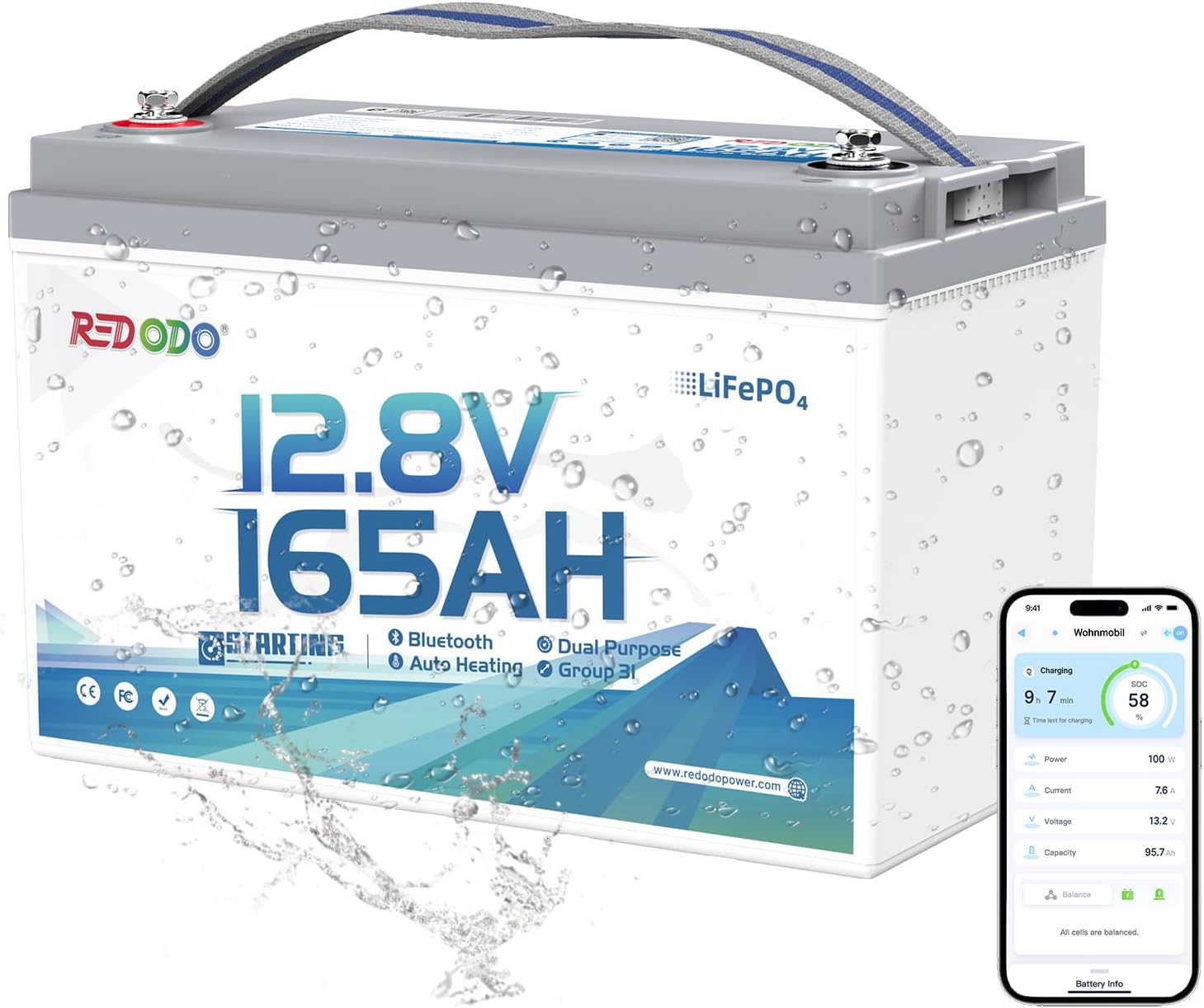
Redodo 165Ah Lithium Starting Battery
- Starting Current
- 1200 CCA
- Group Size
- Group 31
- Capacity
- 2112Wh
- Battery Chemistry
- Lithium
- Ingress Protection
- IP67
Advantages
- 1200 CCA at 14°F
- 2112Wh stated capacity
- Group 31 case size
- IP67 ingress protection
- Bluetooth 5.0 monitoring
Limitations
- Discharge disabled below 4°F
- Not compatible with unregulated outboards
This Redodo is a Group 31 lithium option for boaters seeking one battery for outboard cranking plus electronics such as fish finders and trolling motors. Its 1200 CCA rating at 14°F and 2112Wh energy give it the stated starting and deep-cycle credentials for that combined role. It is designed as a replacement for a dual-battery arrangement only where the boat’s electrical demands and fit are appropriate.
Bluetooth 5.0 connects to the Redodo app for status monitoring and discharge management, with OTA upgrades included. Auto-heating brings the battery from below 32°F to 50°F for charging. The battery disables discharge below 4°F, an operational limit that matters for very cold use. It has IP67 water and dust resistance and retains approximately 15% of power through its emergency reserve mode.
The Redodo 12V 165Ah Dual Purpose Lithium Marine Battery, 1200CCA is the most relevant alternative because it shares Group 31 sizing, 1200CCA, 2112Wh and IP67 protection. This model specifically states that discharge is disabled below 4°F. The other model instead specifies charging at -4°F and states an engine rating up to 300HP, so that model is better suited when that published engine rating is essential.
Redodo 165Ah Group 31 Two-Pack
- Starting Current
- 1200CCA
- Group Size
- Group 31
- Capacity
- 2112Wh
- Battery Quantity
- 2 Pack
- Engine Rating
- up to 300HP
Advantages
- Two 165Ah batteries included
- 1200CCA starting current
- 2112Wh per battery
- Stated for outboards up to 300HP
- IP67 ingress protection
Limitations
- Not compatible with unregulated outboards
- Batteries may arrive separately
The Redodo 165Ah two-pack is for a boat whose electrical layout calls for two substantial matching Group 31 batteries. The package includes 2 Pack batteries, each specified with 2112Wh deep-cycle energy and 1200CCA for compatible fuel outboards up to 300HP. This is a package decision for a two-battery system, not simply a substitute for one battery in a single tray.
Each battery has IP67 water and dust protection, self-heating support for charging at –4°F, Bluetooth monitoring and OTA updates. The stated reserve is approximately 25%, with a one-click forced startup for emergencies. The batteries can support parallel connections for higher CCA or a series arrangement described as up to a 48V 33.79kWh system. Items may arrive separately because of shipping size limits.
Compared with the single Redodo 12V 165Ah Dual Purpose Lithium Marine Battery, 1200CCA, this selection supplies two batteries and specifies an approximately 25% reserve rather than approximately 15%. Choose the two-pack when the boat has room and a planned electrical system for two Group 31 batteries. For one battery location, the single-battery model avoids buying a second unit that may not fit the intended installation.
How to Choose a Dual Purpose Marine Battery
The right battery starts with the boat’s physical tray and charging system, then comes down to how much cranking output and deep-cycle energy the day actually requires. Treat a dual-purpose battery as part of the complete electrical system rather than an isolated replacement part.
Confirm Engine Compatibility
Check the outboard manufacturer’s battery requirement and confirm that the motor has a voltage regulator before selecting a lithium starting battery. Several models here expressly exclude unregulated outboards, and some name particular engine families. An adequate CCA figure is not a substitute for charging-system compatibility. Also distinguish a marine outboard application from automotive or inboard use when a battery’s stated exclusions require it.
Match the Battery Group
Group size is the first fit check. A Group 24, Group 27 or Group 31 designation affects whether the battery suits the existing tray, hold-down and cable arrangement. Measure the available location and inspect terminal clearance before moving to a larger capacity class. Do not assume a higher-capacity battery will fit because it is still a 12V battery.
Balance Starting and Runtime
CCA describes stated cranking current, while Ah or Wh capacity describes stored energy in different units. For a boat with a demanding electronics load, capacity deserves as much attention as engine starting output. Estimate the combined draw of the loads you expect to run and the time they run. A dual-purpose battery simplifies a system, but it still has a finite energy budget.
Plan for Cold Conditions
Lithium batteries may include heating and low-temperature charge protection, but the trigger temperatures vary by model. Those features can support charging in cold weather under their stated conditions, not remove the need to follow the battery’s temperature limits. AGM and lithium designs also have different published operating details. Choose based on the climate and how the boat will be stored and charged.
Review Reserve Behavior
An emergency reserve keeps a stated portion of energy available for starting rather than letting accessory loads drain the battery completely. Reserve percentages differ, and some models offer an emergency override. Think of this as a safeguard for an appropriate installation, not permission to ignore battery state of charge. Monitoring can help you see capacity, current and fault information before the reserve is needed.
Set Up Charging Correctly
Verify charger, alternator and any DC-to-DC equipment requirements before installation. Some marine batteries specifically require a proper charger or DC-to-DC converter depending on generator type. A battery cannot correct an unsuitable charging source. Follow the battery manufacturer’s instructions and applicable marine electrical practices for secure mounting, wiring protection and charging connections.
Dual Purpose Marine Battery Comparison Table
| Product | Best For | Starting Current | Group Size | Capacity | Ingress Protection | Battery Voltage |
|---|---|---|---|---|---|---|
| Litime 12V 165Ah Marine Battery | For High-Capacity Single Battery | 1200CCA(@14°F) | Group 31 | 2112Wh | Not Specified | 12V |
| Power Queen 12V100Ah Group 24 Battery | For Group 24 Replacement | 900CCA | group 24 | 100Ah | IP67 | 12V |
| Power Queen 12V100Ah Cranking Battery | For Bluetooth Monitoring | 900CCA | group 24 | 100Ah | IP67 | 12V |
| Redodo 100Ah Group 27 Two-Pack | For Two-Battery Installations | 900 CCA | Group27 | 100Ah | IP67 | 12V |
| Odyssey 34M-PC1500ST-M Marine Battery | For AGM Battery Preference | Cold Crank Amp (CCA)- 850 | Not Specified | Not Specified | Not Specified | Not Specified |
| Redodo 165Ah 1200CCA Marine Battery | For Outboards Up to 300HP | 1200CCA | Group 31 | 2112Wh | IP67 | 12V |
| Redodo 165Ah Lithium Starting Battery | For Cold-Weather Monitoring | 1200 CCA | Group 31 | 2112Wh | IP67 | 12V |
| Redodo 165Ah Group 31 Two-Pack | For Dual Group 31 Banks | 1200CCA | Group 31 | 2112Wh | IP67 | 12V |
How We Evaluated Dual Purpose Marine Batteries
I compared the selected batteries by their stated starting current, capacity, group size, chemistry, environmental protection, reserve features and compatibility limits. I gave extra weight to facts that change installation or day-on-water planning, such as a published engine rating, physical group size, cold-weather controls and whether the package includes one or two batteries. Recommendations distinguish documented use cases rather than treating ratings or price as proof of performance.
Frequently Asked Questions
Can one dual purpose battery replace separate starting and house batteries?
It can when the battery’s stated cranking output, capacity, fit and charging compatibility match the boat’s engine and electrical loads. Replacement is a system decision. A boat with extensive accessories or long runtime demands may still need a separate battery bank.
What is the difference between CCA and capacity?
CCA is a stated measure of starting current under a specified cold test condition. Capacity is stored energy, commonly expressed as Ah or Wh. A battery can have strong cranking output yet provide less accessory runtime than a higher-capacity option.
Why does group size matter for a marine battery?
Group size helps identify the battery’s physical case class and affects tray fit, hold-down hardware and cable reach. Check the boat’s battery compartment rather than assuming that another 12V battery will fit the existing location.
Do lithium marine batteries work in freezing weather?
Some lithium models include self-heating and low-temperature protection, but their specified thresholds differ. Cold-weather charging and discharge limits still apply. Review the exact temperature provisions and ensure the boat’s charging setup is compatible before relying on a battery in freezing conditions.
What does IP67 mean on a marine battery?
IP67 is an ingress-protection rating for resistance to dust and water ingress under its rating conditions. It can be relevant around spray and moisture, but it does not replace secure mounting, protected terminals or appropriate marine electrical installation.
Should I choose a one-pack or two-pack battery option?
Choose based on the electrical layout and number of battery locations, not package quantity alone. A two-pack can suit a system designed for two matching batteries. Confirm space, wiring architecture, charging capability and whether parallel or series connections are supported for the planned system.
Final Thoughts
My main recommendation for a high-capacity single-battery setup is the Litime 12V 165Ah Dual Purpose Marine Cranking LiFePO4 Battery for Boat because it combines 1200CCA, 2112Wh and Group 31 sizing. Choose the Power Queen Group 24 models when that smaller case size is required. For a two-battery plan, the Redodo two-packs are purpose-built package options, provided the boat’s charging system, compartment space and outboard compatibility are confirmed first.



