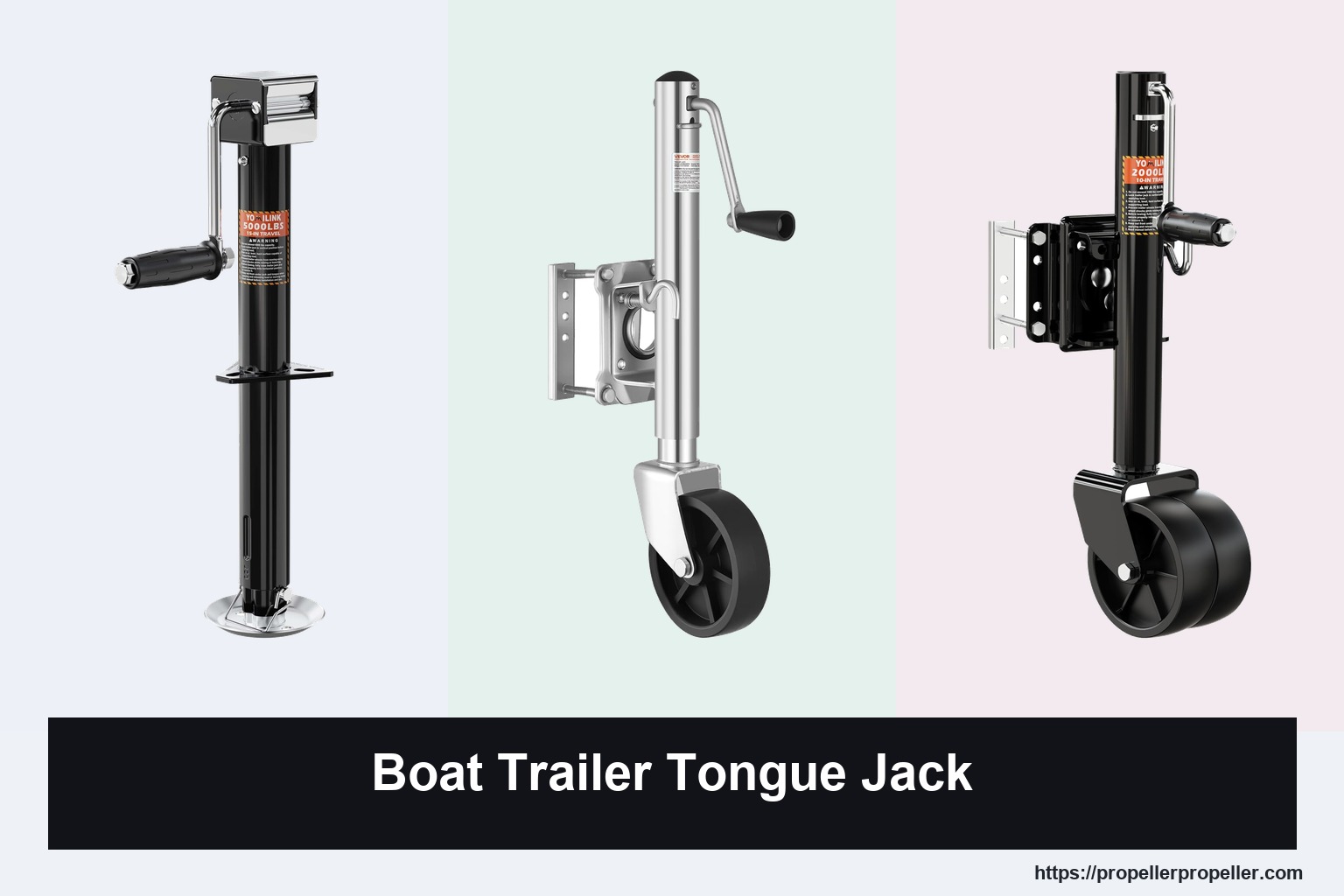
A boat trailer tongue jack has one job that matters every time you hitch, unhitch, or store the trailer: it has to lift smoothly, stay stable under load, and survive repeated exposure to water, grit, and corrosion. The right choice is not just about capacity. It is also about how much lift range you need, whether a wheel helps with maneuvering, how the mounting method fits your trailer tongue, and how much weight you are willing to carry on the trailer itself.
That is why the best options in this category vary so much. Some jacks emphasize higher lifting capacity and broad height adjustment for heavier trailer setups. Others trade raw capacity for easier rolling and compact swing-away convenience. The strongest picks below are the ones that balance strength, corrosion resistance, installation practicality, and everyday usability for boat trailers, with each model serving a different kind of buyer and trailer setup.
Top Boat Trailer Tongue Jack on the Market

YOMILINK 5000 lb A-Frame Jack
- 5000 lbs load capacity
- 5-level drop leg
- 23.2 to 45.6 inches
- High carbon steel body
- Bolts or welds on

VEVOR Swivel Wheel Trailer Jack
- 1000 lbs load capacity
- PP single wheel
- Swivel fold-up design
- 12.8 to 23 inches
- Alloy steel build

YOMILINK 2000 lb Dual Wheel Jack
- 2000 lbs load capacity
- Dual PP tires
- 25.5 to 37.8 inches
- Bolt-on or weld-on
- High carbon steel

MaxxHaul 10-Inch Swing Back Jack
- 1000 lb capacity
- 6-inch rolling wheel
- Swing-back design
- Side wind handle
- Bolt-on installation
This article may contain affiliate links. As an Amazon Associate, the website may earn from qualifying purchases at no additional cost to you.
Boat Trailer Tongue Jack Reviews
YOMILINK 5000 lb A-Frame Jack
- Load Capacity
- 5000 pounds
- Minimum Height
- 22.4 inches
- Item Dimensions
- 23 x 5.5 x 5.5 inches
- Material Type
- High Carbon Steel
- Compatible with Vehicle Type
- RV, Trailers, Travel Trailers, Utility Trailers, Campers, Fifth Wheels, Boat Trailers, Marine Trailers, Jet Ski Trailers
Advantages
- 5000 lbs capacity
- Wide height range
- 5-level drop leg
- Carbon steel construction
- Bolts or welds on
Limitations
- Heavier than wheel jacks
- Less maneuverable by hand
The YOMILINK 5000 lbs A-Frame Trailer Jack is the strongest lift-focused option in this group, and that matters when the trailer sits heavy on the tongue or carries a larger rig. Its 5000 pounds capacity gives it a much wider margin than the lighter swivel-wheel models, so it is the one to consider when you want lifting authority more than maneuverability. The adjustable height range from 23.2 to 45.6 inches also gives it enough span to serve both higher and lower trailer setups without forcing you to work at the edge of its travel. For buyers with a boat trailer that needs real vertical support, that range is a practical advantage, not a luxury.
This jack is built around a straightforward mounting approach. It can be bolted or welded to the tongue, which gives it flexibility for different trailer builds and repair strategies. The 5-level drop leg is the detail that makes setup more adaptable at the ramp or in storage, because you are not relying only on crank travel for every height change. Its heavy-duty carbon steel body, galvanized inner and outer tubes, and powder finish all point in the same direction. That combination is aimed at resisting wear and corrosion, which is especially important on a boat trailer that sees moisture and road spray.
Against the other three jacks here, this is the clear choice when maximum tongue support is the priority and rolling convenience matters less. It is heavier and more specialized than the wheel-equipped swing jacks, so it is not the easiest option for frequent hand positioning in a driveway. Still, it offers the strongest load ceiling and the broadest vertical adjustment in the group, which is exactly what a serious trailer owner may need. If your trailer is heavy or you want the most confidence from a fixed A-frame jack, this is the most decisive recommendation in the lineup.
PHOTO: YOMILINK 5000 lb A-Frame – Jack with Wheel → Source: Amazon.com
VEVOR Swivel Wheel Trailer Jack
- Load Capacity
- 1000 Pounds
- Maximum Lifting Height
- 10 inches
- Minimum Height
- 4 inches
- Material Type
- Alloy Steel
- Style Name
- Swivel
Advantages
- Swivel fold-up design
- PP caster wheel
- Corrosion-resistant alloy steel
- Easy manual cranking
- Good for wet conditions
Limitations
- Lower capacity than others
- Best for lighter trailers
The VEVOR Trailer Jack with Wheel is the most movement-friendly choice in this group, and that is the reason to buy it. With a 1000 lbs load capacity and a lift range from 12.8 to 23 inches, it is clearly aimed at lighter trailer loads where easy positioning matters as much as vertical support. The PP single wheel is the feature that changes day-to-day use, because it lets the trailer roll instead of forcing you to drag or micro-adjust the tongue by brute force. For small to mid-size boat trailers, that can make hitching and storage noticeably less frustrating.
Its swivel style adds another layer of practicality. The jack folds up when not in use, which helps protect ground clearance and keeps it out of the way during travel. The alloy steel structure is paired with corrosion-resistant construction language, and the PP wheel is designed to handle wet or salty conditions without relying on a metal caster that can be more vulnerable in marine environments. That combination suggests a jack built for routine outdoor exposure rather than just occasional dry use. The manual crank operation also keeps the system simple, which is useful when you do not want to depend on power or electronics at the ramp.
Compared with the heavier-capacity YOMILINK A-frame jack, this model is easier to live with when you need rolling control more than brute strength. It is not the right answer for a heavily loaded tongue, but it is very well matched to a lighter boat trailer that gets moved around often. The wheel and swivel format make it the most convenient option here for driveway storage and hand positioning. If your trailer weight stays within its rating and you want the simplest mobility, this is the smartest pick among the four.
PHOTO: VEVOR Swivel Wheel Trailer – Swivel Wheel Jack → Source: Amazon.com
YOMILINK 2000 lb Dual Wheel Jack
- Load Capacity
- 2E+3 pounds
- Minimum Height
- 25.5 inches
- Item Dimensions
- 6.4 x 6.3 x 23.6 inches
- Material Type
- High Carbon Steel
- Manufacturer Warranty Description
- 1 Year
Advantages
- 2000 lbs capacity
- Dual-wheel support
- Broad height range
- Bolt-on or weld-on
- Corrosion-resistant steel build
Limitations
- Heavier than single-wheel models
- Less capacity than heavy-duty jack
The YOMILINK 2000 lbs Trailer Jack with Dual Wheel sits in the middle of this roundup in a very useful way. Its 2000 lbs load capacity gives it twice the rating of the lighter swivel-wheel options, while the dual-wheel layout adds better support and easier movement over rough ground. That makes it a strong candidate for trailer owners who need more confidence under load but do not want to jump all the way to a fixed heavy-duty A-frame jack. The height range from 25.5 to 37.8 inches is tall enough for many trailer tongues and still broad enough to handle common parking and hookup scenarios.
The practical advantage of the dual PP tire setup is that the load is spread out more than on a single caster. That matters when you are rolling across mud, gravel, or uneven storage areas, because the wider footprint is meant to resist sinking. The jack can be bolted or welded on, so it can fit different trailer configurations and installation preferences. High carbon steel, galvanized inner and outer tubes, and powder coating all point to a jack that is built for outdoor use and repeated exposure, which is exactly what a boat trailer demands over time.
Relative to the VEVOR wheel jack, this one is the stronger and more stable mover. Relative to the 5000-pound A-frame jack, it is less about maximum lifting reserve and more about practical balance. That makes it the best middle ground for someone who wants a swivel-style jack but needs more capacity and better tracking than a lighter single-wheel model can deliver. If your trailer lives in mixed terrain and you want a jack that feels sturdier without becoming overly specialized, this is the most balanced recommendation in the set.
PHOTO: YOMILINK 2000 lb Dual – Dual-Wheel Jack → Source: Amazon.com
MaxxHaul 10-Inch Swing Back Jack
- Load Capacity
- 1000 Pounds
- Maximum Lifting Height
- 10 inches
- Material Type
- Alloy Steel
- Manufacturer Warranty Description
- 90 days
- Style Name
- 10″ Lift Single Wheel- 1000 lbs Capacity
Advantages
- Swing-back design
- 6-inch wheel
- Side wind handle
- Bolt-on setup
- Corrosion-resistant finish
Limitations
- Lower capacity tier
- 90-day warranty
The MaxxHaul 10″ Lift Swing Back Trailer Jack is the classic utility-minded option in this roundup. Its 1000 lb capacity places it in the same basic load class as the VEVOR wheel jack, but the swing-back layout and 6-inch wheel make it especially easy to tuck out of the way when towing and to roll around when parking. For owners of smaller boat trailers, that combination can be enough to cover the daily routine without paying for more lift than the trailer actually needs. The side wind handle also keeps cranking simple and familiar.
The steel construction and corrosion-resistant finish are important because this kind of jack spends its life close to road spray and ramp moisture. The bolt-on installation is another practical advantage for buyers who want a straightforward setup rather than welding. A swing-back jack is useful when ground clearance matters, because you can rotate it up and out of the way before hitting the road. The 6-inch wheel is not just there for convenience. It also helps the trailer move more easily in driveways, storage spaces, and shop floors where you may need small alignment changes more often than full repositioning.
Compared with the VEVOR model, this MaxxHaul jack is less focused on a larger caster and more on familiar utility-trailer simplicity. Compared with the YOMILINK 2000-pound jack, it gives up load reserve and the confidence of a dual-wheel design. That tradeoff is what makes it the value play. It is the most established all-rounder for buyers who want a no-nonsense swing jack and do not need extra capacity. If your trailer is light enough and you want an affordable, proven-style solution, this is the cleanest budget-conscious choice here.
PHOTO: MaxxHaul 10-Inch Swing Back – Swivel Wheel Jack → Source: Amazon.com
How to Choose a Boat Trailer Tongue Jack
Choosing a tongue jack for a boat trailer starts with the real job it needs to do. It must lift enough tongue weight to hitch safely, hold the trailer level while parked, and survive wet, salty, and gritty conditions without turning sticky or unstable. The right design depends on whether you need raw lifting strength, rolling convenience, or a compact jack that folds out of the way. A smart purchase starts with capacity, then moves to height range, mounting style, wheel design, and the amount of corrosion resistance you need for marine use.
Load Capacity
Capacity should be the first filter because a jack that is too light will feel slow, strained, and unstable under a loaded tongue. For a small trailer, a lower-rated jack can be enough. For a heavier boat rig, more reserve matters because it reduces stress on the mechanism and gives you a safer margin when the trailer is not perfectly balanced. The important point is not to buy the biggest number available. It is to match the jack to the actual tongue load and leave room for real-world conditions such as gear, fuel, and uneven parking surfaces.
Lift Range
The lift range determines whether the jack can actually reach usable height at the ramp and in storage. A taller range is helpful when the coupler sits high or when the tow vehicle and trailer are not close in height. A shorter range can still be fine for lower setups if you do not need much vertical travel. Look at both the minimum and maximum height, not just one number. That tells you whether the jack can get low enough for hitching and high enough to level the trailer when it is standing alone.
Wheel or Fixed
A wheel makes a trailer jack easier to move, especially on driveways, shop floors, and flat storage areas. It reduces the effort needed to line up a coupler or reposition the trailer by inches. Fixed or A-frame styles usually focus more on stability and lift strength than movement. That tradeoff matters for boat owners because a trailer that is moved often benefits from rolling support, while a trailer that mostly stays in one place may be better served by a more rigid jack. Decide which behavior you will use most often, then choose accordingly.
Mounting Method
Mounting style affects how much work the installation will take and how permanent the setup will be. Bolt-on jacks are easier for most buyers because they do not require welding, and they are usually simpler to replace later. Weld-on or dual-mount designs can be better when you want a more permanent fit or when the trailer build calls for that kind of attachment. The best choice depends on the trailer tongue itself. Before buying, check how much space you have, whether the tongue is designed for an A-frame mount, and whether you want the jack to stay fixed or swing away.
Marine Durability
Boat trailers face a tougher environment than many utility trailers because they often see water, splash, salt, and long outdoor storage. That means corrosion resistance is not a minor feature. Steel construction is common, but finishes, coatings, and galvanized tubes change how long the jack will keep moving smoothly. If you launch frequently or store near the coast, that matters even more. A jack that looks sturdy on paper can become frustrating if its moving parts seize or degrade quickly. Favor materials and finishes that are clearly intended for outdoor exposure, not just occasional use.
Everyday Handling
Small details shape how pleasant the jack is to use. Handle style influences cranking comfort. Wheel size affects how well the trailer rolls across gravel or soft ground. Swivel or swing-back designs determine whether the jack stays out of the way during towing. Those features may seem minor, but they often decide whether a jack feels convenient or annoying after the first few trips. Think through your normal routine. If you park in a tight driveway, easy folding matters. If you move the trailer by hand often, rolling control matters more than a higher rating.
Trailer Jack Comparison Table
| Product | Best For | Capacity | Lift Height | Min Height | Material | Warranty |
|---|---|---|---|---|---|---|
| YOMILINK 5000 lb A-Frame Jack | Best heavy-duty pick | 5000 pounds | Not Specified | 22.4 inches | High Carbon Steel | NoWarningApplicable |
| VEVOR Swivel Wheel Trailer Jack | Best maneuvering pick | 1000 Pounds | 10 inches | 4 inches | Alloy Steel | Not Specified |
| YOMILINK 2000 lb Dual Wheel Jack | Best balance of strength | 2E+3 pounds | Not Specified | 25.5 inches | High Carbon Steel | 1 Year |
| MaxxHaul 10-Inch Swing Back Jack | Best value swing jack | 1000 Pounds | 10 inches | 15 centimeters | Alloy Steel | 90 days |
How We Tested & Analyzed Boat Trailer Tongue Jack
This roundup was organized around the decisions that actually matter for a trailer tongue jack: lifting capacity, usable height range, mounting style, wheel configuration, material construction, and corrosion resistance. Those factors determine whether a jack can safely support the tongue, fit the trailer geometry, and remain practical in marine conditions. Features were treated as useful only when they changed installation, handling, durability, or everyday convenience in a meaningful way.
Products were compared by their relative strengths within the same category, not by trying to force them into identical use cases. A high-capacity fixed jack was weighed against wheel-equipped swivel designs on the basis of support, mobility, and setup flexibility. Where specifications were available, exact dimensions, material type, and warranty terms were used to sharpen the tradeoff analysis. Where a detail was absent, it was left out rather than inferred.
The result is a buyer-focused guide that prioritizes grounded, category-level judgment. That means emphasizing what the jack changes in real use, such as how easily a trailer can be positioned, how much reserve strength the mechanism has, and how well it should hold up outdoors. It also means recognizing that the best choice depends on trailer weight, terrain, storage habits, and whether the trailer spends more time parked, launched, or maneuvered by hand.
Frequently Asked Questions
How much capacity does a boat trailer tongue jack need?
It should comfortably exceed the tongue weight of the trailer, not just barely meet it. Extra capacity helps the jack lift more smoothly and reduces strain on the mechanism. For heavier boat trailers, reserve strength becomes more important because gear, balance, and loading conditions can change the load the jack has to handle.
Is a wheel better than a fixed jack?
A wheel is better when you frequently move or align the trailer by hand. It makes small positioning changes easier and can reduce the effort needed at the driveway or storage area. A fixed jack can be the better choice when you care more about rigidity and lifting strength than rolling convenience.
Why does corrosion resistance matter so much?
Boat trailers are exposed to water, spray, mud, and long outdoor storage. Those conditions can wear down metal surfaces and moving parts faster than dry use. A jack with better coatings, galvanized components, or corrosion-resistant materials is more likely to stay smooth and dependable over time, especially in salty environments.
What mounting style is easiest for most buyers?
Bolt-on installation is usually the simplest because it avoids welding and makes replacement easier later. It is a strong choice for buyers who want a manageable install and a less permanent setup. Weld-on styles can be useful for custom trailer builds, but they are less convenient when you want flexibility or easier removal.
Final Thoughts
The best boat trailer tongue jack is the one that matches your trailer weight, your storage space, and how often you need to move the trailer by hand. A heavier boat rig benefits from stronger capacity and more vertical range. A lighter trailer usually rewards a wheel-equipped jack that folds away cleanly and is easy to crank. There is no single perfect format for every buyer, but there is a clear best fit for each kind of trailer use.
If you want the safest starting point, choose based on the job you actually do most often. Prioritize reserve strength for heavier loads, rolling convenience for frequent repositioning, and corrosion resistance for anything that lives near water. Once those priorities are clear, the right jack becomes much easier to identify, and the trailer becomes easier to live with every time you hitch or launch.