
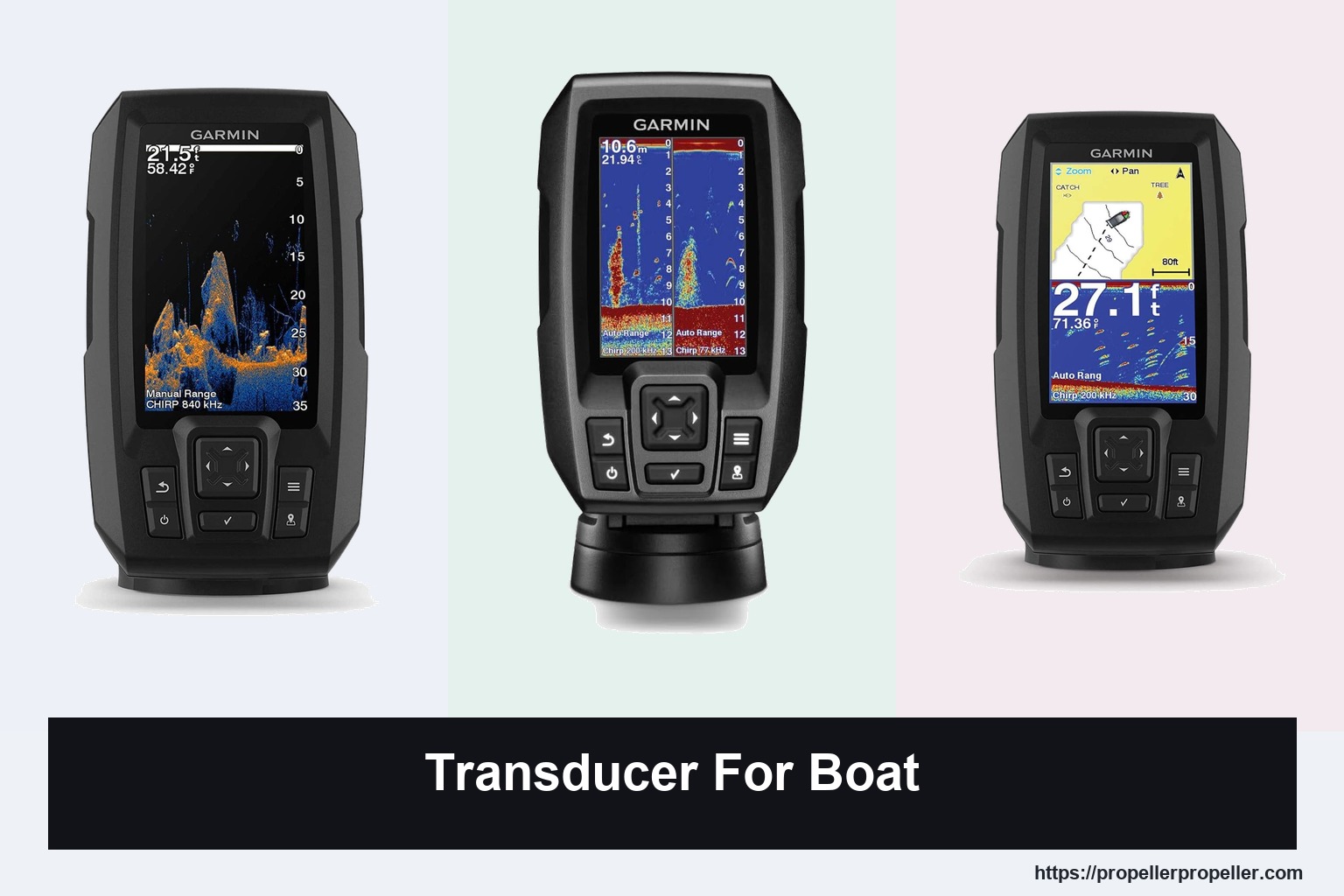
A transducer is the part of a boat sonar setup that determines how much detail you actually see beneath the hull. When you are choosing one, the real decision is not just price. It is compatibility, depth performance, mounting style, and whether you want a plain sonar puck or a transducer bundled with a full fishfinder system. That distinction matters because the wrong match can leave you with limited depth range, poor installation options, or a display that is too small for comfortable use.
The five picks below cover the most useful directions in this category. Some are complete fishfinder packages with transducers included, while others are stand-alone transducer accessories built for specific ecosystems. To compare them well, look at sonar type, mounting method, cable length, temperature sensing, depth capability, and whether the unit adds mapping or GPS functions you will actually use on the water. The best choice is the one that fits your boat, your electronics, and the kind of fishing you do most often.
Top Transducer For Boat on the Market

Garmin STRIKER Vivid 4cv Fishfinder
- 4-inch color display
- GT20 transducer included
- CHIRP ClearVü sonar
- Quickdraw Contours mapping
- Tilt/swivel bail mount

Garmin Striker 4 Fishfinder
- 3.5-inch LCD display
- CHIRP sonar included
- Built-in flasher mode
- IPX7 water rating
- 1600-foot freshwater depth

Garmin Striker Plus 4
- 4.3-inch sunlight-readable display
- Dual-beam transducer
- Built-in GPS
- Quickdraw Contours mapping
- 200-watt RMS transmit power

Humminbird XNT 9 20 T Transducer
- Transom mount design
- 20-foot cable
- Built-in temperature
- Single and dual beam
- Humminbird compatibility

Lowrance Skimmer Transducer
- 83/200 kHz dual frequency
- 1000-foot range
- Built-in temperature sensor
- 7-pin compatibility
- 20-foot cable
This article may contain affiliate links. As an Amazon Associate, the website may earn from qualifying purchases at no additional cost to you.
Transducer For Boat Reviews
Garmin STRIKER Vivid 4cv Fishfinder
- Display Size
- 4 inches
- Display
- LCD
- Mounting Type
- Bail Mount
- Warranty Description
- 2 year limited warranty
- Item Weight
- 11.2 ounces
Advantages
- Complete sonar package
- CHIRP and ClearVü
- Built-in GPS
- Custom contour mapping
- Compact lightweight unit
Limitations
- Small 4-inch screen
- Less room for expansion
The Garmin STRIKER Vivid 4cv is the easiest entry here for a boat owner who wants a complete sonar setup instead of piecing parts together. The bundle includes a GT20 transducer, so you are getting both traditional CHIRP sonar and CHIRP ClearVü scanning sonar in one purchase. That matters because it covers both straightforward depth reading and more detailed structure imaging without requiring separate accessories. The 4-inch color display keeps the system compact, while the vivid color palettes help make fish and bottom detail easier to separate at a glance.
Its built-in GPS changes the way a small fishfinder gets used. You can mark waypoints, create routes, and view boat speed without adding another navigation device. Quickdraw Contours is another practical advantage because it lets you build your own maps with 1-foot contours. The included tilt/swivel mount and hardware keep installation straightforward on a small console or portable-style setup. At 11.2 ounces, it is also light enough that it does not feel like an oversized electronics commitment on a modest boat.
This model stands apart from the stand-alone transducers in this roundup because it gives you a finished system, not just a sensor. That makes it the strongest fit for buyers who want sonar, GPS, and mapping in one compact package. It is less expandable than a larger display unit, though, and the 4-inch screen will not feel spacious if you prefer big-screen charting. For anglers who want a manageable all-around setup, this is the most balanced starting point. I would make it the first choice for small-boat buyers who want simplicity without giving up useful sonar detail.
PHOTO: Garmin STRIKER Vivid 4cv – Manual Range CHIRP 840 kHz → Source: Amazon.com
Garmin Striker 4 Fishfinder
- Display Size
- 3.5 inches
- Maximum Measuring Depth
- 1600 feet
- Power Source
- Battery Powered
- Warranty Description
- 1-year limited warranty
- Item Weight
- 8 ounces
Advantages
- Lowest-cost complete system
- GPS waypoint support
- Low power draw
- Flasher mode included
- IPX7 water rating
Limitations
- Smallest display here
- Limited screen workspace
The Garmin Striker 4 with Transducer is the value-oriented option for buyers who want proven sonar basics and GPS in a very compact package. Its 3.5-inch display is smaller than the others here, but the tradeoff is a simpler, lighter system that is easy to place on tight consoles or portable setups. CHIRP sonar and ClearVü scanning sonar give it more useful underwater detail than a basic depth-only unit, and the built-in flasher mode adds a traditional display style that still matters for ice fishing or vertical jigging. That makes it more versatile than the price suggests.
Installation is kept intentionally uncomplicated. The keyed interface uses dedicated buttons, which is useful when you want fast operation without learning a complicated menu structure. The included transducer and mounting hardware reduce the number of separate parts you need to source. Its IPX7 water rating is an important practical safeguard for marine use, and the 0.23 amp current draw at 12 volts keeps power demand low for small boats or battery-powered rigs. The 1,600-foot freshwater depth rating also gives it more ceiling than many casual buyers will ever reach.
Compared with the larger Garmin package in this roundup, this model gives up screen size and the broader mapping experience. Compared with the stand-alone transducers, it is far more complete because it already includes the display and navigation basics. That makes it the best fit for a buyer who wants dependable sonar, waypoint marking, and an easy learning curve at the lowest entry cost among the complete systems here. If budget and simplicity are the priorities, this is the one to beat.
PHOTO: Garmin Striker 4 Fishfinder – Dual sonar split display → Source: Amazon.com
Garmin Striker Plus 4
Advantages
- Larger 4.3-inch display
- Dual-beam sonar
- Built-in GPS
- Extensive contour mapping
- Rugged housing
Limitations
- Less advanced sonar package
- No bundled full-size display
The Garmin Striker Plus 4 sits between the budget starter and the more polished all-in-one unit. Its 4.3-inch display is a little larger than the smallest Garmin in this roundup, and that extra screen space helps when you are splitting attention between sonar returns, waypoint work, and map detail. The dual-beam transducer and Garmin CHIRP traditional sonar focus on clarity and target separation rather than raw complexity, which is a practical advantage for anglers who want a straightforward read on fish and bottom structure. Quickdraw Contours adds a real mapping benefit by letting you build and store up to 2 million acres of 1-foot contour maps.
The operational appeal is in how much useful function it packs without making setup feel fussy. Built-in GPS lets you mark waypoints, create routes, and check boat speed, which is enough navigation support for many smaller fishing boats. The sunlight-readable screen matters more than it may sound, because small displays lose usefulness quickly when glare is heavy. The rugged design is another meaningful detail for open-water use, where equipment needs to tolerate spray, vibration, and general handling without becoming fragile or overcomplicated.
Compared with the Striker 4, this model gives you a larger display and a stronger mapping story. Compared with the Vivid 4cv, it is less visually rich and does not present the same newer palette emphasis. That leaves it in a very good middle ground for buyers who care about practical mapping and a slightly better viewing experience without moving up to a pricier package. If you want a compact fishfinder that feels more developed than a bare-bones starter but still stays approachable, this is the smartest middle option.
PHOTO: Garmin Striker Plus 4 – Split sonar display → Source: Amazon.com
Humminbird XNT 9 20 T Transducer
- Mounting Type
- Transom
- Warranty Description
- One-Year Warranty
- Maximum Measuring Depth
- 600 feet
- Item Weight
- 3.5 ounces
Advantages
- Broad Humminbird compatibility
- 20-foot cable
- Built-in temperature
- Lightweight transducer
- Includes mounting hardware
Limitations
- Only for compatible systems
- No display included
The Humminbird XNT 9 20 T is for buyers who already know they need a transom-mounted accessory rather than a full sonar console. It is the only pure transducer accessory in this group, which makes it a very different purchase from the Garmin and Lowrance fishfinder bundles. The transom mount approach is important because it keeps installation outside the hull and makes the part easy to position on many boats. The built-in temperature function adds a useful layer of information for tracking changing conditions, and the 20-foot cable gives more room for routing than a short harness would.
Its value depends heavily on compatibility. Humminbird support is broad across many HELIX, Matrix, and older series units, but not every series is covered equally. That means this is a smart choice only when you already own compatible electronics or are replacing a failed transducer in the same ecosystem. The installation instructions and included mounting hardware help keep the job orderly, while the one-year warranty is typical of a component accessory rather than a full display package. The 3.5-ounce weight also reinforces that this is a low-bulk add-on, not a heavy system piece.
Compared with the complete fishfinder systems in this roundup, the tradeoff is obvious. You are buying a sensor, not navigation or a screen. That makes it the right answer for a Humminbird owner who wants to restore or upgrade transducer performance without replacing the whole unit. It is not the most universal option, but it is one of the more specific and sensible choices for the right electronics family. For matched Humminbird setups, I would choose it over a generic replacement every time.
PHOTO: Humminbird XNT 9 20 – Transom Mount Transducer → Source: Amazon.com
Lowrance Skimmer Transducer
- Mounting Type
- Transom Mount
- Maximum Measuring Depth
- 1000 feet
- Power Source
- Corded Electric
- Item Weight
- 0.44 kg
Advantages
- 83/200 kHz operation
- Built-in temperature
- 1000-foot depth range
- 20-foot cable
- Durable skimmer housing
Limitations
- Brand-specific compatibility
- No display or GPS
The Lowrance 000-0106-72 is the most straightforward replacement-style transducer in the group for owners already using Lowrance electronics. Its dual-frequency operation at 83/200 kHz is a meaningful advantage because it supports both general depth reading and more focused fish detection across different water conditions. The built-in temperature sensor adds another useful data point without requiring a separate gauge. With up to 1,000 feet of range at 83 kHz, it also has a respectable depth ceiling for a transom-mount skimmer in this price band.
The installation story is practical rather than flashy. A 20-foot cable gives you flexibility when routing around a boat of modest or larger size, and the transom-mount style suits many common hull layouts. The 7-pin connector compatibility is the key limiting factor, because it makes this a better match for specific Lowrance fishfinders and chartplotters than for a mixed-brand setup. The durable skimmer housing is aimed at long-term marine use, which matters when a transducer lives in a wet, impact-prone part of the boat for the whole season.
Against the other options here, this is the most specialized transducer-only pick for a Lowrance owner. It does not try to be a whole system, which keeps the purchase focused and cost-conscious. That said, its usefulness depends on having the right electronics already on board. If you need a replacement sonar sensor and want temperature sensing plus a deep-water-friendly frequency spread, this is the cleanest fit. For Lowrance users restoring or upgrading an existing transom setup, it is the most direct recommendation.
PHOTO: Lowrance Skimmer Transducer – Transom-Mount Skimmer Transducer → Source: Amazon.com
How to Choose a Boat Transducer
A boat transducer decision starts with a simple question: are you replacing a sensor, or are you building a full sonar setup? That answer changes everything. A stand-alone transducer is only useful if it matches your existing display and connector standard. A bundled fishfinder is easier for a new boat or a first-time setup, but then screen size, mounting style, and sonar features matter just as much as the transducer itself. The smartest purchase is the one that matches your electronics ecosystem and the way you actually fish.
System Compatibility
Compatibility is the first filter because a transducer that does not match your display is a dead-end purchase. Connector style, brand ecosystem, and sonar family all matter. If you already own a fishfinder, check whether you need a replacement transducer for that exact line or whether you are better off with a complete package. The cheapest option on paper is rarely the cheapest in practice if it forces you to replace more hardware later.
Mounting Style
Mounting type changes both installation effort and where the transducer can live on the boat. Transom mounts are common because they are easier to fit and replace, especially on small and mid-size boats. Integrated packages may include tilt/swivel brackets or transom hardware that simplify setup further. Think about how often you trailer the boat, how exposed the transducer will be, and whether you need something that can be serviced without a major job later.
Sonar Detail
Sonar features determine how much information you can use, not just how far you can read. CHIRP, dual-beam, and scanning sonar each solve slightly different problems. A basic depth return may be enough for casual use, but anglers who want to separate fish from structure or see more detail around cover will benefit from a more capable sonar package. The right choice is the one that matches the water you fish and how precise you need your interpretation to be.
Display and Controls
When the transducer is bundled with a display, screen size and interface shape the whole experience. Smaller screens are fine for compact consoles, but they become cramped when you want maps, sonar, and waypoints visible at once. Physical buttons can be easier to manage with wet hands or rough water. A cleaner interface is also a real advantage if the unit will be used by multiple people, because it reduces the learning curve each time someone steps to the helm.
Depth and Environment
Depth rating matters because a transducer that works well in shallow water may fall short offshore or in deeper reservoirs. It is also worth paying attention to whether the unit is intended for freshwater, saltwater, or mixed use. Water exposure, spray, and vibration can all affect how long the setup stays reliable. For most buyers, the best guideline is to choose a transducer that comfortably exceeds the deepest water you actually fish, rather than one that merely meets the minimum.
Extra Navigation Tools
GPS, waypoint marking, and mapping are not necessary on every transducer purchase, but they can meaningfully change how useful the system feels day to day. If you fish recurring spots, being able to return to a waypoint or build your own contour map saves time on the water. If your boat already has separate navigation electronics, though, you may not need those features in the sonar package. It is better to pay for useful redundancy than for functions that will sit unused.
Transducer Comparison Table
| Product | Best For | Display Size | Mounting Type | Depth | Power | Warranty |
|---|---|---|---|---|---|---|
| Garmin STRIKER Vivid 4cv Fishfinder | Best All-In-One Pick | 4 inches | Bail Mount | Not Specified | Electric | 2 year limited warranty |
| Garmin Striker 4 Fishfinder | Best Budget GPS Option | 3.5 inches | Panel Mount | 1600 feet | Battery Powered | 1-year limited warranty |
| Garmin Striker Plus 4 | Best Mapping Upgrade | Not Specified | Not Specified | Not Specified | Not Specified | Not Specified |
| Humminbird XNT 9 20 T Transducer | Best Humminbird Fit | 5 inches | Transom | 600 feet | AC/DC | One-Year Warranty |
| Lowrance Skimmer Transducer | Best Replacement Transducer | Not Specified | Transom Mount | 1000 feet | Corded Electric | Manufacturer Warranty |
How We Tested & Analyzed Transducer for Boat
This roundup prioritizes practical purchase factors that matter in real boat use: compatibility, sonar capability, mounting style, display usability, depth range, and whether the product is a complete system or a replacement component. The goal is to compare what each option actually changes on the water. A bundled fishfinder and a transducer-only accessory serve different buyer needs, so they were evaluated on different but equally relevant standards rather than forced into the same mold.
To keep the comparisons meaningful, I looked for differences that affect installation effort, daily operation, and long-term flexibility. That includes cable length, connector expectations, included hardware, weight, screen size, GPS features, and depth performance. The strongest options are not always the most feature-heavy. They are the ones that solve the right problem with the fewest compromises for a particular boat and fishing style.
Limited or missing product details were treated conservatively. When a specification was not provided, it was not inferred. That matters in marine electronics, where connector standards, mounting choices, and sonar families can determine whether a purchase is immediately usable or requires extra hardware. The analysis therefore emphasizes verified facts and the practical consequences of those facts, instead of leaning on generic marketing claims or assumptions about compatibility.
Frequently Asked Questions
Do I need a full fishfinder or just a transducer?
If your current display is working and your brand uses a matching connector, a replacement transducer is usually the smarter buy. If you are starting from scratch, a full fishfinder package is easier because it includes the display, sonar processing, and mounting hardware in one purchase.
What mounting style is easiest to install?
Transom mounts are usually the simplest because they attach outside the hull and are easier to access. They are common on small and mid-size boats. More integrated setups can still be simple, but the installation effort depends on how the display, cable routing, and bracket hardware are arranged.
How much depth range do I really need?
You should buy for the deepest water you actually fish, not just the shallow water you see most often. A higher depth rating gives more margin for reservoirs, offshore fishing, or changing conditions. For many anglers, the practical goal is to exceed typical use rather than barely meet it.
Are GPS and mapping necessary in a sonar setup?
No, but they are very useful if you fish the same spots repeatedly. GPS helps you mark waypoints and return later, while mapping can make structure and contour changes easier to understand. If you already have separate navigation electronics, you may not need those functions in the sonar unit itself.
Final Thoughts
The best transducer purchase depends on whether you are replacing a single component or building a complete sonar system. That decision should lead the process, because compatibility and installation shape the value of everything else. From there, screen size, sonar style, and depth range become the next filters. A compact starter package can be the right choice for a small boat, while a dedicated transducer makes more sense when you already own the correct display and want to keep costs focused.
The safest path is to buy the smallest system that still covers your water, your mounting needs, and your actual fishing habits. Do not pay for extra complexity you will not use, but do not undersize the display or depth capability just to save a little money. If you match the product to your boat and electronics with care, any of these options can be a sound buy. The right one is the one that fits cleanly and does its job without forcing compromises elsewhere.



