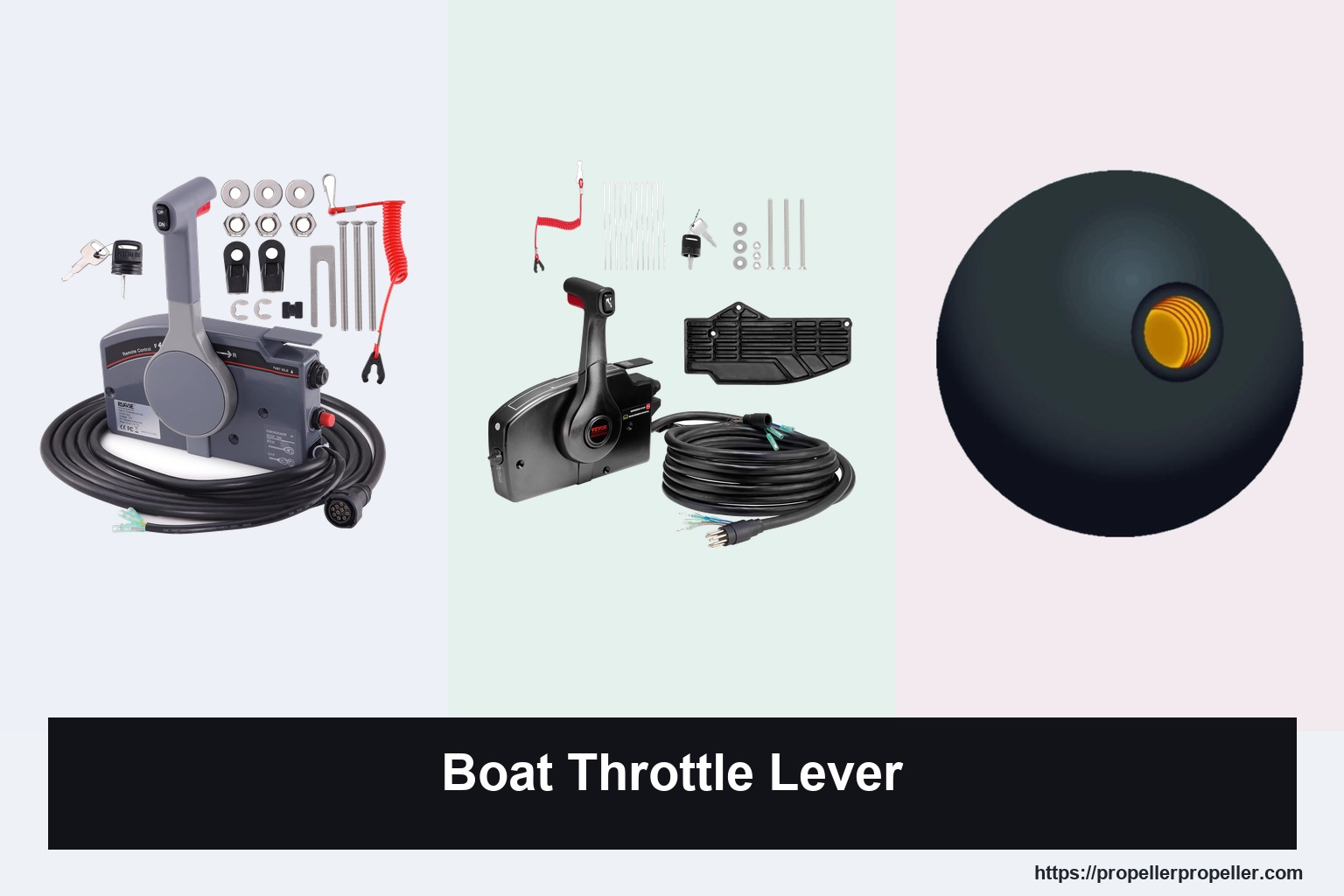
A boat throttle lever is one of those controls that quietly determines how confident the helm feels every time you leave the dock. The right unit has to do more than move the engine from idle to open throttle. It needs to shift cleanly, suit your cable system or engine family, and give you a predictable feel when the boat is in close quarters or running hard. That combination of compatibility, control, and safety is what separates a sensible upgrade from a frustrating replacement.
The four options here cover different needs within the same category. Two are side-mounted remote control boxes for outboard setups, one is a dual-lever control knob for a twin-engine application, and one is a single-lever side mount control built around broad cable compatibility and safety logic. The practical differences matter. A buyer who needs a Yamaha-specific replacement should not shop the same way as someone trying to match a Mercury system or a twin-engine layout. The best pick depends on engine type, mounting style, wiring, and how much control feel or safety integration you want at the helm.
Top Boat Throttle Lever on the Market

Rupse Yamaha Side Mount Control Box
- Yamaha electric-start compatibility
- 16.7 ft 10-pin harness
- Thumb trim and tilt switch
- Adjustable throttle friction
- Push-to-choke key switch

VEVOR Mercury Side Mount Control
- Mercury PT 2-stroke fit
- 16.3 ft 8+4 harness
- Die-cast aluminum housing
- Power trim switch
- Emergency stop lanyard

SEACHOICE Twin Lever Control Knob
- Twin lever layout
- Chrome-plated brass
- 33C type cables
- Red and black knobs
- Brass shims and clamps

Uflex B184MERC Side Mount Control
- Single lever dual action
- Horizontal or vertical install
- Neutral safety switch
- Pull-out warm-up handle
- Broad cable compatibility
This article may contain affiliate links. As an Amazon Associate, the website may earn from qualifying purchases at no additional cost to you.
Boat Throttle Lever Reviews
Rupse Yamaha Side Mount Control Box
- Maximum Horsepower
- 250 hp
- Item Weight
- 4.56 kg
- Material Type
- Aluminum
- OEM Equivalent Part Number
- 703-48205
Advantages
- OEM-equivalent Yamaha replacement
- Long 10-pin harness
- Trim and tilt switch
- Adjustable throttle friction
- Includes mounting hardware
Limitations
- Yamaha-focused compatibility
- No warranty listed
The Rupse control box is aimed at Yamaha owners who need a side-mount replacement that preserves the familiar remote-control layout. Its strongest value is the combination of OEM 703-48205 compatibility and the included 16.7 ft 10-pin harness, which reduces the uncertainty that often comes with swapping helm controls. The maximum horsepower rating reaches 250 hp, so it covers a wide spread of Yamaha electric-start outboards. That range matters because buyers do not need to guess whether the control is undersized for a heavier rig.
Its construction and control layout push the product toward practical day-to-day use rather than novelty. The aluminum build keeps the box from feeling flimsy, while the thumb-operated trim and tilt switch adds the kind of adjustment that becomes useful every time the boat is loaded differently or trimmed for a change in water conditions. The push-to-choke key switch and safety lanyard also matter at the helm because they place starting, shifting, and emergency shutoff in one familiar control cluster. Adjustable throttle friction is another useful detail, since it lets you tune lever resistance instead of accepting an overly loose or stiff feel.
Compared with the other controls here, this is the most directly focused Yamaha replacement and the one most likely to reward a straightforward swap. It is not trying to serve as a universal solution, and that specialization is a strength when you already know your engine family and want less guesswork. The reversible handle helps with right-hand or left-hand installation preferences, but the real appeal is the predictable match to Yamaha electric-start outboards. Buyers who want a clean replacement with the most obvious compatibility path should start here and treat it as the most purpose-built option in the group.
PHOTO: Rupse Yamaha Side Mount – Remote Control Box and Harness → Source: Amazon.com
VEVOR Mercury Side Mount Control
- Item Weight
- 9.8 pounds
- Package Dimensions
- 17.72 x 11.81 x 6.69 inches
Advantages
- Mercury PT 2-stroke fit
- Die-cast aluminum housing
- Power trim and tilt switch
- Adjustable throttle friction
- Emergency stop lanyard
Limitations
- Mercury-specific application
- Heavier than compact controls
This VEVOR control box targets Mercury PT 2-stroke owners who want a side-mounted throttle with modern convenience features built in. The most useful hardware cues are the 16.3 ft harness and the 8+4 pin connection setup, because those details determine whether the control can physically reach and interface with the boat’s wiring. The die-cast aluminum housing and aluminum alloy interior point to a sturdier build than a basic plastic housing, which matters on a control that sees constant hand contact and vibration. The ABS handle and sturdy buttons further reinforce that this is meant for regular marine use rather than occasional handling.
Operationally, the control is designed to keep movement smooth and adjustments easy. Throttle friction can be tuned to personal preference, which helps prevent either a loose lever that creeps or a stiff one that feels tiring over time. The power trim and tilt switch adds a practical edge for changing engine angle during loading or temporary stops. The emergency lanyard is another important layer, because it gives the helm a fail-safe stop if the operator leaves position unexpectedly. Installation guidance also matters here, since the control should be fitted with power fully disconnected before any wiring work begins.
Against the Yamaha-specific Rupse unit and the more universal Uflex control, this VEVOR model sits in the middle. It is more targeted than a broad multi-application lever, but it also packages more structure and more electrical detail than the simplest throttle-only solutions. That makes it a strong choice for Mercury PT 2-stroke owners who want a balanced mix of compatibility, ruggedness, and trim control. If your priority is a Mercury-oriented side mount with a long harness and a clear safety setup, this is the most convincing contender in the group.
PHOTO: VEVOR Mercury Side Mount – Throttle Control and Harness → Source: Amazon.com
SEACHOICE Twin Lever Control Knob
- Item Depth
- 5-7/16
- Material Type
- Brass
- Handle Type
- Knob, Lever
- Hand Orientation
- Ambidextrous
- Handle Attachment Mechanism
- screw
Advantages
- Twin lever control layout
- Chrome-plated brass
- Designed for 33C cables
- Brass shims included
- Lowest price in group
Limitations
- Model-specific compatibility
- No integrated trim controls
SEACHOICE takes a different path from the single-lever remote boxes in this roundup. This is a twin-lever control knob, so it belongs in setups where clutch and throttle are handled separately for one engine. That arrangement can be useful when the boat’s control architecture is already built around distinct lever functions. The most important evidence points are the 33C type control cables and the chrome-plated brass construction. Together they tell you the knob is built for a specific mechanical setup rather than for broad, modern plug-and-play use.
The supplied dimensions are compact enough to fit a helm that already expects a dedicated control knob rather than a full boxed remote. Its brass shims and cable clamps are a practical installation advantage because they reduce the number of extra pieces a buyer needs to source separately. The red and black knobs also improve lever identification, which can be more than cosmetic when the operator wants instant visual separation between functions. Because the design is model-specific, the real decision point is not feature abundance but whether the boat’s cable system and control layout already match this style.
This control is far less universal than the Yamaha and Mercury side-mount units, but that is exactly why it belongs in a serious shortlist. Buyers who need a full remote box will not want it, yet owners of compatible twin-lever systems may value its simpler, more direct mechanical setup. It is also the least expensive option here, so it suits someone replacing a compatible knob and not trying to redesign the helm. Choose it when your control system is already built around this format and you want a straightforward, cable-based solution without paying for extra electronics.
PHOTO: SEACHOICE Twin Lever Control – Black Knob → Source: Amazon.com
Uflex B184MERC Side Mount Control
- Item Weight
- 5.4 pounds
- Product Dimensions
- 10.08 x 6.42 x 5.59 inches
- Exterior
- Zinc
Advantages
- Single lever dual action
- Horizontal or vertical mount
- Neutral safety switch option
- Broad cable compatibility
- Exceeds EN ISO 11547
Limitations
- Some cables need kits
- Higher price than others
The Uflex B184MERC is the most flexible control in the group for buyers who need a side-mount solution with broader installation options. Its single-lever dual-action layout keeps shift and throttle together, and the pull-out handle disengages shift for warm-up. That matters in real use because it gives the operator a cleaner idle-up routine without forcing the boat into gear. The optional neutral safety switch and the note that the control exceeds EN ISO 11547 standards when that switch is installed show that safety is part of the design, not an afterthought.
Compatibility is where this model earns its place. It works with a wide range of outboard, inboard, and I/O power plants, and it can be installed horizontally or vertically on either side of the boat. That kind of flexibility is valuable when the helm layout is awkward or when the buyer is replacing an older control without wanting to redesign cable routing. The product description also notes support for several cable families, though some require a separate connection kit. That is a useful installation consequence because it reminds the buyer that universal on paper does not mean zero planning in practice.
Compared with the Yamaha and Mercury-specific controls, this one is the least tied to a single engine family and the most adaptable to different boat layouts. It does not include the trim-switch emphasis of the first two products, but it compensates with broader application and a more formal safety story. For buyers who need one control that can fit a wider range of cable systems and mounting positions, it is the strongest general-purpose pick. If your priority is flexibility rather than brand-specific replacement, this is the one to choose.
PHOTO: Uflex B184MERC Side Mount – Side Mount Control → Source: Amazon.com
How to Choose a Boat Throttle Lever
The best boat throttle lever is the one that matches your engine family, cable system, and helm layout without creating extra work during installation. That sounds simple, but the category includes very different control styles. Some are full side-mount remote boxes for specific outboards. Others are mechanical knobs or dual-lever controls built around older cable systems. Start with fit, then weigh safety features, wire length, friction adjustment, and how much control feel you want at the helm.
Engine Match
Compatibility is the first filter because throttle controls are not interchangeable in the way a generic accessory might be. A control that is built for one engine family can be a fast, clean replacement. A broader control can work across more boats, but only if the cable style and mounting pattern line up. If the engine and control family are mismatched, the rest of the feature list stops mattering. Choose the narrowest fit that still covers your setup, because that usually gives you the least hassle during installation and the fewest surprises afterward.
Mounting Style
The mounting layout should fit the way you actually operate the boat. Side-mount controls are common when you want shift and throttle in one hand and extra switches close at reach. Dual-lever setups serve a different job, especially when clutch and throttle are handled separately. A control can also be horizontally or vertically mounted, which becomes important when the helm space is tight or the original cutout has to stay in place. Measure the available space before you buy, and think about whether the lever will clear seats, rails, or nearby panels.
Cable and Harness Length
Harness and cable length are more than convenience details. They determine whether the control reaches the boat’s wiring cleanly or forces awkward routing. Short runs can look tidy, but only if the control is close enough to the engine interface. Longer harnesses add flexibility during installation, which can be valuable on larger boats or replacement jobs where the original path is not ideal. When the harness includes multiple pin configurations, that can simplify the job, but it also means you need to confirm your connection standard carefully before ordering.
Safety Features
A kill switch or lanyard is worth prioritizing because it changes what happens in an emergency. If the operator leaves the helm unexpectedly, the engine should stop instead of continuing to run unchecked. Neutral safety functions matter too because they help prevent an accidental in-gear start. For many buyers, these are not luxury features. They are the difference between a control that simply moves the engine and one that actively reduces risk. If you run with passengers, dock often, or expect frequent starts and stops, safety hardware should weigh heavily in the decision.
Control Feel
Throttle friction and lever feel affect every minute on the water. A lever that is too loose can creep or feel vague. A lever that is too stiff can be tiring when you are making constant small adjustments. Friction adjustment is especially useful because it lets you tune the control to your preferences and the boat’s behavior. Trim and tilt switches also influence daily usability since they keep common adjustments at the helm instead of forcing you to reach elsewhere. Small ergonomic details often matter more than buyers expect once the boat is moving and conditions change.
Materials and Durability
Material choice affects both longevity and how the control feels after repeated use. Aluminum and die-cast metal housings generally signal a sturdier control than lightweight plastics, especially in a marine environment where vibration and moisture are constant concerns. Brass components can be valuable in cable-based controls because they support a more traditional mechanical system and often accompany model-specific installation hardware. Look beyond the headline material and think about the parts you will touch most often. Handles, knobs, buttons, and clamps all matter because they are the wear points you will actually notice over time.
Boat Throttle Comparison Table
| Product | Best For | Weight | Material | Color | Model |
|---|---|---|---|---|---|
| Rupse Yamaha Side Mount Control Box | Best Yamaha Replacement | 4.56 kg | Aluminum | Black | Not Specified |
| VEVOR Mercury Side Mount Control | Best Mercury Option | 9.8 pounds | Not Specified | Not Specified | Boat Throttle Control |
| SEACHOICE Twin Lever Control Knob | Best Twin Lever Pick | Not Specified | Brass | Black | Not Specified |
| Uflex B184MERC Side Mount Control | Best Versatile Mount | 5.4 pounds | Not Specified | Not Specified | 3006.03 |
How We Tested & Analyzed Boat Throttle Lever
This roundup was built by comparing category-relevant factors that affect real purchase decisions at the helm. Compatibility mattered first, because boat throttle controls are only useful when they match the engine family, cable system, and mounting style already on the boat. From there, the analysis weighed control feel, safety hardware, harness length, installation flexibility, and construction materials. Those are the differences that change whether a control is easy to live with or frustrating to fit and operate.
The evaluation also treated specialization as a feature, not a drawback by default. A model built for a specific outboard family can be the strongest choice when it offers a clean replacement path, while a broader control earns points for flexibility if the boat layout or cable system is less standard. Safety switches, lanyards, and warm-up functions were compared for practical value rather than as a simple checklist. That approach keeps the recommendations grounded in how the control will actually be used.
Limitations were handled by refusing to infer anything that was not clearly supported. If a product did not clearly present a warranty, that absence was left alone. If compatibility was narrow, that was treated as a tradeoff rather than a flaw. The goal was to identify which control is best for a given buyer profile, not to force every option into the same mold. That is especially important in marine controls, where fit and feel matter more than generic feature count.
Frequently Asked Questions
What matters most when buying a boat throttle lever?
Compatibility matters most. The lever has to match the engine family, cable type, and mounting layout already on the boat. After that, focus on safety features, friction adjustment, and harness length. A well-matched control will feel more precise and be easier to install than a feature-rich unit that does not fit your setup.
Do I need a side-mount control or a dual-lever control?
That depends on how your boat is arranged. Side-mount controls are common for integrated shift and throttle operation at one helm position. Dual-lever controls suit systems that separate clutch and throttle or use older mechanical layouts. The right choice is the one that matches the control architecture already on the boat.
Are trim and tilt switches important?
They are very useful if you want to adjust engine angle from the helm without reaching elsewhere. That can improve convenience during loading, shallow-water operation, or quick speed changes. They are not mandatory for every boat, but they are a meaningful upgrade when the boat is used often and the driver wants faster on-the-fly adjustment.
Why does throttle friction adjustment matter?
Friction adjustment lets you tune how stiff or loose the lever feels. That matters because a lever that moves too easily can feel imprecise, while one that is too stiff can become tiring. The ability to set the resistance to your preference improves control confidence and makes the helm feel more natural during longer runs.
Final Thoughts
The right boat throttle lever is the one that solves your actual helm problem with the fewest compromises. For some buyers, that means a direct replacement for a specific outboard family. For others, it means choosing a broader control that can adapt to cable routing, mounting space, or safety requirements. The best results usually come from narrowing the field by fit first and then by the features you will use every trip.
If your priority is a clean, dependable installation, do not overvalue extra functions that do not match the boat’s setup. Focus on compatibility, control feel, safety hardware, and the physical layout of the helm. That approach makes it easier to choose with confidence and harder to end up with a control that looks right but works poorly in practice. Among these four, the strongest choice is the one that aligns most closely with your engine, cables, and operating style.