
What Is a Cleat Hitch?
A cleat hitch is the standard way to secure a rope or line to a two-horn cleat. The line takes a full turn around the cleat’s base, crosses the horns in a figure-eight pattern, and finishes with a locking underhand loop over the final horn. It is used on recreational boats and in sailing, including for securing a main halyard.
The hitch is specific to a standard cleat. It should not be treated as the tying method for every deck fitting, such as a Sampson post or bitts.
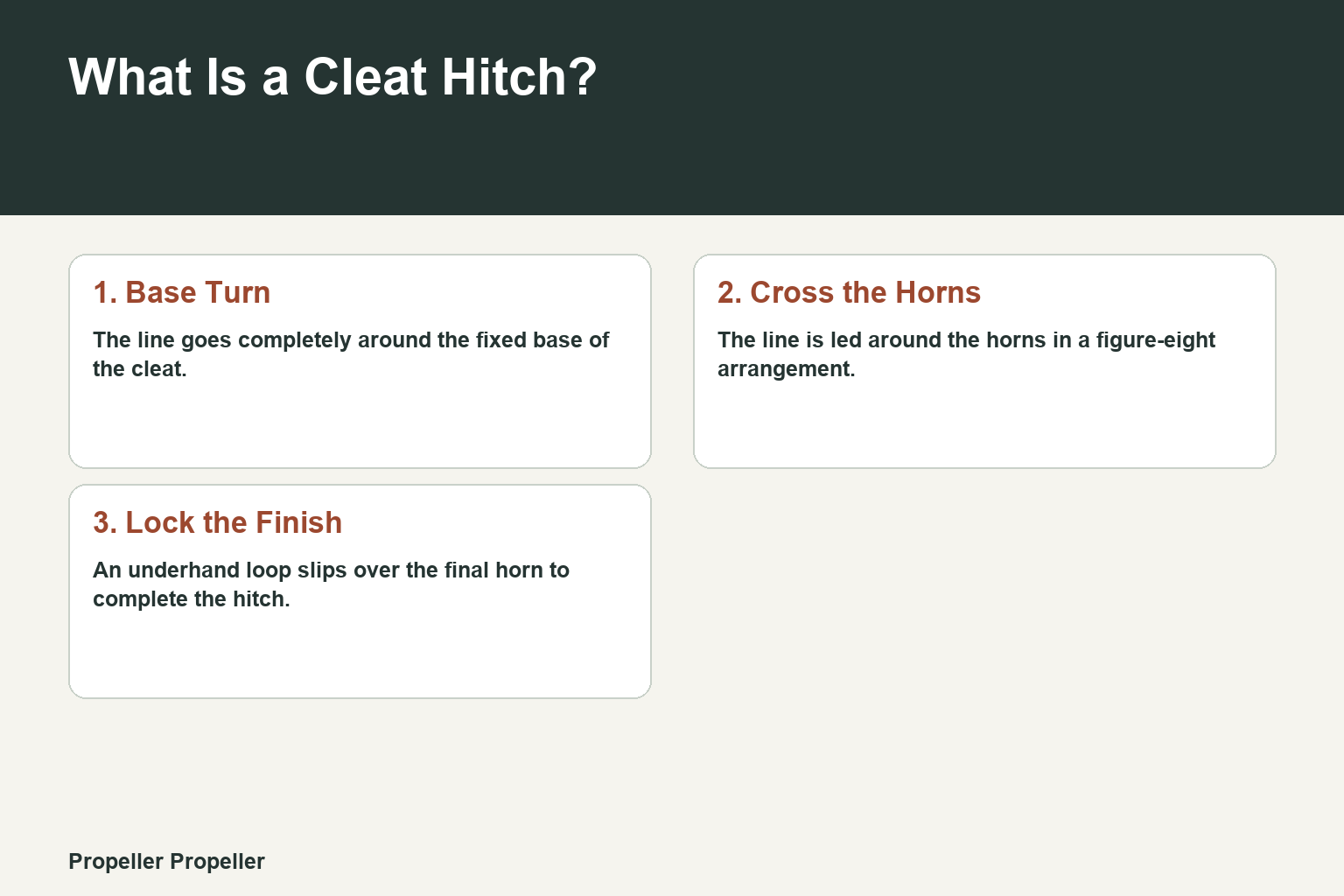
- 1. Base TurnThe line goes completely around the fixed base of the cleat.
- 2. Cross the HornsThe line is led around the horns in a figure-eight arrangement.
- 3. Lock the FinishAn underhand loop slips over the final horn to complete the hitch.
A cleat hitch secures a line around the fixed base and horns of a standard two-horn cleat; the final underhand loop locks the last turn.
How a Cleat Hitch Holds a Line
The base turn is the foundation: it places the working line around the cleat’s base before the line is led across the horns. The following figure-eight turns keep the line seated on the cleat. The final underhand loop, slipped over the last horn, locks the arrangement in place. A useful way to read the hitch is that the rope moves around a fixed fitting; the cleat itself does not turn or travel.
- Start with one complete turn around the base.
- Cross the two horns in a figure-eight pattern.
- Finish with an underhand loop over the last horn.
Sources: SAR Seamanship Reference Manual — Securing a line to a standard cleat · U.S. Army Corps of Engineers Motorboat Refresher Manual — Cleat Hitch
Tie a Standard Cleat Hitch
Use this sequence on a standard two-horn cleat. Keep the line under control while tying it, particularly when it is already under tension. The last loop matters: simply wrapping a line around the horns is not the complete cleat hitch shown in the instructional sequence.
1Take a complete turn around the base
Lead the line fully around the base of the cleat.
2Cross to the opposite horn
Bring the line around one horn and across the cleat toward the other horn.
3Continue the figure eight
Take the line around the other horn to complete the figure-eight arrangement.
4Lock the final turn
Make an underhand loop in the line and slip it over the last horn.
| Part of the Hitch | What the Line Does | Purpose in the Sequence |
|---|---|---|
| Base turn | Makes one complete turn around the cleat base | Begins the securement on the fitting |
| Figure-eight turns | Crosses between and around the two horns | Seats the line across the cleat |
| Final loop | Forms an underhand loop over the last horn | Locks the hitch |
| Small-cleat exception | Uses a half hitch in place of the second full figure eight | Allows the method when two full figure eights do not fit |
Sources: SAR Seamanship Reference Manual — Securing a line to a standard cleat · U.S. Army Corps of Engineers Motorboat Refresher Manual — Cleat Hitch
When the Cleat Is Small
A standard arrangement uses complete figure eights, but physical space on the fitting can limit what fits. The Canadian Coast Guard reference allows a half hitch to substitute for the second complete figure eight when the cleat is too small to accept two complete figure eights. That is a size-related exception for a standard cleat, not a reason to apply the same method to a different fitting type.
Sources: SAR Seamanship Reference Manual — Securing a line to a standard cleat
Where You Will See This Hitch
Cleats are described as the most common fitting on recreational craft, so the cleat hitch is a core boat-handling method. In sailing, it is also used to secure a main halyard. That example clarifies its role: a cleat hitch secures a line to onboard hardware; it is not merely a general-purpose decorative knot.
- Recreational craft commonly use cleats as line-securing fittings.
- Sailors may use a cleat hitch to secure the main halyard.
Sources: SAR Seamanship Reference Manual — Securing a line to a standard cleat · MIT Sailing — How to tie a Cleat Hitch
Use the Hitch Only With the Right Fitting
The name describes both the line arrangement and the hardware it is tied around. Standard cleats have two horns that receive the figure-eight crossings and the final locking loop. Sampson posts and bitts are distinct fittings, so the standard cleat-hitch instructions should not be assumed to transfer to them. In my view, identifying the fitting first is more valuable than memorizing a rope pattern out of context.
| Fitting | Use the Standard Cleat-Hitch Sequence? | Reason |
|---|---|---|
| Standard two-horn cleat | Yes | The base turn, horn crossings, and final loop are designed for this fitting. |
| Sampson post | Do not assume so | It is distinguished from a standard cleat in the seamanship reference. |
| Bitts | Do not assume so | They are a separate fitting type, not a two-horn cleat. |
Sources: SAR Seamanship Reference Manual — Securing a line to a standard cleat · U.S. Army Corps of Engineers Motorboat Refresher Manual — Cleat Hitch
Frequently Asked Questions
Is a cleat hitch a knot?
It is commonly called a hitch because it secures a line to a fitting: specifically, a standard two-horn cleat.
Why is the final loop needed on a cleat hitch?
The underhand loop slipped over the final horn is the locking finish in the illustrated cleat-hitch sequence. Figure-eight wraps alone do not describe the full sequence.
Does the rope make a full turn around the cleat base?
Yes. The standard method begins with a complete round turn around the cleat’s base before the line is led around the horns.
What if two full figure eights will not fit?
The Canadian Coast Guard seamanship reference states that a half hitch may replace the second complete figure eight when the cleat is too small for two complete figure eights.
Can I use a cleat hitch on a Sampson post?
Do not assume so. The seamanship reference distinguishes standard cleats from Sampson posts and bitts, which are different fittings.
Final Thoughts
For a standard cleat, begin at the base, build the figure eight across the horns, and finish with the locking loop. Confirm that the hardware is actually a cleat before using this hitch.



