
How to Balance a Boat Propeller: Static vs Dynamic Balancing
For a full-size boat propeller, the practical way to balance it is to have a propeller shop dynamically balance it after any needed blade reshaping, then use static balancing as a final check. The shop spins the propeller on a balancing machine, uses sensors to locate imbalance, and removes the indicated amount of metal.
Static balancing can reveal a heavy side under gravity, but it cannot fully assess the twisting imbalance that occurs while a propeller rotates. That distinction is why I would treat a static check as useful confirmation, not a substitute for professional dynamic balancing on a full-size boat.
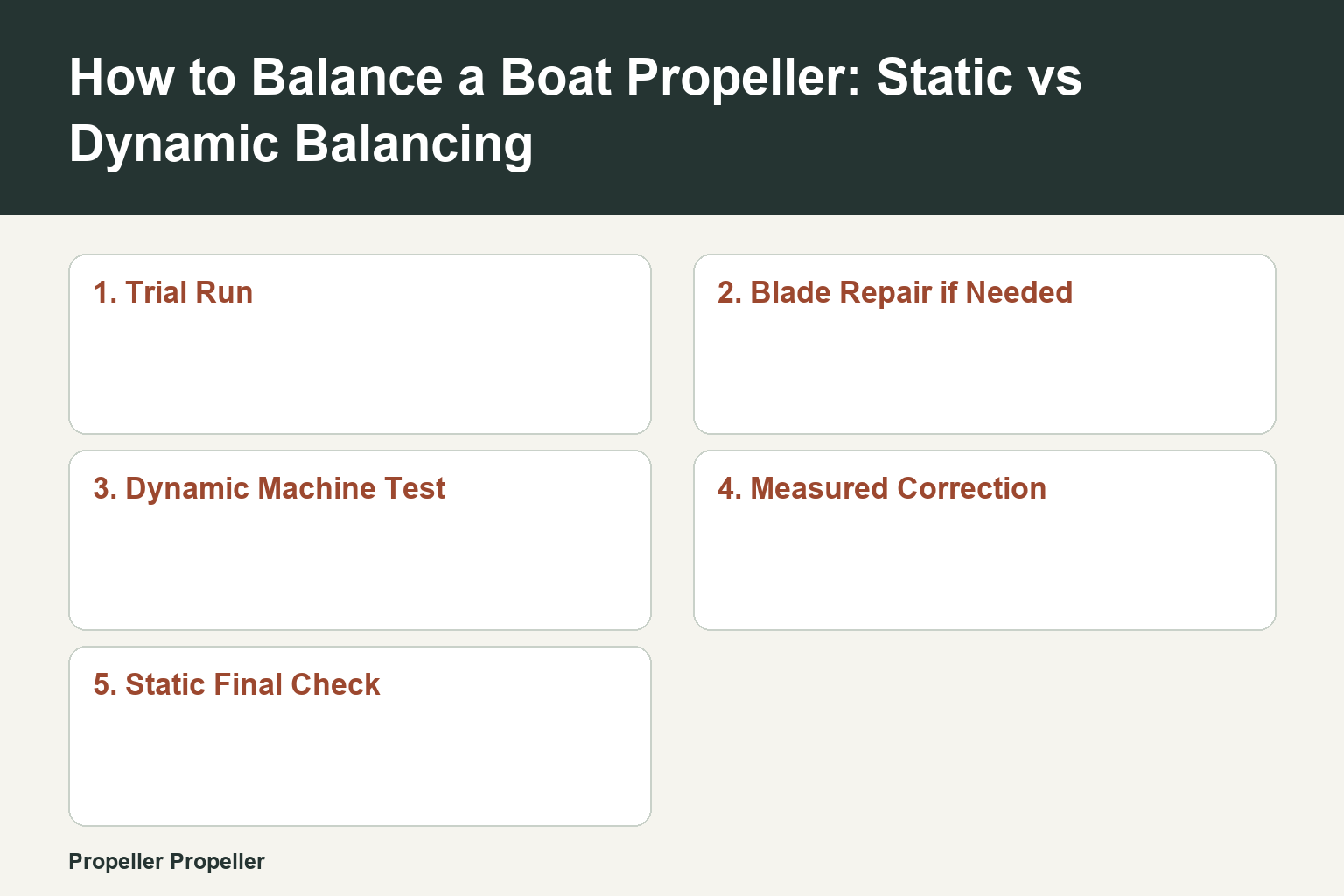
- Trial RunEstablish the boat’s on-water behavior before hauling.
- Blade Repair if NeededA shop may heat and reshape damaged blades before balance correction.
- Dynamic Machine TestThe propeller spins while accelerometers measure wobble.
- Measured CorrectionSoftware identifies the location and amount of metal to remove.
- Static Final CheckA stationary balance check confirms the completed work.
In professional balancing, the propeller rotates only during the dynamic machine test; the static check is performed with the propeller at rest.
Start With the Right Type of Balancing
A propeller can be out of balance in more than one way. Static imbalance means one area is heavy enough for gravity to pull that side downward when the propeller rests on a balancing stand. Dynamic imbalance involves forces in different planes as the propeller spins, creating a twisting condition that a stationary check may not reveal. For a boat propeller, dynamic balancing is the more complete assessment because it measures the rotating part rather than only its resting position.
- Static balancing identifies a gravity-driven heavy side.
- Dynamic balancing measures imbalance while the propeller is spinning.
- A dynamic machine can indicate where material should be removed and how much is required.
Sources: Boating Magazine: Computer propeller repair basics · Power & Motoryacht: Boat propeller repair and analysis · Model Power Boat Association: Propeller balancing
Why a Static Check Is Not the Whole Job
Static balancing is commonly used as a final check after repair, and it will often identify a straightforward heavy spot. But a propeller can still vibrate if blade spacing or thickness is uneven, because computerized measurement may primarily evaluate the blade face rather than every dimensional difference. Dynamic balancing is intended to detect imbalance during rotation, including effects that do not show up when the propeller is simply resting on a stand.
| Method | What It Measures | What It Can Miss |
|---|---|---|
| Static balancing | A gravity-driven heavy side while the propeller is at rest | Rotational twisting imbalance |
| Dynamic balancing | Imbalance while the propeller spins, using machine sensors | Some dimensional issues, such as uneven spacing or thickness, may still require separate attention |
Sources: Boating Magazine: Computer propeller repair basics · Power & Motoryacht: Boat propeller repair and analysis · Model Power Boat Association: Propeller balancing
Have a Full-Size Propeller Balanced at a Prop Shop
The usual full-size workflow starts with a useful baseline: make trial runs before hauling the boat so you can identify whether vibration or performance concerns are present. Once the boat is hauled, a propeller shop can assess and correct the propeller. If blades require repair, the shop may heat and reshape them before balancing. It then spins the propeller on a balancing machine; accelerometers and software identify the imbalance location and the amount of metal to remove. A static-balance check can follow as final confirmation.
1Record the Boat’s On-Water Behavior Before Hauling
Make trial runs before hauling so any vibration or other operating concern can be compared with the result after service.
2Arrange Prop-Shop Assessment After Hauling
For a full-size propeller, use a shop equipped to measure dynamic imbalance rather than relying solely on a stationary balance check.
3Correct Blade Shape When Repair Is Needed
A repair shop may heat and reshape damaged blades before balancing, because blade condition affects the finished result.
4Dynamically Balance the Propeller
The shop spins the propeller while sensors measure wobble. Software identifies where material should be removed and the required amount.
5Confirm With a Static Check
Use static balancing as a final check after the rotating measurement and corrective work are complete.
Sources: Boating Magazine: Computer propeller repair basics · Power & Motoryacht: Boat propeller repair and analysis
Decide When to Request Dynamic Balancing
Dynamic balancing is particularly sensible when the goal is the most complete correction after propeller repair or when a static check alone does not resolve a vibration concern. One repair-source perspective is that static balancing works most of the time, whereas dynamic balancing is more comprehensive. It may add about 10 percent to Class 1 or Class S repair pricing, so it is worth asking the shop what measurement and correction are included in its quoted repair.
- Consider periodic propeller checks even when there has been no obvious strike; one source suggests every couple of years.
- Ask whether the quote includes dynamic balancing, static balancing, or both.
- Do not assume a balanced blade face alone proves that blade spacing and thickness are uniform.
| Situation | Appropriate Response | Reason |
|---|---|---|
| Routine periodic check | Ask a prop shop to assess the propeller | Periodic checks can identify concerns even without a known strike |
| Blade requires repair | Repair blade shape, then dynamically balance | Reshaping and balance correction are separate parts of the repair process |
| Static check appears acceptable but vibration remains | Request dynamic balancing and discuss blade dimensions | A resting check does not fully measure rotating imbalance |
Sources: Boating Magazine: Computer propeller repair basics · Power & Motoryacht: Boat propeller repair and analysis
Do Not Transfer Model-Prop Filing Methods to a Boat Propeller
Model-boat guidance describes marking the low point on a statically balanced propeller and filing material from the front of a blade, then rechecking after sharpening. That is a hobby-scale method, not a general instruction for a full-size marine propeller. The source itself distinguishes the scale and methods. Removing metal from a full-size propeller without measurement can change blade shape as well as weight, so professional measurement and correction are the sounder route.
Frequently Asked Questions
What is the difference between static and dynamic propeller balancing?
Static balancing checks whether gravity pulls one side of a stationary propeller downward. Dynamic balancing checks the propeller while it rotates, allowing the machine to detect rotational imbalance and indicate where corrective metal removal is needed.
Can a propeller pass a static balance check and still cause vibration?
Yes. Static balancing does not fully assess dynamic, twisting imbalance. Uneven blade spacing or thickness may also remain a source of vibration even when a computerized measurement of the blade face looks acceptable.
Does a bent blade need repair before balancing?
A repair shop may heat and reshape blades before performing the balancing work. Balancing is part of restoring the propeller, not necessarily a replacement for correcting damaged blade shape.
Should I test the boat before taking the propeller to a shop?
A trial run before hauling can provide a useful baseline for comparison after service. Note the operating behavior that led you to seek propeller work.
How often should a boat propeller be checked?
One source recommends checking propellers every couple of years, even if the boat has not had an obvious propeller strike.
Final Thoughts
For a full-size boat, use a pre-haul trial run and a prop shop’s dynamic balancing service, with static balancing as the final confirmation. That approach addresses rotating imbalance without treating a stationary gravity check as the entire diagnosis.



