
Types of Boat Lifts Explained: Choose the Right Setup
The main types of boat lifts are bottom-standing, piling-mounted, floating, and shore-mounted systems. Within these categories, you may also encounter vertical, hydraulic, and cantilever lifting designs. The right choice depends chiefly on the dock or shoreline arrangement, bottom conditions, water depth and water-level changes, plus the fully loaded weight of the boat.
I would start with the site rather than the lift mechanism. A lift that suits a firm, level lakebed may be a poor match for a floating dock or a shoreline where water depth changes substantially.
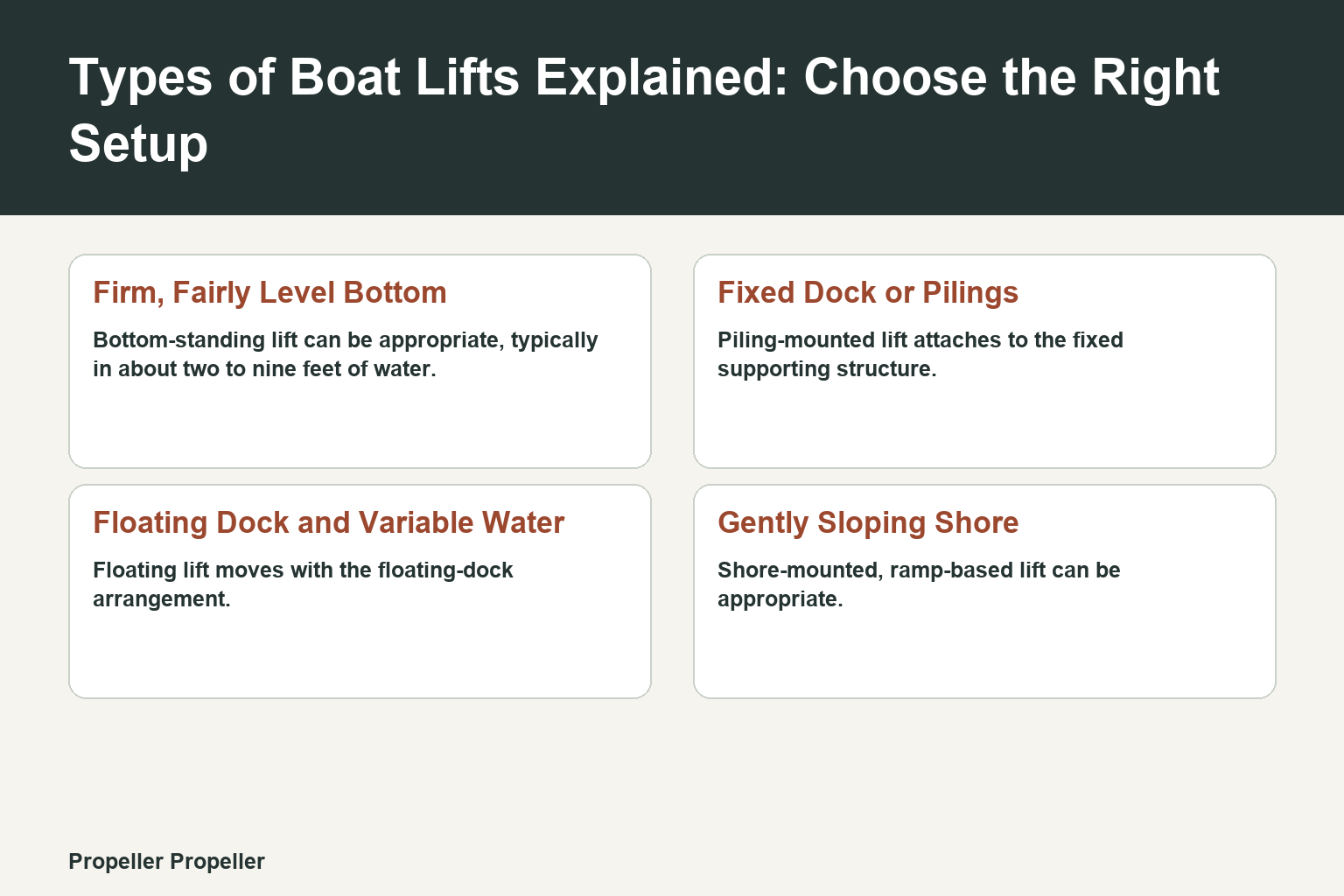
- Firm, Fairly Level BottomBottom-standing lift can be appropriate, typically in about two to nine feet of water.
- Fixed Dock or PilingsPiling-mounted lift attaches to the fixed supporting structure.
- Floating Dock and Variable WaterFloating lift moves with the floating-dock arrangement.
- Gently Sloping ShoreShore-mounted, ramp-based lift can be appropriate.
The lift category follows the available support structure and site conditions: bottom, fixed dock, floating dock, or shoreline.
What a Boat Lift Does
A boat lift supports a boat above the water when it is stored at a dock, marina, or shoreline. Raising the hull out of the water is the shared purpose, but the structure that supports the lift and the path it uses to raise the boat vary considerably. Those differences determine where a lift can be installed and how well it accommodates changing water conditions.
- Bottom-standing lifts are supported from the water bottom.
- Piling-mounted lifts attach to fixed docks or pilings.
- Floating lifts are commonly paired with floating docks.
- Shore-mounted lifts use a ramp arrangement from shore.
| Lift Category | Support or Location | Best-Matched Condition |
|---|---|---|
| Bottom-standing | Rests on the water bottom | Firm, fairly level bottom; typically about 2–9 feet of water |
| Piling-mounted | Attached to a fixed dock or pilings | Permanent fixed-dock or piling arrangement |
| Floating | Used with a floating dock | Water levels that fluctuate |
| Shore-mounted | Ramp-based from shore | Gently sloping shoreline |
Sources: Discover Boating: How to choose the right boat lift
Bottom-Standing Lifts
A bottom-standing lift rests on the lake or river bottom, making it a practical option where that bottom is firm and fairly level. Discover Boating identifies typical water depths of about two to nine feet for this style. Its support comes from below rather than from a floating dock or shore ramp, so bottom condition is central to the decision.
- Best matched to a firm, relatively level bottom.
- Typically used in roughly two to nine feet of water.
- Not the natural choice when the bottom cannot provide stable support.
Sources: Discover Boating: How to choose the right boat lift
Piling-Mounted and Floating Lifts
Piling-mounted lifts connect to fixed docks or pilings and are mostly electrically operated. They suit a permanent fixed-dock arrangement. Floating lifts, by contrast, are often used with floating docks; because the dock and lift float, this arrangement is useful where water levels fluctuate. The key distinction is not simply how the boat rises, but whether the support structure stays fixed or moves with the water.
- Choose piling-mounted designs for an appropriate fixed dock or piling structure.
- Consider a floating lift when it will be integrated with a floating dock.
- Water-level movement is a major reason floating-dock arrangements can be preferable.
Sources: Discover Boating: How to choose the right boat lift
Shore-Mounted Lifts
A shore-mounted lift uses a ramp-based approach from land and is best suited to a gently sloping shoreline. It is therefore a shoreline solution rather than a dock-supported one. Before treating this as the default for waterfront property, assess the slope: a gradual bank supports the intended ramp arrangement, while a steep or unsuitable shore points toward another lift category.
- Uses a ramp-based configuration from shore.
- Best suited to gently sloped shorelines.
- Selection depends on shoreline shape rather than water-bottom support alone.
Sources: Discover Boating: How to choose the right boat lift
Vertical, Hydraulic, and Cantilever Lifting Designs
The terms vertical, hydraulic, and cantilever describe lifting designs that may affect usable travel and site tolerance. Vertical lifts provide the broadest vertical adjustment in the cited manufacturer comparison: standard travel is stated as 66 inches, with some configurations reaching 80 inches. Hydraulic cantilever lifts move through an arc and typically offer 48 to 60 inches of travel, making them less suitable where water levels change frequently or substantially.
- Vertical lifts require approximately 36 inches of water depth plus the boat's draft.
- Hydraulic lifts require approximately 16 to 26 inches plus draft.
- A vertical lift installed more than about six inches out of level can develop cable or pulley problems.
| Consideration | Vertical Lift | Hydraulic Cantilever Lift |
|---|---|---|
| Travel stated in source | Standard 66 inches; up to 80 inches | Typically 48–60 inches |
| Motion | Vertical adjustment | Arcing motion |
| Changing water levels | Better suited because it offers greater adjustment | Less suited |
| Water depth guidance | About 36 inches plus draft | About 16–26 inches plus draft |
Sources: ShoreMaster: Boat lift types, how to choose · ShoreMaster: Hydraulic vs vertical boat lifts for fluctuating water levels
Match Capacity and Installation Requirements to the Site
Capacity should be based on the boat’s dry weight from its specification sheet, then increased to account for fuel, water, and gear. One manufacturer recommends adding 25 percent for those onboard loads. That is a useful sizing method, but capacity ratings are model-specific; compare the resulting required capacity with the rating and instructions for the exact lift under consideration. Waterfront installations also often require permits, so verify local requirements before committing to a design.
1Identify the supporting location
Determine whether the available site is a firm bottom, fixed dock or pilings, floating dock, or gently sloping shore.
2Assess water conditions
Consider water depth, bottom levelness where relevant, and the extent to which water levels change.
3Calculate a loaded boat weight
Use the published dry weight and add an allowance for fuel, water, and gear; the cited manufacturer uses 25 percent as its recommendation.
4Confirm the specific lift and approvals
Check the selected model’s capacity and installation requirements, then investigate applicable waterfront permits before installation.
Sources: Discover Boating: How to choose the right boat lift · ShoreMaster: Boat lift types, how to choose · ShoreMaster: Hydraulic vs vertical boat lifts for fluctuating water levels
Frequently Asked Questions
Which boat lift is best for changing water levels?
A floating lift paired with a floating dock is commonly used where water levels fluctuate. Among the lifting designs discussed in the manufacturer comparison, vertical lifts offer more vertical adjustment than hydraulic cantilever lifts and are better suited to changing levels.
What bottom conditions does a bottom-standing lift need?
It needs a firm, fairly level bottom. Discover Boating describes this type as typically suitable for water about two to nine feet deep.
Is a hydraulic lift the same as a floating lift?
No. Hydraulic describes a lifting design, while floating describes how the lift is supported or integrated with a floating dock. These terms address different parts of the overall setup.
How much lift capacity should I allow for gear and fuel?
Start with the boat’s published dry weight. The cited manufacturer recommends adding 25 percent for fuel, water, and gear, then confirming that the exact lift model is rated for the calculated load.
Why does lift levelness matter?
Levelness is particularly relevant to vertical lifts. The cited manufacturer warns that setting one more than about six inches off level can cause cable or pulley problems.
Final Thoughts
Choose the lift category that fits the physical site first, then select a lifting design with enough travel and verified capacity for the boat in its loaded condition. Confirm local permitting requirements before installation.



