
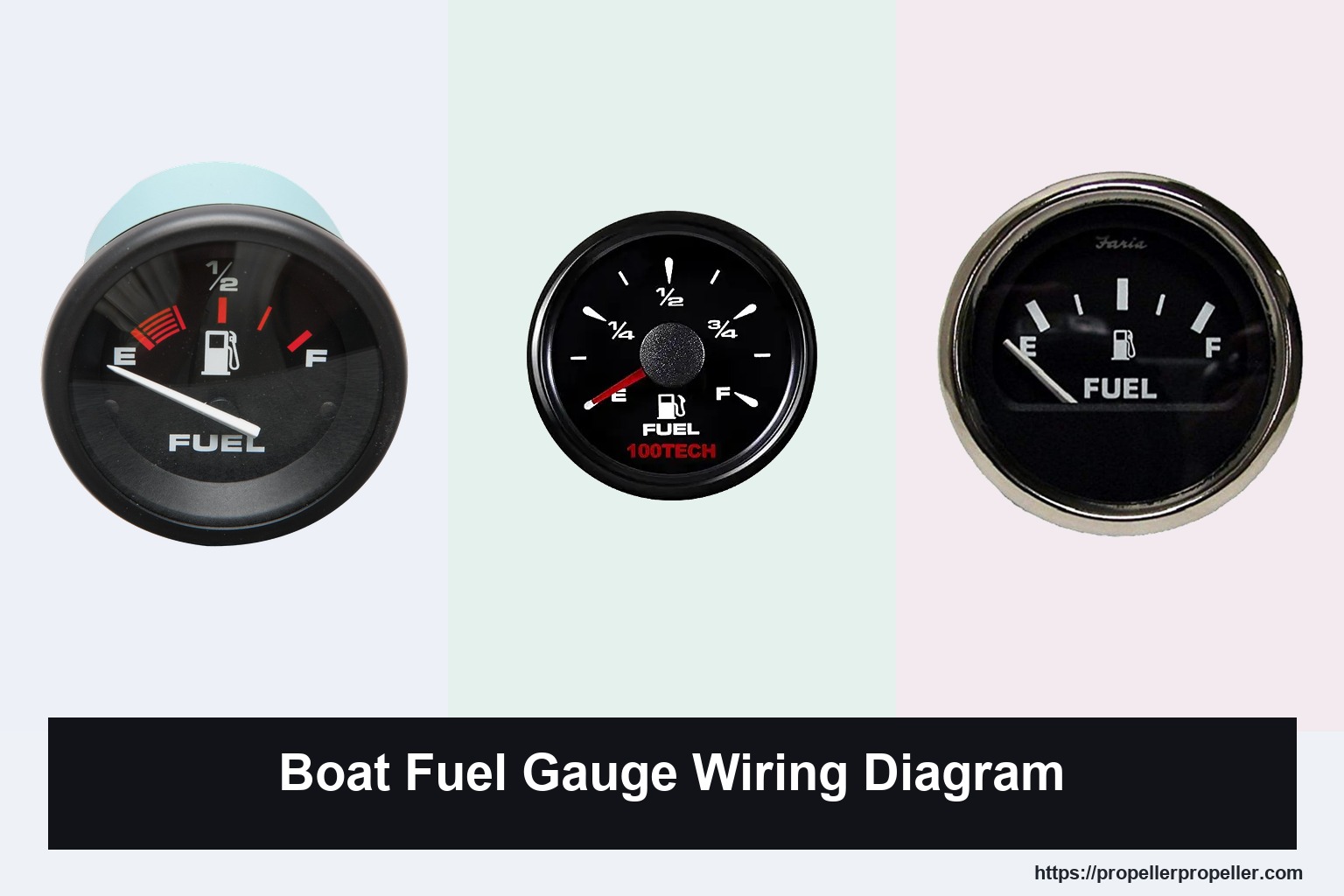
A boat fuel gauge wiring diagram is only useful if the gauge and sender actually speak the same electrical language. That is where many buyers get stuck. The physical dash opening, the sender resistance range, the backlight style, and the sealing level all matter because a neat diagram will not save a mismatched setup. The right gauge should make the tank easier to read, fit the console cleanly, and tolerate vibration, moisture, and the occasional rough day on the water.
The best choices in this category are not just about style. They need to match the sender output, fit the common 2-1/16 inch opening used in many marine dashboards, and give you readable markings at a glance. Some are simple replacement gauges, while others add adjustable backlighting or higher water resistance. The products below were selected around practical wiring compatibility, installation ease, and the kind of durability boat owners actually need when the gauge lives in a wet, vibrating environment.
Top Boat Fuel Gauge Wiring Diagram on the Market

Sierra Amega 2-Inch Fuel Gauge
- 12 VDC operation
- Scratch-resistant curved glass
- Perimeter and thru-dial lighting
- 2.13-inch hole size

100TECH Adjustable Marine Fuel Gauge
- Five sender signals
- 9-32V DC range
- IP67 waterproof rating
- 8-color backlight modes

Moeller Dash Mounted Fuel Gauge
- 33 to 240 ohms
- Stainless steel build
- Compact dash format
- Single-gauge package

100TECH White Adjustable Fuel Gauge
- Five sender signals
- 7-color lighting
- IP67 waterproof rating
- 52 mm installation

RUPSE Fuel Sender And Gauge
- SAE 5-hole mounting
- 10 quick terminals
- 8 backlight colors
- Stainless steel sensor

BLLYOGU 12V Fuel Level Gauge
This article may contain affiliate links. As an Amazon Associate, the website may earn from qualifying purchases at no additional cost to you.
Boat Fuel Gauge Wiring Diagram Reviews
Sierra Amega 2-Inch Fuel Gauge
- Item Dimensions
- 5.25 x 4 x 3.75 inches
- Item Weight
- 4.64 ounces
- Material Type
- Glass
- Warranty Description
- limited warranty
- Model
- 57902P
Advantages
- Classic analog layout
- Curved glass lens
- Near-flush bezel
- Common dash opening
- Perimeter lighting
Limitations
- No adjustable sender range
- Limited to 12 VDC
The Sierra 57902P Fuel Gauge is the straightforward choice for a cleaner dash and a familiar analog readout. Its black dial, red graduations, white numerals, and vivid white pointer staff create a display that is easy to scan without clutter. The curved glass lens and near-flush bezel matter in a boat console because they reduce the look of bulk while also protecting the face from wear. The 12 VDC design keeps it aligned with standard marine electrical systems.
Installation is also simple in the way a good replacement gauge should be. The required hole size is 2.13 inches, which places it in the common dash-gauge category and reduces the odds of surprise rework. Perimeter and thru-dial lighting are a useful touch for early starts and evening runs because the gauge remains readable when ambient light drops. The glass construction and scratch-resistant lens also suit a helm area where salt spray and constant wiping are part of normal use.
Compared with the more adjustable electronic options in this roundup, this Sierra unit wins on straightforwardness rather than flexibility. It does not try to cover multiple sender ranges or color schemes, so buyers should treat it as a clean fit for an existing 12-volt setup that already matches the gauge. That focus is exactly what makes it appealing for a conventional rebuild or a tired factory panel. For buyers who want a polished, dependable analog replacement, this is the most natural starting point.
PHOTO: Sierra Amega 2-Inch Fuel – Fuel Dial → Source: Amazon.com
100TECH Adjustable Marine Fuel Gauge
- Item Dimensions
- 2.5 x 2.5 x 2.5 inches
- Item Weight
- 3.53 ounces
- Warranty Description
- 2 Years
- Material Type
- Stainless Steel
- Thread Style
- Npt
Advantages
- Five signal ranges
- Wide voltage support
- IP67 waterproofing
- 316 stainless bezel
- 8-color backlight
Limitations
- Setup requires calibration
- Not for all sender outputs
The 100TECH Boat Fuel Gauge is built for buyers who need more than a simple replacement dial. Its strongest advantage is the adjustable signal support, which covers several common sender outputs and lowers the risk of being locked out by a mismatch. The 5 signal inputs and 9-32V DC operating range make it more adaptable than a basic 12-volt-only gauge. That flexibility matters on boats that have been modified, repowered, or fitted with a sender that does not match the original dash instrument.
Daily use is improved by the anti-vibration needle behavior and the 8-level fine scale. On the water, that matters because fuel readings are easier to follow when the pointer stays steady instead of fluttering with engine movement. The 52 mm, 2-1/16 inch install diameter keeps it compatible with common dash openings, and the setup instructions are meant to make calibration less intimidating. The 316 stainless steel bezel and IP67 rating add real value in a marine environment where moisture and corrosion are constant concerns.
Against the Sierra gauge, this 100TECH model gives up a little of that classic, finished look in exchange for much broader electrical compatibility. It is also more useful than a fixed-range gauge when you are unsure which sender output is already installed. The tradeoff is that the added adjustability requires more attention during setup. For anyone replacing a gauge in a mixed or uncertain system, this is the most versatile option in the group and the one I would prioritize first.
PHOTO: 100TECH Adjustable Marine Fuel – Black Dial → Source: Amazon.com
Moeller Dash Mounted Fuel Gauge
- Item Dimensions
- 6 x 3.25 x 2.75 inches
- Item Weight
- 2.72 ounces
- Material Type
- Stainless Steel
Advantages
- Broad sender match
- Stainless steel construction
- Simple dash-mounted format
- Low-complexity replacement
- Compact instrument size
Limitations
- No backlight customization
- No stated waterproof rating
The Moeller Marine Electric Dash Mounted Fuel Gauge is the plain-spoken option for a boat owner who wants a traditional dash instrument without extra display features. Its defining strength is the 33 to 240 ohm sender compatibility, which fits a broad swath of common marine fuel systems. That range makes it easier to pair with an existing sender when the main goal is to restore a functioning gauge rather than redesign the helm. The stainless steel construction also gives it a more durable feel than lightweight plastic alternatives.
Because this is a dash-mounted gauge, installation is centered on replacing a standard panel unit rather than adapting to a specialty display. The compact packaging and small overall dimensions suggest a straightforward instrument-class fit. That can be a benefit in older consoles where space is limited and a larger multifunction unit would be unnecessary. With no extra lighting modes or digital display layers to sort through, setup stays focused on wiring correctness and sender match.
Compared with the adjustable 100TECH gauges, the Moeller trades versatility for simplicity. That is not a weakness if your sender output already lands in the 33 to 240 ohm zone and you do not want to spend time dialing in multiple settings. It also lacks the visual flair and broad customization of the more modern alternatives. Even so, for a basic repair-minded buyer, this is one of the cleanest and least complicated choices in the roundup.
PHOTO: Moeller Dash Mounted Fuel – Black Fuel Dial → Source: Amazon.com
100TECH White Adjustable Fuel Gauge
- Item Dimensions
- 2.5 x 2.5 x 2.5 inches
- Item Weight
- 3.84 ounces
- Warranty Description
- 2 Year Warranty
- Material Type
- Stainless Steel
Advantages
- Five sender signals
- 7-color backlight
- IP67 sealing
- 316 stainless bezel
- Smooth sweeping needle
Limitations
- Requires calibration
- Not universal for every sender
This 100TECH Marine Fuel Gauge is a strong match for a buyer who wants the same adjustment range as the black version but prefers a cleaner white look. It supports the same broad sender compatibility, including several common resistive outputs, which is the feature that matters most when the tank sender and dash gauge do not match neatly. The smooth-sweeping needle is also worth noting because stable pointer movement is easier to read while the boat is moving. The 52 mm install diameter keeps it in the common marine gauge format.
The 9-32V DC operating range and 12V-24V compatibility make it practical for a wide spread of boat and vehicle electrical systems. That flexibility is valuable if the gauge is being used in a custom dash or in a setup that may not stay exactly stock. The IP67 waterproof and dustproof grade, along with the 316 stainless steel bezel, give it the kind of protection a helm gauge needs when it lives close to spray and humidity. The 7-color lighting cycle is also useful when you want the dash to match existing illumination rather than stand out awkwardly.
Against the black 100TECH model, this version is mainly a styling choice with similar technical utility. It has the same calibration and sender-matching logic, so the real question is whether you want the white face for better contrast or a lighter dash appearance. It is less traditional than the Sierra gauge and more configurable than the Moeller, which places it squarely in the middle of the field. For a builder or restorer who wants adjustability without a dark dial, this is the most balanced pick.
PHOTO: 100TECH White Adjustable Fuel – White Dial → Source: Amazon.com
RUPSE Fuel Sender And Gauge
- Item Dimensions
- 13 x 2 x 2 inches
- Material Type
- Glass,Stainless Steel
- Manufacturer Warranty Description
- 1year
- Mounting Type
- Bung Mount
Advantages
- Sender and gauge included
- Stainless steel body
- SAE 5-hole mount
- 10 quick terminals
- Broad fuel compatibility
Limitations
- More involved installation
- Only one stated length
The RUPSE Fuel Sender Unit stands apart because it is not just a gauge. It combines the sender and gauge side of the job, which is useful when the tank side of the system needs to be replaced as well. The SAE 5 hole mounting pattern and included hardware are important because they reduce guesswork around fitment. The stainless steel construction and reed-switch interior are aimed at longer service life, stable output, and accurate measurement, which is exactly what matters when the reading depends on both the tank unit and the dash display working together.
The practical appeal here is that the package addresses wiring and installation as part of one system rather than as two separate purchases. The NBR gasket, M5 screws, and 10 quick wiring terminals are all clues that the unit is meant for a more complete installation process. The fuel compatibility listed for gasoline, diesel, water, and methanol also broadens the use case beyond a basic recreational boat tank. For someone replacing a worn sender as well as the gauge, that can simplify the project and reduce the risk of piecing together mismatched parts.
Compared with the standalone gauges above, this is the more complete but also more involved option. It is not the best pick if you only need a dash instrument and already trust your sender. It is the best pick when the tank hardware is part of the problem and you want one coordinated solution. That makes it the most useful choice for a full fuel-level refresh, especially in boats where sender condition is uncertain and wiring cleanup is part of the job.
PHOTO: RUPSE Fuel Sender And – Sender and Gauge Kit → Source: Amazon.com
BLLYOGU 12V Fuel Level Gauge
- Item Dimensions
- 2.4 x 2 x 1.6 inches
- Item Weight
- 2.8 ounces
- Material Type
- Acrylonitrile Butadiene Styrene (ABS)
- Part Number
- BLGF0714-01
Advantages
- Lowest price
- White LED backlight
- Common 2-1/16 inch size
- Smooth needle action
- Simple E-1/2-F reading
Limitations
- Limited sender compatibility
- No waterproof rating stated
The BLLYOGU 12V Fuel Level Gauge is the low-cost option in this group, but it still covers the essentials most boat owners need from a basic replacement dial. Its key compatibility point is the 240-33ohm sender support, which places it in a common marine range. The 2-1/16 inch, 52 mm format also keeps it in the standard dash-gauge size class. The white LED backlight and smooth needle movement are useful because they improve legibility without adding complexity or a menu-driven interface.
This is the kind of gauge that makes sense when you want to restore a working fuel readout without paying for multiple signal options or a premium bezel. The E-1/2-F display range is simple to interpret, and the ABS construction keeps weight and cost down. It is also described as suitable for car, truck, boat, motorcycle, RV, and yacht use, so it is broadly positioned rather than narrowly specialized. That can be helpful if the same style of gauge is being used across several projects.
Compared with the more expensive adjustable gauges, the BLLYOGU sacrifices sender flexibility in exchange for price and simplicity. It does not offer the corrosion resistance or waterproof credentials of the stainless-steel rivals, so buyers should be honest about the environment where it will live. For a straightforward budget replacement on a compatible 12-volt setup, though, it is hard to ignore. It is the right call when cost control matters more than advanced calibration or marine-grade extras.
PHOTO: BLLYOGU 12V Fuel Level – Gauge with Bezel → Source: Amazon.com
How to Choose Boat Fuel Gauges
Choosing a boat fuel gauge is really about two separate decisions. First, the gauge must match the sender output already in the tank or the new sender you plan to install. Second, it has to survive the marine environment without becoming unreadable or unreliable. A good wiring diagram is only the starting point. You still need the right opening size, the right voltage range, and a display that stays legible when the helm is wet, vibrating, or dimly lit.
Sender Match
The sender resistance range is the first thing to verify because it determines whether the gauge can interpret the tank signal correctly. Common marine systems may use one resistance window, while other vehicles or replacement senders use another. If the gauge and sender do not match, the needle may sit wrong all the time or never reach empty and full accurately. The safest path is to identify the sender output before buying, then choose a gauge that explicitly covers that range.
Voltage and Power
Boat fuel gauges are usually tied to a 12-volt system, but some replacement gauges are built for wider operating ranges. That matters if the helm has been modified, if the gauge may be used in another vehicle, or if the electrical system is not perfectly standard. A broader voltage range does not automatically make a gauge better, but it can reduce compatibility problems. The key is to match the gauge’s stated operating range to the system that will actually power it.
Mounting Size
Physical fit is easy to overlook until the panel is already apart. Many marine fuel gauges use the common 2-1/16 inch opening, which simplifies replacement in a standard dash. Still, the exact cutout or hole size should be checked before purchase because small differences can turn a quick swap into a panel modification. If your goal is a clean replacement, prioritize a gauge that fits the existing opening without adapters or rework.
Water and Corrosion Resistance
A fuel gauge on a boat lives in a tougher environment than one in a car. Salt air, spray, humidity, and frequent cleaning all punish exposed parts. Stainless steel bezels, sealed housings, and IP-rated protection are useful because they reduce the chance of fogging, rust, and electrical failure. If the gauge sits near the helm where spray and condensation are common, stronger environmental protection is worth paying for. It often determines whether the gauge still looks and works well after a season of use.
Lighting and Readability
Backlighting matters more on a boat than many buyers expect. Early launches, evening runs, and covered helms all make the gauge harder to read. A simple white dial can be enough for one boat, while another may benefit from adjustable illumination that matches the dashboard. Readability also depends on pointer clarity and dial contrast. The goal is not just style. It is being able to verify fuel level quickly without leaning in or using a flashlight.
Replacement or Full System
Some buyers only need to replace the dash gauge, while others discover the sender in the tank is also part of the problem. Those are different jobs. A standalone gauge is simpler and cheaper when the sender is already known to be healthy. A gauge-and-sender kit is the better route when the whole measurement chain needs refreshing. Deciding which problem you are solving before you buy will save time, reduce wiring confusion, and lower the chance of ending up with mismatched parts.
Fuel Gauge Comparison Table
| Product | Best For | Sender Range | Size | Warranty | Material | Number of Items |
|---|---|---|---|---|---|---|
| Sierra Amega 2-Inch Fuel Gauge | Best Classic Gauge | Not Specified | 5.25 x 4 x 3.75 inches | limited warranty | Glass | 1 |
| 100TECH Adjustable Marine Fuel Gauge | Best Adjustability | Automotive Replacement Fuel Gauge for Boat RV Yacht Car Truck Motorcycle, 240-33ohm 0-190ohm 240-30ohm 0-180ohm 10-180ohm | 2.5 x 2.5 x 2.5 inches | 2 Years | Stainless Steel | 1 |
| Moeller Dash Mounted Fuel Gauge | Best Simple Replacement | Not Specified | 6 x 3.25 x 2.75 inches | Not Specified | Stainless Steel | 1 |
| 100TECH White Adjustable Fuel Gauge | Best White Dial Pick | Aftermarket Fuel Level Gauge Automotive Replacement Gauge 240-33ohm 0-190ohm 240-30ohm 0-180ohm 10-180ohm Motocycle Car Truck | 2.5 x 2.5 x 2.5 inches | 2 Year Warranty | Stainless Steel | 1 |
| RUPSE Fuel Sender And Gauge | Best Sender Kit | Not Specified | 13 x 2 x 2 inches | Not Specified | Glass,Stainless Steel | 1 |
| BLLYOGU 12V Fuel Level Gauge | Best Budget Gauge | 2″ (52mm) 240-33ohm Universal E-1/2-F Pointer Meter for Car Boat RV Yacht Motorcycle | 2.4 x 2 x 1.6 inches | Not Specified | Acrylonitrile Butadiene Styrene (ABS) | 1 |
How We Tested & Analyzed Boat Fuel Gauge Wiring Diagram
This roundup focused on the decision points that matter most in marine fuel-readout work. Electrical compatibility was the primary filter, especially sender resistance ranges and operating voltage. I also weighed mounting size, environmental protection, and readability because those are the issues that most directly affect whether a gauge can be installed cleanly and trusted in day-to-day boating. Decorative claims and marketing language were ignored unless they supported a real installation or use-case advantage.
Differences were compared by looking at how much flexibility each product gives the installer versus how simple it is to use once installed. A fixed-range replacement is attractive when the system is already known. Adjustable gauges are more useful when the sender type is uncertain or the vessel has been modified. I also separated pure dash gauges from sender-inclusive kits because they solve different problems, even though both may appear in the same search results.
I treated limited compatibility, extra calibration steps, and environmental ratings as meaningful tradeoffs rather than flaws to overlook. A more adjustable gauge can be the right answer for one boat and the wrong one for another. Likewise, a simple analog replacement can be the most sensible choice when the system is already standard. The point of the analysis was to help a buyer choose the least risky path for the wiring and sender setup they actually have.
Frequently Asked Questions
What resistance range should I look for in a boat fuel gauge?
Match the gauge to the sender output already in the tank or the sender you plan to install. Common ranges vary, so do not assume one gauge will work with every setup. If the resistance range is wrong, the needle can read inaccurately across the entire tank, which defeats the purpose of replacing the instrument.
Is a 2-1/16 inch gauge size standard on boats?
It is one of the most common marine dash sizes, which is why many replacement gauges use it. Even so, you should confirm the opening before ordering. A small mismatch can turn a simple swap into panel modification, especially on older boats or custom dashboards.
Do I need waterproofing for a fuel gauge?
For most boats, stronger moisture protection is a smart purchase rather than a luxury. A gauge near spray, humidity, or frequent washdowns benefits from sealed construction and corrosion-resistant materials. Better protection can improve long-term readability and reduce the chance of electrical problems around the helm.
When should I buy a sender-and-gauge kit instead of only a gauge?
Choose a kit when the tank sender is also worn, inaccurate, or unknown. That approach replaces the measurement chain more completely and reduces the chance of pairing a new gauge with a failing sender. If the sender is already known to be correct, a standalone gauge is usually the simpler route.
Final Thoughts
The best boat fuel gauge wiring diagram is the one that leads to a clean match between sender, voltage, and dash opening. That is the real buying decision. A polished dial is useful, but only if it reads the tank correctly and survives the marine environment. Once you identify the resistance range and the space available in your panel, the choice becomes much clearer. The right gauge should remove uncertainty, not add another wiring problem.
For a simple replacement, a standard analog gauge is often enough. For a modified system or an uncertain sender, an adjustable option is safer. And when the whole fuel-level chain needs attention, a sender-and-gauge kit is the more complete fix. Focus on compatibility first, then decide how much flexibility and environmental protection your boat really needs. That sequence will get you to the most reliable result with the least frustration.



