
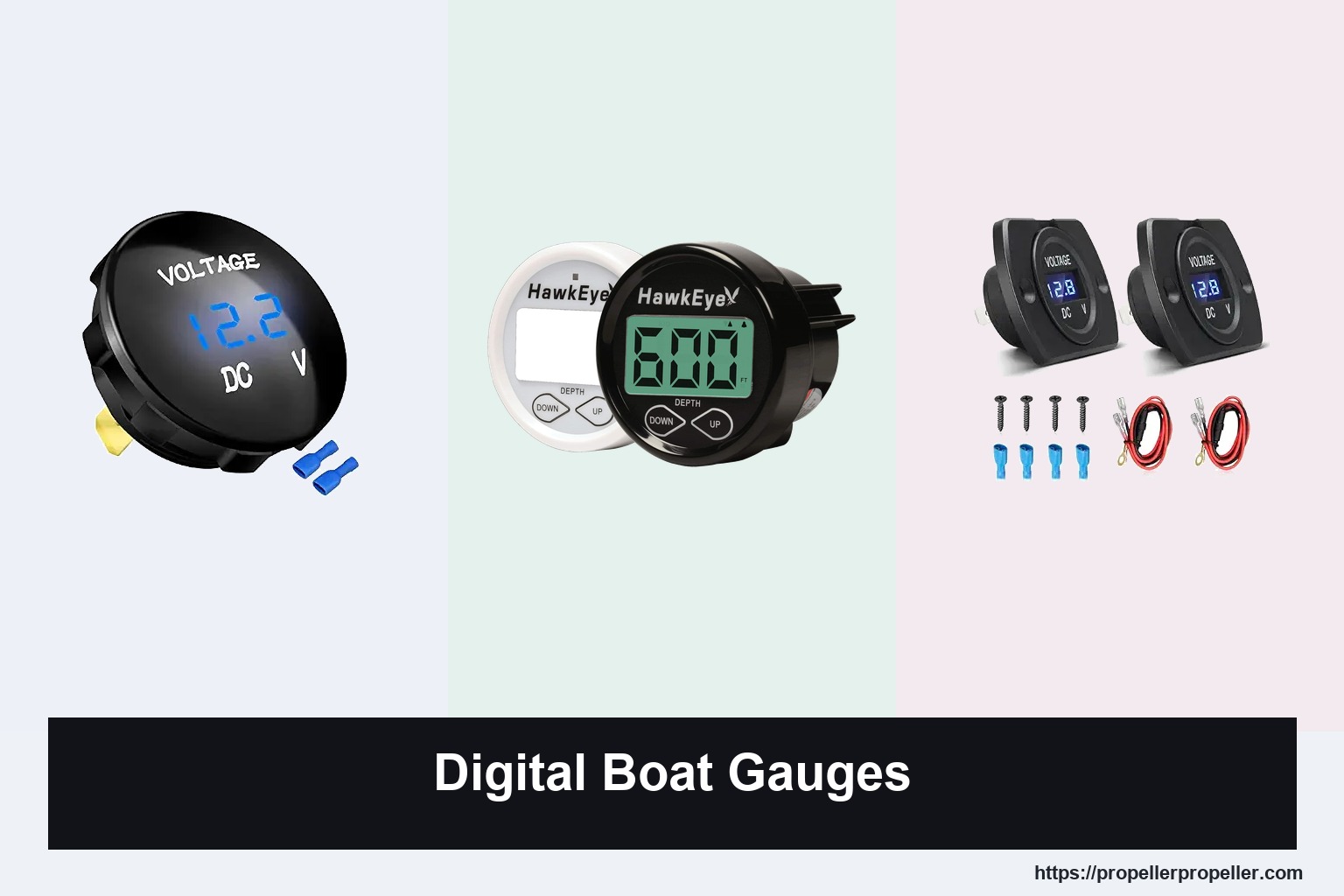
Digital boat gauges do more than fill an empty panel. They turn scattered electrical, speed, depth, and engine data into information you can read at a glance, which matters when conditions change quickly and attention is already split between trim, traffic, weather, and wake. The right gauge is the one that fits your mounting space, speaks the language of your boat’s systems, and stays readable when glare, spray, or vibration become part of the day.
This roundup focuses on practical differences that affect ownership. Some buyers need a simple voltage monitor for a small craft or auxiliary battery. Others need a depth sounder, a GPS speed display, a networked engine instrument, or a complete multi-gauge cluster. The best choice is not always the most feature-rich one. It is the unit that matches your electrical system, installation depth, display visibility, and the specific data you actually need underway.
Top Digital Boat Gauges on the Market

DaierTek DC Voltmeter Gauge
- 8-48V measurement range
- 0.1V accuracy
- Waterproof design
- 1 1/8-inch panel hole
- Blue LED display

Hawkeye DepthTrax 2B Depth Finder
- 2.5 to 600 feet
- 1.86-inch display
- 200 kHz transducer
- Audible warning system
- Flush or surface mount

Anina Dual Pack Voltmeter Monitor
- Two-pack value
- 8V-48V readout
- 0.1-0.2V accuracy
- 29mm panel mount
- Blue LED digits

Simrad IS35 Digital Display
- NMEA2000 data display
- 240 x 360 color screen
- Automatic page cycling
- Surface or flush mount
- Engine and vessel data

MAIMEIMI GPS Speedometer 85mm
- 85mm panel cutout
- TFT screen display
- mph, knots, km/h
- IP67 waterproof
- 9-32V working voltage

ARTILAURA 7 Gauge Marine Kit
- Seven-gauge kit
- GPS speedometer and tachometer
- 316L metal bezel
- IP67 waterproof and dustproof
- Includes senders and sensors
This article may contain affiliate links. As an Amazon Associate, the website may earn from qualifying purchases at no additional cost to you.
Digital Boat Gauges Reviews
DaierTek DC Voltmeter Gauge
- Voltage
- 12 volts
- Material Type
- Plastic
- Item Weight
- 9.07 g
- Model
- DS4010W
Advantages
- Very low price
- Compact panel footprint
- Simple voltage monitoring
- Waterproof design
- 2-year after-sales warranty
Limitations
- Voltage only, no other data
- Requires matching panel opening
The DaierTek voltmeter is aimed at buyers who want a straightforward battery check rather than a full dashboard retrofit. Its 8-48V measurement range covers common 12V and 24V systems, and the 0.1V accuracy gives a more useful picture than a vague warning light ever could. That makes it easier to spot charging problems, weak batteries, or a system that is slowly drifting out of range before a trip becomes a recovery job. The compact form also keeps the install visually clean instead of overwhelming a small helm or accessory panel.
Mounting is uncomplicated if you already have a standard opening to work with. The gauge fits a 1 1/8-inch hole and uses a nylon retaining nut, so it is better suited to quick panel replacement than to a custom fabrication project. The waterproof design matters on boats because spray and humidity are normal, not exceptional. It is also a simple readout, not a multi-function instrument, so it works best when you want voltage status only and do not need deeper diagnostics or network integration.
Against the other options here, this is the most stripped-down instrument but also the easiest to justify for budget-conscious buyers. It costs far less than the depth finder, GPS speedometer, or full gauge kit, and it avoids the complexity of sensor pairing and network setup. The tradeoff is obvious: you get voltage monitoring, not navigation or engine data. That is exactly why it stands out for small boats, trailers, and owners who only need one reliable electrical health check. I would recommend it for the simplest installations and the tightest budgets.
PHOTO: DaierTek DC Voltmeter Gauge – Voltage Meter → Source: Amazon.com
Hawkeye DepthTrax 2B Depth Finder
- Display Size
- 1.86 inches
- Maximum Measuring Depth
- 600 feet
- Display
- LCD
- Mounting Type
- Transom Mount
- Power Source
- DC power supply
Advantages
- Wide depth range
- Large in-dash display
- Audible and visual alarms
- No-glare LCD
- Works with fiberglass or thin aluminum
Limitations
- Transducer fit depends on hull type
- More involved installation than simple gauges
The Hawkeye DepthTrax 2B is for boaters who need continuous depth awareness instead of a general-purpose gauge. Its 2.5 to 600 feet reading range is broad enough for many inland and coastal uses, and the 1.86-inch display keeps the information compact without taking over the dash. That combination matters because depth equipment is only helpful if it stays readable when the boat is moving and the operator is scanning other instruments at the same time. The in-dash format also suits a cleaner helm layout than a loose portable unit.
Installation deserves attention because transducer choice affects where the system will work properly. The included dual-mount transducer can shoot through solid fiberglass hulls and up to 1/8-inch aluminum hulls, but glue-in mounting is restricted to non-cored fiberglass or thin aluminum only. That limitation is important. It means this is not a universal pick for every hull construction. The no-glare polarized LCD and sun cover are practical touches for bright water, and the 3-stage warning system adds an audible and visual layer when depth becomes a real concern.
Compared with the voltmeters and speed gauges in this group, this unit is the one aimed at safety-critical information rather than convenience data. It is also less installation-flexible than the simple panel gauges, because the transducer and hull compatibility determine whether it is a good fit. The upside is stronger consequence: depth visibility can prevent costly mistakes in shallow water. Buyers who spend time in unfamiliar channels, changing tides, or shallow approaches should put this near the top of the list. It is the clearest recommendation for dedicated depth monitoring.
PHOTO: Hawkeye DepthTrax 2B Depth – Digital Depth Finder → Source: Amazon.com
Anina Dual Pack Voltmeter Monitor
- Power Source
- Corded Electric
- Compatible Devices
- Car, Motorcycle, Boat, Trailer
- Item Weight
- 0.11 kg
- Model
- SP-2531
Advantages
- Two gauges included
- Broad voltage range
- Clean panel mounting
- Water-resistant sealed design
- Useful for multiple vehicles
Limitations
- Voltage only
- Installation still requires a panel opening
Anina’s voltmeter monitor is built around everyday battery management, but the two-pack format changes its value equation. With 8V-48V readout coverage and 0.1-0.2V accuracy, it is useful on both 12V and 24V systems, while the pair of units lets you monitor more than one circuit or equip two different vehicles at once. That is a meaningful advantage for owners who juggle a boat and a trailer, or a primary battery and a reserve system. The blue LED display keeps the readout easy to check in mixed light without adding much visual bulk.
Installation is also a strong part of the pitch. The gauge is designed for a 29mm panel mount and comes with the mounting hardware and wiring accessories needed for a clean panel job. That makes it less improvised than many inexpensive voltage displays. The sealed construction is the feature that matters most on a boat, because splash, rain, and humidity are routine. It remains a voltage-only instrument, though, so it is useful for monitoring battery condition but not for diagnosing the root cause of a charging problem by itself.
This model sits between the cheapest single-gauge option and the more specialized marine instruments. Its main tradeoff is that you do not get depth, speed, or engine data. What you do get is two monitors for a modest step up in price, which makes it easier to cover multiple setups at once. That is why it stands out for buyers with more than one battery-fed platform or for anyone trying to build in redundancy. I would choose it when the priority is practical coverage rather than a single ultra-compact install.
PHOTO: Anina Dual Pack Voltmeter – Two-Gauge Set → Source: Amazon.com
Simrad IS35 Digital Display
- Item Weight
- 1.4 pounds
Advantages
- Network-based data display
- Full-color screen
- Automatic page prioritization
- Surface or flush mounting
- Shows multiple vessel metrics
Limitations
- Depends on NMEA2000 data
- Highest price in the group
The Simrad IS35 is for boats that already live on a NMEA2000 network and need a display that can surface the important data without forcing the operator through a clumsy menu structure. Its 240 x 360 LED screen is a much richer interface than the monochrome utility gauges elsewhere in this roundup, and the NMEA2000 compatible architecture is the key reason to buy it. It can show engine and vessel data drawn from connected sensors, which means the real value depends on what your network already supplies. That makes it a serious instrument rather than a universal one.
The attraction here is how the display prioritizes information. It can automatically show engine metrics, fuel economy, depth history, and other available data across pre-configured pages, which reduces the chance of hiding the wrong screen when conditions are busy. The unit starts when the N2K bus powers up, so integration is the point, not standalone flexibility. That dependency is important. If your boat is not already equipped for networked data, the display’s strengths become irrelevant until the rest of the system is in place.
Compared with the depth finder and the simple voltage gauges, this is the most sophisticated option in the group and the one least suited to casual retrofit work. It costs significantly more, but that price buys a larger role in the helm architecture. Buyers with compatible engines and sensors will appreciate the cleaner data presentation and the ability to centralize information on one screen. Buyers without a network should look elsewhere. I recommend it for integrated marine systems where the display can actually use the data available to it.
PHOTO: Simrad IS35 Digital Display – Display Screen → Source: Amazon.com
MAIMEIMI GPS Speedometer 85mm
- Item Dimensions
- 3.8 x 3.8 x 2.2 inches
- Material Type
- Metal, Plastic
- Item Weight
- 10.4 ounces
- Part Number
- MA-CX8049B
Advantages
- GPS-based speed reading
- Multiple speed units
- IP67 waterproof rating
- Fog-resistant display
- Wide voltage compatibility
Limitations
- Needs sky view for best signal
- Initial lock takes time
This MAIMEIMI speedometer is aimed at operators who want speed data without relying on a pitot tube or mechanical cable setup. Its 85mm panel cutout and TFT screen display make it more modern than basic analog dials, while the GPS function turns it into a cleaner solution for boats that need speed over ground rather than wheel-based speed. The ability to switch between mph, knots, and km/h broadens its usefulness across different waters and vessel types. That versatility matters because speed data is one of the most frequently checked values at the helm.
Setup is more specific than the simple voltmeter gauges. The gauge needs a clear view of the sky to acquire signal, and the first fix can take about 30 seconds. That means it is not instant in the same way as an electrical readout, but the tradeoff is a more flexible installation path because no physical speed sensor is needed. The IP67 waterproof and anti-fogging protection are valuable on a marine dash where spray and temperature swings can haze a weaker screen. The 9-32V operating window also broadens compatibility with common boat and vehicle systems.
This model competes differently from the depth finder and the network display. It is narrower in scope than both, but that focus makes the speed readout clearer and easier to justify for many owners. Compared with the more complex Simrad system, it is far cheaper and does not need a marine data network. Compared with the simple voltage meters, it adds movement data that is useful during cruising, towing, and fuel planning. I would recommend it for buyers who want GPS-based speed in a straightforward dash format without building a full electronics suite.
PHOTO: MAIMEIMI GPS Speedometer 85mm – GPS Speedometer → Source: Amazon.com
ARTILAURA 7 Gauge Marine Kit
- Number of Items
- 7
- Material Type
- Stainless Steel 316L Bezel + Anti-fog Glass
- Thread Style
- Npt
- Item Weight
- 0.39 kg
- Part Number
- AR-Set7A-0003B
Advantages
- Complete seven-gauge coverage
- Includes sensors and antenna
- Marine-grade materials
- Scratch-resistant lenses
- 7-color backlight
Limitations
- More complex installation
- Overkill for single-gauge needs
The ARTILAURA kit is the right choice when a bare helm needs a complete information package rather than a single replacement gauge. It combines seven functions, including GPS speed, tachometer, fuel, water temperature, oil pressure, volt, and trim, so the result is closer to a coordinated cockpit upgrade than a one-off instrument swap. The seven-gauge kit format is what sets it apart, and the 316L metal bezel gives the set a more durable, marine-oriented feel than lightweight plastic-only alternatives. For buyers rebuilding an entire panel, that breadth can be the deciding factor.
The installation consequences are more demanding than the simpler products here. The set uses an 85mm opening for the larger gauges and 52mm openings for the smaller ones, and it also includes the GPS antenna plus the relevant senders and sensors. That is helpful because it reduces sourcing friction, but it also means the installer needs to manage multiple components, sensor threads, and resistance ranges. The IP67 waterproof and dustproof rating is valuable in that context because the kit is clearly intended for marine exposure rather than sheltered dashboards. The scratch-resistant curved glass lenses further support long-term readability.
Compared with the single-function gauges, this kit is more expensive and more involved, but it solves a different problem. A buyer replacing several aging instruments may find it more economical and visually consistent than piecing together individual gauges from separate sources. It is not the best choice if you only need one reading. It is the strongest choice when the helm needs speed, engine, electrical, and trim data in one coordinated set. I would recommend it for a full panel overhaul where broad coverage matters more than minimal installation effort.
PHOTO: ARTILAURA 7 Gauge Marine – Gauge Set → Source: Amazon.com
How to Choose Digital Boat Gauges
The best digital boat gauge is the one that matches the job you actually need it to do. A voltage monitor, a depth finder, a GPS speed display, a networked engine screen, and a full instrument cluster all solve different problems, and they install very differently. Before you compare styling or price, decide whether you are replacing one failing instrument or building a more capable helm from scratch. That single decision narrows the field faster than any feature list.
Match the Job
Start with the information you need most often. If you only want to know whether the battery is healthy, a voltage gauge is enough. If you run unfamiliar water, depth data deserves priority. If speed over ground matters for cruising or fuel planning, GPS speed is the cleaner answer. A full gauge package makes sense when you are replacing several instruments at once. The category looks similar from a distance, but the right answer depends on which number you need at a glance when the boat is moving.
Check Installation Space
Panel size matters more than many buyers expect. Round gauges can look interchangeable, yet cutout diameter, mounting depth, and rear clearance determine whether the install is easy or frustrating. A compact voltage gauge can drop into a small opening, while a larger display or multi-gauge set needs more room behind the panel. Before ordering, measure the opening and the space behind it. That one step prevents the common mistake of buying the right function in the wrong physical size.
Plan for Power and Data
Some gauges read a direct voltage source and work as soon as they are wired. Others depend on sensors, transducers, GPS reception, or a marine network. That difference changes the whole project. A network display is most useful when compatible engine and vessel data are already available. A depth finder needs the right transducer placement. A GPS speed gauge needs sky visibility. The more information the gauge gathers from external sources, the more important compatibility becomes before installation begins.
Look at Visibility
A gauge that cannot be read quickly is of limited value. Display type, brightness, glare resistance, and backlight behavior all matter on the water, especially in direct sun or at night. Smaller displays can work well if the numbers are crisp. Larger screens help when multiple data pages compete for attention. Anti-glare glass, polarized LCDs, and bright LED or TFT displays each solve a different visibility problem. Choose the format that stays legible in your typical light conditions rather than the one that looks best in product photos.
Consider Marine Durability
Boat electronics live with moisture, vibration, temperature swings, and occasional spray. Water resistance is useful, but it should be interpreted in context. A sealed voltage gauge can handle splash exposure, while a full marine display or gauge kit may also need dust protection, fog resistance, or corrosion-tolerant materials. If the helm is partly exposed, durability becomes more than a comfort feature. It is what keeps the gauge readable and electrically stable after seasons of use rather than a few weekends on the water.
Weigh System Expansion
Think beyond the first installation. A single gauge can solve an immediate problem, but some setups invite expansion later. If you might add depth, engine data, or trim monitoring later, it can be smart to choose a system that leaves room for that growth. On the other hand, if you want the lowest-cost fix for one battery or one failed dial, simplicity is a virtue. The best category choice is the one that matches both today’s need and the amount of complexity you are willing to maintain.
Digital Boat Gauges Comparison Table
| Product | Best For | Material | Items | Item Weight | Part Number | Model |
|---|---|---|---|---|---|---|
| DaierTek DC Voltmeter Gauge | Best Budget Voltmeter | Plastic | 1 | 9.07 g | DS4010W-BL+DS2 | DS4010W |
| Hawkeye DepthTrax 2B Depth Finder | Best Depth Display | Not Specified | 1 | 1.7 pounds | Not Specified | Not Specified |
| Anina Dual Pack Voltmeter Monitor | Best Dual-Pack Value | Not Specified | 1 | 0.11 kg | SP-2531 | SP-2531 |
| Simrad IS35 Digital Display | Best Network Display | Glass | 1 | 1.4 pounds | DSI-044 | DSI-044 |
| MAIMEIMI GPS Speedometer 85mm | Best GPS Speed Gauge | Metal, Plastic | 1 | 10.4 ounces | MA-CX8049B | Not Specified |
| ARTILAURA 7 Gauge Marine Kit | Best Complete Gauge Kit | Stainless Steel 316L Bezel + Anti-fog Glass | 7 | 0.39 kg | AR-Set7A-0003B | Not Specified |
How We Tested & Analyzed Digital Boat Gauges
This roundup was built around the decisions that matter most in real boat use: what each gauge measures, how clearly it presents that information, what installation demands it creates, and how well it fits common marine environments. The analysis favored practical consequences over catalog-style feature counting. A product only earned attention for a specific feature when that feature changed the ownership experience in a meaningful way, such as compatibility, readability, or installation effort.
The comparisons also weighed how much system dependency each product introduces. Some gauges are self-contained and only need power or a simple panel opening. Others depend on transducers, GPS reception, sensor ranges, or networked marine data. Those dependencies shape who should consider them and who should skip them. Price mattered as a tradeoff, but not in isolation. A higher price only counted when it brought broader coverage, better display quality, or more integrated data in a way that a buyer could actually use.
Finally, the evaluation distinguished between single-purpose tools and broader instrument solutions. That distinction is important because boaters do not all need the same level of dashboard complexity. A useful buying guide has to explain when simplicity is the better value and when a more complete system is worth the extra installation work. The result is a category view that prioritizes fit, readability, and operational usefulness instead of treating every gauge as if it solved the same problem.
Frequently Asked Questions
What makes a digital boat gauge worth buying?
A good digital boat gauge turns a critical number into something you can read quickly and trust. The value comes from the combination of accuracy, visibility, and fit. If it solves the measurement problem cleanly and matches your panel or system, it can be far more useful than an older analog dial that is harder to read in motion or glare.
Do I need a networked system for marine gauges?
Not always. Simple voltage, speed, and depth units can work on their own with the right power source, sensor, transducer, or GPS signal. A networked display becomes important when you want engine and vessel data pulled from compatible marine electronics. If your boat does not already support that data structure, a standalone gauge is usually the simpler choice.
How important is waterproofing on a boat dash?
Very important, but the level you need depends on exposure. A helm that gets spray, humidity, or occasional washdown should use hardware built for marine conditions. Waterproof or sealed construction helps protect the electronics and can improve long-term reliability. If the dash is fully enclosed, durability still matters, but the risk is lower than on an open console.
Should I choose one gauge or a full gauge set?
Choose one gauge when you only need one reading or want to replace a single failed instrument. Choose a full set when you are rebuilding the panel, want a consistent look, or need several data points at once. The set is usually more involved to install, but it can save you from mixing mismatched instruments across the helm.
Final Thoughts
Digital boat gauges are easiest to choose when you start with the information, not the hardware. A simple voltage monitor is a smart fix for battery awareness. A depth finder belongs in shallow or unfamiliar water. A GPS speed display is better when you want speed over ground without mechanical complexity. A networked display or full gauge kit only makes sense when your boat can actually support that level of integration. Once you sort the category by job, the shortlist gets much smaller.
The most confident purchase is the one that matches your panel space, wiring plan, and operating conditions. Readability, compatibility, and installation effort matter just as much as the numbers on the screen. If you want the lowest-friction upgrade, stay with a self-contained gauge. If you are rebuilding a helm or adding meaningful navigation and engine data, spend for the system that gives you room to grow. The right digital gauge should simplify your time on the water, not complicate it.



