
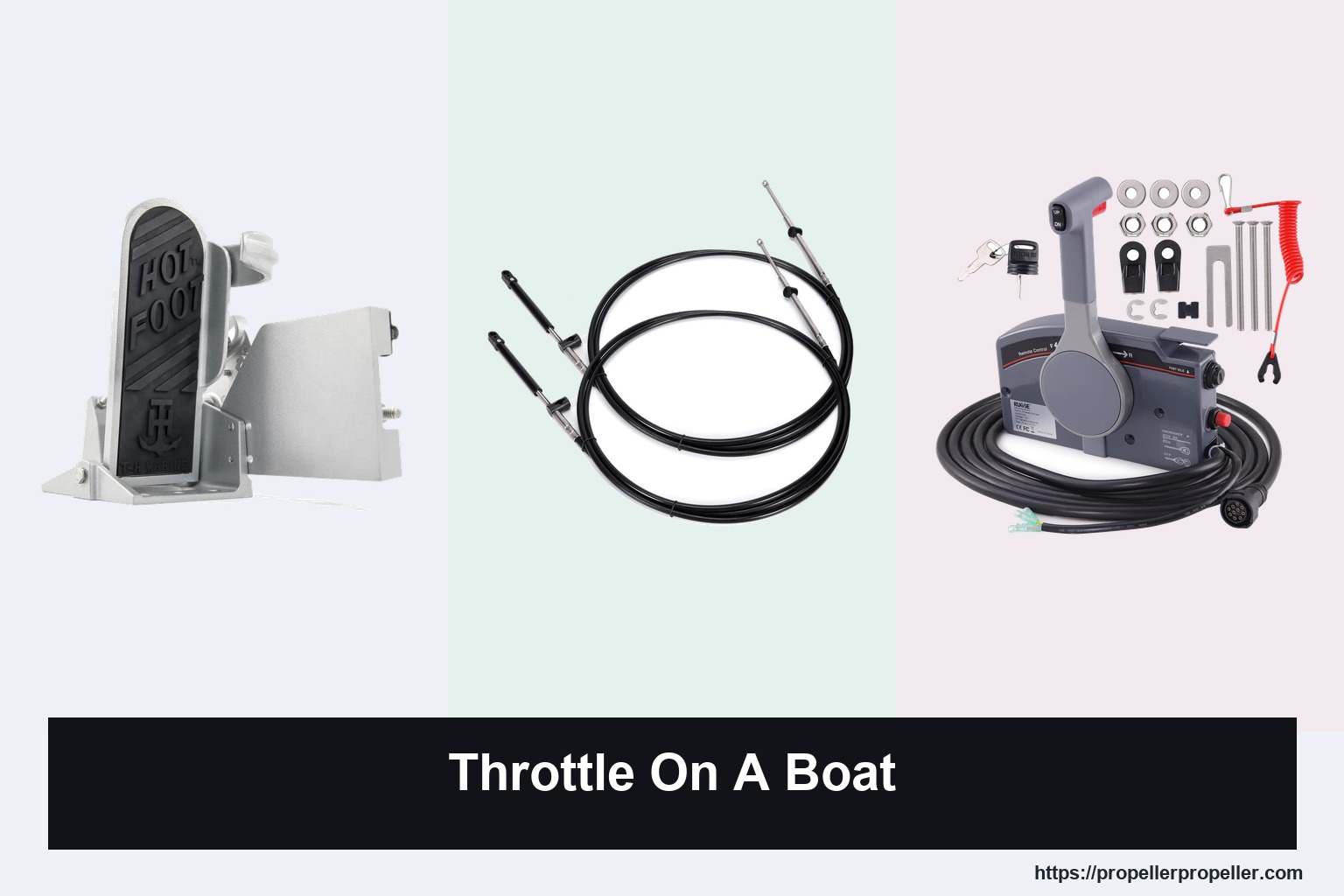
Choosing throttle hardware for a boat is not just about replacing a lever or adding a pedal. It is about how quickly you can react, how much control you have at speed, and how safely the engine returns to idle when you are off the control. The right setup depends on whether you want foot-operated precision, a cable replacement, or a side-mounted remote box that integrates shifting, trim, and safety features into one station.
The four options below cover different parts of the control chain, so the best pick depends on how your boat is rigged and what engine family you run. Some are built around universal cable-driven compatibility, while others are purpose-built for specific outboard platforms. The key differences are compatibility, mounting style, harness length, control layout, and the consequences those choices have for installation, ergonomics, and emergency shutdown behavior.
Top Throttle On A Boat on the Market

T-H Marine Hot Foot Foot Throttle
- Foot pedal control
- Cast aluminum body
- Stainless hardware
- Automatic idle return

Atesilor Gen1/Gen2 Control Cables
- Two cables included
- 10ft length
- Stainless steel cores
- Gen1 and Gen2 options

RUPSE Yamaha Side Mount Control

VEVOR Mercury Side Control Box
- Mercury PT 2-stroke
- 8+4 pin harness
- Power trim switch
- Emergency stop lanyard
This article may contain affiliate links. As an Amazon Associate, the website may earn from qualifying purchases at no additional cost to you.
Throttle On A Boat Reviews
T-H Marine Hot Foot Foot Throttle
- Operation Mode
- Manual
- Connector Type
- Cable
- Mounting Type
- Floor Mount
- Control Type
- Foot Pedal
- Compatible Devices
- All outboards and inboards using standard throttle cables
Advantages
- Foot-operated throttle control
- Automatic return to idle
- Stainless steel hardware
- Cast aluminum body
- Works with standard cables
Limitations
- Requires floor-mount installation
- Not a full control box
The T-H Marine HF-1-DP is the most direct choice here for drivers who want throttle control at the floor instead of at the helm. Its foot pedal control changes how the boat feels in use because your hand stays free for steering, trimming, or other tasks while your right foot manages power. The automatic idle return is the safety feature that matters most when speed is up and reaction time is short. Letting off the pedal sends the engine back to idle, which gives the operator a built-in reset instead of relying on hand placement alone.
Construction details support that control logic. The cast aluminum body, stainless steel hardware, and Teflon and nylon bushings are all there for a reason. They point to a control that is meant to stay smooth under repeated use and harsh moisture exposure rather than feel loose after a season. The floor-mount format and cable operation mean the boat has to already be set up around standard throttle cables, so installation is less about electronics and more about proper mechanical routing. The patented idle stop for FICHT and Optimax engines also matters because it shows that low-speed behavior has been considered for specific engine types rather than left vague.
Against the other picks in this roundup, this one is the most specialized for driving feel rather than compatibility breadth. It does not replace a remote control box or a shift system. It replaces the way you command throttle once the boat is already configured for cable control. That makes it the strongest option for performance-minded owners who want faster response and a cleaner helm workflow. If you need a straightforward way to control speed with your foot and your boat already matches the cable requirement, this is the clearest recommendation.
PHOTO: T-H Marine Hot Foot – Foot Throttle → Source: Amazon.com
Atesilor Gen1/Gen2 Control Cables
- Size
- 10ft
- Number of Items
- 2
- Material
- Plastic, Stainless Steel
- Warranty Description
- 1 Year Manufacturer
- Style
- Gen 1
Advantages
- Throttle and shift cables
- Stainless steel cable cores
- ABS protective sheath
- Gen1 and Gen2 options
- One replacement purchase
Limitations
- Length must be matched carefully
- Limited to specific controller families
Atesilor targets a very different buyer: someone replacing worn control cables rather than the control head itself. The package includes both throttle and shift cables, so you are not piecing together a repair one line at a time. The 10ft length gives a clear starting point for boats that need a standard run, and the stainless steel cores matter because marine cables face constant moisture and corrosion pressure. When the cable itself is the weak link, these are the details that determine whether the control feels crisp or sluggish.
Length and compatibility are the real decision points here. The product notes that excessively long cables can introduce delay and excessively short cables can create tight operation and even risk breakage, which is the kind of limitation that matters before you order. It also separates Gen1 and Gen2 support, with the 600A series calling for Gen1 and the 4000 series calling for Gen2. That means the right fit depends on the controller family, not just on the boat brand. The ABS sheath adds another layer of protection, which is useful in salt and humidity exposure where jacket wear can quickly turn into internal damage.
Compared with the foot throttle and the side-mounted control boxes, this is not an upgrade in cockpit features. It is a maintenance part that restores the mechanical pathway between the control and the engine. That makes it the most practical choice when the boat already has the right control hardware and the issue is cable wear or replacement. Buyers who know their controller family and need a matched throttle-and-shift cable set should look here first. If you need to revive a cable system rather than redesign it, this is the most targeted option in the group.
PHOTO: Atesilor Gen1 Gen2 Control – Throttle Cables → Source: Amazon.com
RUPSE Yamaha Side Mount Control
- Maximum Horsepower
- 250 hp
- Material Type
- Aluminum
- Mounting Type
- Handlebar Mount
- Operation Mode
- Electric
- Item Weight
- 4.56 kg
Advantages
- Side-mounted control box
- Trim and tilt switch
- Adjustable throttle friction
- Safety lanyard included
- Reversible handle orientation
Limitations
- Yamaha-specific compatibility
- More complex installation
RUPSE is aimed at owners of electric-start Yamaha outboards who need a full remote control box rather than a standalone throttle part. The value is in consolidation. Shift, throttle, key switch, trim, and lanyard functions are all grouped into one side-mounted station, which reduces clutter and creates a more complete helm layout. The 10 pin wiring harness and 16.7ft harness give you useful installation reach, especially when the mounting position is not directly next to the engine interface. That makes this more than a simple lever replacement. It is a control-center swap for a compatible Yamaha setup.
The operation details are the main practical advantage. The adjustable throttle friction lets you tune lever resistance to preference, which matters when you want either a lighter touch or more deliberate lever movement. The push-to-choke key switch, fast-idle lever, and trim/tilt switch bring several common helm actions into one assembly. There is also a shut-off lanyard and clip, which adds a direct safety layer if the operator leaves the helm unexpectedly. Because the reversible handle can be used on right-hand installations and changed to left-hand orientation, it gives some flexibility in helm layout, though compatibility still remains centered on Yamaha electric-start models.
This control box sits between the simpler cable parts and the more universal foot throttle. It is the right kind of product when you want a full remote station and your engine family matches the unit. It is not the broadest fit in the group, and it is not meant for a universal floor mount. Its strength is that it packages everyday operating functions with engine-specific compatibility in one assembly. For Yamaha owners who need a full side control with long harness reach, this is the most complete and purpose-built choice.
PHOTO: RUPSE Yamaha Side Mount – Remote Control Box → Source: Amazon.com
VEVOR Mercury Side Control Box
- Package Dimensions
- 17.72 x 11.81 x 6.69 inches
- Item Weight
- 9.8 pounds
Advantages
- Mercury PT 2-stroke fit
- Long 16.3 ft harness
- Power trim switch
- Emergency stop lanyard
- Aluminum alloy construction
Limitations
- Engine family is narrow
- Heavier than cable parts
VEVOR focuses on Mercury PT 2-stroke outboards, so its strongest appeal is compatibility paired with a complete control layout. The side-mounted box combines throttle, shifting, trim, and emergency shutdown into one interface, which is useful when you want fewer separate pieces at the helm. The 16.3 ft harness gives generous routing reach, while the 8+4 pin connection style tells you immediately that this is built around a specific Mercury wiring arrangement rather than a generic swap. That specificity can save time if your engine matches, because the control is designed around the expected electrical and mechanical integration.
Material choices reinforce the marine use case. The aluminum alloy interior, die-cast aluminum housing, and crack-resistant ABS handle are all aimed at long-term exposure to vibration, moisture, and frequent lever movement. The friction-adjustable throttle lever matters because it lets you tune lever feel instead of accepting a fixed drag level. The low-temperature start air-fuel ratio adjustment is another sign that the control is trying to stay dependable in colder conditions, while the power balance and tilt switch adds practical day-to-day value when loading, stopping, or trying to keep the engine angle appropriate for the situation.
Relative to the Yamaha-focused control box, this one is for a different engine family and a different installation path. Compared with the foot throttle, it keeps shifting and trim in the same hand control rather than moving throttle management to the deck. That makes it the better fit for Mercury PT 2-stroke owners who want a full, helm-mounted control station with safety lanyard support and a long harness. It is not the universal answer, but within its compatibility window it is the most complete option here for Mercury-oriented remote control replacement.
PHOTO: VEVOR Mercury Side Control – Control Box Kit → Source: Amazon.com
How to Choose Boat Throttle Hardware
Boat throttle hardware seems simple until the wrong control creates awkward ergonomics, slow response, or a compatibility problem that stops the project before it starts. The best choice depends on how the boat is set up now, whether you are replacing a cable or a full control station, and how much of the operating sequence you want under one hand or one foot. That is why the category splits into very different products, even when they all affect speed and shift control.
Control Layout
Start with where you want your input to happen. A foot pedal changes the way you drive because throttle control moves to the deck and your hand remains freer for steering or trim. A side-mounted box keeps throttle, shift, and often trim in one station near the helm. Cable replacements sit behind the scenes and only make sense when the control head is already in place. The best layout is the one that matches how you actually operate the boat, not the one that looks most advanced on paper.
Compatibility First
Marine throttle hardware is often limited by engine family, controller type, or cable standard. That is why compatibility should be checked before anything else. A cable set may need a specific controller generation, while a remote control box may only work with a particular outboard brand or series. If you skip that step, you risk buying a part that is mechanically close but functionally wrong. The safest approach is to confirm the engine, control system, and connector style before you compare price or features.
Installation Realities
Installation effort is different for each throttle category. A foot pedal needs a floor mount and cable routing that supports smooth movement without binding. A control box needs room at the helm, a harness path, and enough access for the wiring and linkage connections. Cable replacements demand the most care in measurement because an overly tight run can stress the system and an overly long one can create sluggish action. The right choice is the one that fits the boat’s physical layout without forcing awkward bends or compromised routing.
Safety and Return Behavior
Throttle control is not just about acceleration. It also affects what happens when your foot comes off the pedal, the lever is released, or the operator leaves the helm. Some systems return to idle automatically. Others add a lanyard that can shut the engine down if the driver moves away unexpectedly. These features matter most when speed, weather, or crowded waterways leave little room for correction. Look for the kind of safety behavior that matches your boating style instead of treating it as an optional extra.
Durability in Saltwater
Marine use punishes moving parts. Corrosion-resistant metal cores, aluminum housings, stainless hardware, and protective cable jackets all help a control stay smooth after repeated exposure to moisture and vibration. Material quality matters because throttle problems usually start as stiffness, friction, or wear long before a total failure appears. If your boat lives in a wet environment or sees heavy seasonal use, the better choice is usually the one built with fewer vulnerable materials and more deliberate protection around the moving surfaces.
Throttle Control Comparison Table
| Product | Best For | Mounting | Control Mode | Material | Weight | Color |
|---|---|---|---|---|---|---|
| T-H Marine Hot Foot Foot Throttle | Best foot throttle | Floor Mount | Manual | Plastic | 2.25 kg | Silver |
| Atesilor Gen1/Gen2 Control Cables | Best cable replacement | Not Specified | Not Specified | Not Specified | Not Specified | Black |
| RUPSE Yamaha Side Mount Control | Best Yamaha control box | Handlebar Mount | Electric | Aluminum | 4.56 kg | Black |
| VEVOR Mercury Side Control Box | Best Mercury control | Not Specified | Not Specified | Not Specified | 9.8 pounds | Not Specified |
How We Tested & Analyzed Throttle on a Boat
This roundup was organized around the decisions that matter most when buying throttle-related hardware for a boat: compatibility, control layout, installation demands, safety behavior, and material durability. Those criteria matter because throttle problems are rarely just about performance. They are usually about whether the control matches the engine, the existing rigging, and the way the operator wants to drive. Each product was evaluated as a different kind of solution rather than forced into one category.
Meaningful differences were weighed by looking at how each product changes the operator’s workflow. A foot control changes how throttle input is delivered. A cable replacement restores the mechanical path between controls and engine. A side-mounted box consolidates shifting, trim, and shutdown behavior into one station. That separation is important because a buyer comparing these items is not comparing identical products. They are choosing between different control philosophies, each with its own installation and usage tradeoff.
Limitations were also part of the analysis. Narrow compatibility, measurement sensitivity, and more involved installation are not flaws to hide. They are the deciding factors that prevent the wrong part from becoming an expensive mistake. The goal was to emphasize grounded purchase guidance and practical consequences rather than reciting catalogs of features. When a product’s strengths were tied to a specific engine family or mounting style, that constraint was treated as part of its value proposition, not as an afterthought.
Frequently Asked Questions
What matters most when choosing boat throttle hardware?
Compatibility matters first, followed by control layout and installation path. A part can look right but still fail if it does not match the engine family, cable standard, or mounting space. After that, decide whether you want a foot-controlled setup, a helm-mounted box, or a cable replacement that preserves the existing control structure.
Do I need a full control box or just cables?
If the lever, shift action, and trim functions already work but the system feels worn, replacement cables may be enough. If you are changing how the boat is controlled at the helm or installing a new station, a full control box is the better match. The right answer depends on whether the problem is inside the rigging or at the control interface.
Why does harness length matter so much?
Harness length affects routing, installation ease, and strain on the connection path. Too short can force tight bends or limit where the control can be mounted. Too long can create clutter and awkward slack. The correct length should support a clean route without pulling on the connector or forcing a compromised layout.
Are safety lanyards worth prioritizing?
Yes, especially on faster boats or in situations where the operator can be thrown off balance. A lanyard adds a shutdown path if the driver leaves the helm unexpectedly. It is not a substitute for careful operation, but it is an important layer of protection that can make a real difference during an emergency.
Final Thoughts
Boat throttle hardware is one of those purchases where the wrong fit is more expensive than the higher price tag. The best choice is the one that matches the boat’s control architecture, engine family, and installation space, then adds the kind of throttle behavior you actually want. For some buyers, that means a foot pedal with automatic return. For others, it means a cable set that restores smooth mechanical action, or a side-mounted control box that centralizes helm functions.
Once compatibility is confirmed, the decision becomes more straightforward. Choose the control style that fits your driving habits and the level of integration you want at the helm. Keep an eye on materials, cable routing, and safety behavior because those details determine whether the system feels precise and dependable after repeated use. With the right match, throttle control becomes less about managing a part and more about improving the entire boating experience.



