
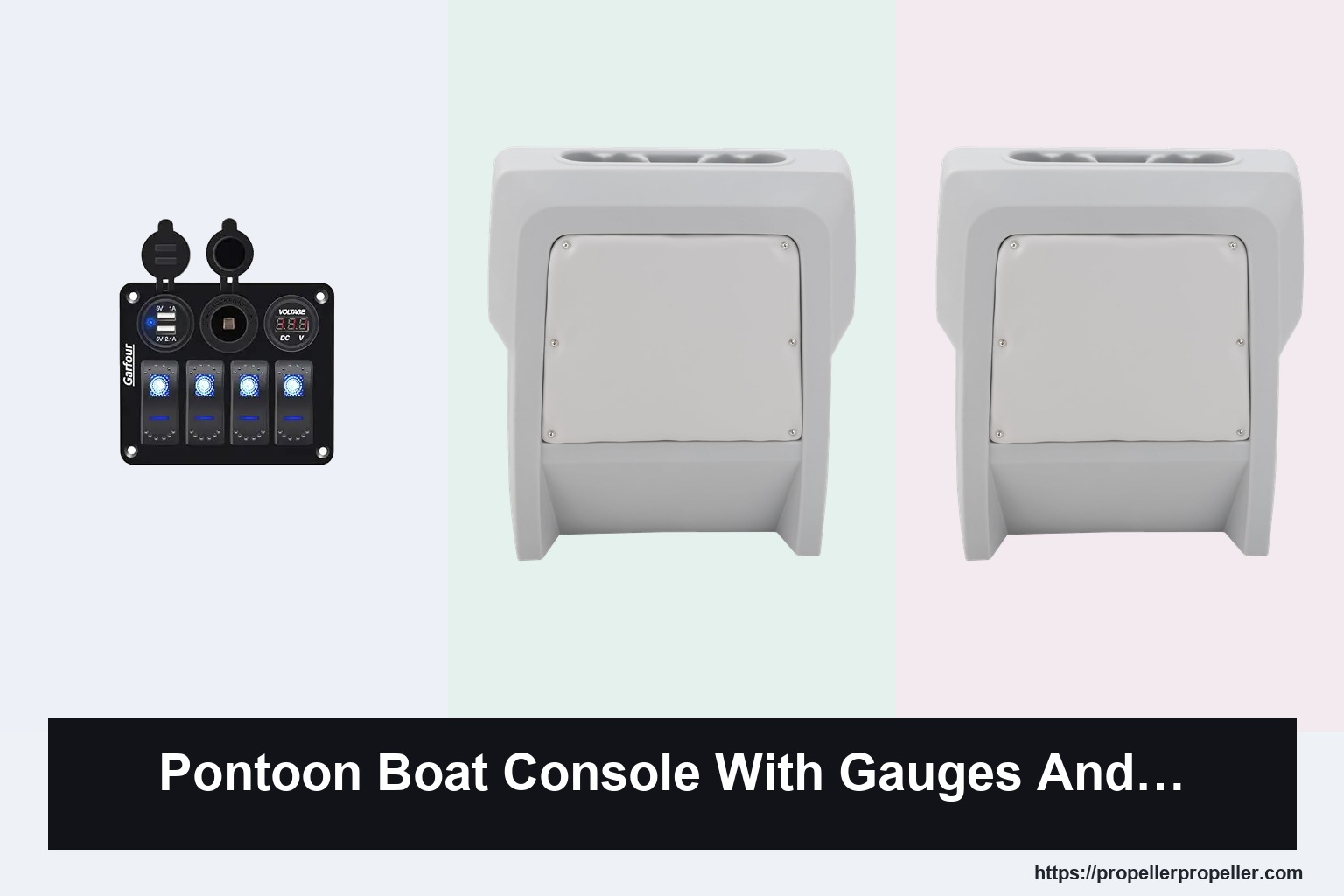
A pontoon helm does more than hold controls. It shapes how easily you can monitor power, reach switches, and keep the captain’s area organized when the boat is moving or tied up. For buyers searching for a pontoon boat console with gauges and switches, the real question is whether the setup gives you enough electrical control, enough durability for marine conditions, and enough convenience to justify the space it occupies.
The three options here approach that job differently. One is a compact electrical control panel built around switches, charging, and voltage monitoring. The other two are full-size pontoon consoles that create a more complete helm area and add storage features on top. Together, they cover two very different purchase paths: add a control center to an existing helm, or replace the front of the boat with a dedicated console that can anchor the whole driving station.
Top Pontoon Boat Console With Gauges And Switches on the Market

Garfour 4-Gang Marine Switch Panel
- 4 independent switches
- Dual 2.1A USB ports
- Digital voltmeter display
- IP65 waterproof rating
- Panel-mount vertical design

DeckMate Gray Pontoon Boat Console
- Gray rotationally molded plastic
- 27 x 15 x 33 inches
- Large removable access panel
- Molded cup holders
- Includes mounting hardware
DeckMate White Pontoon Boat Console
- White rotationally molded plastic
- 27 x 15 x 33 inches
- Large removable access panel
- Molded cup holders
- Universal fit
This article may contain affiliate links. As an Amazon Associate, the website may earn from qualifying purchases at no additional cost to you.
Pontoon Boat Console With Gauges And Switches Reviews
Garfour 4-Gang Marine Switch Panel
- Current Rating
- 12 A
- Operating Voltage
- 24 volts
- Circuit Type
- 4-way
- International Protection Rating
- IP65
- Item Dimensions
- 4.3 x 4.7 x 2 inches
Advantages
- Combines switching and charging
- Clear battery voltage monitoring
- Water-resistant marine construction
- Pre-wired for simpler installation
- Works on 12V and 24V systems
Limitations
- Not a full console
- Requires a mounting location
This panel is the most direct solution for a pontoon owner who needs switches and monitoring in one compact control point. The 4-way circuit layout lets you organize multiple accessories without scattering controls around the helm, and the digital voltmeter keeps battery status visible while you run lights, pumps, or electronics. The dual USB ports add a separate convenience layer for phones and tablets, which matters when the boat is used for long days rather than short trips. Because it combines power control and charging in one faceplate, it is easier to centralize than a larger console component.
The practical strength here is installation simplicity. The unit is pre-wired, so it avoids the complexity of building a custom switch layout from scratch, and the panel-mount form is easier to position in a helm or dash area than a bulkier console replacement. Its IP65 rating is important on a pontoon because splash, rain, and wet hands are normal, not exceptional. The 12 A current rating and 24 volt operating voltage make it a fit for many marine and utility electrical setups, while CE and UL certification add confidence that the panel is not just decorative hardware.
Against the two full consoles in this group, this is the specialist option. It does not replace the helm structure, add molded storage, or create a captain’s station. What it does is solve the control problem cleanly. That makes it the right pick for buyers who already have a usable console but want better switch management, visible battery information, and charging in a small footprint. If your priority is gauges and switches rather than a full boat console rebuild, this is the sharpest recommendation.
PHOTO: Garfour 4-Gang Marine Switch – Switch Panel With Voltmeter → Source: Amazon.com
DeckMate Gray Pontoon Boat Console
- Item Weight
- 35 pounds
- Seat Depth
- 15 inches
- Manufacturer Warranty Description
- 1 year warranty
- Fit Type
- Vehicle Specific Fit
Advantages
- Rigid molded plastic body
- Large removable access panel
- Cup holders and storage tray
- Includes mounting hardware
- Substantial 35-pound build
Limitations
- No built-in switches
- No integrated voltage display
This console is aimed at a buyer who wants a dedicated helm structure rather than a small add-on panel. The solid rotationally molded plastic construction is the main practical value, since that kind of body is built to stand up better to the kind of bumps and weather exposure a pontoon helm sees over time. The matching vinyl-covered access panel also matters because the front of the helm is one of the most handled surfaces on a boat, and a cleaner finish helps the console feel like part of the vessel instead of an afterthought. With molded cup holders and a storage tray on top, the console does more than hold controls.
The size and access details are what separate it from a compact switch panel. Its 27-inch width, 15-inch depth, and 33-inch height define a real helm footprint, so this is not a casual bolt-on accessory. That matters because you need room to place it without crowding traffic flow or interfering with leg space. The removable access panel is a useful service feature when wiring, controls, or other hardware need attention later. At 35 pounds, it is substantial enough to feel anchored once installed, and the included mounting hardware reduces the number of extra pieces you have to source.
Compared with the rocker-switch panel, this is the better choice when the goal is to create or refresh the actual captain’s area. It does not include integrated switches, charging ports, or a built-in voltmeter, so buyers wanting a true electrical command center will need to add those functions separately. What it does offer is a more complete front-end structure with storage and a cleaner visual presence. Choose this console if you want a gray helm shell with practical organization and a more permanent installation, especially when the boat needs a central driving station rather than just a control plate.
PHOTO: DeckMate Gray Pontoon Boat – Gray Console With Hatch → Source: Amazon.com
DeckMate White Pontoon Boat Console
- Item Weight
- 35 pounds
- Seat Depth
- 15 inches
- Manufacturer Warranty Description
- 1 year warranty
- Fit Type
- Universal Fit
Advantages
- Universal fit profile
- Rigid molded plastic body
- Large removable access panel
- Includes mounting hardware
- Bright white finish
Limitations
- No integrated switches
- No voltage monitoring
The white version serves the same helm role as the gray model, but its fit and color positioning may suit a different boat layout better. The universal fit is the key difference, because it broadens where the console can be used without tying the buyer to a vehicle-specific configuration. For pontoon owners who want a cleaner, brighter helm look, the white finish is also an obvious visual choice. Like the gray version, it uses a solid rotationally molded plastic body and a matching vinyl-covered access panel, so the structure is still focused on durability and a finished appearance rather than lightweight convenience.
Its installation implications mirror the gray console. The 27 by 15 by 33 inch footprint means you need to plan the helm area carefully before committing to it, and the 35-pound weight suggests a component meant to stay put once mounted. The removable access panel is especially valuable in a console of this size because maintenance access becomes more important as more wiring and controls are added around the helm. Included mounting hardware simplifies the setup step, and the molded cup holders and top tray keep small items from taking over the captain’s area.
This is the easiest recommendation when you want the same structural benefits as the gray unit but prefer a white console or a broader fit profile. It still does not replace a dedicated switch panel, so it is not the answer for buyers whose main need is gauge-and-switch integration. Instead, it works best as the foundation of a complete pontoon helm, especially when the boat owner wants a neutral, bright console that can be paired with separate electrical controls. For a full replacement-style console, it is the most versatile of the three.
PHOTO: DeckMate White Pontoon Boat – White Console With Hatch → Source: Amazon.com
How to Choose a Pontoon Boat Console
A pontoon console should solve a layout problem, not create one. The right choice depends on whether you need electrical control, a full helm shell, or both. Some buyers are trying to organize switches and add charging in a limited space. Others want a central driving station with storage and access for future wiring work. Those are different jobs, and the best purchase is the one that matches the way you actually use the boat.
Helm Role
Start by deciding whether you need a control surface or a complete console. A compact switch panel is useful when the helm already exists and you only need better control of accessories. A full console makes more sense when you want to define the captain’s area, improve organization, and create a more finished front end. If you buy the larger option for a problem that only needs switches, you may waste space. If you buy a panel when the boat really needs a helm structure, the result can feel incomplete.
Size and Footprint
Physical size matters more on a pontoon than many buyers expect. A console occupies walking space, leg room, and access around the driver’s seat. Measure the area carefully and think about how people move through the boat when it is loaded with gear and passengers. Smaller control panels are easier to place in tight spaces. Larger helm consoles need enough room to sit naturally without crowding the seating plan or forcing awkward reach angles at the wheel and controls.
Electrical Needs
For buyers focused on gauges and switches, electrical capability is the first filter. Count how many accessories need to be controlled, whether you need charging ports, and whether you want battery voltage visible from the helm. A panel with multiple switches and a voltmeter can simplify everyday use because you do not have to add separate accessories for each function. If your boat uses several lights, pumps, or electronics, choose a layout that leaves room for growth rather than one that is already full on day one.
Access and Service
A removable access panel is not a small detail. Once wiring is inside a console, service access becomes part of ownership. You may need to inspect connections, adjust accessories, or add hardware later. A design that opens easily saves time and reduces frustration during upgrades. This is especially useful on pontoon boats, where the helm area often becomes the central point for both wiring and storage. Better access also reduces the chance that maintenance turns into a full disassembly job.
Materials and Finish
Marine use is hard on surfaces. Sun, splash, wet hands, and constant contact can wear down weaker materials quickly. Solid molded plastics are attractive because they give the helm a more durable structure, while vinyl-covered touch points help the console feel more finished and easier to live with. Color also matters. A gray or white helm can influence the visual tone of the boat, but the practical question is whether the finish looks intentional and holds up to repeated use around the water.
Installation Setup
Installation difficulty should be part of the purchase decision, not an afterthought. Pre-wired electrical panels are attractive because they reduce the amount of work needed to get started. Full consoles often include mounting hardware, but they still require careful placement and planning. Ask whether you are comfortable handling a compact dash component or whether you need a larger replacement-style unit that may involve more measurement and alignment. The easier the setup, the faster the boat returns to service, which matters when the season is already underway.
Console Comparison Table
| Product | Best For | Fit Type | Weight | Depth | Warranty | Color |
|---|---|---|---|---|---|---|
| Garfour 4-Gang Marine Switch Panel | Best electrical control panel | Not Specified | Not Specified | Not Specified | Not Specified | Blue |
| DeckMate Gray Pontoon Boat Console | Best gray console | Vehicle Specific Fit | 35 pounds | 15 inches | 1 year warranty | Gray |
| DeckMate White Pontoon Boat Console | Best universal console | Universal Fit | 35 pounds | 15 inches | 1 year warranty | White |
How We Tested & Analyzed Pontoon Boat Console with Gauges and Switches
This roundup was built around category-level usefulness rather than cosmetic appeal. The analysis focused on how each product addresses the basic pontoon helm decision: control, structure, access, fit, and durability. Electrical panels were judged by how well they consolidate switching and monitoring. Full consoles were judged by footprint, access design, materials, and how much of the helm they actually replace. That approach keeps the recommendations practical for buyers who are trying to solve a real installation or upgrade problem.
Meaningful differences were compared using only grounded product facts. Fit type, dimensions, weight, access design, mounting support, and marine-facing construction were all treated as decision drivers because they affect whether a console will work in a real boat layout. The comparison also considered what each product does not include. That matters just as much in this category because a switch panel and a full console are not interchangeable, even if both sit in the captain’s area and both affect how the boat feels to operate.
Limitations were handled conservatively. When a product record did not support a specification, that detail was not filled in from assumption. The result is a guide that emphasizes confirmed strengths and practical tradeoffs instead of inflated claims. Where the available facts were richer, the reviews focused on how those facts affect installation effort, daily usability, service access, and the kind of buyer each product serves best. The goal was a clean buying framework, not a recitation of catalog text.
Frequently Asked Questions
Do I need a full console or just a switch panel?
Choose a full console when you need the captain’s station itself, including structure and access space for wiring. Choose a switch panel when the helm already exists and you mainly need better control, voltage monitoring, or charging. The right answer depends on whether you are building the front of the boat or improving what is already there.
Why does access matter so much in a pontoon console?
Access matters because wiring and accessories often need maintenance after installation. A removable panel makes future adjustments easier and reduces the chance that a simple fix turns into a major teardown. That is especially important in a helm area, where multiple electrical connections can live behind a relatively small front surface.
What should I measure before buying a console?
Measure the available width, depth, and height in the helm area, plus the space needed for seating and leg movement. A console can look compact in photos and still crowd the deck once installed. Also think about reach to controls and whether the unit will interfere with traffic flow around the captain’s seat.
How important are materials in marine use?
Very important. Pontoon consoles are exposed to sun, moisture, and constant touch, so materials affect both lifespan and appearance. Molded plastics can handle structure well, while vinyl-covered surfaces help the helm feel more finished. A better material choice can reduce wear, preserve appearance, and keep the console looking intentional over time.
Final Thoughts
The best pontoon boat console is the one that matches the job you actually need done. If your boat only needs switches, charging, and a battery readout, a compact panel is the smartest use of space. If you need a genuine helm structure, the larger consoles bring the stronger long-term solution because they create a cleaner captain’s area and give you room to build around them.
The key is to avoid treating all console-style products as the same purchase. Electrical control panels and full boat consoles solve different problems, and the right one depends on how much of the helm you are replacing. Once you know that, the decision gets much easier. Choose the compact option for function in a small footprint, or choose a full console when you want a more complete pontoon driving station that feels finished from day one.



