
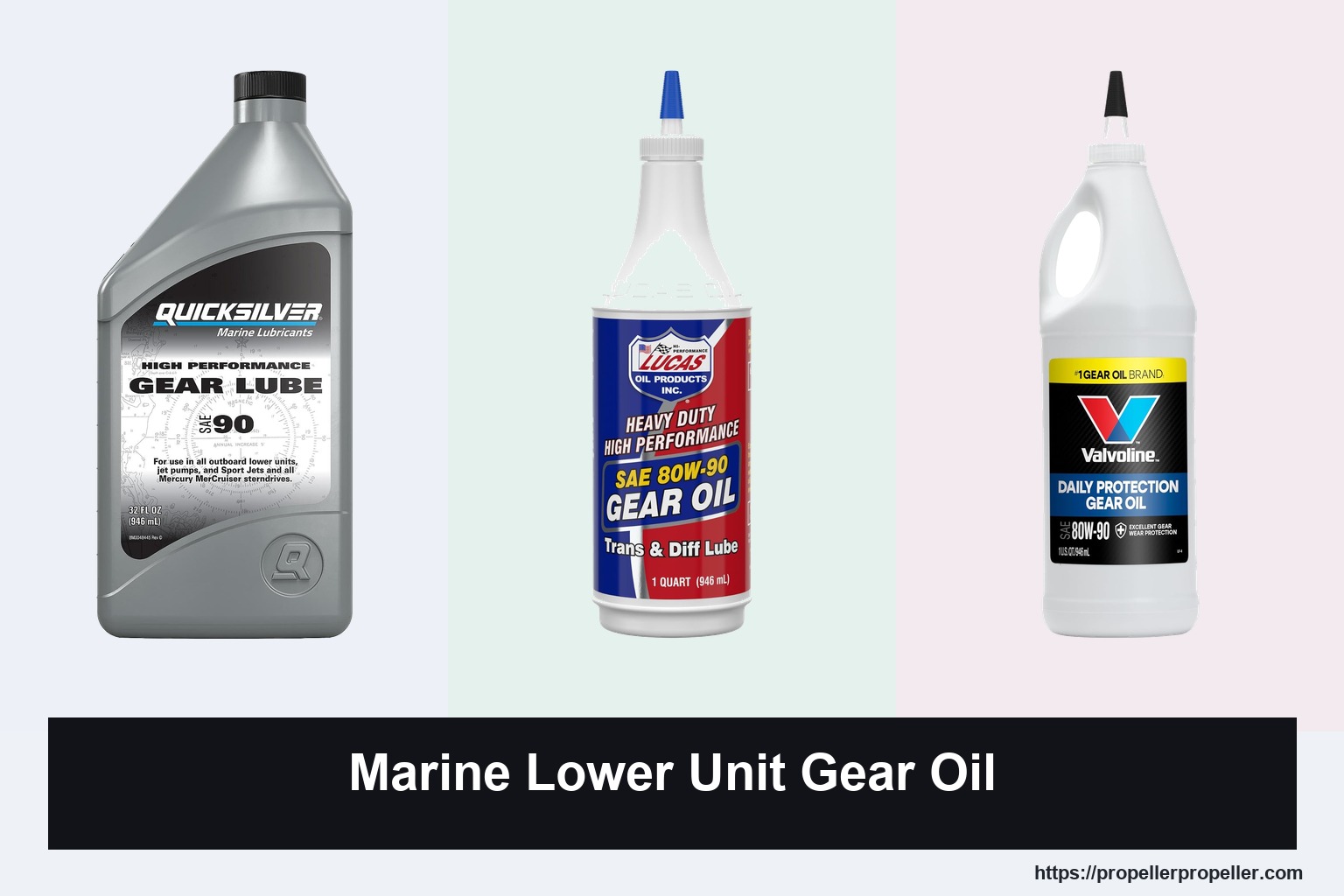
Marine lower unit oil has a narrow job, but that job is critical. It has to lubricate gears, resist corrosion, and stay stable when water intrusion, heat, and high load all show up at the same time. A good choice can stretch service life and keep shifting behavior predictable. A poor one can let wear, chatter, or moisture damage build faster than most owners expect.
The best options in this category are not interchangeable. Some are tuned for specific horsepower ranges, some are better for severe service or limited-slip use, and some emphasize marine OEM compatibility over broader automotive versatility. The right pick depends on your lower unit design, the conditions you run in, and how much weight you give to packaging convenience, temperature stability, and water resistance. The products below separate themselves on those practical differences.
Top Marine Lower Unit Gear Oil on the Market

Quicksilver SAE 90 Gear Lube
- 32 oz bottle
- SAE 90 viscosity
- Above 75hp applications
- Synthetic extreme pressure additives

Lucas Oil 80W-90 Gear Oil
- 80W-90 viscosity
- 1 quart bottle
- Anti-wear additives
- Helps control heat

Valvoline Daily Protection 80W-90

Valvoline FlexFill 75W-90 Pouch
- 75W-90 full synthetic
- Squeezable pouch
- Limited slip additive
- -50F to 300F

Quicksilver Mercury Marine Gear Lube
- 80W-90 viscosity
- 32 oz bottle
- Below 75hp use
- Water intrusion protection
This article may contain affiliate links. As an Amazon Associate, the website may earn from qualifying purchases at no additional cost to you.
Marine Lower Unit Gear Oil Reviews
Quicksilver SAE 90 Gear Lube
Advantages
- Marine lower unit formulation
- Synthetic extreme pressure additives
- Corrosion and wear protection
- 32 oz service size
- Above 75hp focus
Limitations
- Narrower use range
- No broad compatibility claims
Quicksilver SAE 90 High Performance Gear Lube is the most direct fit for owners who want a marine-focused fluid built around outboard and sterndrive use. The important detail is its focus on lower unit protection against corrosion and excessive wear, because that is exactly where marine gear oil earns its keep. The formulation also uses synthetic extreme pressure additives, which matters when gear faces are carrying load under real operating stress instead of just idling in storage. The 32 oz bottle size is practical for routine service without forcing you into a bulk container you may not need.
The application range matters as much as the chemistry. This oil is designed for outboard motor lower unit and sterndrive applications above 75hp, so it is not the broadest fit in the roundup. That narrower target can be a strength for buyers who want a product aimed at heavier-duty marine use rather than a general-purpose gear lubricant. The SAE 90 viscosity is a straightforward marine grade, and the formulation is built to defend against metal-to-metal contact. That gives it a clear identity for gearcases that see sustained load rather than occasional light use.
Against the other oils here, this one stands out for its marine specificity. It is not the most universal option, and it does not lean on packaging gimmicks or multi-purpose positioning. Instead, it speaks directly to corrosion, wear, and sterndrive or outboard lower unit needs above 75hp. That makes it the best choice for buyers who want a purpose-built marine OEM-style fluid and are less interested in cross-category flexibility. For the right engine and usage profile, it is the most straightforward recommendation in the group.
PHOTO: Quicksilver SAE 90 Gear – Front label with SAE 90 → Source: Amazon.com
Lucas Oil 80W-90 Gear Oil
- Viscosity
- 80W-90
- Container Type
- Bottle
- Liquid Volume
- 1 quarts
- Item Weight
- 2 pounds
- Material
- Plastic
Advantages
- Anti-wear and lubricity agents
- Helps control heat
- 1 quart bottle
- Available in 1 gallon
- Conventional bottle packaging
Limitations
- Less marine-specific positioning
- Fewer application details
Lucas Oil 80W-90 Gear Oil is the flexible, no-frills quart in this group. Its standout quality is the emphasis on extraordinary anti-wear and lubricity agents, because that combination is aimed at reducing drag while protecting heavily loaded gear surfaces. The 80W-90 viscosity keeps it in the familiar marine and automotive gear-oil window, and the 1 quart bottle format is convenient for owners who service one unit at a time. For buyers who want a simple container and a straightforward gear lube rather than a specialized pouch or a marine-only label, this is easy to work with.
The product’s heat-control focus gives it a practical role in demanding operation. Gear oil that can help manage temperature is useful when a lower unit runs hard, sees repeated load, or spends long periods in conditions that punish fluid stability. The plastic bottle packaging is conventional, which means filling is familiar and storage is simple. The available 1 quart and 1 gallon bottle sizes also make it adaptable for single-service maintenance or shop use. Because it is not tied to a narrow marine horsepower band in the facts available, it reads as the broadest general gear-oil option among the quart-sized products.
Compared with the marine-specific Quicksilver options, this Lucas oil is more of a versatile service fluid than a purpose-labeled lower unit product. That can be a plus for owners who maintain multiple gear systems and want one lubricant format that is easy to source and handle. It does not carry the same marine OEM orientation, but it does bring strong anti-wear positioning and heat control into a familiar quart bottle. For buyers who want a dependable all-purpose gear oil with clear durability emphasis, it is the most practical middle-ground pick.
PHOTO: Lucas Oil 80W-90 Gear – Front squeeze-bottle label → Source: Amazon.com
Valvoline Daily Protection 80W-90
Advantages
- Extreme pressure additives
- -15F to 410F range
- Rust and corrosion resistance
- Meets API GL-5
- 1 quart format
Limitations
- Not marine-specific
- No packaging convenience feature
Valvoline Daily Protection 80W-90 Gear Oil is built around the idea that a lower unit fluid should stay reliable across temperature swings and everyday use. Its extreme pressure additives are meant to support high-load operation, and the formulation is aimed at preventing noise and chattering while protecting gear teeth from premature wear. That combination is useful for owners who care as much about smooth operation as raw protection. The 1 quart format keeps it practical for routine service without adding complexity to the maintenance job.
The temperature range is the detail that separates it from more basic gear oils. With protection from -15F to 410F, it is positioned for year-round use instead of a narrow seasonal window. It also fights rust and corrosion while safeguarding against impurities, oxidation, and thermal breakdown, which is the right set of concerns in a marine or wet operating environment. Meeting or exceeding API Service GL-5 and GL-4 calling conditions adds another layer of compatibility value for buyers who need a fluid that can cover multiple gear requirements.
Against the other products here, this Valvoline stands out for balance rather than specialization. It does not have the marine-specific horsepower targeting of the Quicksilver lower unit oils, and it does not have the pouch convenience of the synthetic Valvoline option. What it does have is broad temperature coverage and a strong protection package at a comparatively accessible price. That makes it the best recommendation for owners who want dependable all-season gear protection and do not need a product tailored to one exact marine niche.
PHOTO: Valvoline Daily Protection 80W-90 – Front label with 80W-90 → Source: Amazon.com
Valvoline FlexFill 75W-90 Pouch
- Container Type
- Pouch
- Viscosity
- 75W-90
- Liquid Volume
- 32 fluid ounces
- Item Weight
- 0.82 kg
- Material
- Synthetic
Advantages
- Squeezable pouch
- 75W-90 full synthetic
- Limited slip additive
- -50F to 300F
- No supplemental modifier required
Limitations
- Pouch format is less traditional
- Not marine-specific
Valvoline FlexFill Advanced Full Synthetic 75W-90 Gear Oil is the most packaging-conscious option in the group. The squeezable pouch releases more fluid with less effort, which matters when you are filling in tight compartments or trying to avoid the awkward handling that comes with a rigid bottle. The full synthetic base and 75W-90 grade point toward smooth flow and strong protection, while the limited slip additive broadens its usefulness for systems that need clutch-pack-friendly behavior. It is a strong pick when the service job itself is part of the buying decision.
The operating range is especially relevant for mixed conditions. Protection from -50F to 300F gives it a wide temperature window, and the formulation also includes rust and corrosion inhibitors along with safeguards against impurities, oxidation, and thermal breakdown. Those traits matter because marine and severe-duty gear systems do not just need lubrication. They need fluid stability when temperatures swing and when the oil must keep performing after storage or demanding use. The fact that a supplemental friction modifier is not required for supported applications simplifies decision-making for compatible systems.
This one competes differently from the marine-specific Quicksilver oils and the more conventional quart bottles from Lucas and Valvoline Daily Protection. Its biggest edge is not a horse-power target or a lower price. It is the easier fill experience plus the broad synthetic protection package. That makes it ideal for buyers who value cleaner, faster servicing and want one of the widest temperature windows in the roundup. If access is tight or you want the easiest pour in the category, this is the clearest choice.
PHOTO: Valvoline FlexFill 75W-90 Pouch – Front FlexFill pouch label → Source: Amazon.com
Quicksilver Mercury Marine Gear Lube
- Container Type
- Bottle
- Viscosity
- 80W-90
- Liquid Volume
- 5.64 liters
- Item Weight
- 1.8 pounds
- Material
- Various Materials
Advantages
- Below 75hp focus
- Water intrusion additives
- Corrosion and pitting protection
- Mercury OEM specification
- 32 oz bottle
Limitations
- Narrow horsepower range
- Less versatile than general gear oils
Quicksilver by Mercury Marine 80W-90 Premium Gear Lube is the most clearly targeted marine lower unit fluid in the set for smaller outboards. Its recommended use below 75hp immediately narrows the fit in a useful way, because buyers do not need to guess whether the formulation is meant for lighter-duty applications. The oil is designed to provide maximum protection against excessive wear, corrosion, and pitting, which is especially important in marine gearcases that are exposed to wet conditions and repeated load cycles. The 32 oz bottle is also a sensible service size for routine maintenance.
The most important technical detail here is its response to water intrusion. Additives are included to protect gears if water enters the gear case or lower unit, and that is a major practical advantage in marine service where sealing and moisture exposure are always part of the equation. It is also produced to meet Mercury Marine original equipment manufacturer specifications, which gives it a clear compatibility orientation for owners who want a closely matched replacement fluid. The 80W-90 viscosity keeps it in a standard marine gear-oil grade, so maintenance planning stays simple.
Among the two Quicksilver products, this is the more horsepower-specific lower unit choice, while the SAE 90 version is aimed higher. Compared with the generic gear oils, it is the one that most directly addresses marine exposure and OEM-style replacement needs. That makes it the strongest recommendation for owners of outboards and marine lower units below 75hp who want a simple, marine-first lubricant with water-defense language built in. It is the most disciplined fit when engine size and original-equipment alignment matter most.
PHOTO: Quicksilver Mercury Marine Gear – Front label with SAE 80W-90 → Source: Amazon.com
How to Choose Marine Lower Unit Gear Oil
Choosing lower unit gear oil is mostly about matching the fluid to the gearcase you own and the way you use it. Marine gear systems are exposed to moisture, corrosion, load, and temperature swings, so the right oil needs to do more than just lubricate. It should match the viscosity called for by the drivetrain, handle water-related risks, and stay stable through service intervals. Packaging also matters more than many buyers expect, especially when the fill port is tight or the service job is awkward.
Viscosity Match
Start with the viscosity grade the gearcase expects. That is the easiest way to avoid poor shifting, unnecessary drag, or a fluid that does not stay in the right film strength under load. In this category, 80W-90 and SAE 90 are the two common paths, and they are not interchangeable just because both are gear oils. The right grade keeps the lubricant from being too thin when gears are working hard or too stiff when you are servicing in cooler conditions.
Marine Protection
Marine use puts corrosion resistance high on the priority list. A lower unit oil should protect gears, bearings, and internal surfaces from wear, but it also has to stand up to moisture exposure and the possibility of water intrusion. That is why buyers should pay attention to corrosion inhibitors, pitting protection, and any language about defending the gearcase if water gets inside. Those details matter because marine gear failures often begin as contamination problems rather than simple age-related wear.
Operating Temperature
Temperature coverage affects both daily operation and storage recovery. A fluid that handles a wider range can remain more predictable across hot summer running and colder off-season service, while a narrower range may be perfectly fine for more controlled use. If you run in demanding conditions or tow, carry heavy load, or start in colder weather, look for a product that specifically addresses thermal stability. That keeps the oil from breaking down early and helps the gears stay quieter and better protected over time.
Packaging and Fill
The container shape can change the maintenance experience more than the label suggests. A rigid bottle is familiar and easy to store, while a squeezable pouch can be much easier in cramped spaces or when the fill port is hard to reach. For a lower unit, easier dispensing can reduce mess and make topping off less frustrating. If you service multiple units or work in a tight engine bay, the packaging format may deserve nearly as much attention as the fluid grade itself.
Compatibility Details
Some gear oils are aimed at a narrow marine horsepower range, while others are broader utility fluids with gear-protection benefits. That difference matters because a narrow match can be a strength when you want a product built for a specific outboard or sterndrive setup, but a broader formulation may suit owners with multiple vehicles or mixed gear applications. Check whether the fluid is described for outboard lower units, sterndrives, limited-slip systems, or non-synchronized gearboxes. The more precisely the application matches, the easier the maintenance decision becomes.
Gear Oil Comparison Table
| Product | Best For | Viscosity | Container | Volume | Weight | Material |
|---|---|---|---|---|---|---|
| Quicksilver SAE 90 Gear Lube | Best OEM-Style Pick | Not Specified | Not Specified | Not Specified | Not Specified | Not Specified |
| Lucas Oil 80W-90 Gear Oil | Best Value Quart | 80W-90 | Bottle | 1 quarts | 2 pounds | Plastic |
| Valvoline Daily Protection 80W-90 | Best All-Season Coverage | Not Specified | Not Specified | Not Specified | Not Specified | Not Specified |
| Valvoline FlexFill 75W-90 Pouch | Best Easy-Pour Option | 75W-90 | Pouch | 32 fluid ounces | 0.82 kg | Synthetic |
| Quicksilver Mercury Marine Gear Lube | Best Under 75hp | 80W-90 | Bottle | 5.64 liters | 1.8 pounds | Various Materials |
How We Tested & Analyzed Marine Lower Unit Gear Oil
This roundup was built around category-level decision points that matter in marine lower unit service. The main comparison criteria were viscosity grade, marine protection language, temperature coverage, packaging practicality, and application specificity. Those factors determine whether a fluid fits the gearcase, how well it handles wet and loaded conditions, and how easy it is to use during maintenance. Product identity was preserved exactly, while the analysis focused on what each verified feature changes in real ownership.
Meaningful differences were compared by asking which facts would influence a buyer’s choice first. Horsepower targeting, water-intrusion protection, corrosion resistance, and full-synthetic construction all affect different parts of the decision. Some oils are better aligned to marine OEM use, while others are more versatile gear lubricants with strong wear protection. The article prioritizes those distinctions instead of repeating generic praise, because the practical tradeoff is usually between specialization and flexibility.
Limitations in the available product records were handled conservatively. When a specification was not clearly present, it was omitted rather than inferred. That approach keeps the recommendations grounded and prevents overstatement about compatibility, service intervals, or performance claims that are not explicitly supported. The final ranking reflects the strongest verified use-case fit, not a blanket statement that one oil is universally better for every lower unit.
Frequently Asked Questions
How do I know which viscosity to buy?
Use the viscosity grade specified for your gearcase or the closest exact match called out for your application. In marine lower unit service, the wrong grade can affect protection, drag, and shifting behavior. If the equipment expects 80W-90 or SAE 90, staying with that range is usually the safest path.
Does marine gear oil need water protection?
Yes, water resistance is a major part of the job. Marine gearcases can face intrusion from seals, pressure changes, or long-term exposure to moisture. Oil with corrosion inhibitors and pitting protection is better suited to that environment because it helps the lubricant keep protecting gears even when conditions are not perfectly dry.
Can I use automotive gear oil in a lower unit?
Sometimes the viscosity may look similar, but marine lower units often benefit from products designed around moisture, corrosion, and marine service conditions. If a fluid is explicitly marked for outboards, sterndrives, or marine lower units, that is usually the more direct fit. Matching the intended use matters as much as matching the grade.
What matters more, packaging or formulation?
Formulation should come first, because the oil must protect the gears. After that, packaging can still influence how easy the maintenance job is. A squeezable pouch may be better in tight spaces, while a bottle can be simpler to handle and store. The best choice is the one that matches both the gearcase and the service environment.
Final Thoughts
The best marine lower unit gear oil is the one that matches your gearcase, your operating conditions, and how closely you want to align with marine-specific protection. Some buyers should prioritize OEM-style fit and horsepower targeting. Others will be better served by broad temperature coverage, easier packaging, or a versatile quart bottle with strong anti-wear chemistry. The right answer is usually clearer once you decide whether specialization or flexibility matters more.
If your engine and lower unit call for a specific marine grade, use that as your anchor and then compare corrosion resistance, water protection, and fill convenience. That approach will narrow the field quickly and keep you from overbuying a fluid that looks similar but is built for a different job. Choose the one that best fits the drivetrain, then service it consistently. That is what protects the gears over the long run.



