
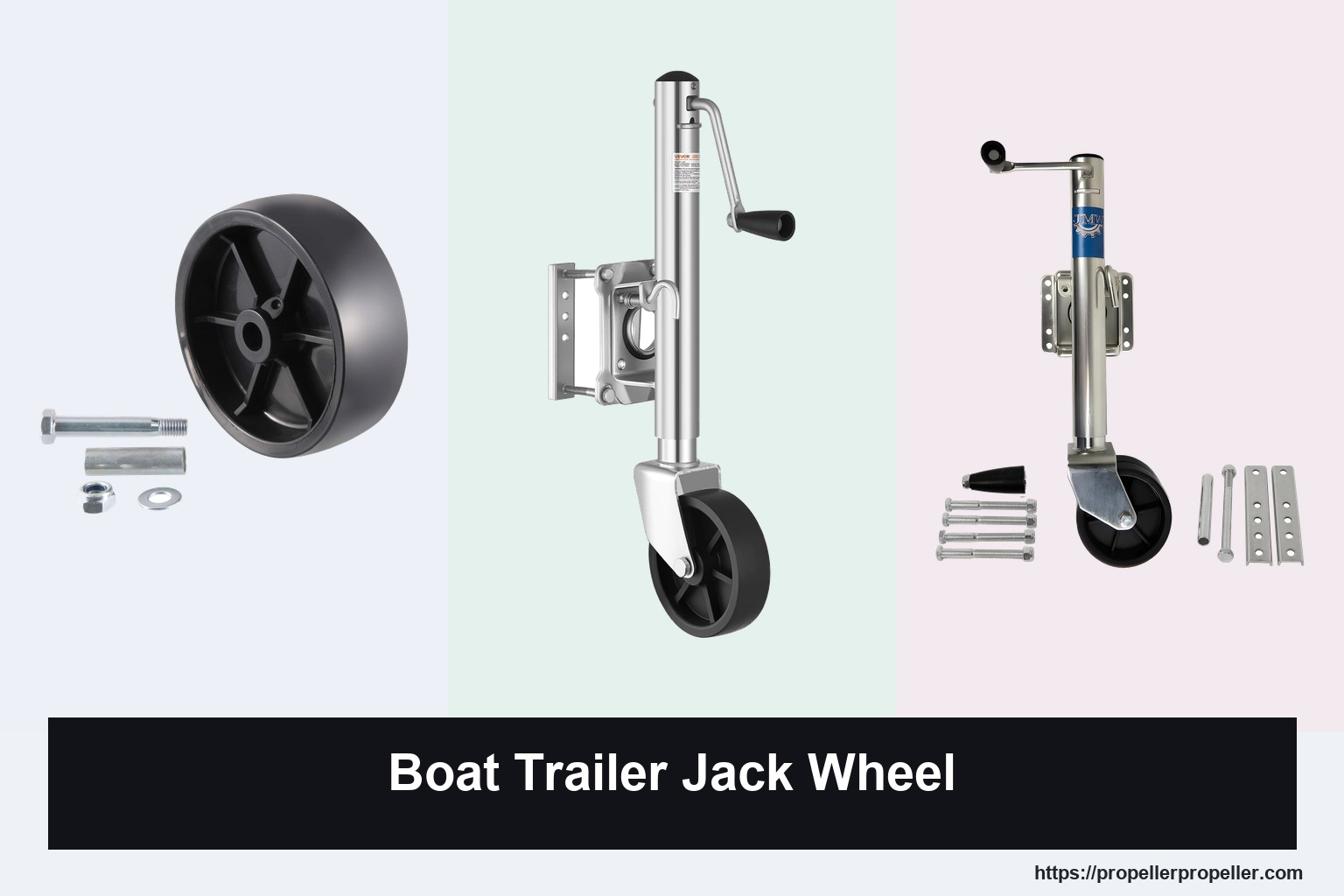
A boat trailer jack wheel seems like a small part until the tongue has to roll over gravel, a ramp apron, or a tight storage area without digging in. The right choice affects how easily you can hitch, park, and reposition a trailer, and it also determines whether a jack stays usable in wet, salty, or rough conditions. In this category, the differences that matter most are wheel diameter, load support, mounting hardware, corrosion resistance, and whether you need a replacement wheel or a complete jack assembly.
This roundup focuses on practical buyer decisions rather than marketing language. Some shoppers only need a replacement caster wheel for an existing jack, while others need a full swivel jack with enough lift range to match trailer tongue height. The strongest picks below cover both ends of that range. The key is to match capacity and mounting style to the trailer, then decide how much convenience you want from the wheel material, swivel design, and installation method.
Top Boat Trailer Jack Wheel on the Market

CURT 28912 6-Inch Replacement Wheel
- 6-inch replacement caster
- Includes bolt and bushing
- Black plastic wheel
- For CURT marine jacks

VEVOR 1000 lb Swivel Trailer Jack
- 1000 lbs load capacity
- 10-inch lift
- PP single wheel
- Swivel fold-up design

Jeremywell 2000 lb Dual-Wheel Jack
- 2000 lbs load capacity
- Dual 6-inch wheels
- Adjustable 12-inch lift
- Galvanized steel finish

YOMILINK 2000 lb Dual-Wheel Jack
- 2000 lbs capacity
- 25.5 to 37.8 inches
- Dual PP tire
- Bolt or weld mounting

TOWKING 6-Inch Trailer Jack Wheel
- 1200 lbs capacity
- 6-inch by 2-inch wheel
- 5/8-inch bore
- Galvanized hardware
This article may contain affiliate links. As an Amazon Associate, the website may earn from qualifying purchases at no additional cost to you.
Boat Trailer Jack Wheel Reviews
CURT 28912 6-Inch Replacement Wheel
Advantages
- Replacement for worn caster
- Includes mounting hardware
- Simple repair path
- Compact single-part solution
- Designed for CURT marine jacks
Limitations
- Jack sold separately
- Limited to compatible jacks
The CURT 28912 is the straightforward choice when the jack itself is still fine and only the wheel has worn out. Its role is narrow but important. A replacement caster keeps the trailer jack rolling instead of dragging, and the included bolt and bushing simplify the job of restoring function without replacing the whole assembly. The 6-inch replacement caster is large enough to improve movement at the tongue, while the black plastic construction keeps the part simple and resistant to unnecessary complexity.
This is the most focused option in the group because it is a wheel-only solution. That matters for buyers who already own compatible CURT marine jacks and do not need a full jack body, crank, or swivel bracket. The practical benefit is lower cost and faster restoration. The limitation is also clear. It is not a universal do-everything part, and the trailer jack itself is sold separately, so buyers need to know they are replacing only the rolling component.
Against the complete jack assemblies in this roundup, this wheel makes sense for the owner who wants the least disruptive fix. It does not compete on capacity or lift because those traits belong to the jack it mounts to. Instead, it wins on specificity and simplicity. If the goal is to keep an existing CURT marine jack working with the least waste, this is the smartest and most economical choice.
PHOTO: CURT 28912 6-Inch Replacement – Replacement wheel kit → Source: Amazon.com
VEVOR 1000 lb Swivel Trailer Jack
- Load Capacity
- 1000 Pounds
- Maximum Lifting Height
- 10 inches
- Minimum Height
- 4 inches
- Material Type
- Alloy Steel
- Style Name
- Swivel
Advantages
- Complete swivel jack assembly
- Bolts to trailer tongue
- Fold-up storage design
- Corrosion-resistant alloy steel
- PP wheel for mobility
Limitations
- Lower capacity than 2000 lb jacks
- Single wheel limits rough-ground stability
The VEVOR jack is built for buyers who want a full trailer-support solution rather than a replacement wheel. Its 1000 lbs load capacity and 10-inch lift put it in the light-duty range, which is often enough for smaller boats and utility setups. The appeal is that one component does the rolling, lifting, and storage work. That reduces the number of parts to think about and gives the tongue a more complete handling upgrade than a wheel swap alone.
Its setup is still relatively direct because it is designed to bolt to the trailer tongue, and the swivel style folds up when not in use. That matters when ground clearance is tight or the jack would otherwise hang low during travel. The alloy steel body adds stability, while the PP single wheel is meant to keep movement predictable in wet or salty conditions. The combination points toward easy daily use rather than maximum brute strength.
Compared with the heavier dual-wheel jacks in this lineup, this model trades raw capacity for a simpler, lighter-duty setup. That tradeoff is useful if the trailer does not demand extreme tongue support and you value compact handling more than maximum load margin. For buyers who want a complete jack with straightforward operation and enough capacity for modest trailer needs, this is an efficient middle-ground pick.
PHOTO: VEVOR 1000 lb Swivel – Swivel jack assembly → Source: Amazon.com
Jeremywell 2000 lb Dual-Wheel Jack
- Load Capacity
- 2000 pounds
- Maximum Lifting Height
- 26 inches
- Minimum Height
- 15 inches
- Material Type
- Steel, Zinc
- Style Name
- Double Wheel
Advantages
- High 2000-pound capacity
- Dual wheels for stability
- Galvanized corrosion protection
- Swivel bracket for storage
- Sidewind handle control
Limitations
- Bulkier than single-wheel jacks
- Higher price than lighter models
Jeremywell takes a more serious approach for trailers that need extra support at the tongue. The 2000lbs trailer jack and dual-wheel design make it a stronger fit for heavier boats, RVs, and utility trailers than light-duty single-wheel options. Two 6-inch wheels spread the load more evenly and improve movement over uneven ground. That can reduce the effort required when a loaded trailer needs to be positioned precisely rather than simply parked.
The steel and zinc construction with a galvanized finish is the sort of detail that matters after repeated exposure to water and road grime. Corrosion resistance is especially important on boat-trailer gear because the tongue hardware often sees more moisture than the trailer frame itself. The sidewind handle is another practical advantage because it can make lifting and lowering more controlled, and the swivel bracket allows the jack to rotate out of the way when not needed.
Compared with the VEVOR single-wheel jack, this one is a better fit when the trailer is heavier and stability matters more than compactness. It is also more expensive than replacement-wheel options, but it solves a larger problem. If you need a full jack with strong support, a wide stance, and a corrosion-conscious finish, this is one of the most convincing choices in the group.
PHOTO: Jeremywell 2000 lb Dual-Wheel – Swivel jack assembly → Source: Amazon.com
YOMILINK 2000 lb Dual-Wheel Jack
- Load Capacity
- 2E+3 pounds
- Minimum Height
- 25.5 inches
- Material Type
- High Carbon Steel
Advantages
- Bolt-on or weld-on mounting
- Wide height range
- Dual-wheel mobility
- Carbon steel construction
- Powder-coated corrosion resistance
Limitations
- Higher cost than basic jacks
- Tall minimum height
YOMILINK targets buyers who want a heavy-duty jack with more installation flexibility than many rivals. Its 2000 lbs load capacity pairs with a height range of 25.5 to 37.8 inches, which helps it work with trailer tongues that sit differently from one setup to another. That range is useful because a jack that lands too low or too high can be awkward to use even if its capacity is technically sufficient. The dual-wheel layout also supports movement on rough ground.
This model stands out because it can be mounted by bolting or welding. That gives installers room to match different trailer builds and permanence preferences. The carbon steel body, galvanized inner and outer tubes, and powder finish point toward long-term corrosion resistance, which is especially relevant for boat use. The PP tire is meant to resist sinking in mud, gravel, and broken terrain, so the jack is not limited to smooth pavement when you need to reposition the trailer.
Against the Jeremywell jack, this one offers a different kind of value. The load rating is the same class, but the mounting choices and broader height fit make it more adaptable to mixed trailer setups. It is not the cheapest answer, but it may be the easier one to integrate cleanly. For buyers who need a heavy-duty jack and want installation options, this is the most flexible selection here.
PHOTO: YOMILINK 2000 lb Dual-Wheel – Swivel jack assembly → Source: Amazon.com
TOWKING 6-Inch Trailer Jack Wheel
- Load Capacity
- 1200 Pounds
- Material Type
- Alloy Steel
- Minimum Height
- 6 inches
- Item Weight
- 11.2 ounces
Advantages
- 1200-pound wheel capacity
- Includes mounting hardware
- Galvanized hardware durability
- Clear wheel dimensions
- SAE-compliant construction
Limitations
- Wheel-only replacement
- Compatibility depends on jack fit
TOWKING is the most focused upgrade for owners who need a replacement wheel with more explicit strength and durability details than the simplest caster-only options. The 1200 lbs load capacity and 6-inch wheel diameter make it a strong match for light-duty jacks that still need dependable movement. The 2-inch width and 5/8-inch bore help define compatibility more clearly than a vague universal label, which is useful when the goal is to buy once and install cleanly.
The galvanized mounting hardware is a practical strength in coastal or damp environments because the wheel assembly is more likely to hold up over time. SAE compliance adds another layer of confidence for buyers who care about standardized manufacture rather than just a generic replacement part. Installation is presented as quick and safe, and the package includes the wheel plus hardware, so the result is less guesswork during repair. It is still a wheel component, though, not a full trailer jack.
Compared with the CURT replacement wheel, this TOWKING option leans harder into spec transparency and a more explicit load rating. Compared with the full jack assemblies, it is the least expensive way to restore mobility without changing the whole tongue support system. For owners who already have a compatible light-duty jack and want a replacement wheel with solid hardware and a clearly stated capacity, this is the best upgrade-focused pick.
PHOTO: TOWKING 6-Inch Trailer Jack – Replacement wheel kit → Source: Amazon.com
How to Choose a Boat Trailer Jack Wheel
Choosing a boat trailer jack wheel starts with a simple question: are you replacing a worn wheel or upgrading the entire tongue-support system? That distinction matters because a wheel-only repair keeps costs down and preserves a jack that still works, while a full jack assembly changes load support, clearance, and handling. Once you know which job you need to solve, the rest comes down to capacity, wheel design, installation method, and how often the trailer sees wet ramps, gravel, or storage movement.
Replacement or Full Jack
A wheel-only replacement is the right answer when the jack body, swivel bracket, and crank still operate correctly. In that case, the wheel is the wear point, and swapping it restores mobility without creating extra expense. A full jack is the better move when the entire assembly is undersized, corroded, or awkward to use. Think about whether the problem is just rolling or whether the whole tongue support needs a new standard.
Load Capacity
Load rating should match the tongue weight and not just the trailer’s general size. A lower-capacity wheel or jack can still seem fine until the trailer is loaded, parked on a slope, or pushed across soft ground. Extra margin matters because it reduces strain during cranking and movement. When in doubt, choose the stronger option if your installation space and trailer design can support it.
Wheel Size and Stability
Wheel diameter changes how easily the jack rolls over ramps, gravel, and uneven storage lots. Larger wheels generally cross obstacles more smoothly, while narrower or smaller wheels are better for compact fit. Stability matters too. A dual-wheel setup spreads the load and can feel steadier when the trailer is heavy or the ground is imperfect. A single wheel is simpler, but it usually has less lateral stability.
Mounting and Fit
Installation style is one of the biggest decision points. Some jacks bolt on, while others also allow welding, and that difference affects permanence and compatibility. You should also pay attention to the height range, because the jack must work with your trailer tongue when it is both raised and lowered. If the minimum height is wrong, the jack can be awkward or unusable even when the capacity is sufficient.
Corrosion Resistance
Boat trailer hardware lives hard lives around water, salt, and road debris. Steel construction is common, but finish quality and material treatment determine how well the part holds up. Galvanized hardware, powder coating, and corrosion-resistant materials all help extend useful life. If the trailer spends time near coastal water or is stored outside, durability is not a luxury feature. It is what keeps the jack functioning after repeated exposure.
Ease of Use
Crank design, swivel function, and wheel type all influence daily convenience. A swivel jack that folds up can improve ground clearance when towing. An ergonomic handle or smooth sidewind crank can also reduce effort, which matters every time the trailer is hitched or unhitched. Buyers who use the trailer often should prioritize operation and storage behavior almost as much as raw capacity, because small conveniences become major time savers.
Boat Trailer Jack Comparison Table
| Product | Best For | Load | Min Height | Material | Color | Compatible with Vehicle Type |
|---|---|---|---|---|---|---|
| CURT 28912 6-Inch Replacement Wheel | Best Replacement Wheel | Not Specified | Not Specified | Not Specified | Not Specified | Not Specified |
| VEVOR 1000 lb Swivel Trailer Jack | Best Light-Duty Jack | 1000 Pounds | 4 inches | Alloy Steel | Black | RV |
| Jeremywell 2000 lb Dual-Wheel Jack | Best Heavy-Duty Value | 2000 pounds | 15 inches | Steel, Zinc | Silver | Trailer |
| YOMILINK 2000 lb Dual-Wheel Jack | Best Mounting Flexibility | 2E+3 pounds | 25.5 inches | High Carbon Steel | Black | Trailer |
| TOWKING 6-Inch Trailer Jack Wheel | Best Wheel Upgrade | 1200 Pounds | 6 inches | Alloy Steel | black | Trailer,Rv,etc |
How We Tested & Analyzed Boat Trailer Jack Wheel
This guide evaluates trailer jack wheels and complete jack assemblies as functional hardware rather than as isolated specs. The main criteria were load support, wheel design, mounting style, height range, corrosion resistance, and the practical difference between replacement parts and full assemblies. Those factors determine whether a trailer can be moved safely, stored cleanly, and matched to the tongue height it actually has.
The comparison also weighs how each design affects real-world use. Single-wheel replacements were judged on fit clarity and repair value. Full jacks were compared on lifting range, stability, and installation flexibility. Dual-wheel designs were treated as a stability upgrade rather than a universal improvement, since they add support but also add size and cost. That tradeoff is central to choosing well in this category.
Limitations matter here because trailer hardware is highly dependent on fit. A high-capacity jack is not automatically the right one if the mounting style or minimum height does not work for your trailer. Likewise, a wheel replacement is only useful when the existing jack is otherwise sound. The best choice is the one that solves the actual problem with enough strength, enough clearance, and enough durability for the environment it will live in.
Frequently Asked Questions
Do I need a wheel replacement or a whole jack?
Choose a wheel replacement when the jack body still lifts and swivels properly, but the caster is worn, cracked, or hard to roll. Choose a full jack when the entire tongue support is undersized, corroded, or difficult to operate. The right answer depends on whether the failure is isolated to the wheel or affects the whole assembly.
Why does wheel diameter matter?
Wheel diameter affects how easily the jack rolls over ramps, gravel, and uneven storage surfaces. A larger wheel generally moves more smoothly and is less likely to dig in. Smaller wheels can be fine for light-duty use, but they usually give up some rolling comfort and obstacle clearance.
What is the advantage of a dual-wheel jack?
A dual-wheel jack spreads the load and usually feels steadier when moving a heavier trailer. That added stability can be helpful on rough ground or when the tongue is loaded. The tradeoff is extra size and cost, so it is most useful when support and movement confidence matter more than compactness.
How important is corrosion resistance for boat trailers?
It is very important because boat trailer hardware sees frequent moisture, road grime, and sometimes salt exposure. Finishes such as galvanizing and powder coating help the jack or wheel assembly last longer and stay easier to use. If the trailer lives outdoors or near coastal water, corrosion resistance should be a top priority.
Final Thoughts
The best boat trailer jack wheel is the one that solves your actual hitching and storage problem without adding unnecessary complexity. For some buyers, that means a simple wheel replacement that restores smooth movement. For others, it means a complete swivel jack with enough lift, clearance, and corrosion resistance to handle repeated use. Capacity, fit, and environment matter more than flashy claims, and the most useful choice is usually the one that matches the trailer’s real weight and working height.
If your trailer is light and you just need a clean repair, a replacement wheel is the most efficient path. If the trailer is heavier or sees rough ground, a full dual-wheel jack is more reassuring. Either way, focus on the support you need today and the conditions the hardware will face over time. That approach leads to a safer, easier, and more durable setup at the tongue.



