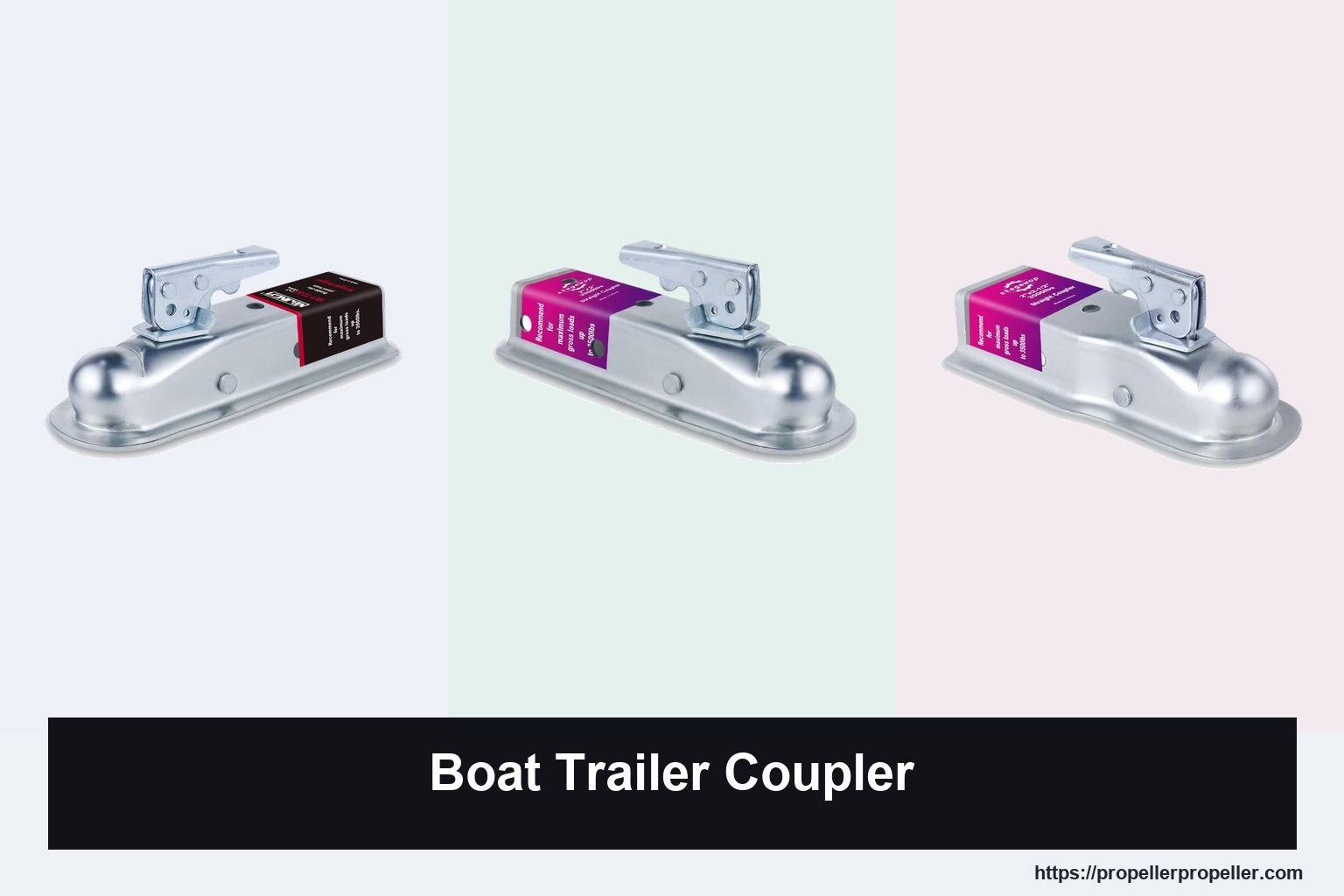
A trailer coupler is one of those parts you rarely think about until it becomes the difference between a calm launch and a stressful trip to the ramp. For boat owners, the right coupler has to match the tongue size, fit the hitch ball cleanly, and stay secure when water, salt, and road grime are working against it. Get the wrong style or capacity and you add noise, wear, and unnecessary risk to every tow.
This roundup focuses on the practical decisions that matter most in the boat-trailer category: straight versus adjustable mounting, 2-inch ball compatibility, load rating, latch security, and corrosion resistance. The best choice is not always the heaviest or the cheapest. It is the one that matches your trailer tongue, your towing load, and how often the coupler will live near spray, ramps, and seasonal storage.
Top Boat Trailer Coupler on the Market

NBJINGYI 2-Inch Straight Coupler
- 3,500 lb GTW rating
- Fits 2-inch ball and channel
- Quick-release latching system
- Zinc-plated steel finish

Stegewop 2-Inch Straight Coupler
- 3,500 lb towing capacity
- Fits 2-inch channel tongue
- Adjustable internal locking nut
- 1-year manufacturer warranty

2.5-Inch Channel Straight Coupler
- 3,500 lb GTW rating
- Fits 2.5-inch channel tongue
- Standard 2-inch hitch ball
- Zinc-plated finish

Stegewop Adjustable 2-Inch Coupler
- 8,000 lb Class IV rating
- Channel-mount height adjustment
- SAE Class IV build
- Rust-resistant black finish
This article may contain affiliate links. As an Amazon Associate, the website may earn from qualifying purchases at no additional cost to you.
Boat Trailer Coupler Reviews
NBJINGYI 2-Inch Straight Coupler
Advantages
- Standard 2-inch ball compatibility
- Simple straight-channel installation
- Safety-lock holes included
- Zinc-plated steel body
- Strong value for capacity
Limitations
- No height adjustment
- Not for heavier trailers
This is the most straightforward choice for a trailer owner who wants a clean, standard connection without paying for extra mounting flexibility. The 3,500 lbs rating places it in the useful middle ground for smaller boats, utility-style trailers, and other moderate towing tasks. The 2″ ball and 2″ channel match keeps the setup simple, which matters when you want one coupler standard across more than one trailer.
The latch design is where the day-to-day value shows up. A quick-release mechanism reduces the fuss at the ramp, and the spring-loaded lever gives the connection a positive feel when you are coupling or uncoupling in a hurry. The pre-drilled holes for a safety pin or coupler lock add a second layer of security, which is especially important when the trailer may sit unattended between outings. Its zinc-plated steel construction is also a practical advantage for wet use, though it is still a basic straight coupler rather than a more configurable mounting solution.
Against the other straight couplers here, this one stands out mainly on simplicity and price rather than extra hardware features. It is the least complicated way to outfit a trailer that already uses a 2-inch channel and a 2-inch ball. That makes it the best recommendation for buyers who want a no-drama, standard-duty coupler and do not need adjustable height or heavier capacity.
PHOTO: NBJINGYI 2-Inch Straight Coupler – 2-Inch Channel Coupler → Source: Amazon.com
Stegewop 2-Inch Straight Coupler
- Manufacturer Warranty Description
- 1 year
- Pull Force
- 3500 pounds
- Material Type
- Alloy Steel
- Finish Type
- Powder Coated
- Item Weight
- 2.11 kg
Advantages
- 2-inch ball socket
- Adjustable locking nut
- Zinc-plated weather resistance
- Quick-lock latch
- 1-year warranty
Limitations
- Still fixed-height design
- Capacity stays at 3,500 lbs
This coupler targets the buyer who wants a familiar straight-mount design but values a few extra details around fit and finish. Its 3,500 lbs GTW rating keeps it in the same practical towing class as other standard boat and utility couplers, while the 2-inch ball socket and 2-inch channel layout make it easy to match common trailer hardware. The adjustable internal locking nut is the feature that matters most in use because it lets you tighten the ball fit rather than living with a loose or overly tight connection.
For routine towing, the weather-resistant zinc finish is more than a cosmetic touch. A trailer coupler that lives near water needs protection from rain, splash, and road grit, and this one is built with that exposure in mind. The quick-lock latch mechanism also reduces hassle when you are hooking up alone. The included hole for a safety pin or lock gives you an obvious place to add secondary security, which is useful for both travel and parking. A 1-year warranty adds some confidence for buyers who want a little more support than the lowest-frills options provide.
Compared with the first straight coupler, this one is less about bare-bones value and more about a slightly more refined towing experience. It does not add height adjustment or higher class capacity, so it remains a sensible pick for standard trailers rather than heavy-duty rigs. If your priority is a dependable 2-inch straight coupler with a more adjustable ball fit and a warranty in place, this is the most balanced option in the group.
PHOTO: Stegewop 2-Inch Straight Coupler – 2-Inch Straight Coupler → Source: Amazon.com
2.5-Inch Channel Straight Coupler
Advantages
- Fits 2.5-inch channel tongue
- Standard 2-inch ball use
- Quick-lock latch
- Zinc corrosion protection
- Snug towing fit
Limitations
- Not adjustable
- Limited to 3,500 lbs
This model solves a specific fit problem, and that is exactly what makes it valuable. The 2-1/2″ channel is the distinguishing factor here, since it is built for trailers that need the wider tongue mount rather than the narrower 2-inch style. The 3,500 lbs GTW rating keeps it in the same familiar towing class, so you are buying fit compatibility rather than chasing a bigger capacity number. For the right trailer, that is the more important decision.
Its purpose is practical rather than flashy. The standard 2-inch hitch ball compatibility keeps it aligned with common towing gear, and the quick-lock latch is useful when repeated ramp hookups are part of your routine. The zinc plating is also a sensible choice for a trailer that will see wet launch areas or salty storage conditions. The internal ball fit is designed to stay snug, which matters because rattling and slack quickly become annoying on longer road runs.
Relative to the other straight couplers, this one is the better answer when the tongue width is the deciding constraint. It does not try to be the heaviest-duty option, and it does not add adjustable ride height. That restraint is a strength if your trailer already has a 2.5-inch channel and you want a clean, standard connection without overspending on features you will not use. For that narrower use case, it is the most appropriate purchase in the set.
PHOTO: 2 5-Inch Channel Straight – 2-Inch Straight Coupler → Source: Amazon.com
Stegewop Adjustable 2-Inch Coupler
- Manufacturer Warranty Description
- 1 year
- Pull Force
- 8000 pounds
- Item Weight
- 9 pounds
- Finish Type
- Powder Coated
- Compatible with Vehicle Type
- ATV, RV, Trailer, Truck, boat trailers
Advantages
- 8,000 lb capacity
- Adjustable channel-mount design
- Level-tow tuning
- Rust-resistant black coating
- Heavy-duty trigger latch
Limitations
- Heavier to handle
- Requires channel-mount setup
This is the coupler for buyers who need more than a standard straight mount. The 8,000 lbs GTW rating moves it into heavy-duty territory, and the channel-mount brackets with height adjustment are the real differentiator. That adjustment matters because trailer level is not a cosmetic detail. A level tow affects stability, weight distribution, and how confidently the trailer tracks behind the vehicle. For heavier boat trailers, that flexibility can be the reason to choose this style over a fixed coupler.
The construction and finish both point to regular exposure rather than sheltered use. A rust-resistant black coating is a meaningful advantage when the coupler will live near marine environments, road salt, or year-round storage. The spring-loaded trigger latch keeps the connection quick, and the adjustable internal nut helps the ball fit stay tight and quiet. At 9 pounds, it is substantially more substantial than the lighter fixed-coupler options, which is consistent with the higher towing class but also means you are handling more metal during installation or replacement.
Compared with the 3,500-pound straight couplers, this one is the clear step up for larger trailers and more demanding towing. It asks for the correct channel-mount setup, so it is not the universal answer for every trailer tongue. That said, if your trailer needs height tuning and you want a coupler that is built to handle a stronger load envelope, this is the strongest recommendation in the group. It is the best fit for buyers who would rather buy once and match the trailer properly than work around a fixed mount.
PHOTO: Stegewop Adjustable 2-Inch Coupler – Adjustable Channel Coupler → Source: Amazon.com
How to Choose a Boat Trailer Coupler
The right coupler starts with fit, not with strength claims. If the tongue width or ball size is wrong, the coupler is useless no matter how impressive the rating looks on paper. Once the fit is correct, the next questions are whether you need a straight mount or an adjustable channel-mount design, how much load the trailer actually carries, and how often the coupler will be exposed to water and road spray. Those are the choices that shape daily use.
Tongue Width
The first measurement to confirm is the trailer tongue width or channel size. A coupler can only work properly when its mounting pattern matches the trailer structure it is bolted to. Straight couplers and wider channel-mount versions are not interchangeable, so this is the decision that narrows the field fastest. If you are replacing an existing part, match the tongue before you shop for anything else. That prevents compatibility problems and avoids the frustration of buying a coupler that cannot physically mount where you need it.
Ball Size
Boat trailer couplers commonly center on a 2-inch hitch ball, but that should still be verified before purchase. Ball size affects how securely the coupler seats, how much noise you hear on the road, and how much trust you can place in the connection during stop-and-go towing. A tight, correct ball fit reduces rattling and unnecessary wear. If you already use multiple trailers, standardizing on one ball size can simplify towing equipment and make ramp days less complicated.
Capacity and Margin
Load rating should be treated as a real working limit, not a number to maximize automatically. A coupler rated for the trailer’s weight class gives you a useful margin for regular towing, while a higher-capacity model is more appropriate when you need extra reserve for a heavier frame or mixed-use hauling. Matching capacity to the trailer keeps the setup practical and avoids overbuying hardware that adds weight without solving a problem. For boat use, the safer choice is the one that fits the actual trailer and leaves a sensible buffer.
Latch Security
The latch mechanism matters because it controls how confidently the coupler stays engaged over rough pavement, long highway stretches, and repeated ramp use. A quick-lock or trigger latch should operate smoothly, but it should also have a way to accept a safety pin or lock. That secondary security point is important if the trailer is parked in public areas or transported regularly. A secure latch does not just prevent uncoupling. It also reduces the vague looseness that makes towing feel less controlled.
Corrosion Resistance
Boat trailers live in harsher conditions than many utility trailers. Water, salt, humidity, and road grime all work on the coupler over time, so finish quality is worth paying attention to. Zinc plating and rust-resistant coatings help the hardware keep its shape and function through seasonal storage and repeated wet launches. This is where the difference between a basic coupler and a better-finished one becomes visible over time. If the trailer is used near saltwater or in winter conditions, corrosion resistance moves from a nice extra to a core buying factor.
Fixed or Adjustable
A fixed straight coupler is the simpler choice when the trailer already sits at the right height behind the tow vehicle. It is straightforward, lighter, and usually less expensive. An adjustable channel-mount coupler is the better option when you need to level the trailer more precisely. That adjustment can improve stability and weight distribution, which matters more as trailer size and load increase. In short, buy fixed when the setup is already right. Buy adjustable when height tuning is part of the towing job.
Boat Trailer Comparison Table
| Product | Best For | Capacity | Finish | Warranty | Weight | Vehicle Fit |
|---|---|---|---|---|---|---|
| NBJINGYI 2-Inch Straight Coupler | Best Budget Straight Coupler | Not Specified | Not Specified | Not Specified | Not Specified | Not Specified |
| Stegewop 2-Inch Straight Coupler | Best Balanced Straight Coupler | 3500 pounds | Powder Coated | 1 year | 2.11 kg | ATV, RV, Trailer, Truck, boat trailers |
| 2.5-Inch Channel Straight Coupler | Best Wide-Channel Fit | Not Specified | Not Specified | Not Specified | Not Specified | Not Specified |
| Stegewop Adjustable 2-Inch Coupler | Best Heavy-Duty Adjustable | 8000 pounds | Powder Coated | 1 year | 9 pounds | ATV, RV, Trailer, Truck, boat trailers |
How We Tested & Analyzed Boat Trailer Coupler
The analysis focused on the decisions that matter most in boat-trailer hardware: mounting compatibility, hitch-ball fit, load rating, latch design, finish protection, and whether the coupler is fixed or adjustable. Those are the factors that change whether a trailer can be connected safely and used efficiently, so they were weighted more heavily than broad marketing language or general product category labels. The goal was to separate simple standard-duty couplers from the heavier or more flexible options.
Differences were judged by practical consequence rather than by counting features. A higher load rating mattered only when it changed the kind of trailer a coupler could realistically support. Adjustable mounting mattered only when it improved trailer level and setup flexibility. Corrosion resistance was treated as especially relevant because boat trailers routinely encounter wet environments. Warranty coverage, when present, was considered a supportive trust signal, but it did not outweigh fit or towing-class relevance.
The review also accounts for the limits of the category. Trailer couplers are specialized parts, and the most important mistake is often a compatibility mismatch rather than a lack of strength. That means the best recommendation is not always the highest-capacity model. It is the coupler that matches the tongue width, ball size, and intended towing conditions with the fewest compromises.
Frequently Asked Questions
How do I choose the right coupler size?
Start with the trailer tongue width and the hitch ball size. Those two measurements determine whether the coupler will mount correctly and lock onto the ball securely. If either one is wrong, the coupler will not be a safe fit, no matter how strong the rating looks.
Is a higher towing rating always better?
Not necessarily. The right rating is the one that matches the trailer and leaves a sensible margin for the load you actually tow. Going far beyond that does not automatically improve performance. Fit, latch security, and corrosion resistance usually matter more once the rating is already appropriate.
Why does finish quality matter on a boat trailer?
Boat trailers spend time near water, and often near salt or grime as well. A protective finish helps the coupler resist corrosion so it keeps working smoothly over time. That is especially important if the trailer is launched often or stored outdoors between trips.
When should I choose an adjustable coupler?
Choose adjustable hardware when trailer height needs tuning to keep the tow level. A level setup can improve stability and weight distribution, which becomes more important as trailer size and load increase. If the current height already works well, a fixed coupler is usually simpler and lighter.
Final Thoughts
A good boat trailer coupler is not the most dramatic part on the trailer, but it is one of the most consequential. The right choice starts with physical fit, then moves to load rating, latch security, and resistance to corrosion. When those pieces line up, towing becomes quieter, more predictable, and easier to trust at the ramp and on the highway.
For smaller trailers, a standard straight coupler is usually the most practical path. For heavier trailers or setups that need height adjustment, an adjustable channel-mount coupler is worth the extra cost and weight. Choose the model that matches your tongue, ball, and towing environment first. That is the safest way to buy well and avoid unnecessary replacement later.