
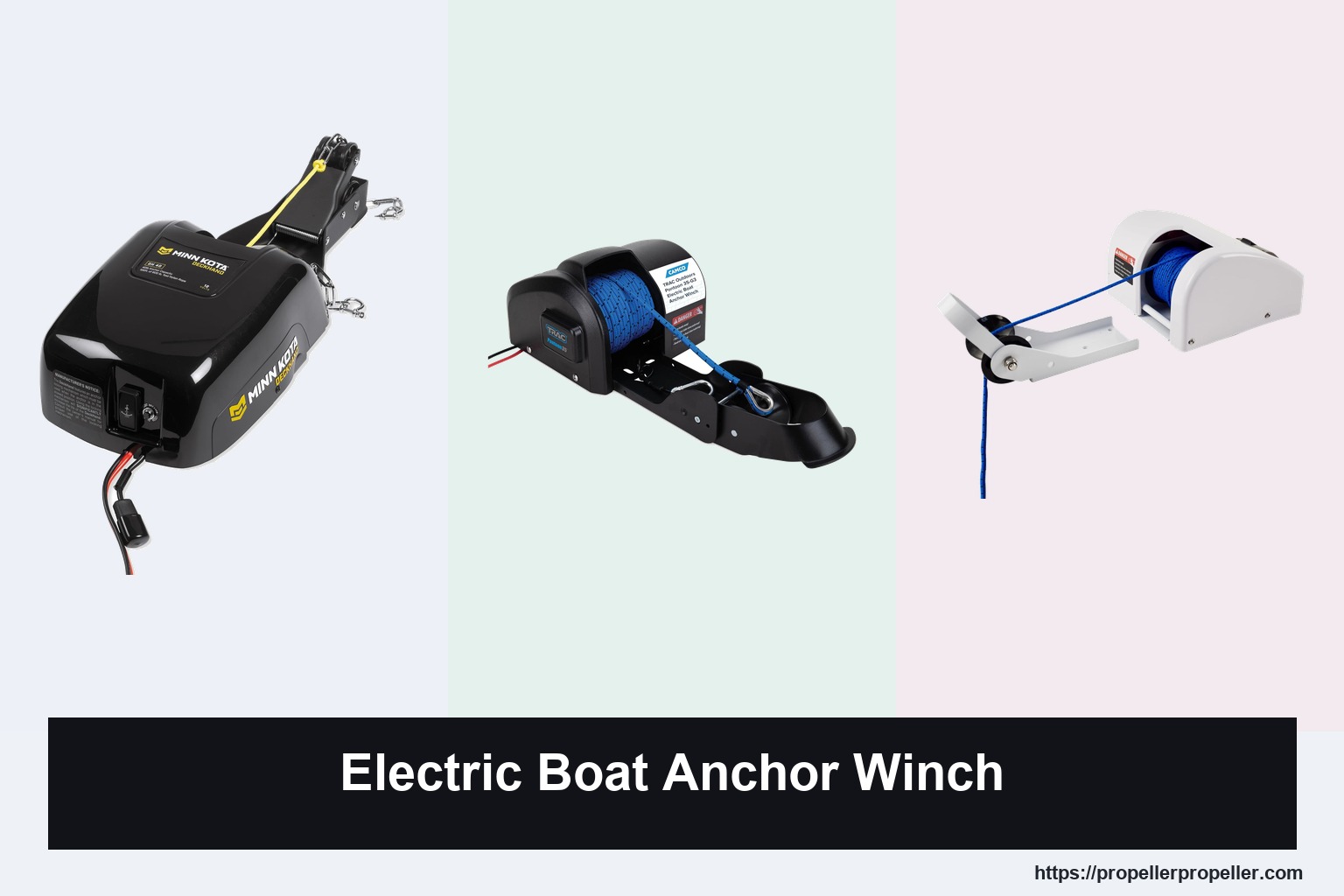
An electric boat anchor winch changes anchoring from a manual chore into a controlled button press. That matters most when you move often, fish over changing bottom contours, or work from a deck where repeated lifting becomes tiring fast. The right unit needs to match your anchor weight, battery setup, mounting space, and the amount of rope you actually need on board. Get those basics wrong and even a capable winch becomes frustrating in daily use.
This roundup focuses on the practical differences that matter before purchase: anchor capacity, power demand, included rope length, control style, motor and gear construction, and installation hardware. Some models are built around simplicity and lower cost. Others add remote operation, stronger materials, or higher-capacity handling. The best choice depends on whether you want a compact helper for light anchoring or a more substantial system for frequent use and heavier loads.
Top Electric Boat Anchor Winch on the Market

Minn Kota Deckhand DH-40 Anchor Winch

Camco TRAC Pontoon 35-G3 Winch

Acdet 25-LB Electric Windlass

Trac Deckboat 40 AutoDeploy-G3

Camco TRAC AnchorZone 20
- 20-lb capacity
- 15-lb recommended load
- 100 feet rope
- Starting battery safe

Ropoana 35/45-LB Windlass
This article may contain affiliate links. As an Amazon Associate, the website may earn from qualifying purchases at no additional cost to you.
Electric Boat Anchor Winch Reviews
Minn Kota Deckhand DH-40 Anchor Winch
- Item Dimensions LxWxH
- 17 x 14 x 12 inches
- Item Weight
- 4 pounds
- Warranty Description
- 2 year Manufacturer
- Material
- Plastic
Advantages
- 40-lb anchor capacity
- Pre-spooled anchor rope
- Base or remote davit
- Integrated stow and deploy switch
- 2-year manufacturer warranty
Limitations
- Anchor not included
- Requires 12-volt battery
The DH-40 is the most complete fit for buyers who want a straightforward electric anchoring setup with enough capacity for serious everyday use. Its 40-lb capacity sets a practical ceiling for heavier anchor work, while the pre-spooled 100 feet of 800-lb test nylon rope reduces the number of parts you need to source before installation. That combination matters because it lowers the friction of ownership. You are not just buying a winch motor. You are getting a system that is already oriented around frequent drop-and-retrieve use.
Installation and operation are designed to stay tidy. The universal davit can mount at the base or remotely, and the anchor stows horizontally to reduce swing on deck. The integrated stow and deploy switch also keeps operation simple at the unit itself. The winch runs on a 12-volt battery, which means your boat needs a compatible electrical setup rather than a purely mechanical anchoring solution. The anti-drag system adds another useful layer because it senses bottom contact and supports controlled drifting at depth instead of abrupt anchor behavior.
Among the six options here, this one stands out for buyers who value the most balanced mix of capacity, convenience, and established design. It does not chase the lowest price, and it is not the lightest unit in the group, but the tradeoff buys confidence in day-to-day anchoring. The 2-year manufacturer warranty adds another layer of reassurance. Choose this when you want the safest all-around recommendation and do not want to compromise on capacity or system polish.
PHOTO: Minn Kota Deckhand DH-40 – Black anchor winch → Source: Amazon.com
Camco TRAC Pontoon 35-G3 Winch
- Item Weight
- 14 pounds
- Product Dimensions
- 16 x 10.5 x 8 inches
- Voltage
- 12 volts
Advantages
- 35-lb anchor capacity
- All-steel gear motor
- 100 feet pre-wound rope
- Sealed membrane switch
- Marine-grade battery wire
Limitations
- Anchor not included
- One-year warranty
This model is a practical choice for pontoon owners who want a mid-capacity electric winch without overcommitting to a more elaborate system. The 35-lb maximum anchor capacity covers a broad range of common anchoring needs, and the all-steel gear motor is the kind of construction detail that matters when you expect the winch to cycle repeatedly over time. The included 100 feet of pre-wound rope also keeps setup uncomplicated. For buyers building around a pontoon-specific anchoring routine, that is a useful mix of strength and simplicity.
Operation focuses on straightforward control rather than extra complexity. The sealed membrane UP/DOWN switch is a sensible feature in a marine environment because it keeps the control layout clean and less exposed than a basic open switch. The separate or integrated anchor roller gives you more flexibility during mounting, and the circuit breaker plus marine-grade battery wire are valuable because they help round out the installation package. The winch runs on 12 volts, so it still depends on a boat electrical system that can support it.
Compared with the best overall pick, this unit is a little less heavy-duty in its capacity target and warranty coverage is shorter at one year. That does not make it a weaker choice for the right boat. It simply positions the winch more tightly around pontoon use and everyday reliability than around maximum versatility. Choose it if you want a clean, well-matched solution for a pontoon and prefer a dependable, cost-conscious middle ground over feature depth.
PHOTO: Camco TRAC Pontoon 35-G3 – Blue rope spool → Source: Amazon.com
Acdet 25-LB Electric Windlass
- Item Dimensions LxWxH
- 9.8 x 9.8 x 5.7 inches
- Material
- Plastic, Steel
- Warranty Description
- no
Advantages
- Remote control included
- 100 feet pre-wound rope
- Automatic reset breaker
- Anti-reverse internal clutch
- Lightweight package
Limitations
- 25-lb capacity limit
- No warranty listed
The Acdet windlass is aimed at buyers who want an affordable entry into powered anchoring without stepping up to the more expensive mid- and high-capacity models. Its 25-lb anchor capacity is lower than several competitors in this roundup, which narrows the use case to lighter anchor loads and more modest boats. In exchange, it includes a remote control and a 100-foot pre-wound rope, so you still get the core convenience benefits that make an electric winch worthwhile. That is the key tradeoff here. Lower capacity, lower cost, but a workable automation package.
Several safety and control choices stand out. The automatic reset circuit breaker is a meaningful protection feature because it restores power after an overload condition is corrected. The up/down switch uses an anti-reverse internal clutch to help prevent free winding, which is useful when you want more controlled anchor handling. The package also includes 14-gauge marine-grade battery wire at 17 feet, so the electrical hookup is not just a bare motor in a box. The plastic and steel construction keeps weight down, though it also signals a lighter-duty build philosophy than the more robust systems in this list.
Against the other entries, this is the most price-sensitive path into electric anchoring and the clearest compromise on load capacity. It does not match the larger safety margin of the 35- and 40-pound units, and it lacks a formal warranty description. Still, for smaller craft or buyers prioritizing the lowest entry cost, it offers useful convenience features that are easy to justify. Choose it when you want the essentials and can stay comfortably within the weight limits.
PHOTO: Acdet 25-LB Electric Windlass – White rope spool → Source: Amazon.com
Trac Deckboat 40 AutoDeploy-G3
- Item Weight
- 13 pounds
- Item Dimensions LxWxH
- 18 x 12.3 x 8 inches
- Warranty Description
- 1 year manufacturer
- Fishing Technique
- Angling
Advantages
- 40-lb anchor capacity
- Wireless remote included
- High-efficiency 12-volt motor
- Sealed membrane switch
- Complete wiring kit
Limitations
- Anchor not included
- One-year warranty
The Deckboat 40 AutoDeploy-G3 is built for buyers who want strong capacity and easier remote operation in one package. The 40-lb maximum anchor capacity puts it in the same practical class as the most capable winch in this roundup, and the wireless remote adds real convenience when you are moving around the deck or managing anchoring from a distance. That pairing matters because the winch is not just about lifting power. It is about reducing the small disruptions that make anchoring feel slow and awkward during a fishing day.
The motor is a high-efficiency 12-volt DC all-steel gear design, which is a useful sign that the unit is aiming for lower battery demand without giving up core mechanical durability. The included sealed membrane UP/DOWN switch gives you a protected local control point, and the circuit breaker plus marine-grade battery wire make the installation kit more complete. The winch still needs a 12-volt boat system, and the anchor is not included, so buyers should plan around those requirements before ordering.
Compared with the DH-40, this model trades a more established brand position for the convenience of wireless operation. That can matter more than small design differences for skippers who value hands-free control and want to manage the anchor from a less fixed position. It is not the lightest or cheapest option in the group, but it earns its place through high capacity and remote flexibility. Select it if your priority is easier control at the boat level rather than the most compact or economical path.
PHOTO: Trac Deckboat 40 AutoDeploy-G3 – Installed deck mount → Source: Amazon.com
Camco TRAC AnchorZone 20
- Item Weight
- 7.49 pounds
Advantages
- 20-lb capacity
- 15-lb recommended load
- Starting battery safe
- Automatic resetting breaker
- Pre-wound braided rope
Limitations
- Light-duty capacity
- One-year warranty
The AnchorZone 20 serves a narrower job than the heavier winches in this roundup, and that is exactly why it can be a smart purchase. The 20-lb maximum anchor capacity and 15-lb recommended load tell you this unit is best treated as a light-anchor solution rather than a general-purpose heavy hauler. For river or smaller anchoring tasks, that can be enough. The lower capacity also keeps the category focused on convenience instead of brute strength, which is the right design priority for some boats.
The winch uses a high-efficiency 12-volt DC all-steel gear motor and is described as safe for use with a starting battery. That compatibility detail matters because it broadens the practical ways you can power it, especially on compact boats where battery management is tight. The 100 feet of 5/32-inch pre-wound rope and the automatic resetting circuit breaker further simplify setup. With the sealed membrane switch and marine-grade battery wire included, the system is built to be complete at the point of installation rather than requiring a lot of extra sourcing.
This is the lightest-duty option among the six and the one most clearly tied to a specific load range. That makes it less flexible than the 35- and 40-pound units, but also easier to recommend for buyers who know they will stay within lighter anchor limits. The one-year warranty is modest, yet the lower weight class and included hardware keep the value proposition coherent. Choose this when your anchor needs are modest and you prefer a purpose-built, simpler setup over capacity you will never use.
PHOTO: Camco TRAC AnchorZone 20 – Compact rope winch → Source: Amazon.com
Ropoana 35/45-LB Windlass
- Item Weight
- 18.7 pounds
- Material
- 316 Stainless Steel, 45 Steel, ABS, PP
- Size
- 35LBS
- Warranty Description
- If you have any questions, please contact our customer service and we will reply to you as soon as possible within 24 hours.
Advantages
- 316 stainless steel
- 70 ft/min retrieval
- 700-lb rope strength
- Sealed switches
- Remote control included
Limitations
- Heavier unit
- Warranty unclear
The Ropoana windlass stands apart because it leans hard into material durability and controlled operation. The 316 stainless steel in the build is especially relevant for marine use, where corrosion resistance is part of long-term ownership value. Its 70 ft/min retrieval speed also gives you a clearer sense of how quickly the anchor can come back aboard. That combination of tough materials and defined operating speed makes this unit attractive to buyers who care about both durability and efficiency in the same purchase.
This model also pays attention to handling and safety details. The long-press lowering action helps avoid accidental release, and the sealed switches add another layer of protection against casual mis-touch. The 100-foot braided rope is rated to 700 pounds of breaking strength, which gives the system a reassuring margin at the rope level. Remote control access within a 32.8- to 49.2-foot radius adds usable flexibility on deck. Installation still requires thoughtful mounting because the unit weighs 18.7 pounds, so this is not a throw-in-and-forget piece of gear.
Against the rest of the group, this is the most material-forward and specification-rich option, though its warranty language is less direct than the clearer manufacturer warranties on some competing models. That makes it especially appealing for buyers who want a more modern feature set and stronger corrosion-resistant construction rather than a long-established brand name. The tradeoff is that it asks more of the buyer to verify fit, mounting, and operating expectations. Choose it if durable construction and faster anchor handling are more important than brand familiarity.
PHOTO: Ropoana 35 45-LB Windlass – Black rope winch → Source: Amazon.com
How to Choose an Electric Boat Anchor Winch
The best electric anchor winch is the one that matches your boat, your anchor, and the way you actually use the deck. Capacity matters first, but power source, rope length, control method, and mounting style can be just as important once you start planning the install. A winch that is too small forces you into a narrow anchor range. One that is overbuilt for your boat can be unnecessary expense and extra weight. The right balance comes from understanding the whole system, not just the headline capacity number.
Anchor Weight Range
Start with the anchor you already use or the one you plan to carry. A winch needs real margin above that weight, not a number that barely matches it. If you anchor in calm water with a lighter setup, a smaller capacity unit can be enough and may be easier to mount and power. Heavier or more frequent anchoring calls for more headroom so the winch is not working at the edge of its limits every time it runs.
Power and Voltage
Most electric boat anchor winches in this category rely on a 12-volt system, so the boat’s electrical setup matters as much as the winch itself. Check whether you have a battery arrangement that can support anchor duty without creating unnecessary drain. High-efficiency motors are worth attention because they can reduce the load on the battery during repeated cycles. If your battery reserves are limited, a more efficient motor can matter as much as raw capacity.
Rope and Reach
The rope package should fit the depth and spacing you typically face on the water. A 100-foot rope is common here, but diameter and strength still affect usability and durability. Thicker rope can feel more substantial, while lighter rope may be easier to manage. Also consider whether the rope arrives pre-wound. That saves setup time and reduces the chance of starting with a messy install.
Controls and Access
Control style changes how the winch feels in day-to-day use. A simple onboard switch is straightforward and keeps operation close to the unit. A wireless or corded remote is more flexible when you move around the deck or want to handle the anchor from another position. If you fish alone, remote access can be a real convenience. If you prefer fewer accessories and a cleaner install, integrated controls may be the better choice.
Mounting and Layout
Look at where the winch will sit on the deck before buying. Some systems offer more flexible davit or roller arrangements, and that can make installation easier when your layout is tight. Pay attention to whether the anchor stows horizontally or needs more swing room. A tidy stow is not just about appearance. It can also reduce deck clutter and accidental contact when people move around the boat.
Durability and Protection
Marine use is hard on moving parts, switches, and wiring. Steel gears, sealed switches, circuit breakers, and corrosion-resistant materials all matter because they help the winch survive repeated exposure to spray and vibration. A better warranty can also matter if you expect regular use, since it signals more confidence in the product’s long-term support. For buyers on saltwater, durability is not a luxury feature. It is part of making the purchase worthwhile.
Anchor Winch Comparison Table
| Product | Best For | Capacity | Weight | Warranty | Color | Item Dimensions LxWxH |
|---|---|---|---|---|---|---|
| Minn Kota Deckhand DH-40 Anchor Winch | Best overall | One Size | 4 pounds | 2 year Manufacturer | Black | 17 x 14 x 12 inches |
| Camco TRAC Pontoon 35-G3 Winch | Best for pontoons | Not Specified | 14 pounds | Not Specified | Not Specified | Not Specified |
| Acdet 25-LB Electric Windlass | Best budget option | Not Specified | Not Specified | no | Black | 9.8 x 9.8 x 5.7 inches |
| Trac Deckboat 40 AutoDeploy-G3 | Best remote control | Standard | 13 pounds | 1 year manufacturer | Gray | 18 x 12.3 x 8 inches |
| Camco TRAC AnchorZone 20 | Best for light anchors | Not Specified | 7.49 pounds | Not Specified | Not Specified | Not Specified |
| Ropoana 35/45-LB Windlass | Most robust build | 35LBS | 18.7 pounds | If you have any questions, please contact our customer service and we will reply to you as soon as possible within 24 hours. | Black | 21.5 x 5.75 x 9.84 inches |
How We Tested & Analyzed Electric Boat Anchor Winch
This roundup was built around the decision factors that matter most for powered anchoring: weight capacity, power requirements, rope package, control method, and installation complexity. Those elements determine whether a winch is merely functional or genuinely convenient on a working deck. I favored specifications that affect real use, such as exact load limits, voltage requirements, rope length, included wiring, switch design, and mounting flexibility, because those are the details that shape day-to-day ownership.
Products were compared on how coherently their features fit a specific boating job. A higher-capacity winch is not automatically better than a smaller one if the boat and anchor combination does not need it. Likewise, remote operation, sealed switches, or stronger gear construction only matter when they solve a real use problem. That approach keeps the analysis practical and prevents overvaluing flashy extras that do not change the anchoring experience in a meaningful way.
The final rankings also account for obvious tradeoffs. Some units prioritize lower price, while others focus on durability, capacity, or easier control. Where a product included a shorter warranty, narrower load range, or heavier mounting burden, that limitation was treated as part of the buying decision rather than ignored. The goal is to help readers choose the winch that fits their boat and use pattern with the fewest surprises after installation.
Frequently Asked Questions
How much anchor capacity do I need?
Choose a winch that comfortably exceeds the weight of the anchor you plan to use. A little margin matters because real-world handling includes rope tension, bottom resistance, and repeated cycling. Smaller boats with light anchors can stay in the lower range, while heavier anchors or more frequent use justify a higher-capacity winch.
Does the winch need a special battery setup?
Most electric anchor winches in this category rely on a 12-volt boat system, so you need a battery arrangement that can handle the load. Efficient motors can reduce drain, but they do not remove the need for a compatible power source. Check wiring length, connector type, and breaker protection before you buy.
Is a remote control worth it?
A remote is useful when you want to move around the deck or control the anchor from a better vantage point. It is less essential if you prefer a simple switch mounted directly on the unit. Remote operation adds convenience, but a clean integrated control layout may be better for buyers who want fewer accessories.
What should I look for in the rope package?
Focus on length, strength, and whether it arrives pre-wound. A 100-foot rope is common and gives you a good starting point for many boats, but strength rating and diameter affect how confidently the system handles load. Pre-wound rope also reduces installation work and lowers the chance of setup mistakes.
Final Thoughts
An electric boat anchor winch is one of those purchases that becomes more valuable the more often you anchor. The best models reduce strain, shorten setup time, and make your anchoring routine feel controlled instead of improvised. Capacity should be your starting point, but the rest of the system matters too. Rope, switches, mounting flexibility, and power demand all determine whether the winch fits your boat naturally or creates a new set of annoyances.
For most buyers, the smartest choice is the winch that matches anchor weight with enough room to spare and a control style that fits the way you use the deck. If you want the broadest all-around recommendation, choose the unit that balances capacity, integration, and support. If your boat is smaller or your anchoring needs are lighter, one of the simpler units can save money without sacrificing the convenience that makes electric anchoring worthwhile.



