You can spend thousands on a new propeller and still leave performance on the table if you ignore prop slippage. Understanding prop slip is one of the fastest ways to diagnose speed loss, fuel economy issues, and inefficient boat setup.
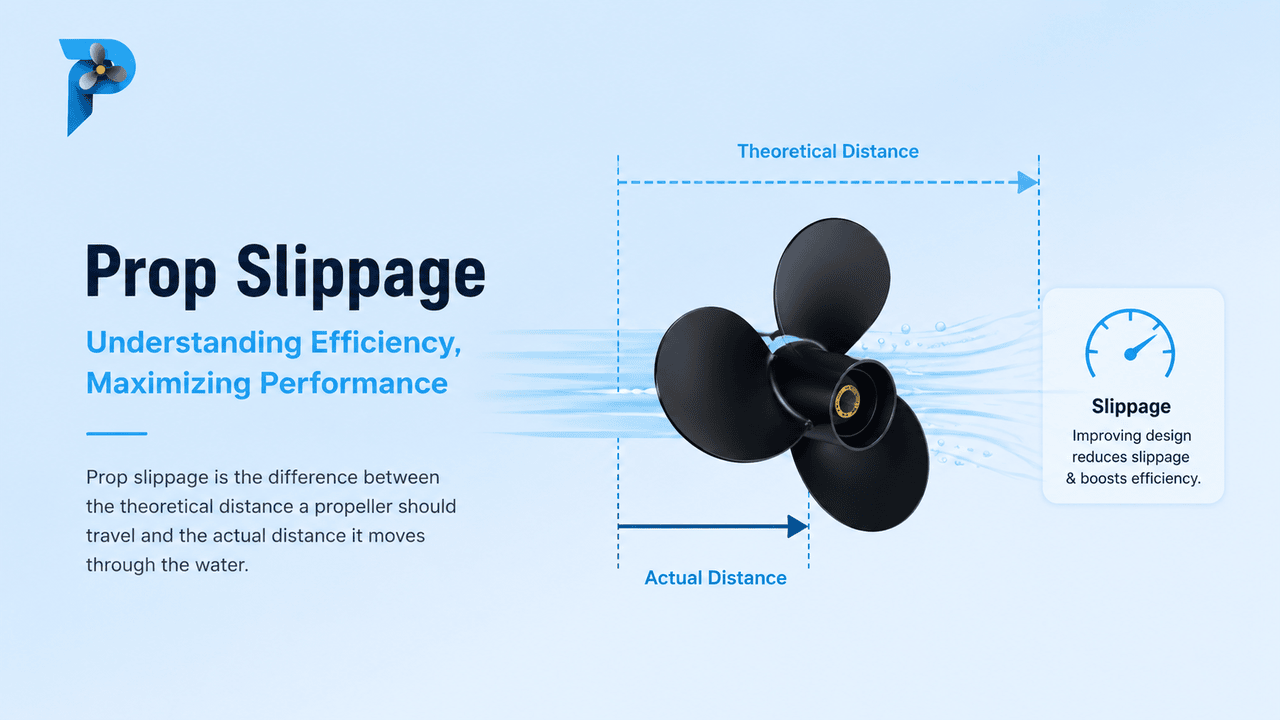
Prop slip is the difference between the theoretical distance a boat propeller should travel through water and the actual distance it travels. It occurs because water is not a solid surface, causing some loss of efficiency. Most boats operate with 5% to 20% prop slip depending on hull design and operating conditions.
Whether you’re running a bass boat, pontoon, center console, or offshore fishing boat, knowing your prop slip percentage can help you optimize speed, RPM, and overall boat performance.
What Is Prop Slippage?
Prop slippage, often called propeller slip, measures how much efficiency is lost as a propeller pushes a boat through water.
If a propeller worked in a perfectly solid medium, every revolution would move the boat forward exactly according to its pitch. In reality, water allows some movement around the blades, reducing the actual distance traveled.
For example, a 24-inch pitch propeller theoretically moves forward 24 inches with each revolution. However, the boat may only achieve the equivalent of 21 or 22 inches of forward travel due to slip.
Prop slip is not necessarily a problem.
Every boat experiences some degree of slip because water behaves differently than a solid surface. The goal is not to eliminate slip completely. The goal is to keep it within an efficient range.
Boat owners often use prop slip calculations to:
- Evaluate propeller efficiency
- Compare propeller setups
- Diagnose performance problems
- Improve fuel economy
- Optimize top speed
- Verify engine setup changes
Why Does Prop Slippage Happen?
Prop slip is a normal part of marine propulsion. Understanding why it happens makes it easier to interpret your slip numbers correctly.
Water Is Not a Solid Surface
Unlike a tire gripping pavement, a propeller works in water.
Water can move, compress, and flow around propeller blades. As a result, some of the energy produced by the engine is lost instead of being converted into forward motion.
This is why every propeller experiences some efficiency loss.
The Difference Between Theoretical and Actual Distance
Theoretical speed assumes a propeller moves forward exactly according to its pitch on every revolution.
Actual speed reflects real-world conditions.
Factors such as hull drag, water conditions, propeller design, and boat load reduce efficiency and create a gap between theoretical speed and actual speed.
That gap becomes your prop slip percentage.
Why Zero Slip Is Impossible
Many boat owners assume zero prop slip is the ideal target.
In practice, zero slip does not exist.
Even highly optimized performance boats experience some slip because water is not rigid. Most high-performance setups target less than 10% slip at wide open throttle.
According to technical guidance from Mercury Marine, propeller slip is a normal characteristic used to evaluate setup efficiency and overall performance.
How To Calculate Prop Slippage
Calculating prop slip is easier than many boat owners expect. Once you know the required inputs, the math becomes straightforward.
Prop Slip Formula
The standard prop slip formula is:
Prop Slip % = ((Theoretical Speed – Actual GPS Speed) ÷ Theoretical Speed) × 100
Before calculating slip, you first need to determine theoretical speed.
Theoretical Speed = (RPM × Prop Pitch) ÷ (Gear Ratio × 1056)
This formula estimates how fast the boat should travel if there were no efficiency losses.
Information You Need
Gather the following information before calculating prop slip:
- Engine RPM
- Propeller pitch
- Gear ratio
- GPS speed
Always use GPS speed rather than a speedometer reading.
GPS data from systems such as Garmin GPS or Lowrance units is significantly more accurate for performance calculations.
Example Calculation
Let’s assume:
- RPM: 5800
- Pitch: 24 inches
- Gear Ratio: 1.87:1
- GPS Speed: 67 mph
Theoretical Speed:
(5800 × 24) ÷ (1.87 × 1056)
= 70.3 mph
Prop Slip:
((70.3 – 67) ÷ 70.3) × 100
= 4.7%
This boat would be operating with excellent propeller efficiency.
Use a Prop Slip Calculator
Manual calculations work well, but online calculators save time.
A prop slip calculator allows you to quickly compare different propeller pitches, gear ratios, and RPM combinations.
Many experienced boat owners calculate slip after every major setup change, including:
- New propeller installation
- Engine height adjustment
- Jack plate modification
- Engine trim testing
What Is a Good Prop Slip Percentage?
A good prop slip percentage depends on boat type, hull design, and operating conditions.
Before evaluating your numbers, it’s important to compare them against realistic benchmarks.
Typical Slip Ranges
Most recreational boats operate between 5% and 20% prop slip.
High-performance boats often achieve lower numbers because their hulls and propellers are optimized for speed.
Pontoons and heavier boats typically experience higher slip percentages.
Slip Chart by Boat Type
| Boat Type | Typical Prop Slip |
|---|---|
| Performance Boat | 5% to 10% |
| Bass Boat | 5% to 12% |
| Offshore Boat | 8% to 15% |
| Ski Boat | 8% to 15% |
| Pontoon Boat | 10% to 20% |
This table provides a useful starting point when evaluating your setup.
WOT vs Cruising Slip
Slip percentages often change throughout the RPM range.
At cruising speed, a boat may experience different efficiency characteristics than it does at wide open throttle.
For this reason, most performance tuning focuses on WOT RPM and GPS speed.
When comparing setups, always compare data collected under similar conditions.
Common Causes of High Prop Slippage
If your slip percentage is unusually high, several factors may be contributing to the problem.
Wrong Prop Pitch
An incorrect propeller pitch can create excessive slip.
Too much pitch may overload the engine.
Too little pitch can allow excessive RPM without efficiently converting power into forward motion.
Incorrect Diameter
Propeller diameter influences how much water the prop can move.
A diameter mismatch can reduce efficiency and negatively affect boat performance.
Ventilation
Ventilation occurs when air reaches the propeller blades.
The propeller loses its ability to grip water effectively, causing RPM to rise while speed suffers.
Ventilation commonly occurs during hard turns or aggressive acceleration.
Cavitation
Cavitation differs from ventilation.
It occurs when low-pressure areas create vapor bubbles around the blades. These bubbles collapse rapidly and can damage the propeller over time.
The U.S. Coast Guard provides educational resources on safe boat operation and maintenance practices that help boat owners identify performance issues before they become costly repairs.
Poor Weight Distribution
Improper weight placement affects hull attitude and water flow.
Excessive stern weight or uneven loading can increase drag and prop slip.
This is particularly common in fishing boats carrying additional gear and batteries.
Engine Height Issues
An outboard mounted too high may ventilate excessively.
An engine mounted too low may create unnecessary drag.
Small engine height adjustments can sometimes produce significant improvements.
Damaged Propeller
Bent blades, damaged edges, or worn hubs reduce propeller efficiency.
Even minor damage can increase slip percentages.
Inspect your propeller regularly, especially after impacts with debris or shallow-bottom contact.
How To Reduce Prop Slippage
Reducing prop slip often involves fine-tuning rather than replacing expensive components.
The most effective improvements usually come from setup optimization.
Optimize Engine Trim
Engine trim affects how the hull rides through the water.
Excessive trim increases drag.
Insufficient trim may prevent the hull from reaching peak efficiency.
Testing different trim settings while monitoring GPS speed and RPM can reveal measurable gains.
Improve Weight Distribution
Move heavy gear toward balanced positions within the boat.
A properly balanced hull generally performs more efficiently and experiences less drag.
Upgrade to Stainless Steel
Stainless steel propellers typically flex less than aluminum models.
This allows them to maintain their designed pitch more effectively under load.
As a result, many boats experience lower slip and improved performance after upgrading.
Adjust Engine Height
A properly positioned outboard improves water flow to the propeller.
Many performance boat owners use jack plates to fine-tune engine height for maximum efficiency.
Select the Correct Propeller
The correct propeller depends on:
- Boat type
- Engine power
- Operating conditions
- Desired performance goals
Manufacturers such as Yamaha Marine and Mercury Marine offer propeller selection guides that help boat owners identify suitable options.
What Your Prop Slip Number Means
Calculating slip is only useful if you know how to interpret the results.
The following ranges provide practical guidance.
Under 5%
This is excellent performance.
Many optimized bass boats and performance boats operate within this range.
5% to 10%
This range is considered very efficient.
Most well-set-up recreational boats should be satisfied with these numbers.
10% to 15%
This is normal for many offshore, family, and utility boats.
Minor optimization opportunities may still exist.
15% to 20%
This range deserves investigation.
The boat may benefit from setup adjustments, propeller changes, or load redistribution.
Over 20%
Slip above 20% often indicates a problem.
Potential causes include ventilation, improper propeller selection, damaged equipment, or incorrect engine height.
Real-World Prop Slip Examples
Real examples help put slip percentages into perspective.
These examples use realistic boating scenarios commonly seen during prop testing.
Bass Boat Example
A bass boat equipped with a 250 HP outboard:
- RPM: 6000
- Pitch: 25
- Gear Ratio: 1.75
- GPS Speed: 73 mph
Calculated slip is approximately 7%.
This represents a strong performance setup.
Pontoon Boat Example
A pontoon boat setup:
- RPM: 5800
- Pitch: 15
- Gear Ratio: 2.33
- GPS Speed: 28 mph
Calculated slip falls around 16%.
For a pontoon, this is completely normal.
Center Console Example
A center console fishing boat:
- RPM: 5600
- Pitch: 21
- Gear Ratio: 1.85
- GPS Speed: 47 mph
Calculated slip lands near 12%.
This is a healthy and efficient result for many offshore-oriented boats.
The Truth About Chasing Lower Prop Slip
Many articles imply that lower slip automatically means better performance.
Experienced prop tuners know the situation is more complicated.
A propeller producing extremely low slip may not provide the best overall boating experience.
During prop testing, it is common to find a setup that produces slightly higher slip while delivering better acceleration, stronger hole shot, improved load carrying ability, or better fuel economy.
For example, a 4-blade propeller may show marginally higher slip than a 3-blade model. However, it may also improve handling, acceleration, and rough-water control.
This is why professional setup specialists rarely evaluate slip alone.
When testing propellers, they look at:
- Slip percentage
- GPS speed
- WOT RPM
- Fuel consumption
- Acceleration
- Boat load
The best propeller is not necessarily the one with the lowest slip.
The best propeller is the one that delivers the right balance of performance for how you actually use the boat.
Frequently Asked Questions
What is a good prop slip percentage?
A good prop slip percentage generally falls between 5% and 15% for most boats. High-performance boats often target less than 10%, while heavier boats such as pontoons may operate efficiently at higher numbers.
Can prop slip be zero?
Prop slip cannot be zero in real-world boating conditions. Water is not a solid surface, so some efficiency loss always occurs as the propeller moves through the water.
Does prop slip affect fuel economy?
Prop slip directly affects fuel economy because inefficient propulsion requires more power to achieve the same speed. Excessive slip often results in increased fuel consumption.
Is cavitation the same as prop slip?
Cavitation and prop slip are different concepts. Cavitation involves vapor bubble formation around propeller blades, while prop slip measures efficiency loss between theoretical and actual boat speed.
How can I reduce prop slip?
Reducing prop slip typically involves optimizing engine trim, adjusting engine height, improving weight distribution, and selecting the correct propeller for your boat and operating conditions.
What causes excessive prop slip?
Excessive prop slip is commonly caused by incorrect prop pitch, poor engine setup, ventilation, damaged propellers, improper weight distribution, or excessive hull drag.
Does stainless steel reduce slip?
Stainless steel propellers often reduce slip because they maintain their designed shape under load better than aluminum props. The improvement varies depending on the boat and setup.
Final Thoughts
Prop slippage is one of the most valuable measurements available when evaluating boat performance. It helps bridge the gap between what a propeller should achieve and what it actually delivers on the water.
Most boats will never achieve zero slip, nor should they try. The goal is to maintain an efficient range while balancing speed, acceleration, fuel economy, and handling.
If you have never calculated your prop slip before, gather your RPM, pitch, gear ratio, and GPS speed data during your next outing. A simple calculation can reveal whether your current setup is performing at its full potential.