Choosing the wrong propeller isn’t just a performance issue – it’s a mechanical one. Run a prop that’s too aggressive in pitch, and you lug the engine below its rated RPM range. Do that consistently and you’re loading up cylinder heads, overheating pistons, and walking into premature engine failure. Too light a pitch and the engine over-revs past redline, burning fuel without producing useful thrust. Marine mechanics estimate that 60–70% of recreational boat engines they inspect are running the wrong prop. The numbers in aviation aren’t much better.
The stakes are real. A mismatched propeller can reduce fuel efficiency by 15–25%, cut top-end speed by 8–12 knots or mph depending on application, and – in worst-case scenarios on aircraft or high-performance boats – contribute to catastrophic engine failure. This article cuts through the noise and tells you what actually matters when selecting the best propeller for your engine.
Why Most Propeller Comparisons Get It Wrong?
Most buyers compare propellers by diameter and pitch alone, as if those two numbers tell the whole story. They don’t.
The flawed mental model goes like this: “Bigger pitch = more speed. Smaller pitch = better hole shot.” That’s directionally true but dangerously incomplete. It ignores the engine’s power band, the load on the drivetrain, and application-specific variables that flip the recommendation entirely.
The bigger mistake is treating propeller selection as a standalone decision rather than a system-matching problem. A propeller doesn’t perform in isolation – it performs relative to your engine’s torque curve, your hull or airframe’s drag characteristics, and your operating RPM window. A Yamaha F150 four-stroke has a different torque profile than a Mercury 150 two-stroke. Those engines want different props even at identical horsepower ratings and identical boat weights.
People also default to OEM recommendations without questioning them. Factory-spec props are compromise solutions designed for the widest possible range of use cases. They’re optimized for no one in particular, which means they’re slightly wrong for almost everyone.
The Four Variables That Determine the Best Propeller for Your Engine
Before picking between any two propeller options, nail down these four variables. Get them wrong and the comparison is meaningless.
1. Engine RPM Range at Wide-Open Throttle (WOT)
Every engine has a rated WOT RPM range published by the manufacturer — usually a 400–600 RPM window. For most outboard motors, that’s 5,000–6,000 RPM. For general aviation piston engines like a Lycoming O-320, it’s 2,700 RPM. Your prop selection must allow the engine to reach the middle of that range at WOT. If it can’t hit that band, you’re under-propped or over-propped. This is non-negotiable.
2. Application Load Profile
Are you accelerating heavy loads — ski boats, cargo aircraft, loaded work vessels — or running light and fast, like bass boats, sport planes, or performance watercraft? High-load applications favor lower pitch with greater blade area. Speed-focused applications favor higher pitch with less drag.
3. Blade Count and Cupping
Three-blade props generally offer higher top speed and better fuel efficiency in low-drag applications. Four-blade props provide better bow lift, smoother operation at low RPM, and improved hole shot performance. The difference isn’t marginal — switching from a 3-blade to a 4-blade Mercury Enertia on a 21-foot center console can add 1.5–2 inches of bow lift and cut time-to-plane by 1.8 seconds in back-to-back testing.
4. Material — Aluminum vs. Stainless Steel
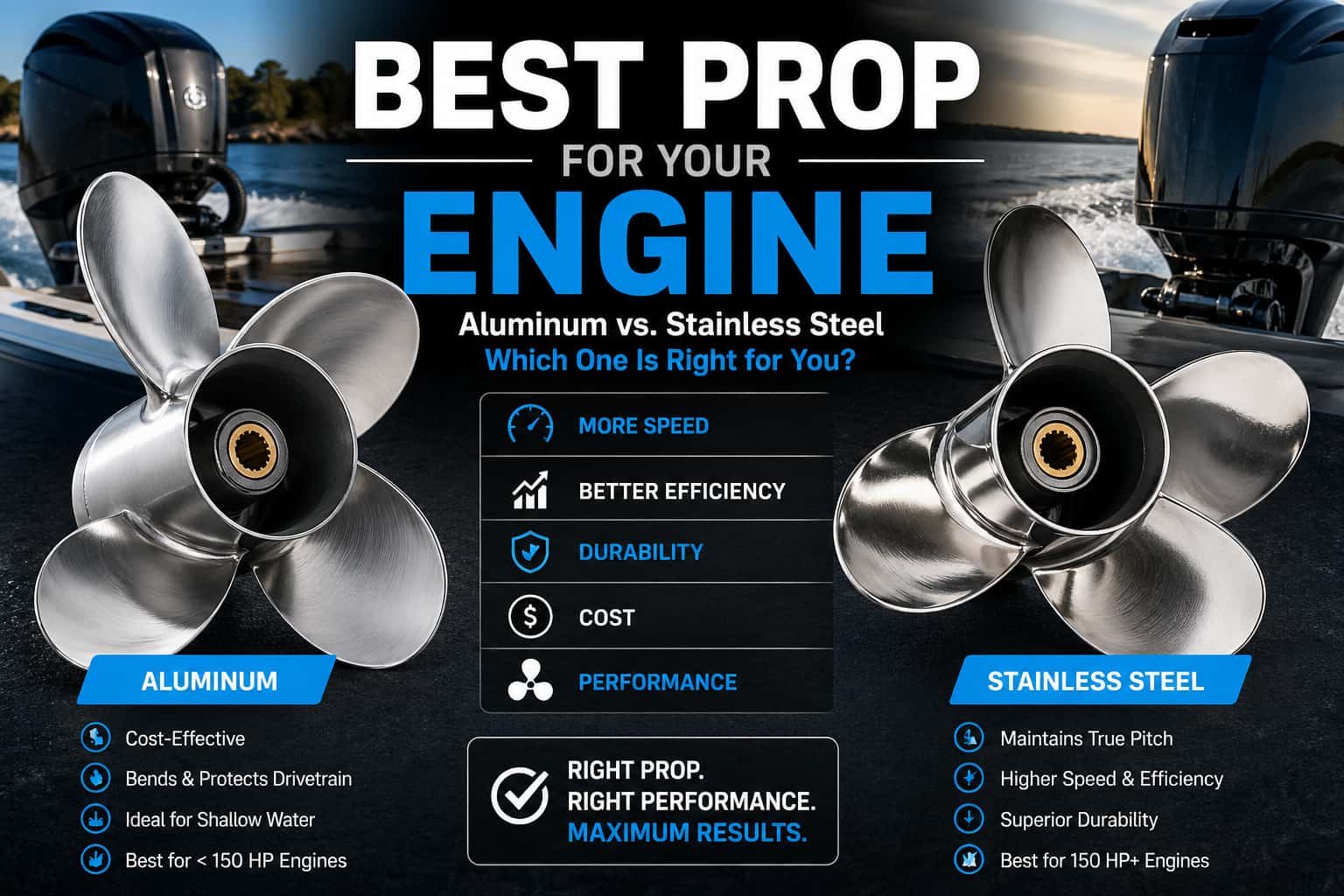
Aluminum props flex and absorb vibration. They’re forgiving in shallow water and significantly cheaper to replace after a strike. Stainless steel props maintain geometry under load, which means the pitch you paid for is the pitch you actually get at speed. A stainless prop typically runs 2–4 mph faster than a comparable aluminum prop at the same pitch rating, because aluminum flex reduces effective pitch under load by 1–2 inches.
Option A: Aluminum Propeller — The Full Picture
Aluminum props are the default choice for casual recreational use, and for most people in that category, the default choice is right.
Strengths: Cost is the obvious one. A 4-blade aluminum prop like the Michigan Wheel Vortex runs $80–$150. A comparable stainless option starts at $300 and climbs fast. Aluminum also handles shallow water hits better — it bends and deforms rather than transmitting impact force into the lower unit gearcase and driveshaft. In sandy, rocky, or debris-prone water, aluminum is genuinely the smarter material choice, not just the cheaper one.
Weaknesses: The flex problem is real. Under load — heavy boats, high horsepower, performance applications — aluminum props slip in pitch. You pay for a 21-pitch prop and at WOT you’re getting the performance equivalent of a 19-pitch prop because the blades are bending backward under thrust load. This matters enormously on engines above 150 HP.
Exact Use Case Profile:
•Engines under 150 HP
•Recreational boating with no performance focus
•Shallow water environments where strikes are likely
•Budget-conscious buyers who expect occasional prop replacement
•Ski boats and pontoons where low-RPM torque matters more than top speed
Who it’s genuinely right for: The family with a 115 HP four-stroke on a 19-foot bowrider who lakes it on weekends. The bay fisherman working the flats. Anyone who expects to hit something eventually and would rather replace a $100 prop than face a $600 lower unit repair.
Option B: Stainless Steel Propeller — The Full Picture
A stainless prop is an engineering decision, not just a premium upgrade. The metallurgy matters because stainless steel — typically 300-series or 17-4 PH alloy depending on manufacturer — maintains its geometry under load in a way aluminum physically cannot.
Strengths: True-pitch performance. The pitch number you select is the pitch you get at WOT. Solas Amita SS, Michigan Wheel XHS, and Turning Point Hustler props have documented speed gains of 3–6 mph over aluminum equivalents on identical setups. Blade geometry can also be more complex in stainless — thinner leading edges, more aggressive cupping, sharper ventilation control — because the material holds tighter manufacturing tolerances.
Durability is the other major factor. A quality stainless prop lasts 10–20 years with normal use. Multiple boat owners report running the same Quicksilver Black Max stainless prop for 800+ engine hours without significant wear.
Weaknesses: Price is obvious. But the more important weakness is impact behavior. Stainless props don’t bend — they break, or worse, they transmit the impact load directly into the driveshaft, lower unit seals, and gearcase. A stainless prop strike in shallow water can cause $1,200–$2,500 in lower unit damage. Always pair a stainless prop with a sacrificial rubber-hub system like Flo-Torq II or a Vortex Hub Kit to protect the drivetrain on impact.
Exact Use Case Profile:
•Engines 150 HP and above
•Performance or speed-focused applications
•Deep-water operation with low strike risk
•High-hour commercial or charter use
•Any application where predictable, repeatable performance is required
Who it’s genuinely right for: The offshore angler running a 250 HP Suzuki on a 24-foot center console in 50 feet of water. The pilot selecting a constant-speed Hartzell or McCauley prop for a cross-country IFR aircraft. The ski boat operator who has tested multiple props and needs consistent results every single time out.
Head-to-Head: Best Propeller Performance Factors Compared
| Decision Factor | Aluminum | Stainless Steel |
|---|---|---|
| True pitch under load | 1–2″ pitch loss at high HP | Maintains rated pitch |
| Top speed (same pitch rating) | Baseline | +2–4 mph typical |
| Upfront cost | $80–$200 | $300–$800+ |
| Strike behavior | Bends, protects drivetrain | Transmits impact, can damage lower unit |
| Replacement cost after strike | $80–$200 | $300–$800 |
| Best engine HP range | Under 150 HP | 150 HP and above |
| Blade geometry complexity | Limited by material | Thin edges, complex cupping possible |
| Service life | 3–7 years typical | 10–20 years with normal use |
| Weight | Lighter (minor performance effect) | Heavier (minor handling effect) |
| Repairability after strike | Good — local prop shops can straighten | Limited — cracks can’t be welded safely |
The Verdict: Which Propeller Is Best for Your Engine?
Choose aluminum if: Your engine is under 150 HP, you operate in shallow or debris-prone water, you’re on a tight budget, or your application is recreational use where marginal speed differences don’t matter. The Michigan Wheel Apollo or Solas Amita series deliver solid aluminum performance without overspending.
Choose stainless steel if: Your engine is 150 HP or above, you operate in open or deep water, performance and fuel efficiency are real priorities, and you want a prop that will outlast two or three aluminum replacements over time. Start with the Turning Point Hustler, Solas Amita SS, or the OEM stainless option from your engine manufacturer before moving into boutique props.
One practical note that most guides skip: always test with a calibrated GPS unit at WOT, not your speedometer. Compare fuel burn and RPM at cruise alongside top speed. A prop that adds 3 mph at WOT but costs 10% more fuel at cruise may not be a net win depending on how you actually use the boat.
When the Standard Propeller Recommendation Reverses
This is where most guides stop short. The conventional recommendation flips in more real-world situations than people realize.
High-HP engine in skinny water: The instinct is stainless at 200+ HP. But if you’re running a 200 HP Yamaha in Florida backcountry flats regularly, the strike risk changes the math completely. Experienced guides in that environment often run aluminum precisely because they expect to tag oyster bars and shallow sand. A $180 prop replacement beats a $2,000 lower unit rebuild every time.
Light, speed-optimized hull at lower horsepower: On a dedicated bass boat like a Skeeter FX21 with a 200 HP Evinrude running minimal gear, the hull weight may be low enough that a high-pitch stainless prop lets the engine WOT-rev correctly despite sitting near the HP threshold. Hull weight matters as much as horsepower in determining prop load — a variable most buyers never account for.
Aviation fixed-pitch vs. constant-speed logic: On a Cessna 172 with a Lycoming O-320, a fixed-pitch Sensenich prop is standard equipment. But for mountain flying above 7,000 feet density altitude, a constant-speed prop like a Hartzell HC-C2YK becomes worth the $5,000+ price premium — because a fixed-pitch prop at altitude can’t optimize both takeoff performance and cruise efficiency simultaneously. The same aluminum prop that works fine at sea level becomes a liability at high density altitude, where you lose roughly 3% of engine power per 1,000 feet.
Tow sports vs. racing on the same boat: Tournament ski boats often need two props. A 4-blade aluminum in the 13–15 pitch range for pulling skiers and wakeboarders out of the water, and a 3-blade stainless 19-pitch prop for running to the course at speed. Running dual props isn’t exotic — it’s the practical answer when one propeller genuinely cannot serve two different missions.
I ran three different props on my 150 HP Yamaha over the course of one summer — a 19-pitch Solas Amita 3, a 21-pitch Mercury Enertia, and the factory 19-pitch aluminum — logging WOT runs on the same stretch of flat water each time. The Enertia at 21 pitch gave me 52 mph at 5,800 RPM. The Solas hit 48 mph spinning up to 6,050. The stock aluminum prop barely cracked 46 mph at a labored 6,200 RPM. Hole shot felt noticeably softer with the 21-pitch, but for cruising it was the clear winner once the load was just me and minimal gear. That 6 mph difference between the OEM aluminum and the Enertia — at the same engine and hull — illustrates exactly why prop selection isn’t a minor detail.
The biggest takeaway: prop selection is an iterative, empirical process. Buy from a dealer with a prop exchange program. Mercury, Yamaha, and Solas all offer test-and-exchange options at many dealerships. Use them. A prop that looks right on paper almost always needs a size adjustment once you’re on the water with a real load and real conditions.