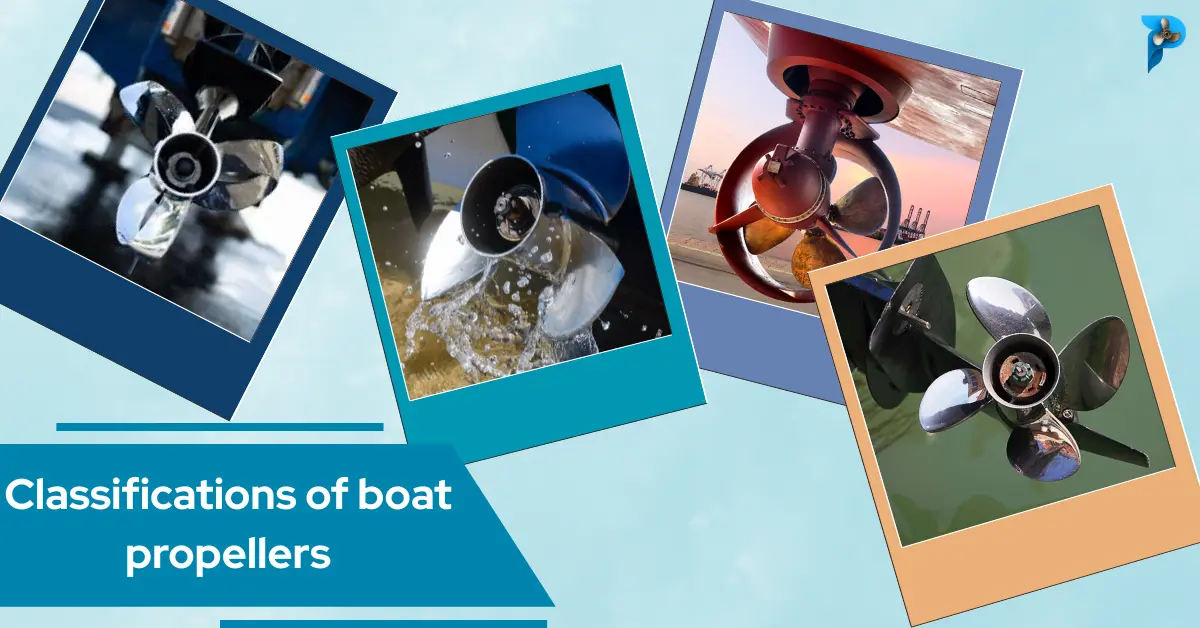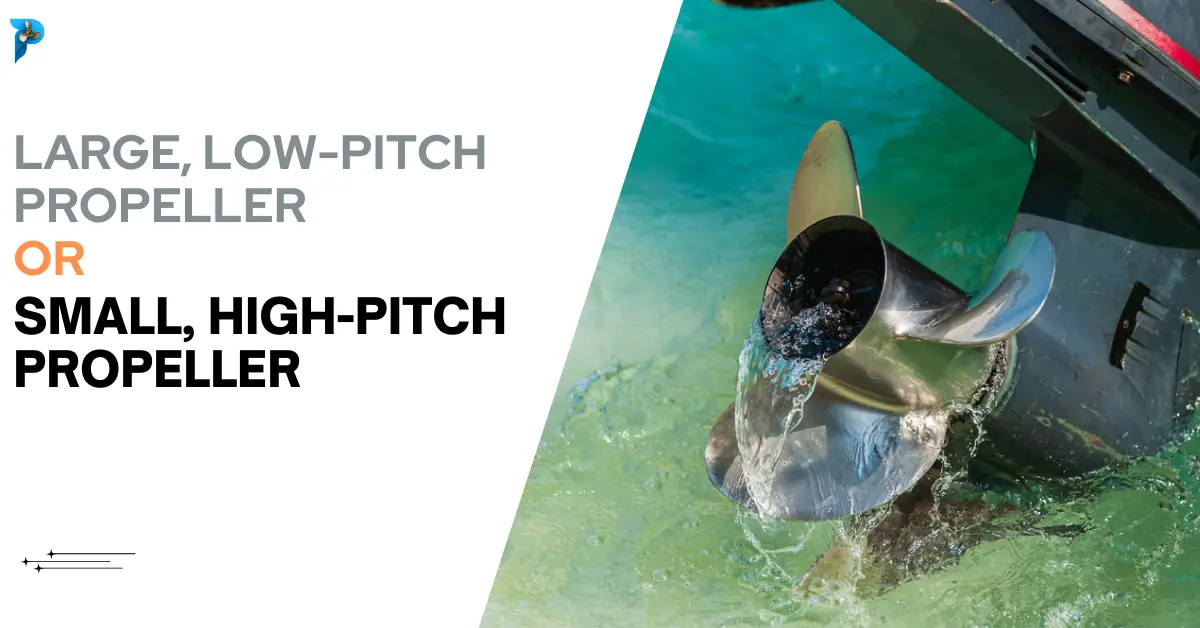
Choosing between a large prop, low pitch, or small, high pitch is one of the most important decisions you can make to get the most performance out of your boat.
Whether you’re trying to decide on a large prop low pitch or small high pitch setup, the right choice can greatly influence how your boat accelerates, handles speed, manages fuel efficiency, and performs under various loads.
In simple terms, propeller diameter refers to the size of the prop, while pitch refers to how far it moves forward in one rotation or the amount of water it pushes per rotation.
A low-pitch prop gives you powerful thrust and faster acceleration, an ideal choice for getting on plane quickly, towing, or navigating heavy loads.
On the other hand, a high-pitch prop offers better top speed and efficiency at cruising RPMs, ideal for speedboats or open-water cruising.
In this guide, we’ll break down the real theory on large prop, low pitch, or small, high pitch for boat propellers. So, you can choose the setup that fits your boat’s performance.
What Is Prop Pitch and Diameter?
When choosing the right boat propeller, two critical terms are often heard: prop pitch and propeller diameter. Let’s have a detailed look at these two.
What is Prop Pitch?
Prop pitch refers to the distance a propeller moves forward per rotation. No water slippage is counted here.
For example, a 19-inch propeller is designed to move the boat forward 19 inches with every full spin.
- A low pitch propeller pushes the boat a shorter distance with each spin, but it lets the engine run faster. This means quicker acceleration, stronger hole-shot, and better towing performance.
It’s ideal for carrying heavy loads, doing watersports, or operating in rough waters.
- A high-pitch propeller covers more distance with each spin. It offers great top speed and improved fuel economy.
Car Gear Analogy
Think of pitch like the gears in your car or truck:
- Low pitch = 1st or 2nd gear → Quick acceleration, better pulling power.
- High pitch = 5th or 6th gear → Better speed and efficiency at higher RPMs.
What Is Prop Diameter?
Propeller diameter is the length from one blade tip to the opposite tip, the full circle the blades make when they spin.
A larger diameter prop moves more water and creates greater thrust, which is useful for heavier boats and rough conditions.
- Large diameter props are usually paired with low pitch to maximize acceleration.
- Small diameter props are typically combined with high pitch for speed and less drag.
Large Prop, Low Pitch – Key Characteristics
A large propeller with low pitch is all about thrust, control, and power at low speeds. This is a specific setup designed to get your boat moving quickly, especially when carrying heavy loads.
This propeller has a big blade surface area, which moves more water per rotation. It results in stronger acceleration and better low-speed handling.
How It Works
- With a larger diameter, the propeller grabs more water per spin.
- With a lower pitch, it doesn’t move too far with each turn.
Instead, it rotates faster and gives you immediate push-off power without overloading the engine at lower speeds.
One solid option in this category is the Turning Point Propellers Hustler Aluminum 4-Blade Propeller – 13.25″ x 15″. This is a well-balanced 4-blade design known for its quick acceleration, improved grip, and excellent low-speed control.
It’s especially useful for pontoons, tow boats, and heavily loaded utility vessels.
Advantages
- Superior Acceleration & Hole-Shot
- Lower Engine RPM for the Same Thrust
- Improved Control at Low Speeds
- Better Load-Carrying Capability
Disadvantages
- Lower Top Speed
- More Strain at High RPMs
Best Use Cases
Here are some of the best use cases where powerful, steady propulsion makes a real difference. These applications benefit from engines designed for torque, control, and reliability.
- Fishing Boats – where slow, controlled movement is often needed.
- Towing and Watersports – ideal for pulling skiers, tubes, or other boats.
- Workboats and Utility Boats – carrying gear, tools, or crew.
- Heavy Hulls or Pontoon Boats – when extra push is needed.
Small Prop, High Pitch – Key Characteristics
If you want top-notch speed and cruising efficiency, a small propeller with high pitch is the go-to setup.
This one has smaller blades with a more angled pitch that can move the boat farther with per rotation.
How It Works
- A high-pitch propeller is designed to “grip” into the water in a stronger way with per rotation.
- When the blades are smaller and lighter, this also reduces drag and load on the engine at higher speeds.
One great example is the SOLAS 13.25 x 19 Aluminum 4-Blade Propeller. It’s a proven high-pitch option with four blades that provide smoother thrust and better grip at high speeds.
Advantages
- Reduced Drag
- Increased Top Speed
- Better Fuel Efficiency at Cruise
Disadvantages
- Slower Acceleration
- Risk of Engine Strain
- Poor Performance Under Load
Best Use Cases
This type of high-pitch, small-diameter propeller works the best where speed and efficiency matter most.
It’s perfect for boats that prioritize top-end performance and steady cruising over quick acceleration.
- Speedboats and Racing Boats – maximizing top speed on open water.
- Cruising Vessels – maintaining steady speeds with better fuel economy.
- Lightweight Boats – where quick push-off isn’t a priority.
- Recreational Day Boats – for covering long distances at moderate throttle.
Direct Comparison: Large Prop Low Pitch or Small High Pitch
Here comes an easy comparison table for your easy understanding.
| Feature | Large Low-Pitch Prop | Small High-Pitch Prop |
| Top Speed | Limited | High |
| Acceleration | Excellent | Moderate |
| Load Handling | Great for heavy or loaded boats | Not ideal for heavy loads |
| Fuel Efficiency | Efficient at low speeds | Efficient at cruising speeds, with less drag |
| Engine Strain | More at high speeds | More at low speeds |
| RPM Performance | Achieves peak RPM quickly | May prevent optimal RPM if over-pitched |
| Best For | Towing, fishing, and rough water | Speedboats, racing, light cruising boats |
As we can see, choosing between a large, low-pitch prop and a small, high-pitch prop depends on your boating needs.
Low-pitch props deliver excellent acceleration and are great for heavy loads, towing, and rough water, but they sacrifice top speed and may strain the engine at high speeds.
In contrast, high-pitch props excel in top speed and cruising efficiency, which makes them ideal for racing or light cruising.
However, they’re less suited for heavy loads and can reduce engine RPM if over-pitched.
Overall, low-pitch props are better for power and control, while high-pitch props favor speed and fuel economy.
Visual Comparison: Performance Breakdown by Prop Type
The chart below offers a side-by-side comparison of how each propeller type performs for categories at a glance.

This graph highlights how large low-pitch and small high-pitch propellers perform across four key metrics:
- Acceleration
Large low-pitch provides powerful thrust and fast holeshot. - Top Speed
Small high-pitch wins here. They can reach higher speeds at cruising RPM. - Load Handling
Large props handle heavy loads better due to greater thrust. - Efficiency
Low-pitch is better at low speeds; high-pitch is more efficient at high speeds.
Propeller Pitch & Size Calculators
There are some excellent propeller calculators and sizing tools that can help you in the perfect setup for your boat’s engine, weight, and performance goals.
Mercury Marine Prop Selector: An industry-leading tool that lets you input your boat type, engine model, load, and performance needs. It recommends the best pitch and diameter prop combinations.
Turning Point Prop Wizard: Match your boat’s specs to the right propeller brand and model, with suggestions for top speed, cruising efficiency, or towing.
FAQs
Is a higher or lower pitch prop better?
A higher pitch prop is better for top speed, while a lower pitch prop delivers better acceleration and pulling power. If you need a quick holeshot or heavy-load performance, go for a lower pitch. If you’re aiming for a high cruising speed, go for a higher pitch.
What happens if the pitch is too high or too low?
If the pitch is too high, the engine can’t reach its ideal RPM. This reduces acceleration and puts extra strain on the engine.
If the pitch is too low, the engine spins too fast. It causes faster wear and poor fuel economy.
Always match the prop pitch to your engine and how you use the boat for best performance.
Does a bigger prop mean more speed?
Not always. A bigger propeller with a low pitch gives more thrust but typically reduces top speed.
A smaller prop with a high pitch can achieve more speed, but only if the engine can handle the load efficiently.
What’s the effect on engine RPM and fuel efficiency?
A low pitch allows the engine to reach high RPMs quickly. It’s good for towing and quick takeoff.
High pitch lowers RPM at speed and saves fuel. Choose based on how you run the boat.
Conclusion
When it comes to propeller choice, two important things matter most: thrust vs. speed. A large, low-pitch propeller gives you strong acceleration, better load handling, and a quick holeshot.
Whereas, A small, high-pitch propeller delivers higher top-end speed and cruising efficiency. So, the ultimate guideline is-
- High Speed = Small Diameter + High Pitch
- Acceleration = Large Diameter + Low Pitch
- Heavy Load = Low Pitch
Every small adjustment can make a big difference. Don’t hesitate to use a prop calculator or consult a marine tech for fine-tuning.
Pick the right one and improve your ride!